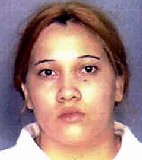
Nixzaliz Santiago
Murderer Miranda Barbour
Murderer · USA · 2013
Miranda Barbour, 19, defendant. · Elytte Barbour, 22, defendant and husband of…
100 victims
Miranda Barbour
Murderer · USA · 2013
Miranda Barbour, 19, defendant. · Elytte Barbour, 22, defendant and husband of…
100 victims
 Megan Huntsman
Murderer · USA · 1996
Megan Huntsman was 40 at sentencing. She was a mother of three children who wer…
6 victims
Megan Huntsman
Murderer · USA · 1996
Megan Huntsman was 40 at sentencing. She was a mother of three children who wer…
6 victims
 Michele Kalina
Murderer · USA · 1996
Michele Kalina pleaded guilty to murder for one of five infants she initially w…
5 victims
Michele Kalina
Murderer · USA · 1996
Michele Kalina pleaded guilty to murder for one of five infants she initially w…
5 victims
 Tiffany Hall
Murderer · USA · 2006
Tiffany Hall was 24 when she was charged in September 2006. She later entered a…
5 victims
Tiffany Hall
Murderer · USA · 2006
Tiffany Hall was 24 when she was charged in September 2006. She later entered a…
5 victims
 Banita Jacks
Murderer · USA · 2007
Banita Jacks was a Washington, DC resident convicted of murdering her four daug…
4 victims
Banita Jacks
Murderer · USA · 2007
Banita Jacks was a Washington, DC resident convicted of murdering her four daug…
4 victims
 Holly Grigsby
Murderer · USA · 2011
Holly Grigsby was sentenced to life in prison without parole on July 15, 2014.…
4 victims
Holly Grigsby
Murderer · USA · 2011
Holly Grigsby was sentenced to life in prison without parole on July 15, 2014.…
4 victims
 Debra Sue Tuggle
Murderer · USA · 1974
Debra Sue Tuggle was an African American woman born in Arkansas. She had a hist…
4 victims
Debra Sue Tuggle
Murderer · USA · 1974
Debra Sue Tuggle was an African American woman born in Arkansas. She had a hist…
4 victims
 Aino Nykopp-Koski
Serial killer · Finland · 2004
Aino Nykopp-Koski Aino Nykopp-Koski was a Finnish nurse. She worked at a range…
5 victims
Aino Nykopp-Koski
Serial killer · Finland · 2004
Aino Nykopp-Koski Aino Nykopp-Koski was a Finnish nurse. She worked at a range…
5 victims
 Naomi Gaines
Murderer · USA · 2003
Naomi Gaines was a 24-year-old mother from St. Paul, Minnesota. On July 4, 2003…
1 victim
Naomi Gaines
Murderer · USA · 2003
Naomi Gaines was a 24-year-old mother from St. Paul, Minnesota. On July 4, 2003…
1 victim
- Gender
- female
- Country
- USA
- Location
- New York City, New York, USA
- Date of birth
- 1978
- Age at first offence
- 28
- Characteristics
- child abuse
- Victim profile
- Nixzmary Brown, 7 (her daughter)
- Method of murder
- Beating to death with both fists and a thick leather belt
- Date(s) of murder
- January 11, 2006
- Years active
- 2006
- Date of arrest
- Same day
- Status
-
Imprisoned
Sentenced to 48 years in prison on November 12, 2008
Background
Nixzmary Brown was a seven-year-old child who died after being abused and murdered in the Bedford-Stuyvesant, Brooklyn section of New York City, New York. Her death led to changes involving the city’s Administration for Children’s Services.
Nixzmary Brown (July 18, 1998 – January 11, 2006) was murdered. During the trial, prosecutors depicted her as beaten and abused by her stepfather, César Rodriguez, and ignored by her mother, Nixzaliz Santiago. The case involved allegations that Brown was tortured, bound, molested, and beaten, and that her death involved a blow to her head.
Nixzaliz Santiago was described as Brown’s mother. She was also portrayed as a battered victim during the defense case. The defense said Santiago’s history included learning disabilities, and that she had been in a homeless shelter by the time she was 22, trailing four children and having a string of failed relationships. The defense also said that after Santiago miscarried, she kept some fetal tissue in a jar at home. During the trial, Santiago was also reported to have been harassed by other inmates during a bus ride to the Brooklyn courthouse after the stepfather was convicted.
César Rodriguez was identified as Brown’s stepfather. The trial materials described that Rodriguez beat Brown to death during a rage that began over a cup of yogurt and a broken printer that he claimed was her fault.
Rodriguez’s sister, Iris, showed up unexpectedly during the burial, prompting shouts and at least one comment of "not being welcome".
The offence
Brown endured torture and was later learned to have been bound, molested and beaten and killed by her stepfather, César Rodriguez.
On the night of Wednesday, January 10, 2006, Rodriguez beat Brown to death with both fists and his thick leather belt. The sentencing and trial portions described Brown as battered, beaten, left alone on the floor, and moaning until she could no longer hold onto life.
Her mother, Nixzaliz Santiago, ignored Rodriguez as he slammed Brown's head into a bathtub and doused her with cold water.
The jury later convicted Rodriguez of first-degree manslaughter. The jury convicted Santiago of manslaughter and acquitted her of second-degree murder.
In Santiago’s trial, the prosecutors argued that Santiago ignored or encouraged repeated beatings by Rodriguez and did not protect Brown or provide medical attention. During closing arguments, prosecutors said Santiago had a duty to help. The defense argued Santiago failed to realize Brown was dying from Rodriguez’s beatings and asked for criminally negligent homicide.
The trial record also included allegations that Brown was bound and restrained, including assault for binding Brown with a bungee cord, and other convictions for unlawful imprisonment and endangering the welfare of a child.
Investigation
Evidence described included traces of Brown’s DNA found on Rodriguez’s belt.
The indictment also alleged that Rodriguez abused Brown for months and smashed her head against a bathtub.
There were also findings and allegations connected to the Administration for Children’s Services (ACS). ACS had received two complaints about Brown’s family. The first complaint, made in 2004, remained unsubstantiated. The second complaint was made on December 1, 2004 when Brown showed up at school with a black eye. Another story in January 2006 brought more details about ACS involvement.
A review by the Administration for Children’s Services found that the agency had failed to heed warning signs of Brown’s abuse, including absences from school. Teachers had noticed Brown’s injuries and notified the city, but case workers had failed to make meaningful contact with the family.
A specialist for ACS, Vanessa Rhoden, testified that on December 1, 2005 she witnessed early signs of abuse in Brown but was rebuffed by Rodriguez. Rhoden said Rodriguez told her he had taken Brown to the hospital, then used foul language to address her and end the conversation. Rhoden testified that she was disturbed and recommended mental health counseling for Brown’s mother. Rhoden also testified that she did not believe Brown was in an unsafe environment and so did not move to have Brown or the other children removed from the family.
A guidance counselor who had filed two abuse reports contacted the state child abuse hotline about Brown’s bruises and also made note that Brown had been absent from school for 46 days.
Investigators and officials were described as being “swamped” with cases, and the Bloomberg administration noted that ACS was responding by hiring 525 more workers.
Following Brown’s death, blame was assigned to the ACS by news media, and six Children’s Services employees were disciplined.
Arrest
The trial materials included arguments regarding Miranda rights for Rodriguez. Rodriguez’s defense claimed he was never read his Miranda rights and that his constitutional rights were violated.
In the jury proceedings, jurors watched a video statement showing Rodriguez talking about the abuse he inflicted on Brown.
Trial
Cesar Rodriguez trial: 2008
Jury selection began during the week of January 6, 2008. The defense objective was to focus on ACS and the parents. The defense lawyer for Rodriguez was Jeffrey T. Schwartz.
Prosecutors sought to show jurors seven pictures of the dead girl at the start of testimony. Photographs of Brown showing her bruised and battered body were described as having “proved too gruesome yesterday for even her accused killer, Cesar Rodriguez.”
During opening remarks on Wednesday, January 16, Assistant D.A. Ama Dwimoh told the Brooklyn jurors that:
“It was inevitable her life would end the way it did: battered and beaten, left alone on the floor, moaning until she could no longer hold onto life”
Defense lawyer Schwartz countered by indicating that Rodriguez was “a loving family man”; that Brown’s mother was “deeply, deeply disturbed,” and that the little girl herself was troubled.
On Friday, January 18, the trial focused on household items described as instruments of torture for Brown. The chief object was the chair that Brown was tied to. A white nylon cord was still attached to the chair. A bungee cord and duct tape, which “Rodriguez allegedly used to cinch Brown's ankles to the chair,” were shown to the jury. The jury was described as most disturbed by a cat-litter box.
During a Monday, January 21 portion, the trial included a description that Brown weighed just 36 pounds when police found her beaten to death on the floor of her Brooklyn apartment, while her family’s refrigerator was “anything but empty.” Jurors saw crime-scene photographs of a refrigerator with food items including milk, pancake mix, salami, tortillas, cream cheese, lettuce—and the yogurt that Nixzmary was punished for stealing the night she died.
In an attempt to show Rodriguez favorably, defense presented a drinking mug titled “World's Greatest Dad.” Schwartz commented:
“I believe Nixzmary bought it for him for Father's Day”
and:
“Nixzmary and he had a close relationship. He was a good father. He was a strict disciplinarian.”
Assistant D.A. Ama Dwimoh rebuked the idea of Rodriguez being a good father to Brown.
New evidence was presented at the close of the trial on Wednesday, January 23. A gag order was issued. For a second time, jurors were sent home on Thursday. The next time jurors would meet was Monday, January 28, 2008. The trial was delayed on January 23 and continued for a fourth day. It was later revealed delays were due to a new witness, with a sealed hearing by the judge, Priscilla Hall, for witness safety concerns. The gag order remained to prevent either side from speaking about the case.
It was reported that Brown’s blood was found in numerous areas of the spare room where she was kept. An expert, Taylor Dickerson, said her DNA profile was clearly present. The chief prosecutor said Brown was tortured and that blood found on the jeans Rodriguez wore on January 11 belonged to Brown.
A jury selection detail stated the jury composition was 10 women and two men, and described the racial composition. Lawyers selected six alternate jurors in case any jurors could not continue.
A video depicting the family shopping on Monday, January 9, 2006 while Brown was left home was shown to the jury. The shopping occurred at a Target store in Downtown Brooklyn, the Atlantic Center Mall, and the specific toy items being purchased included Power Ranger action figures, Hot Wheels cars, Play-Doh, Bratz dolls, etc. Brown was not seen in the video, and defense lawyer said the video did not prove anything.
Miranda rights and evidence included on February 4 and afterward. On February 4, jurors watched a video statement showing Rodriguez talking about the abuse he inflicted on Brown. Prosecutors considered the video “the most damning evidence.” Prosecutor Ama Dwimoh said:
“He calmly and coldly talks about how he would beat Nixzmary Brown”
Schwartz attacked the video by cross-examining Det. Steven Sneider, and at one point Schwartz called for a mistrial, which the court denied. Schwartz then stated to the jury that Rodriguez was taking responsibility for wounds inflicted by Brown’s mother, Nixzaliz.
During a Wednesday, February 6 portion, Schwartz made a comment about possible porn in the prosecutor’s home. Brooklyn Supreme Court Justice Priscilla Hall reprimanded Schwartz after the jury was dismissed. It was described as related to Schwartz’s complaints about prosecutors using Brown’s backpack and other personal items and piles of pornography found at the apartment.
Forensic photographs were shown on Thursday, February 7. Barbara Sampson of the medical examiner’s office testified that bruises were only hours or days old. She indicated Brown received a head blow two days before her death as the cause of death, and that Brown was unconscious and going into respiratory depression for at least several hours before she died. Sampson testified:
“She was unconscious and going into respiratory depression for at least several hours before she died,”
Sampson further testified about the mechanism of death and subdural hematoma and said neither Rodriguez nor Santiago did anything to help Brown during the hemorrhage. Sampson stated the head blow was the “straw that broke the camel's back” and that Brown died from “child abuse syndrome.” Sampson also provided details including that Brown was somnolent, then in a coma, that Brown probably had progressive respiratory depression, possibly moaning and groaning sounds, and gasping for air, and that subdural hematoma was the mechanism of her death.
Trial testimony included an emergency room doctor who reported he witnessed no signs of abuse on Brown after a medical exam seven weeks before Brown’s death in which Rodriguez brought the little girl to the hospital. When asked about whether he made a report, the doctor said “no,” and the prosecutor said his decision was a mistake, while the physician indicated he did not know at the time. Official hospital records from a November 29, 2005 visit said:
“No other bruises present.”
Dr. Charles Wetli was expected to testify, and it was later indicated that Wetli stated Brown was definitely killed by a blow to her head, conflicting with defense arguments that Brown was never hit on her head.
Trial procedures included an attorney change and delays. On February 27, the lawyer for Nixzaliz Santiago, Robert Abrams, removed himself from the case citing “communication difficulties.” It was reported that the judge apologized to jurors about delays, including that the trial never started before 10:30 a.m. and rarely went past 5 p.m., with jurors sent home five times without hearing testimony, long lunch breaks, and a half-day every Friday.
On March 4, jurors heard testimony from a Riker’s Island inmate/witness described as a secret witness who claimed Brown’s mother was her murderer. Prosecutors dismissed that person as unreliable, but defense wanted her to take the stand. It was reported her testimony could be in a closed-door hearing for safety reasons. The inmate’s testimony included claims about sexual abuse and that Santiago told the inmate her husband was a good man and the child was evil. The inmate testified that Santiago referred to Brown as 'diablo' and said “...that her husband was a good man and the child was evil”. The inmate also said Santiago told her: “told me her child was a bad kid and her and her husband killed her.” The inmate said Santiago had desired to hurt Brown because she discovered Rodriguez making Brown have oral sex with him.
On March 13, the jury began deliberating. Justice L. Priscilla Hall provided instructions on the 12 criminal charges. Schwartz made one last unsuccessful attempt at a mistrial, arguing the prosecution should not have used photographs.
On Tuesday, March 18, Rodriguez was convicted of first-degree manslaughter.
Rodriguez faced a maximum of 29 years for manslaughter, weapons possession, and endangering the welfare of a child.
Cesar Rodriguez sentencing (described in the trial materials)
On Thursday, April 3, Brooklyn Supreme Court Justice L. Priscilla Hall sentenced Cesar Rodriguez to a term of 26 ⅓ to 29 years in prison. The judge gave 25 years for first-degree manslaughter and 1 ⅓ to 4 years for false imprisonment, which was described as the maximum term.
Rodriguez briefly addressed the court before being led away, saying:
“I'm just sorry for causing anybody any emotional pain or distorted memories about the child. I'm just sorry. I loved Nixzmary.”
As he was led away, a woman in the crowd yelled “murderer!” and another shouted “I!”
Nixzaliz Santiago trial: 2008
Santiago was tried after Rodriguez’s conviction. Her jury selection began on Monday, September 15, 2008.
During opening remarks, prosecutors said Brown’s last words as she lay dying were “Mommy, mommy, mommy.” Prosecutor Ama Dwimoh stated Santiago did not stop Rodriguez from “repeatedly beating” Brown and said Santiago “didn't protect”, “didn't love” and “didn't nurture” Brown.
Supreme Court Justice Patricia DiMango allowed one juror who was an elementary school teacher to leave. Santiago wiped her eyes, and defense attorney Sammy Sanchez pleaded Santiago’s case, arguing Santiago could not help herself because she was battered by Rodriguez. Sanchez said:
“You know why she didn't call the police? There is no phone. He disconnected the phone. He isolated the family”
The trial was brought to a halt by Justice Patricia DiMango amid secret meeting accusations about a juror and a possible mystery witness caused by a letter sent to a defense lawyer DiMango obtained. The letter-writer informed the Daily News that the teacher raised his hand to indicate he could not be fair, though the judge and lawyers did not observe the action. The juror told the judge he did not raise his hand. DiMango questioned a juror accused of admitting she could not be fair in her chambers and then told the courtroom:
“If it comes to my attention that anyone here is attempting in any way to inappropriately influence these proceedings ... I take that extremely seriously, and will deal directly with that individual or individuals.”
During the trial, Ulbis Rivera testified after making a 911 call shouting that “7-year-old is unconscious.” Rivera said Santiago appeared calm even though moaning sounds were heard on the 911 call. Rivera said Santiago told her Brown had drowned, but Brown was still lying on the floor, dry and clothed. Rivera testified Santiago was “faking” remorse over Brown’s death. When asked why she believed Santiago was faking, Rivera said:
“Her daughter was on the floor, she was all disfigured, [Santiago] goes to my house and she calmly tells me the baby drowned.”
Rivera further testified:
“When I go downstairs, and I come across the girl like that, it went through my head, 'She's calm, the girl's dead, and she's acting like nothing happened.' ”
Rivera said that when she called 911, she heard Santiago howling, and cried on the witness stand as Dwimoh presented photographs of Brown.
The defense included closing arguments. Defense lawyer Kathleen Mullin conceded that Santiago was guilty, stating she was guilty only for failing to realize Brown was dying from Rodriguez’s beatings. Mullin urged the jury to convict Santiago of criminally negligent homicide, carrying a maximum of four years. Mullin continued to blame Rodriguez for deadly blows and argued that duct tape prevented Brown from crying out while Rodriguez was beating her. Mullin held up a picture of Nixzmary’s battered body and said:
“What he was doing was this.”
Mullin said in closing that Santiago had no idea Rodriguez was beating Brown to her death.
Assistant D.A. Dwimoh argued against this defense, describing the girl as “unrecognizable” in death and stating that someone in the courtroom had a duty to help, and that someone was Nixzaliz Santiago. Dwimoh said Santiago was plotting her defense while Brown was dying, according to the account.
Jury deliberations took 18 hours over a three-day period.
The jury found Santiago guilty of manslaughter, and acquitted her of the more serious charge of second-degree murder. The jury’s manslaughter verdict matched the verdict Rodriguez received. The record described that Santiago would face additional time because she was previously convicted of four lesser crimes: assault for binding Brown with a bungee cord, blackening her eye, unlawful imprisonment, and endangering her welfare.
After the verdict, the judge indicated a protection order would prevent Santiago from seeing her other children.
Santiago’s statements and prosecution comment after verdict
After the trial, D.A. Ama Dwimoh made a statement:
“Today was a good day for children because this jury said that parents have a duty - it's not just what you do but what you don't do . . . Nixzmary, being a 7-year-old child, was owed a duty by her mother to protect her and give her medical attention.”
In the New York Times excerpt, Dwimoh was quoted outside the courtroom:
“The journey for justice for Nixzmary is almost over,”
and also:
“This is a good day for the children,”
and:
“It’s not just what you do, it’s what you don’t do.”
Dwimoh also said Santiago was found guilty for “acts of omission” and described that Nixzmary “just did not matter to Cesar Rodriguez and Nixzaliz Santiago,” in the cited account.
Sentencing
Santiago was sentenced on November 12, 2008 to 43 years in prison.
The record states that Justice Patricia DiMango made harsh remarks to Santiago, including:
“You may not have delivered the fatal blow, but were it not for your failure to act, Nixzmary Brown would probably not have died from that blow,”
“By your own statements, she gasped for air - moaning - and called for you twice until she died. You, Mrs. Santiago, ignored the desperate calls and left this little 7-year-old alone and you did nothing”
and:
“You had a duty to act. You were the mother.”
The trial materials also included the status that her sentence was “Sentenced to 48 years in prison on November 12, 2008.”
Santiago’s defense attorney Kathleen Mullin said she would appeal.
Rodriguez’s sentencing is also described: Brooklyn Supreme Court Justice L. Priscilla Hall sentenced Cesar Rodriguez on April 3 to 26 ⅓ to 29 years, with 25 years for first-degree manslaughter and 1 ⅓ to 4 years for false imprisonment.
Appeals
Kathleen Mullin said she would appeal.
Outcome
The jury convicted Nixzaliz Santiago of manslaughter and acquitted her of second-degree murder.
The jury convicted Cesar Rodriguez of first-degree manslaughter.
Aftermath
Nixzmary’s Law proposal
Nixzmary’s Law was proposed in January 2006 by New York State senator Joseph Bruno. The law was designed to deter or prevent child abuse related crimes by charging parents connected to the death of their children with first degree murder, with maximum punishment in New York State of 25 years to life in prison without the possibility of parole.
After passing the law, reports increased to New York States' child abuse hotline. The article said:
“Driving the trend is increased public awareness of the hotline . . . ”
The article provided a telephone number for New York’s Central Register of Child Abuse and Mistreatment as (800) 342-3720.
Legislation in the form of a Bill sent to New York Governor Paterson had been approved by the state’s Senate to target those individuals who had killed a child, especially in a “cruel and wanton manner”. Senator Ruben Diaz Sr. said:
“We have to send a message that this kind of abuse of children has to stop.”
City panel and ACS changes
In March 2006, a City panel was created by Mayor Bloomberg in response to Brown’s death, advocating changes including assigning a full-time supervisor, a lieutenant, to child welfare headquarters as a liaison between the two agencies. Caseworkers would be required to seek entry orders when denied access to the home of a child suspected to be at risk of neglect or abuse. School officials would have more license to alert authorities when a student had too many unexplained absences.
Other changes were recommended, including better communication with school officials regarding absenteeism, a 24-hour hotline, instant-response teams, and new training for police personnel regarding sensitivity to abused children.
Funeral and burial
Nixzmary Brown’s funeral was held at St. Mary Church on Manhattan's Lower East Side.
According to a Newsday report, there was considerable anger during the burial of Nixzmary Brown, with two sides of Brown's family present. Rodriguez's sister, Iris, showed up unexpectedly and her appearance prompted shouts by others to leave, and at least one comment of 'not being welcome'.
New York City Council involvement
There was a City Council hearing on the ACS in September 2007 announced by Councilman Bill de Blasio. De Blasio cited the death of 21-month-old Hailey Gonzalez after she was allegedly beaten by her mother's boyfriend and the death of a 2-month-old after the child was allegedly shaken by his mother in a homeless shelter.
De Blasio said ACS had made some progress but noted that children were still being lost.
Former ACS supervisor comments and ACS commissioner comments
On January 13, Roger Moore, a former ACS supervisor, came forward to discuss with the New York Daily News the failure of the ACS and how opportunities were lost, including mention of another child-murder involving a 16-month old boy and other factors. Moore said that because of the issue of drowning of the little boy in a bathtub, the issue of Brown wasn't even discussed. Moore described lack of follow-up work not being done by caseworkers and supervisors in Brooklyn regarding abuse in Brown’s case.
ACS Commissioner John Mattingly also made comments. He mentioned methods that could have been used but weren't, including that ACS could have brought pressure on Brown’s family to reveal more about the girl's condition; paid more attention to reports from Brown's school staff; and sought a warrant to enter Brown's home, but none of these measures were used.
Mayor Michael Bloomberg asked:
“Why the caseworkers didn't push further, harder - that's what we are investigating today.”
ACS recruitment drive
As of March 2008, ACS launched a $1M recruitment drive for new child welfare caseworkers. It was reported that the agency was getting many applications, but retention of caseworkers was a great problem. It was also reported that in 2007, 17 percent of the city's caseworkers had quit. The pay was reported as starting at $39,000. Videos and illustrations were being used in the recruitment process.
Comparisons and other child felony reports
Andrea Peyser compared Nixzmary Brown to another young girl murdered years earlier, Justina Morales. In that case, both the mother, Denise Solero, and her boyfriend were described as deciding the girl had to die because she resisted taking a bath.
More reports of child felonies in 2008 included the murder of an 8-month-old named Elijah Rodriguez.
Public Advocate Betsy Gotbaum said that at least 28 children had died since 2004 “under suspicious circumstances.” She said:
“Child fatalities in the city shelter system are a recurring problem ... We must do more to improve coordination between Administration for Children's Services and Department of Homeless Services to keep children safe in city shelters.”
Both agencies defended their work with a joint statement:
“Our agencies are committed to the best interest of the children and families we serve.”
Jury instructions, verdict framing, and overall case framing
The jury deliberated for three days and asked the judge for clarification of the law six times, including once just 15 minutes before they delivered the verdict.
After the verdict was read, an interpreter whispered in Santiago’s ear, and she put her left hand to her left cheek and said nothing. The judge said protection orders preventing Santiago from seeing or communicating with her five other children would remain in force. Santiago said she understood.
Prosecutors charged that Santiago ignored—and in some cases encouraged—vicious beatings of Nixzmary at the hands of her stepfather. The verdict was described as an echo of the judgment seven months ago against Rodriguez.
The trial described that prosecutors faced a more difficult task highlighting the connection between neglect and the daughter’s death, and that prosecutors suggested they succeeded in presenting that connection, with Dwimoh stating that the jury sent a message that parents have a duty.

Spotted an error, or have more information about this case?