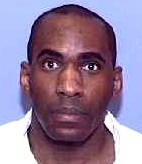
Kerry Dimart Allen
Murderer Russell Ellwood
Murderer · USA · 1991
Russell Ellwood was a former taxi driver. Authorities suspected him of killing…
20 victims
Russell Ellwood
Murderer · USA · 1991
Russell Ellwood was a former taxi driver. Authorities suspected him of killing…
20 victims
 Robert Martines Perez
Murderer · USA · 1994
Name: Robert Martines Perez · Other name used in proceedings: Robert Martinez P…
15 victims
Robert Martines Perez
Murderer · USA · 1994
Name: Robert Martines Perez · Other name used in proceedings: Robert Martinez P…
15 victims
 Billy Frank Vickers
Murderer · USA · 1993
Billy Frank Vickers Vickers was executed by lethal injection in Texas on Januar…
14 victims
Billy Frank Vickers
Murderer · USA · 1993
Billy Frank Vickers Vickers was executed by lethal injection in Texas on Januar…
14 victims
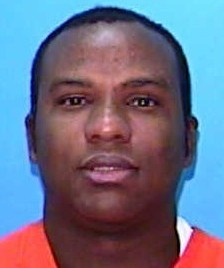 Ernest Whitfield
Murderer · USA · 1995
Ernest Whitfield was convicted and sentenced to death for the June 19, 1995 mur…
1 victim
Ernest Whitfield
Murderer · USA · 1995
Ernest Whitfield was convicted and sentenced to death for the June 19, 1995 mur…
1 victim
 Huang Hu
Frustrated murderer · China · 2002
Huang Hu was born in 1973 in Wuchuan, Guangdong, China. He died on January 3, 2…
0 victims
Huang Hu
Frustrated murderer · China · 2002
Huang Hu was born in 1973 in Wuchuan, Guangdong, China. He died on January 3, 2…
0 victims
 William Hamilton Little
Murderer · USA · 1983
December 3, 1983 — Michael John Rammel found the body of Marilyn Peter in her h…
1 victim
William Hamilton Little
Murderer · USA · 1983
December 3, 1983 — Michael John Rammel found the body of Marilyn Peter in her h…
1 victim
 Michael Iver Peterson
Murderer · USA · 1985
Michael Iver Peterson was born October 23, 1943, near Nashville, Tennessee, USA…
2 victims
Michael Iver Peterson
Murderer · USA · 1985
Michael Iver Peterson was born October 23, 1943, near Nashville, Tennessee, USA…
2 victims
 Randall Loyal Smith
Murderer · USA · 1990
Randall Loyal Smith was born on 12/31/53. He was sentenced to death on 3/9/1992…
1 victim
Randall Loyal Smith
Murderer · USA · 1990
Randall Loyal Smith was born on 12/31/53. He was sentenced to death on 3/9/1992…
1 victim
- Gender
- male
- Country
- USA
- Location
- Harris County, Texas, USA
- Date of birth
- July 21, 1959
- Age at first offence
- 41
- Characteristics
- rape
- Victim profile
- Kienna Lashay Baker (female, 2)
- Method of murder
- Beating
- Date(s) of murder
- May 10, 2000
- Years active
- 2000
- Date of arrest
- —
- Status
-
Sentenced to death
Sentenced to death on May 30, 2001
Case record: Kerry Dimart Allen
Background
Kerry Dimart Allen was convicted of capital murder and sentenced to death. He appealed on direct appeal from Harris County. The appellate court affirmed the judgment of the trial court.
Kerry Dimart Allen was born on 07/21/1959 and was 41 at the time of receiving the case material on 05/30/2001. The offence date was 05/10/2000, when Allen was 40. The offence county was Harris. The victim was identified as a black female, Kienna Lashay Baker, an individual under six years of age.
Allen’s gender was male, with black hair. His height was 5 ft 11 in and his weight was 184. His eye colour was brown and he was described as Native.
Allen was a St. Louis, Missouri laborer as a prior occupation.
Allen had a prior prison record: #548386 on a two year sentence from Harris County for two counts of sexual assault. He was released on mandatory supervision on 09/27/1989. He returned from mandatory supervision on 09/03/1998. He was released on mandatory supervision on 07/14/1999. He received mandatory supervision discharge on 03/15/2000.
Co-defendants were none.
The offence
On 05/10/2000 in Houston, Allen sexually assaulted and murdered a two-year-old black female, Kienna Lashay Baker, in her home.
The mother of the victim had left her four children under the care of Allen while she went to work.
The indictment alleged that Allen intentionally and knowingly caused the death of Kienna Lashay Baker, an individual under six years of age, by striking her in the chest and abdomen with his hand or with an unknown instrument or by an unknown manner and means.
The cause of death was determined to be blunt force trauma to the abdomen and chest.
Investigation
At the emergency room on May 10, 2000, Nurse Kimberly McCreary observed that Baker had numerous bruises of different colors, including a pronounced bruise between her eyes and discoloration on the chest and groin areas, linear marks on her chest, and some scars on her arms and legs.
McCreary testified that Baker was pronounced dead after Emergency Medical Services personnel attempted, without success, to resuscitate her. When McCreary checked Baker’s rectal temperature, she noticed that Baker’s anal opening was "gaping," that some of her bowel was visible, and that there was "some clear pink-tintish fluid around the anal area."
McCreary testified that the "prolapsed bowel" was an unusual condition in a pediatric patient, but that she had seen the condition previously "in a case of sexual assault or an alleged sexual assault."
McCreary testified that she wrapped a blue pad "like a diaper" around Baker’s legs and bottom after the attending physician took swabs of her rectal and vaginal areas for lab analysis.
Christi Kim, a forensic biologist at the Houston Police Department Crime Laboratory, testified that she detected the presence of semen in Baker’s underpants, anal swabs, and the blue padding. Human DNA was extracted from these items, but it was not possible to identify the donor.
Dr. Lee Ann Grossberg Krishnan, an Assistant Harris County Medical Examiner, performed an autopsy. Krishnan observed abrasions, scars, and discoloration all over Baker’s body. She observed contusions between Baker’s eyebrows and on the right side of her jaw and a laceration on the inside of her lower lip. She found hemorrhages on Baker’s scalp, chest, neck, back, thighs, and buttocks.
Krishnan testified that the multiple areas of hemorrhaging on Baker’s scalp could have been caused by multiple blows to her head. She testified that the hemorrhage on Baker’s chest and the bruising of her lungs could have been caused by a strong impact to the front of the chest. She testified that her "fractured" liver and hemorrhaged kidneys were consistent with multiple blows to her abdominal area. Krishnan believed that the damage to Baker’s liver, kidneys, and lungs most likely occurred in the hour before her death.
Krishnan concluded that Baker’s death was a homicide and that the cause of death was blunt force trauma to her chest and abdomen.
Krishnan testified further that she found recent "petechial hemorrhaging" in Baker’s vaginal area indicative of "some type of trauma to that region" and that it looked like it was probably inflicted on the day of her death. Baker’s hymenal ring appeared to be open, which meant either that she was "born with an open hymenal ring or something penetrated this region to cause the hymenal ring to remain open." There was a "skin tag" on Baker’s anus, which could indicate irregular healing of some past trauma that could have been caused by penetration of the anus. Krishnan also found a hemorrhage within the wall of Baker’s rectum, consistent with an object penetrating her anus and rectum with a large amount of force. Krishnan testified that the hemorrhage in Baker’s rectum could have been inflicted any time in the forty-eight hours before death.
Dr. Joan Shook reviewed the medical records associated with Baker’s death. Shook testified that Baker’s rectum was penetrated with a significant amount of force to cause "bruising all the way through the muscle and into the deep tissues of her abdominal contents," and that the trauma to Baker’s rectum occurred within hours of her death.
Shook testified further that Baker’s vaginal hemorrhage indicated trauma to the vaginal area within a short period before her death, while the dilation of her vaginal opening was indicative of chronic sexual abuse.
Shook concluded that Baker "was beaten over an hour or two and ultimately beaten to death. And in the course of that she was anally raped, and that contributed to her demise."
Evidence was described as "relevant" if it had "any tendency to make the existence of any fact that is of consequence to the determination of the action more probable or less probable than it would be without the evidence."
Trial
Allen was convicted of capital murder under Tex. Pen. Code 19.03(a)(8) and sentenced to death.
Jury selection
Allen raised fourteen points of error on direct appeal.
In points of error one, two, and three, Allen argued that the trial court erred in overruling his challenge of veniremember Berg for cause. Allen claimed his challenge should have been granted because Berg was biased against him regarding the mitigation special issue (Art. 37.071, 2(e); Art. 35.16(a)(9) & (c)(2)).
The appellate court discussed the requirements for preserving error with respect to denial of a challenge for cause, including the need to assert a clear and specific challenge, use a peremptory strike on the complained-of veniremember, exhaust peremptory strikes, request additional peremptory strikes, identify an objectionable juror, and claim he would have struck the objectionable juror with a peremptory strike if he had one to use (Nelson v. State, 848 S.W.2d 126, 134 (Tex. Crim. App. 1992), cert. denied, 510 U.S. 830 (1993)).
The appellate court found that the record showed Allen asserted a clear and specific challenge for cause against Berg, exercised a peremptory strike against Berg, and exhausted his peremptory strikes. The appellate court found Allen failed to meet the fifth and sixth requirements because, while Allen identified Linda Smith Schultz as the objectionable juror in his appellate brief, he failed to identify Schultz as objectionable in the trial court and thus waived the right to complain about the trial judge’s overruling of his challenge for cause.
The appellate court overruled points of error one, two, and three.
Evidence at guilt/innocence phase
In points of error four through eleven, Allen argued the trial court violated Texas Rules of Evidence 401 and 403 when, at the guilt/innocence phase of trial, it admitted evidence that the victim had been sexually assaulted.
Allen also argued admission violated Rule 404, but the appellate court stated he failed to object on that basis at trial and did not consider that argument (citing Tex. R. App. Proc. 33).
The appellate court addressed the testimony of four witnesses: Kimberly McCreary, Dr. Lee Ann Grossberg Krishnan, Dr. Joan Shook, and Christi Kim.
The appellate court reviewed the trial court’s decision to admit evidence under an abuse of discretion standard and described the relevance test: evidence that tends to make the existence of any fact that is of consequence to the determination of the action more probable or less probable than it would be without the evidence (Tex. R. Evid. 401).
The appellate court stated a reasonable trial judge could have concluded the medical evidence was relevant. It noted Shook’s testimony that the anal rape "contributed to her demise." It also stated that evidence of the sexual assaults was relevant to show motive to kill Baker because if Baker was killed, she could not tell anyone who assaulted her.
Regarding Rule 403, the appellate court stated that relevant evidence may be excluded if the danger of unfair prejudice substantially outweighs probative value, and that Rule 403 favored admission of relevant evidence and carried a presumption that relevant evidence would be more probative than prejudicial (citing Jones v. State, 944 S.W.2d 642, 652-53 (Tex. Crim. App. 1996), cert. denied, 522 U.S. 832 (1997)).
The appellate court stated the trial court did not abuse its discretion in admitting the complained-of testimony and overruled points of error four through eleven.
Mitigation special issue
In point of error twelve, Allen argued the mitigation special issue was unconstitutional because it failed to place the State’s burden on proving aggravating circumstances beyond a reasonable doubt.
Allen relied on Apprendi v. New Jersey, 530 U.S. 466 (2001). The appellate court summarized Apprendi as holding that any fact that increases the penalty for a crime beyond the prescribed statutory maximum must be submitted to a jury and proved beyond a reasonable doubt, except for the fact of a prior conviction. The appellate court quoted the Apprendi holding: "Other than the fact of a prior conviction, any fact that increases the penalty for a crime beyond the prescribed statutory maximum must be submitted to a jury, and proved beyond a reasonable doubt." (Id. at 490.)
The appellate court stated Allen’s reliance on Apprendi was misplaced, explaining that Apprendi applied to facts increasing penalty beyond the statutory maximum. It stated under Texas Penal Code sections 12.31 and 19.03, the prescribed statutory maximum for capital murder was fixed at death, so nothing decided during punishment could enhance sentence beyond the prescribed range. It also stated Apprendi did not address who bears the burden of proof but focused on who should be the fact-finder for sentence enhancement.
The appellate court overruled point of error twelve.
Appellate review of special issues
In point of error thirteen, Allen contended the Texas capital murder sentencing scheme was unconstitutional because there was no meaningful appellate review of the special issues. The appellate court stated it had previously rejected this complaint (citing Conner v. State, 67 S.W.3d 192, 202-203 (Tex. Crim. App. 2001)).
It also stated it did not review the sufficiency of evidence to support a jury’s negative answer to the mitigating evidence special issue and repeatedly declined to conduct a factual sufficiency review of the future dangerousness special issue (citing McGinn v. State, 961 S.W.2d 161, 169 (Tex. Crim. App.), cert. denied, 525 U.S. 967 (1998)).
The appellate court overruled point of error thirteen.
Arbitrary imposition claim tied to county resources
In point of error fourteen, Allen argued his death sentence was arbitrarily imposed in violation of the Eighth and Fourteenth Amendments because the death penalty was disparately applied in similar cases depending on the county of prosecution.
Allen alleged large counties with large budgets, such as Harris County, were able to seek the death penalty more frequently than smaller or poorer counties and that a defendant in a county with a large budget was likely to receive the death penalty, while a similarly situated defendant in other counties would not be at risk.
The appellate court stated this argument was previously raised (Bell v. State, 938 S.W.2d 35 (Tex. Crim. App. 1996); King v. State, 953 S.W.2d 266 (Tex. Crim. App. 1997)). In those cases, the appellate court had declined to reach the merits due to lack of empirical data, case law, or other factual basis.
For this case, the appellate court described Allen’s attempt to provide factual basis using tables from the Texas Department of Criminal Justice website showing number of offenders sentenced to death and number executed from each county in Texas, asserting higher numbers for Harris County than any other county. Allen also relied on a press release: Office of State Senator Eddie Lucio, Jr., District 27, press release titled "Landmark bill adding Life Without Parole as sentencing option in capital cases passes in Senate Committee on Criminal Justice," dated April 19, 2001, stating a death penalty case in Texas cost taxpayers an average of $2.3 million and that "[r]ural counties cannot always afford to try a death penalty case."
Allen also cited two Houston Chronicle articles to show financial constraints meant similar capital murders would be treated differently based on county jurisdiction: M. Tolson, "A Deadly Distinction," HOUSTON CHRON., Feb. 5, 2001; S. Brewer, "DA Can Afford to Prosecute with a Vengeance," HOUSTON CHRON., Feb. 3, 2001.
The appellate court quoted Allen’s assertion: "Financial constraints in each of the 254 counties control the decision whether to seek the death penalty. The risk of facing the death penalty has been greater, substantially, in Texas counties with bigger budgets than in all the remaining counties."
The appellate court stated Allen provided information regarding the number of offenders sentenced to death and number executed from each county but failed to provide budgetary data for each of those counties.
The appellate court stated that Harris County sentencing more offenders to death than any other county did not in and of itself establish disparate treatment among similarly situated defendants. It cited that one article included as part of Allen’s argument stated the "history of ample budgets" was only one of several factors contributing to higher number of death penalty convictions in Harris County.
It referenced Tolson’s factors listed in a quotation block, including: "[a] capital murder statute whose design leans toward the imposition of death;" "[a] decentralized criminal justice system that places the setting of execution dates in the hands of trial court judges;" "[a] streamlined state appellate process with tight deadlines;" "[p]erhaps the most conservative U.S. Circuit Court of Appeals;" "[a] history of ample budgets courtesy of the Commissioners Court that have provided sufficient staff and resources;" "[a]n adequate number of felony courts (22) and judges friendly to capital sentencing in most of them;" and "an immense tide of regional culture, religion, and history, all of which helped to set the stage for the arrival of a prosecutor who took on the job with a literalist vision of law and order."
The appellate court stated Allen made no threshold showing of disparate treatment between himself and other similarly situated defendants and overruled point of error fourteen.
Appeals
This case reached the Court of Criminal Appeals of Texas under number 74,140: KERRY DIMART ALLEN v. THE STATE OF TEXAS.
The appellate opinion was delivered by Holcomb, J., joined by Keller, P.J., and Price, Johnson, Keasler, Hervey, and Cochran, JJ. Meyers and Womack, JJ., each filed opinions concurring in the result.
The appellate court affirmed the judgment of the trial court and stated it was delivered June 11, 2003.
Sentencing
Allen was sentenced to death on May 30, 2001.
Outcome
Other details
Allen’s TDCJ Number was 999386.

Spotted an error, or have more information about this case?