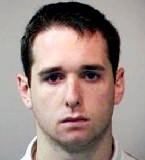
Raymond Clark
Murderer Joshua Wayne Andrews
Murderer · USA · 2000
Joshua Wayne Andrews was a serial killer accused of killing several people in V…
5 victims
Joshua Wayne Andrews
Murderer · USA · 2000
Joshua Wayne Andrews was a serial killer accused of killing several people in V…
5 victims
 Leon Davis Jr.
Murderer · USA · 2007
Leon Davis Jr. was sentenced to death on April 29, 2011, for the execution-styl…
5 victims
Leon Davis Jr.
Murderer · USA · 2007
Leon Davis Jr. was sentenced to death on April 29, 2011, for the execution-styl…
5 victims
 Raymond Lee Oyler
Murderer · USA · 2006
Raymond Lee Oyler was convicted for starting the 2006 Esperanza fire in Riversi…
5 victims
Raymond Lee Oyler
Murderer · USA · 2006
Raymond Lee Oyler was convicted for starting the 2006 Esperanza fire in Riversi…
5 victims
 Terry Lee Hankins
Murderer · USA · 2000
Terry Lee Hankins was convicted by a jury of capital murder and was sentenced t…
5 victims
Terry Lee Hankins
Murderer · USA · 2000
Terry Lee Hankins was convicted by a jury of capital murder and was sentenced t…
5 victims
 Anthony Garcia
Murderer · USA · 2008
Anthony Garcia was a former doctor who was found guilty on all counts including…
4 victims
Anthony Garcia
Murderer · USA · 2008
Anthony Garcia was a former doctor who was found guilty on all counts including…
4 victims
 Robert Jackson
Murderer · USA · 1992
Robert W. Jackson, III — defendant; male; white · Elizabeth Girardi — victim ·…
1 victim
Robert Jackson
Murderer · USA · 1992
Robert W. Jackson, III — defendant; male; white · Elizabeth Girardi — victim ·…
1 victim
 Walter Seifert
Mass murderer · Germany · 1964
Committed suicide by poisoning himself with cyanide the same day; died next day…
10 victims
Walter Seifert
Mass murderer · Germany · 1964
Committed suicide by poisoning himself with cyanide the same day; died next day…
10 victims
 Tooba Yahya
Murderer · Canada · 2009
Tooba Yahya was a 41-year-old second wife in the polygamous Shafia household. H…
4 victims
Tooba Yahya
Murderer · Canada · 2009
Tooba Yahya was a 41-year-old second wife in the polygamous Shafia household. H…
4 victims
 Tony Von Carruthers
Murderer · USA · 1994
February 24, 1994 — Marcellos “Cello” Anderson borrowed a white Jeep Cherokee f…
3 victims
Tony Von Carruthers
Murderer · USA · 1994
February 24, 1994 — Marcellos “Cello” Anderson borrowed a white Jeep Cherokee f…
3 victims
- Gender
- male
- Country
- USA
- Location
- New Haven, Connecticut , USA
- Date of birth
- January 28, 1985
- Age at first offence
- 24
- Characteristics
- rape, sexual assault, domestic violence
- Victim profile
- Annie Marie Le, a 24-year-old American doctoral student
- Method of murder
- Strangulation
- Date(s) of murder
- September 8, 2009
- Years active
- 2009
- Date of arrest
- September 17, 2009
- Status
-
Imprisoned
Pleaded guilty on March 17, 2011. Sentenced to 44 years imprisonment on June 3, 2011
Case record: Raymond Clark (Annie Le)
Background
Annie Marie Le (July 3, 1985 – September 8, 2009) was a 24-year-old American doctoral student at the Yale School of Medicine's Department of Pharmacology. She was last seen in a research building on the New Haven campus on September 8, 2009, and was found dead inside a wall cavity in a basement laboratory in the Yale laboratory building on Sunday, September 13, which was her planned wedding date.
Raymond J. Clark III was a Yale lab technician who worked in the building where Le disappeared. He was 26 years old when police arrested him on September 17.
Le was due to be married on September 13, 2009, in Syosset, New York, to Jonathan Widawsky, a graduate student in applied physics and mathematics at Columbia University.
Le was born in San Jose, California, to a Vietnamese American family and spent her childhood with her aunt and uncle. She was valedictorian of her graduating class at Union Mine High School, and she was voted one of two students to be "the next Einstein." After earning approximately $160,000 in scholarship money, she attended and graduated from University of Rochester. Her major was cell developmental biology, with a minor in medical anthropology. She was accepted into a graduate program at Yale that would have led to her earning a doctorate in pharmacology, and her research had applications in the treatment of diabetes and certain forms of cancers.
Le previously wrote an article for Yale Medical School's B Magazine titled "Crime and Safety in New Haven," published in February 2009.
The offence
On the morning of September 8, Le left her apartment and took Yale Transit to the Sterling Hall of Medicine on the Yale campus. At about 10:00 a.m., she walked from Sterling Hall to another campus building at 10 Amistad Street, where her research laboratory was located.
Le left her purse, cell phone, credit cards, and cash in her office at Sterling Hall. She entered the Amistad Street building just after 10:00 a.m., as documented on footage from the building's security cameras. Le was never seen leaving the building.
Le was found dead inside a wall cavity in the basement of the Yale laboratory building at 10 Amistad Street. Authorities eventually revealed that she was found inside the wall cavity in the basement; she was placed into the wall upside down, her bra was pushed upwards towards her head, and her panties were pulled down around her ankles. It was also determined that among other injuries, her jaw and one collar bone had been broken before her death.
The Connecticut medical examiner’s autopsy found that Le’s death was due to "traumatic asphyxia due to neck compression".
Investigators later described the condition of Le’s body and related evidence, including that her body was found concealed in a wall behind a toilet in a mechanical chase. She was wearing surgical gloves with her left thumb exposed, and several items surrounded her body in the wall cavity, including a green-inked pen, a stained lab coat and a sock. The sock matched a blood-stained sock found earlier.
At the sentencing, Clark’s remorse was described, and while family members spoke about crimes committed, Clark offered no explanation for the attack and no motive was ever given.
Investigation
After Le did not return home, police were called. At approximately 9:00 p.m. on the evening of September 8, when Le still had not returned to her home, one of her five housemates called police to report her missing. Because investigators were puzzled that security camera footage did not show Le exiting the Amistad Street building, police closed the whole building for investigation.
Police also searched through refuse at the Hartford dump, where Yale's garbage is incinerated, looking for clues as to Le's whereabouts. The FBI, the New Haven Police Department and the Connecticut State Police were all involved in the search.
On Sunday, September 13, authorities discovered Le's body inside the wall of a basement laboratory in the Amistad Street building. Bloody clothes had previously been found above a ceiling tile in the same building. The building and area were monitored by about 75 security cameras, and the entrance to the building and the rooms inside required Yale ID cards in order to be opened and accessed. The basement where Le’s body was found housed animals (mostly mice) used for experiments and research.
Because of high security measures, authorities and Yale officials maintained that it would have been extremely difficult for someone without a Yale identification card to enter the basement laboratory where Le's body was discovered, leading them to focus their investigation on Yale employees and students.
Evidence and security access trail
As investigators searched the building and combed through electronic key card swipe records and video surveillance footage, they uncovered DNA evidence and repeated encounters with Clark that fueled suspicions.
Le’s roommate, Natalie Powers GRD ’13, reported her missing on the evening of Sept. 8. Nothing appeared to involve Clark until Sept. 10. That day, pharmacology postdoctoral fellow Rachel Roth approached Yale Police Officer Sabrina Wood showing a box of Wipe-All hygienic wipes with what appeared to be splattered blood sitting on a steel pushcart in G13, one of the laboratory rooms where Le had worked. Wood called FBI agents to the scene. While waiting for the FBI, Wood watched Clark come in and leave G13 “several” times, according to an affidavit. He walked over to the pushcart and shifted the box of wipes from one side of the cart to the other, turning it so the blood splatter faced away from Wood, then leaned on the cart as he made small talk with the officer.
Later that day, Clark began scrubbing a drain in G13, even though Wood said the drain did not appear to need cleaning.
Investigators also had another interaction described in the affidavit: Clark came up to Yale Police Officer Jennifer Garcia on Sept. 10 and volunteered information, saying he had known Le. Clark told Garcia he had seen Le working in G13 at about 10:30 a.m. on Sept. 8 and later saw her leaving the building at 12:30 p.m. Video surveillance records did not show Le leaving 10 Amistad at any time after she entered it that day.
During interviews with Le’s co-workers, investigators spoke to Clark on Sept. 10 and learned that he had been assigned to take care of the animals in three laboratory rooms, including G13, on the day of Le’s disappearance. Clark told FBI agents he and Le had known each other for at least four months, but had never socialized or seen each other outside of work.
Investigators asked Clark about scratches on his face and upper left arm; Clark said they had come from a cat.
While investigators asked the public for information by displaying Le’s photograph on billboards and setting up a tip line, other FBI team members gathered objects from the building and Le’s home. They amassed about 250 pieces of evidence, including the box of Wipe-Alls and an extra-large lab coat with red stains found in a recycling bin in 10 Amistad.
DNA on the box and lab coat matched DNA on toiletries taken from Le’s house. Lab testing revealed DNA on the lab coat from an unknown male.
Police initially insisted there was no evidence of foul play and no suspects, even as they collected bloody evidence. Later, when state crime investigators found bloody clothing during a search of the basement of 10 Amistad on Sept. 12, police confirmed that they had declared the building a crime scene.
Items found included a rubber glove, a white sock, a pair of Vikings-brand work boots labeled “Ray-C” on the back, and one blue short-sleeved hospital scrub shirt, all stained with what appeared to be blood. Investigators found blood-like stains and spray patterns that had been cleaned off the walls of G22 and G13, later confirmed to be blood. On the next day, an odor “similar to that of a decomposing body” struck investigators inspecting the locker room in the basement of 10 Amistad, according to the warrant. Cadaver dogs were brought to the scene and immediately detected a decomposing body.
Shortly after 5 p.m., investigators found Le’s body concealed in a wall behind the toilet in a mechanical chase. She was wearing surgical gloves with her left thumb exposed, with items surrounding her in the wall cavity, including a green-inked pen, a stained lab coat and a sock that matched the blood-stained sock found the day before.
On Sept. 15, police obtained a search and seizure warrant to collect mouth swabs, body hair, fingerprints and fingernail clippings from Clark. DNA testing showed that stains on the sock had a mixture of Le’s and Clark’s DNA. The pen contained Le’s blood, and Clark’s DNA was inside the pen cap and on the barrel. Over the next few days, more hair fibers and blood stains turned up in various lab rooms.
FBI agents performed a detailed examination of when and where Clark’s security keycard was used in the building before and on Sept. 8, finding flurries of activity. He used the keycard to access G22 three times and once to access G13 in the 12 days between Aug. 27 and Sept. 8. He used it 11 times to open G22 and five times for G13 on Sept. 8 alone. Investigators stated Clark moved between rooms a total of 55 times between 10:40 a.m. and 3:45 p.m. on Sept. 8. Investigators also found that Clark’s keycard was the only one used to access G22 after Le swiped into 10 Amistad on the morning of Sept. 8.
Additional evidence and claims at proceedings
Court documents released later described further evidence and the investigation leading to Clark’s arrest. Investigators found a bloody blue T-shirt similar to the one Clark was wearing in video surveillance at 10 Amistad St. Investigators also found a box of hygienic wipes on a steel pushcart outside the room where Le disappeared, and an extra-large lab coat with blood stains with DNA matching Le and an unknown male.
They found a blood-stained rubber glove Le had worn and Le's white athletic sock hidden in a ceiling with blood and hair containing both her and Clark's DNA. Investigators also found a pair of work boots labeled “Ray-C,” one missing its shoelaces, and a blue short-sleeved hospital scrub similar to one worn by Clark that day.
The documents stated that physical evidence gathered in 10 Amistad St. led investigators to obtain a search and seizure warrant for Clark to collect mouth swabs, body hair, fingerprints and fingernail clippings. Chemical testing revealed that bloodstains had been cleaned up in several rooms in the basement, including the last room into which Le swiped her ID card. Electronic records of keycard access showed Clark and Le were in the same room at the same time on the day Le went missing.
Investigators also reported seeing a scratch on Clark’s face and left bicep on Sept. 10, and Clark said cats had scratched him.
On Sept. 13, authorities discovered Le’s body after smelling odor from a wall behind a toilet in a basement locker room. Underneath her body, investigators found a bloody green ink pen, which investigators later matched to the pen he used to sign his timesheets earlier that morning. Investigators matched blood on the pen to Le and DNA on its cap to Clark.
The disclosure followed court proceedings about whether documents could remain sealed. New Haven Superior Court Judge Roland Fasano ruled that releasing the court records would not interfere with Clark’s right to a fair trial.
At the guilty plea hearing, co-prosecutor David Strollo was required to list charge-substantiating details, including DNA, keycard, finger print and video evidence, on the record. It was stated that a bloody sock bearing both Clark and Le’s DNA found in a ceiling at 10 Amistad St. was part of the evidence, and that the information included that Le’s body was found upside down, partially decomposed inside a wall in a basement locker room, with a broken jaw and collarbone. Medical examiners found those injuries while Le was still alive.
At the hearing, it was also described that Le’s bra was pushed up and her panties were found around her ankles. Seminal fluid was described as found on her panty liner, and it was stated that the sample was not large enough to test for a DNA match with Clark. Other semen found on the scene matched Clark’s.
Strollo also stated that Clark tried to cover up the crime by attempting to pull evidence from the wall using fishing line and that Clark scrubbed a drain clean and used air freshener to conceal the odor. The report also stated that Clark’s attorneys disputed a claim that notes to co-workers in Clark’s sock indicated he was trying to fabricate an alibi.
Defense attorney Beth Merkin said evidence was still being discovered at one point during the proceedings.
Arrest
Police arrested Raymond Clark on September 17 at a Cromwell, Conn., motel in the early morning. His arrest occurred nine days after Le was first reported missing and five days after her body was found in a wall cavity in the basement of 10 Amistad St.
The previous day, Clark had been taken into custody after police obtained a warrant to collect DNA samples from him and he had been released after providing a sample.
At the time police arrested him, investigators had already built an evidentiary trail that included keycard access, DNA matches, and surveillance-related observations.
Clark was held at the MacDougall-Walker Correctional Institution in Suffield, Connecticut, on $3 million bail. He appeared in Connecticut State Superior Court on October 6, 2009, without entering a plea at that time. His hearing was delayed until January 26, 2010, because not all of the materials in the case had been made available to lawyers.
Clark initially pleaded not guilty on January 26. His pretrial hearing was scheduled for March 3, 2010, in New Haven. A pretrial evidence processing date was scheduled for July 26. In October 2010, the case was continued with another hearing scheduled for February 9, 2011. In March 2011, Clark entered a guilty plea in Le’s murder in exchange for a 44-year prison term.
Trial / Plea
Clark pleaded guilty to the murder on March 17, 2011. The guilty plea was described as part of a plea bargain with a 44-year prison term.
In addition to the murder plea, on an additional charge of an attempted sexual assault of Le, Clark entered an Alford plea, which was described as a guilty plea that did not admit the facts but conceded the sufficiency of the evidence against him.
At the guilty plea, Clark wore a blue button-down shirt and black pants. He winked at his family as he entered the courtroom and did not speak except to plead guilty and answer “yes” and “no” to the judge’s questions.
The pleas were officially entered on March 17, and he was formally sentenced to 44 years’ imprisonment on June 3.
Sentencing
Clark was sentenced to 44 years’ imprisonment on June 3, 2011. At sentencing, family members of Le and of the defendant were present and visibly distraught and crying.
Clark spoke publicly about his crimes for the first time. Clark expressed remorse and turned toward members of Le’s family to apologize. Clark said:
“I stand here today taking full responsibility for my actions,”
“I am truly, truly sorry for taking Annie’s life.”
Le’s family delivered statements at the beginning of the proceeding expressing anguish concerning the crimes Clark committed and the loss’s impact on them.
Le’s mother, Vivian Le, delivered remarks, addressing Clark directly. She said:
“You took away my only daughter,”
“Her future is gone, her life is gone. Society has lost a beautiful woman. My family has lost a beautiful soul.”
Le’s uncle, Tuyet Bui, made remarks at the proceeding. He said:
“I must speak up today and state emphatically that I feel as though Annie’s life has been and will be further denigrated and defiled if this Court renders a decision which calls for anything less than the very life of the man who raped, brutalized, and murdered her,”
Le’s brother, Chris, said that no punishment could make him feel better about the situation and that he hoped Clark could realize the “totality of his actions.”
Connecticut Superior Court Judge Roland Fasano delivered final words of sentencing. He said:
“Closure is not a likely scenario,”
“This defendant is going to pay for this crime every day of his existence.”
Joseph Tacopina, the attorney for Le’s parents, addressed the press after sentencing in front of the courthouse. Tacopina recognized the possibility of a civil suit and said the family was determined to ensure all of those responsible for Le’s death “in any way, shape, or form” were held accountable.
The sentencing remarks and surrounding commentary also stated that individuals serving time for murder in Connecticut were not eligible for parole. The co-prosecutor David Strollo stated that individuals serving time for murder in Connecticut were not eligible for parole, and a sentencing range under Connecticut sentencing guidelines was described at a hearing, with Clark’s final agreed sentence at 44 years.
Clark was described as currently serving his sentence at the Cheshire Correctional Institution as inmate #371189. He was described as scheduled for release on September 16, 2053. The report also described Clark’s age at release as 70.
Appeals
The case narrative did not describe an appeal outcome. It did describe court battles about documents being sealed or released, with Judge Roland Fasano ruling on public release not interfering with Clark’s right to a fair trial.
Outcome
Raymond Clark pleaded guilty to murder on March 17, 2011, and was sentenced to 44 years’ imprisonment on June 3, 2011.
The report stated Clark expressed great remorse at sentencing, but offered no explanation for the attack and no motive was ever given.
Aftermath
Media coverage occurred after Le’s disappearance and the discovery of her body. It included descriptions of international coverage, memorials held in New York and California, and a live broadcast of Annie Le's funeral on the internet. The Yale community publicly mourned Le’s death.
The coverage also involved backlash in some circles and debate about the level of media interest. Slate contributor Jack Shafer opined:
“Journalists almost everywhere observe this rough rule of thumb: Three murders at a Midwestern college equal one murder at Harvard or Yale.”
Connecticut Post columnist MariAn Gail Brown argued there is a “pecking order” in the investigation of crimes, and that Le’s murder attracted media attention because she was “an Ivy Leaguer. Translation: Someone who might earn beaucoup bucks. Someone who possesses sky's-the-limit potential. Vivacious and attractive, too.”
At one point, Yale’s Office of Public Affairs and Communications released a statement following the guilty plea hearing, stating:
“We hope today’s guilty plea and the sentence that will follow will help bring closure to them and to all in the Yale community who suffered by her senseless killing,”
Spotted an error, or have more information about this case?