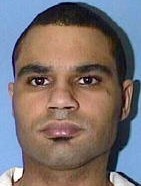
Marcus Bridger Cotton
Murderer Russell Ellwood
Murderer · USA · 1991
Russell Ellwood was a former taxi driver. Authorities suspected him of killing…
20 victims
Russell Ellwood
Murderer · USA · 1991
Russell Ellwood was a former taxi driver. Authorities suspected him of killing…
20 victims
 Robert Martines Perez
Murderer · USA · 1994
Name: Robert Martines Perez · Other name used in proceedings: Robert Martinez P…
15 victims
Robert Martines Perez
Murderer · USA · 1994
Name: Robert Martines Perez · Other name used in proceedings: Robert Martinez P…
15 victims
 Billy Frank Vickers
Murderer · USA · 1993
Billy Frank Vickers Vickers was executed by lethal injection in Texas on Januar…
14 victims
Billy Frank Vickers
Murderer · USA · 1993
Billy Frank Vickers Vickers was executed by lethal injection in Texas on Januar…
14 victims
 Windel Ray Workman
Murderer · USA · 1987
Windel Ray Workman was convicted and sentenced to death for the January 10, 198…
1 victim
Windel Ray Workman
Murderer · USA · 1987
Windel Ray Workman was convicted and sentenced to death for the January 10, 198…
1 victim
 Niels Nielsen
Murderer · USA · 1995
Niels Christian Nielsen was convicted of killing his ex-wife, Sue Marshel, and…
2 victims
Niels Nielsen
Murderer · USA · 1995
Niels Christian Nielsen was convicted of killing his ex-wife, Sue Marshel, and…
2 victims
 Alexander Tchayka
Spree killer · Russia · 1994
Alexander Tchayka (born in 1974 in Sumy, USSR (now, Ukraine)) was a Russian ser…
4 victims
Alexander Tchayka
Spree killer · Russia · 1994
Alexander Tchayka (born in 1974 in Sumy, USSR (now, Ukraine)) was a Russian ser…
4 victims
 Edward Davidson
Murderer · USA · 2008
Edward Davidson “Fast Eddie”, “the Spam King” Edward “Eddie” Davidson (July 29,…
2 victims
Edward Davidson
Murderer · USA · 2008
Edward Davidson “Fast Eddie”, “the Spam King” Edward “Eddie” Davidson (July 29,…
2 victims
 Ernest Wholaver
Murderer · USA · 2002
In July 2002, Ernest R. Wholaver, Jr. was charged with multiple sexual offenses…
3 victims
Ernest Wholaver
Murderer · USA · 2002
In July 2002, Ernest R. Wholaver, Jr. was charged with multiple sexual offenses…
3 victims
- Gender
- male
- Country
- USA
- Location
- Harris County, Texas, USA
- Date of birth
- September 28, 1974
- Age at first offence
- 22
- Characteristics
- robbery, rape?, torture, drugs
- Victim profile
- Gil Epstein, 27 (Fort Bend County Assistant District Attorney)
- Method of murder
- Shooting (.38-caliber pistol)
- Date(s) of murder
- September 18, 1996
- Years active
- 1996
- Date of arrest
- 7 days after
- Status
-
Executed
Executed by lethal injection in Texas on March 3, 2004
Marcus Bridger Cotton
Background
Marcus Bridger Cotton was convicted of capital murder and sentenced to death for murdering Fort Bend County Assistant District Attorney Gil Epstein during a robbery in the parking lot of the Jewish Community Center in southwest Houston.
Cotton was 21 at the time of the September 18, 1996 killing and 29 at the time of execution. He was adopted as a two-week-old baby by a Houston family.
Defense pleas at sentencing and trial included childhood abuse, neglect, and drug use. Cotton’s adoptive mother was described as a drug addict who habitually abused her children. Cotton first tried drugs when he was 5, and when he was 10 he witnessed his mother shoot his father. Cotton’s adoptive father, Edward, testified and said he did not believe his son was guilty and that the verdict was unfair, adding: “I love him,” and “I’m gonna see if I can still help him.”
Cotton claimed he had been “stoic” when the verdict was read. Asked by the judge if he had anything to say, he replied: “No, sir.”
Cotton later gave a petition/letter from prison addressed to Texas Governor Rick Perry and the Texas Board of Pardons and Parole. In that written statement he also gave the personal court identifier: “Marcus B. Cotton # 999252 Polunsky Unit 3872 FM 350 South Livingston Texas 77351 USA”.
Cotton also wrote a “Marcus' Penpal Request” letter. In that letter he described limitations on his “ink-pen-art” drawing and asked for “friendship” and “potential outlet and/or person(s) willing to build a rapport” so his work could be showcased.
The offence
On September 18, 1996, Cotton and Lawrence Watson, armed with pistols, set out on bicycles to rob someone in the parking lot of the Jewish Community Center in Houston. They spotted Gil Epstein and Sean Caruthers walking toward their cars.
Watson approached Caruthers, put a .38-caliber pistol to his head, demanded his cash, and ordered him to leave. Caruthers drove to the front of the community center to call police, then returned to the parking lot and observed Cotton in the front passenger seat of Epstein’s car.
Meanwhile, Cotton approached Epstein and demanded money after pulling a 380 semi-automatic pistol. Epstein told Cotton he did not have any money but had an “expensive board” in his car. Cotton walked Epstein to his car and forced him into the back passenger seat. Cotton began searching Epstein’s wallet and glove compartment.
Caruthers began flashing his lights and honking his horn in an effort to ward off the robbers. Watson testified that Cotton ordered him to kill Caruthers. Watson pointed his gun at Caruthers but did not fire. Watson heard a gunshot behind him. Witness testimony described Cotton firing two shots into Epstein’s head while still in Epstein’s car.
After the shooting, Cotton got out of the car, jumped on his bicycle, and rode toward Caruthers’s car. Caruthers drove into Cotton and knocked him off his bike. Cotton escaped on foot by jumping a fence while Watson also fled.
Witnesses testified that Cotton decided to kill Epstein after discovering Epstein’s assistant district attorney badge in Epstein’s wallet. The badge was found lying at the victim’s feet inside the car.
After the killing, witnesses testified that Cotton later bragged about “shooting the law” after seeing the badge. In court testimony, Watson also said Cotton ordered him to “kill that bitch” during the disturbance.
Investigation
Following the robbery and shooting, Houston police arrested Cotton and Watson about a week after the incident after tips to CrimeStoppers.
Witnesses identified Cotton during lineups, including a first trial period identification and later identifications in a second lineup. In defense material presented in later proceedings, contradictions in witness statements were discussed, including statements about skin color, facial hair, and stature. Contradictory statements were also described as concerning the wound on Cotton’s left leg, which was said to have resulted from the collision, with Cotton claiming it instead came from a broken step.
Watson told police that Cotton killed Epstein because he saw the gold badge he carried as a member of the district attorney’s office. The badge was found at Epstein’s feet inside the car.
Caruthers testified that he drove to call police and then returned to the side of the building where he saw Cotton in Epstein’s car. Carla Chisholm, described as a security guard at the center, testified she saw Cotton aiming a gun at Epstein.
Arrest
After the incident, Cotton was arrested at his girlfriend’s home about a week after the slaying.
Watson was also arrested after the CrimeStoppers tips, and he implicated Cotton. One of the arrest-related accounts described suspect sketches being released by news media before arrests on Sept. 26 and Sept. 27, 1996.
Trial
First trial
Cotton was tried twice for the murder of Epstein.
Cotton’s first trial ended in a hung jury. The jury deadlocked 11-1 for conviction. One juror refused to join deliberations. The jury foreman and other jurors said the holdout made unreasonable statements, spewed profanities and said that Jews are rich enough to contribute to CrimeStoppers to help solve crimes.
Watson did not testify at the first trial.
Cotton claimed he was not at the shooting scene and denied being the gunman who confronted Epstein in the community center parking lot and demanded his wallet. In that denial, he said: “I was not there,” and later: “I don’t say it wasn’t me.” In the prison statement about innocence he also said: “I’m not saying these people didn’t see what they saw,” and added: “I’m saying it wasn’t me.”
A separate appellate discussion stated that Cotton was first tried for the murder of Epstein on March 17, 1997, and a jury deadlock caused a mistrial.
Second trial (capital murder)
At the second trial, held in November 1997, a jury convicted Cotton of capital murder.
The second trial jury convicted Cotton of capital murder in less than an hour and then sentenced him to death. Another account described jurors deliberating more than seven hours before agreeing to the death sentence.
Watson testified at the second trial and said Cotton killed Epstein. Watson’s testimony described the robbery motive and the shooting sequence. Watson also testified that Cotton yelled to him to “kill that bitch” when Caruthers created the disturbance. Watson said he aimed at Caruthers but did not fire and then heard a shot behind him; he turned and saw Cotton fire while still in Epstein’s car.
The trial included other witness testimony: Caruthers testified he saw Cotton in Epstein’s car and that Cotton pointed a pistol. Carla Chisholm testified that she saw Cotton aiming a gun at Epstein. Several witnesses testified that Cotton told them he decided to kill Epstein after seeing the law enforcement badge.
Defense attorneys Chuck Hinton and Mack Arnold attempted to explain Cotton’s upbringing and presented his adoptive mother’s drug addiction and abuse and described his childhood. When questioned by the judge after verdict, Cotton said: “No, sir.”
Cotton’s criminal history included prior convictions and prison terms. At the second trial and in subsequent proceedings, his prior offenses were referenced, including drug possession and attempted murder.
Sentencing
After the second punishment hearing, the court assessed a sentence of death on Nov. 12, 1997.
A procedural timeline included: Oct. 15, 1996 — a Harris County grand jury indicted Cotton on the capital offense; Nov. 7, 1997 — a jury found Cotton guilty of capital murder; Nov. 12, 1997 — after a separate punishment hearing the court assessed a sentence of death.
A federal appellate discussion later described the first direct appeal in which the Texas Court of Criminal Appeals upheld Cotton’s conviction and sentence.
Appeals
Cotton pursued state and federal habeas corpus relief.
On June 30, 1999, the Texas Court of Criminal Appeals affirmed the conviction and sentence on direct appeal.
On Aug. 6, 1999, Cotton’s direct appeal was also described as affirmed by the Texas Court of Criminal Appeals.
Cotton then filed an application for writ of habeas corpus in the state trial court on Aug. 6, 1999, and the Court of Criminal Appeals denied habeas relief on June 7, 2000.
In the U.S. Supreme Court, certiorari was denied after direct appeal on June 29, 2000.
Cotton later filed a petition for writ of habeas corpus in a Houston federal district court on June 29, 2001. The federal district court denied habeas relief on Oct. 30, 2002.
On Aug. 21, 2003, the 5th U.S. Circuit Court of Appeals denied/affirmed the judgment of the District Court.
On Nov. 19, 2003, Cotton petitioned the U.S. Supreme Court for certiorari review. On Feb. 23, 2004, the U.S. Supreme Court denied the petition.
A decision by the U.S. Court of Appeals for the Fifth Circuit described issues including prosecutor comments on Cotton’s failure to testify, counsel’s ineffective assistance for failing to call two witnesses, and due process comments by the trial judge during jury selection regarding the Texas capital sentencing scheme. The decision granted a COA on the issue of prosecutor’s closing argument and otherwise denied a COA on other issues. It affirmed the district court’s denial of habeas relief with respect to the closing argument issue, and it denied relief on the other COA issues.
Outcome
Cotton was executed by lethal injection in Texas on March 3, 2004 in Huntsville.
Before execution, a media advisory described that on Wednesday, March 3, 2004, Marcus Bridger Cotton was scheduled to be executed after 6 p.m. The advisory stated he was sentenced to die for the capital murder of Gil Epstein on November 12, 1997 for the offense occurring on September 18, 1996.
Accounts of the execution described administration of lethal injection at about 6:07 p.m. and pronouncement dead about six minutes later, with one account describing he was pronounced dead at 6:13 p.m.
Cotton’s final words were quoted as: “Well, Mom, sometimes it works out like this. Love life, live long. When you are dealing with reality, real is not always what you want it to be.”
Cotton’s mother was described as watching through a window, and witnesses were described in reporting as gathered for the execution.
Other details
Victims and persons involved
- Gil Epstein: Fort Bend County Assistant District Attorney; age 27; shot to death.
- Sean Caruthers: companion of Epstein; drove a car to call police; testified at trial.
- Lawrence Watson: accomplice; testified at second trial; pleaded guilty to aggravated robbery and was sentenced to 10 years imprisonment.
- Carla Chisholm: security guard at the Jewish Community Center; testified at trial.
- Watson’s gang affiliation was described as being a member of the “Black Gangsta Disciples” since age 10 in a related account.
Quotations from the record
Baruch Epstein, Gil’s father, said: “Justice has finally been served for our son,” and later: “This negative ordeal is over.” Zohara Epstein, Gil’s mother, said: she wanted to see Cotton’s execution and would give the injection herself if she could. Cotton’s prior statement included: “Well, Mom, sometimes it works out like this. Love life, live long. Cotton was also quoted as saying: “I became a much better trial lawyer after working with him for just about 5, 6 months,” which was said by Greg Gilleland about Gil Epstein. A prosecutor statement included: “The death penalty statute was written for a man like Marcus Cotton,” said by prosecutor Luci Davidson.
Defense attorney statements included Arnold saying: “His whole life he's been knocked down and kicked,” and Arnold also said: his client fully expected the death penalty, which will be automatically appealed. Prosecutor Michael Hartman was quoted in relation to Epstein: “He was always fun, no matter what was going on,” and “Always some kind of story about something and something exciting and entertaining all the time.” Strimple was quoted on Epstein: “It doesn't mean that it's all over. Rosen explains why he wants to attend the execution,” and separately: “It will be a relief to have that part done,” though those remarks were made in the context of execution-viewing discussion.
Carl ProDeathPenalty.com related content described Cotton’s claims about evidence and consistency, but it also included claims and descriptions: “With today's technologies and testing capabilities, a fiber is just as testable and important as a whole shirt,” and “However, this piece of evidence, which might have contributed to finding out the truth, was only glossed over.”
Prior criminal history
Cotton had juvenile conviction history referenced in multiple places. In 1992, he pleaded guilty to possession of cocaine and was sentenced to 4 years in prison; he was paroled in 1992 and convicted of attempted murder that same year.
He was paroled in 1996, 7 months before murdering Epstein. Additional accounts described:
- A conviction for attempted murder and a 6-year sentence, with 4 years served.
- Due to strict prison population caps imposed by U.S. District Judge William Wayne Justice, Cotton was never actually sent to prison and instead served 3½ months in county jail, then was released because of Justice’s ruling against the state using county jails as overflow capacity.
- In November 1993, he was sentenced to 6 years for attempted murder, and he was released in February 1996.
Grand jury and procedural dates
The procedural history presented included:
- Oct. 15, 1996 — A Harris County grand jury indicted Cotton on the capital offense.
- Nov. 7, 1997 — A jury found Cotton guilty of capital murder.
- Nov. 12, 1997 — Following a separate punishment hearing, the court assessed a sentence of death.
- Jun. 30, 1999 — Texas Court of Criminal Appeals affirmed conviction and sentence on direct appeal.
- Aug. 6, 1999 — Cotton filed an application for writ of habeas corpus in the state trial court.
- Jun. 7, 2000 — The Court of Criminal Appeals denied habeas relief.
- Jun. 29, 2001 — Cotton filed a petition for a writ of habeas corpus in a Houston federal District Court.
- Oct. 30, 2002 — The federal district court denied habeas relief.
- Aug. 21, 2003 — 5th U.S. Circuit Court of Appeals denied/affirmed the District Court judgment.
- Nov. 14, 2003 — The trial court entered an order setting the execution date for Mar. 3, 2004.
- Nov. 19, 2003 — Cotton petitioned the U.S.
- Feb. 23, 2004 — The U.S. Supreme Court denied the petition for writ of certiorari.
Final meal and execution details
A final meal was described as: chicken fried steak with cream gravy, macaroni and cheese, fried okra, one slice of cheesecake with whipped cream and sprinkled pecans, one slice of pecan pie and apple juice.
One account described he was administered lethal injection at 6:07 p.m. and pronounced dead six minutes later, with another describing pronouncement at 6:13 p.m.

Spotted an error, or have more information about this case?