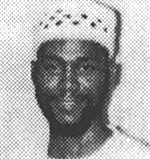
Tyrone Gilliam
Murderer Brian Kevin Rosenfeld
Murderer · USA · 1985
Brian Kevin Rosenfeld Brian Kevin Rosenfeld was sentenced to three concurrent l…
23 victims
Brian Kevin Rosenfeld
Murderer · USA · 1985
Brian Kevin Rosenfeld Brian Kevin Rosenfeld was sentenced to three concurrent l…
23 victims
 Yahweh ben Yahweh
Murderer · USA · 1980
Yahweh ben Yahweh was born and legally named Hulon Mitchell Jr. (October 27, 19…
23 victims
Yahweh ben Yahweh
Murderer · USA · 1980
Yahweh ben Yahweh was born and legally named Hulon Mitchell Jr. (October 27, 19…
23 victims
 Russell Ellwood
Murderer · USA · 1991
Russell Ellwood was a former taxi driver. Authorities suspected him of killing…
20 victims
Russell Ellwood
Murderer · USA · 1991
Russell Ellwood was a former taxi driver. Authorities suspected him of killing…
20 victims
 Robert Martines Perez
Murderer · USA · 1994
Name: Robert Martines Perez · Other name used in proceedings: Robert Martinez P…
15 victims
Robert Martines Perez
Murderer · USA · 1994
Name: Robert Martines Perez · Other name used in proceedings: Robert Martinez P…
15 victims
 Jessie James Cowans
Homicide - Murderer · USA · 1977
Jessie James Cowans Jessie James Cowans was arrested for armed robbery when he…
2 victims
Jessie James Cowans
Homicide - Murderer · USA · 1977
Jessie James Cowans Jessie James Cowans was arrested for armed robbery when he…
2 victims
 Roger Dale Vaughn
Murderer · USA · 1991
Roger Dale Vaughn was convicted of capital murder in Texas and was executed by…
1 victim
Roger Dale Vaughn
Murderer · USA · 1991
Roger Dale Vaughn was convicted of capital murder in Texas and was executed by…
1 victim
 David Lauren Crespi
Murderer · USA · 2006
David Lauren Crespi was a 45-year-old bank executive. He worked as a senior vic…
2 victims
David Lauren Crespi
Murderer · USA · 2006
David Lauren Crespi was a 45-year-old bank executive. He worked as a senior vic…
2 victims
 Samuel Manzie
Homicide · USA · 1997
Samuel Manzie was a 15-year-old charged as an adult in New Jersey for the killi…
1 victim
Samuel Manzie
Homicide · USA · 1997
Samuel Manzie was a 15-year-old charged as an adult in New Jersey for the killi…
1 victim
 James Meyer
Homicide · USA · 2006
James Meyer was 15 years old at the time he pleaded guilty to first-degree arso…
1 victim
James Meyer
Homicide · USA · 2006
James Meyer was 15 years old at the time he pleaded guilty to first-degree arso…
1 victim
 Serge Fortin
Mass murderer · France · 1999
October 2001 — His sentence was commuted to 30 years in prison. · October 2003…
4 victims
Serge Fortin
Mass murderer · France · 1999
October 2001 — His sentence was commuted to 30 years in prison. · October 2003…
4 victims
- Gender
- male
- Country
- USA
- Location
- Baltimore County, Maryland, USA
- Date of birth
- 1956
- Age at first offence
- 32
- Characteristics
- abduction, robbery, drugs
- Victim profile
- Christine Doerfler (female, 21)
- Method of murder
- Shooting ( sawed-off shotgun)
- Date(s) of murder
- December 2, 1988
- Years active
- 1988
- Date of arrest
- —
- Status
-
Executed
Executed by lethal injection in Maryland on November 16, 1998
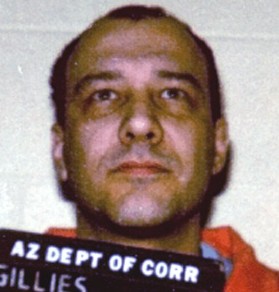
Case record: Tyrone Gilliam
Background
Tyrone Gilliam was convicted in the murder of Christine Doerfler.
Gilliam was executed by lethal injection in Maryland on November 16, 1998.
The offence
Gilliam and two codefendants abducted Christine Doerfler as she arrived at her sister's Baltimore County home and forced her to drive to an automated teller machine.
The men got no more money. After driving to a dead-end street, Gilliam put a sawed-off shotgun to the back of Doerfler's head and pulled the trigger.
Gilliam said the killing came during a frenzied search for drug money while he was high on PCP and crack cocaine.
The offence involved a $3 robbery.
Investigation
Gilliam said he confessed twice to the shooting because of police coercion and bad advice from his attorney.
When the governor later reviewed evidence, he found that Gilliam confessed twice to pulling the trigger and that his confessions were corroborated by two co-defendants.
Trial
Tyrone Gilliam was convicted in the Dec. 2, 1988, murder of Christine Doerfler.
The codefendants were Tony and Kelvin Drummond. Both brothers were convicted of murder and given life sentences. Kelvin Drummond received a life sentence with the possibility of parole. Tony Drummond drew a sentence of life without parole.
A co-defendant testified that Gilliam had done it, and Gilliam was convicted as the trigger man.
Gilliam changed his account after the murder. At one point he said he was not the trigger man.
Gilliam told reporters that he was so heavily drugged during the incident that he could not remember what happened.
Gilliam’s attorney, Jerome H. Nickerson Jr., produced affidavits from the Drummond brothers stating that Gilliam was not the trigger man. The affidavits did not say who fired the shotgun, and Nickerson said Saturday that if he could get a court hearing, the shooter would be identified.
On Sunday, prosecutors obtained new statements from both Drummonds in which the brothers said the affidavits they had given Nickerson were not true. The new statements were included in prosecutors’ filings with the governor in his consideration of Gilliam’s bid for clemency.
Sentencing
Gilliam was sentenced to death.
Baltimore County Circuit Judge John F. Fader II convicted and sentenced Gilliam for Doerfler's murder.
Fader was better known for trying to sort out messy divorce and child custody cases and was put in a position with the Gilliam case.
Fader alone convicted and sentenced Gilliam for Doerfler's murder.
At the time of sentencing, Fader said he thought of the picture of Christine Doerfler with a 2-inch hole in the back of her head and he thought of the life draining out of her young body as she sat in her car at the deadend of a road.
Fader said:
"I can say only with a heavy heart and with no satisfaction with the duty that I must perform that I conclude that death is the sentence to be applied in this case,"
Fader signed Gilliam's death warrant several times over the past 9 years as the case was appealed to court after court.
Fader gave life in prison to two other defendants facing execution in his courtroom. In one of those cases, the jury had voted to send a man to the death chamber, but the sentence was reversed on appeal, and Fader gave him a life sentence. In both cases, Fader saw reasons to spare their lives. One of the defendants had a history of psychiatric problems and later hanged herself in prison. The other had been in foster care his entire life and was living in a bus at the time of the murder he committed.
In Gilliam’s case, Fader said there was no reason under the law to excuse Gilliam from the ultimate punishment.
Fader said:
"It was a coldblooded murder, and what a waste of human life, a vibrant life,"
Fader also said:
"He had as much support help from a loving, caring family with the ability to help as most people have in life,"
"He chose not to accept that advice, that counseling, that opportunity. He chose drugs, and the crime that was committed here."
Fader said he did not believe drugs Gilliam had taken that night—PCP and cocaine—had fundamentally impaired his judgment.
Appeals
Gilliam's case had been reviewed and upheld 16 times by state and federal appellate courts.
The United States Court of Appeals For the Fourth Circuit issued an opinion referenced as 97-14.
Outcome
Gilliam was pronounced dead at 10:27 p.m., a few minutes after prison guards administered a lethal dose of drugs through intravenous lines.
Before the injections started, Gilliam said:
"Allah, forgive them for what they do."
Then he turned toward his attorney and a Muslim spiritual adviser among the witnesses and said:
"I love you,"
His final words were:
"Allah akbar,"
Outside the Maryland Penitentiary, more than 200 capital punishment opponents stood on a street and held candles, sang songs of support, and chanted:
"They say death row, we say hell no."
Gilliam refused a last meal.
Aftermath
Governor Parris N. Glendening rejected Gilliam’s plea for clemency.
In a 5-paragraph statement, Glendening said he had reviewed evidence in the case since Gilliam’s death warrant was issued Oct. 5. Glendening said the facts in the case showed that "Mr. Gilliam shot and murdered Miss Doerfler in cold blood."
Glendening stated that Gilliam confessed twice to pulling the trigger and that his confessions were corroborated by two co-defendants.
The U.S. Supreme Court refused to hear the case.
Earlier in the day, both the Supreme Court and Maryland Gov. Parris N. Glendening rebuffed 11th-hour petitions to spare Gilliam.
Nation of Islam leader Louis Farrakhan issued an urgent plea for mercy Sunday to Glendening, saying Gilliam's conversion to Islam had "helped him to see the error of his ways."
Gilliam joined the Nation of Islam in 1994 and went by the names Tyrone X. Gilliam and Minister As-siid Ben Maryam.
Gilliam was the third inmate executed in Maryland in this decade after a hiatus of almost 33 years.
At least five other condemned men in prisons from Virginia to California were awaiting execution the same week.
Three men, including one in Virginia, were set to be executed Tuesday.
Richard Dieter, executive director of the Death Penalty Information Center in Washington, said:
"It's an unusual number by any measure,"
He also said:
"So far this year, he said, there have been 54 executions."
Baltimore County Circuit Judge J. William Hinkel said:
"It's one of the most difficult decisions" a judge has to make,
Hinkel also said:
"You have in your hands the ultimate sanction. That is an awesome responsibility."
During the execution, Gilliam's father, Tyrone Gilliam Sr., spoke to protesters before the execution in a rambling and emotional speech:
"Although this may silence him, don't let his life stop the struggle."
Gilliam's execution included a Muslim spiritual adviser among the witnesses.
Gilliam had a legal representation by attorney Jerome H. Nickerson Jr.
Fader II was identified as the judge who signed the death warrant.
Execution commander William Sondervan ordered the lethal injection.
Max Obuszewski wrote about physician participation in executing Gilliam and described an American Medical Association ethical opinion. The ethical opinion stated:
“A physician, as a member of a profession dedicated to preserving life when there is hope of doing so, should not be a participant in a legally authorized execution.”
The article also quoted the American Medical Association citation as:
“1992 Code of Medical Ethics, Current Opinions of the Council on Ethical and Judicial Affairs of the American Medical Association [article 2.061 Leonard Sipes, Jr., director of public information for the Department of Corrections, would not reveal the exact role played by physicians in the killing of Gilliam.”
The article later referenced conclusions with these items:
(1) Laws should incorporate AMA guidelines excluding physician participation;
(2) Violations of medical ethical standards such as anonymity clauses should be eliminated;
(3) state medical societies should adopt AMA guidelines against medical participation; and
(4) the state medical boards should define physician participation as unethical conduct and take appropriate action against violators.
The article also included a quote from John Price-Gilliam:
"We are in the midst of a war on minorities and the poor."
The article included a quote from Tyrone:
"My crime was the result of poverty and desperation. Politicians kill for power and prestige."
Other details
Tyrone Gilliam was identified as 32 years old at the time of execution.
Christine Doerfler was identified as 21 years old.
Gilliam's codefendants were identified as brothers Tony and Kelvin Drummond, also described as Kelvin LeGrant Drummond and Delano Anthony "Tony" Drummond.
Protesters included capital punishment opponents outside the prison.
Gilliam was described as having been strapped down at 10 p.m. inside the death chamber, and a needle was inserted through his skin.
The legal outcome remained execution by lethal injection on November 16, 1998.

Spotted an error, or have more information about this case?