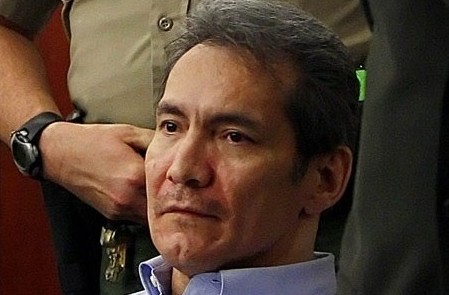
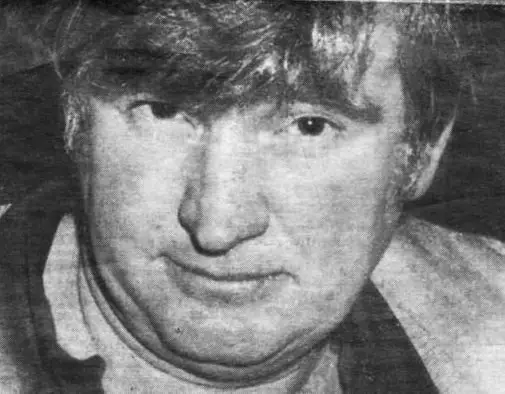
Floyd Maestas
Murderer Robert Martines Perez
Murderer · USA · 1994
Name: Robert Martines Perez · Other name used in proceedings: Robert Martinez P…
15 victims
Robert Martines Perez
Murderer · USA · 1994
Name: Robert Martines Perez · Other name used in proceedings: Robert Martinez P…
15 victims
 Robert Glen Jones
Murderer · USA · 1996
Defendant: Robert Glenn Jones (ADC#070566) · Co-defendant: Scott Nordstrom (ADC…
7 victims
Robert Glen Jones
Murderer · USA · 1996
Defendant: Robert Glenn Jones (ADC#070566) · Co-defendant: Scott Nordstrom (ADC…
7 victims
 Joshua Wayne Andrews
Murderer · USA · 2000
Joshua Wayne Andrews was a serial killer accused of killing several people in V…
5 victims
Joshua Wayne Andrews
Murderer · USA · 2000
Joshua Wayne Andrews was a serial killer accused of killing several people in V…
5 victims
 Juan Carlos Alvarez
Murderer · USA · 1998
Juan Carlos Alvarez, born on March 9, 1977, in San Luis, Mexico, was a Hispanic…
5 victims
Juan Carlos Alvarez
Murderer · USA · 1998
Juan Carlos Alvarez, born on March 9, 1977, in San Luis, Mexico, was a Hispanic…
5 victims
 Danielle Nathaniel Simpson
Murderer · USA · 2000
Danielle Nathaniel Simpson was condemned for the capital murder of Geraldine Da…
1 victim
Danielle Nathaniel Simpson
Murderer · USA · 2000
Danielle Nathaniel Simpson was condemned for the capital murder of Geraldine Da…
1 victim
 Raymond Edmunds
Murderer · Australia · 1966
Raymond Edmunds Raymond Edmunds was serving a life sentence for the 1966 murder…
2 victims
Raymond Edmunds
Murderer · Australia · 1966
Raymond Edmunds Raymond Edmunds was serving a life sentence for the 1966 murder…
2 victims
 Kenneth Bartley
Homicide · USA · 2005
Defendant: Kenneth Bartley Jr., 15-year-old student (also referred to as Kennet…
1 victim
Kenneth Bartley
Homicide · USA · 2005
Defendant: Kenneth Bartley Jr., 15-year-old student (also referred to as Kennet…
1 victim
 Russell Eugene Weston
Homicide · USA · 1998
Russell Eugene Weston Jr. was born December 28, 1956 and used the nickname “Rus…
2 victims
Russell Eugene Weston
Homicide · USA · 1998
Russell Eugene Weston Jr. was born December 28, 1956 and used the nickname “Rus…
2 victims
 Cynthia Pugh
Murderer · USA · 1983
Cynthia Pugh was convicted in 1984 of murdering her boss and lover, Manlius bus…
1 victim
Cynthia Pugh
Murderer · USA · 1983
Cynthia Pugh was convicted in 1984 of murdering her boss and lover, Manlius bus…
1 victim
 James Randall Rogers
Murderer · USA · 1980
James Randall Rogers was convicted in Floyd County of murder and aggravated ass…
1 victim
James Randall Rogers
Murderer · USA · 1980
James Randall Rogers was convicted in Floyd County of murder and aggravated ass…
1 victim
- Gender
- male
- Country
- USA
- Location
- Salt Lake, Utah, USA
- Date of birth
- 1955
- Age at first offence
- 49
- Characteristics
- rape, robbery
- Victim profile
- Donna Lou Bott, 72
- Method of murder
- St abbing with knife
- Date(s) of murder
- September 28, 2004
- Years active
- 2004
- Date of arrest
- —
- Status
-
Sentenced to death
Sentenced to death on February 6, 2008
Case record: Floyd Maestas
Background
Floyd Eugene Maestas was repeatedly convicted of violence against elderly women before being sentenced to death for the killing of Donna Lou Bott. He continually denied committing the crime and had no comment on Wednesday.
The story of Maestas’ attacks against elderly women began no later than 1974. Bruce Hansen had walked past the darkened home of the aunt who raised him on the night he visited her and later said: "I usually visited her on my way home, but on that night I didn't." He added: "I still can't forgive myself for that."
Inside, Maestas was beating and raping 64-year-old Donna Jensen. Hansen recalled: "The doctors had to sew one of her nipples back on — that's how bad it was,"
Maestas, then 17 years old, was convicted of burglary and was paroled after serving 18 months. Three months after his release, he was arrested again.
Jerrilynn Comollo still sobbed when she thought about cleaning Maestas’ blood from underneath her grandmother’s fingernails. Comollo recalled: "She had fought so hard that all that blood was way down into the quick,"
Alinda Ross Robbins McLean, a 79-year-old woman, was repeatedly raped and savagely beaten over the course of several hours on the evening of Oct. 13, 1976. Before Maestas left her home, he lifted a broken lamp from the floor and told the twice-widowed woman that he was going to use it to gouge out one of her eyes. The report says: "And then he did just that."
While she cleaned her grandmother’s hands, the old woman wondered aloud why she had been chosen for such punishment. The record quotes the woman saying: "She just kept saying, over and over, 'I can't understand why anyone would do this to me.'"
The same account says Maestas served six years for the attack on McLean and then spent the following decade in and out of prison on a slew of parole violations, which his family members said had something to do with elderly women.
In the fall of 1989, prosecutors were eyeing Maestas in at least three new burglaries. In two, elderly victims were physically beaten and sexually assaulted. Officials chose to prosecute Maestas on a third case: a burglary in which Maestas was confronted by three elderly Greek sisters who had come home from church together to make some Baklava, and he was chased out of their home before he could attack.
Convicted of theft, burglary and being a habitual criminal, Maestas was sentenced to one to 15 years in prison. The other cases were set aside: one was dismissed and the other never filed.
Loene Nelson, now 69 years old, said she was still not sure why her case was ignored. The record quotes Nelson saying: "At the time, a detective showed me his rap sheet and said, 'Listen, this is all this guy needs to be put away forever," She added: "I believed him."
Nine years later, Maestas was back on the street and repeatedly violated his parole.
In April 2000, he was convicted of burglary and sentenced to a one-to-5-year prison term. The burglary was described as one of few convictions on Maestas’ lengthy criminal record that did not involve an elderly female victim. Maestas was released from prison on Sept. 7—nine months before the full five years and without supervision, said parole board chairman Mike Sibbett.
Three weeks later, Bott was dead.
The offence
Donna Lou Bott, 72, was killed after breaking into her Salt Lake home on Sept. 28, 2004. The record says Maestas beat, choked, stabbed and then stomped Bott, rupturing the aorta in her heart.
It also describes findings after Bott’s death. Her badly beaten body lay in the bedroom of her home for three days before police—acting on concerns of neighbors—entered her home. Next to her body, police found a pair of her underwear.
An autopsy determined Bott’s face had been slashed while she was still alive. The autopsy determined she was strangled and that her teeth were fractured, and it determined she had been raped.
The record also connects prior attacks to subsequent outcomes and says: "It took more than one man to kill her. It took an entire system."
Investigation
The record says that Floyd Maestas’ fingerprints were found in Bott’s home and that his DNA was found in her body. It says that although Maestas may have been responsible for the stabbing, beating, raping and strangling of 75-year-old Donna Lou Bott, it took more than one man to kill her and an entire system.
Arrest
No separate arrest event was described in the provided text.
Trial
Maestas was previously convicted by a jury of killing Donna Lou Bott, 72.
During the death-sentence hearing, the record describes last-minute efforts by defense attorneys to change the outcome. Third District Judge Paul Maughan imposed the death sentence.
The record describes multiple motions by the defense team during the hearing:
- The judge denied two motions to give Maestas a new penalty phase trial for his capital murder conviction and to set aside the verdict of death because of what the lawyers described as Maestas’ limited mental capacities and his inability to properly advise his defense attorneys.
- Defense attorney Denise Porter challenged the way a question from a juror had been handled. The juror asked whether the Board of Pardons could overrule a sentence of life in prison without parole and still offer parole. The judge said that motion was too late and that the jurors had been directed to examine jury instructions that spelled out which of the two verdicts they could render.
- Defense attorney David Mack objected to the judge’s ruling that Maestas had the legal right to make decisions regarding his defense.
The record says Maestas last week had opposed his attorneys’ plans to present evidence of his hardscrabble childhood involving sexual, physical and substance abuse. The record says this evidence would have shone some embarrassing light on Maestas’ family and that Maestas insisted he would not involve his family in the court proceedings even if that meant he would be at a disadvantage.
The record quotes Mack arguing that: "He said it was ironic that a room filled with highly educated people put their creative energies toward seeing that a "damaged, morally disadvantaged" person was sent to his death."
The record says Mack also described it as: "It was 'freakish' that the court ordered the defense team to take orders from Maestas when he was the least capable person to understand or help with such intricate legal matters that had such high stakes."
Mack said the jury ended up with an "unreliable verdict" and that Maestas’ 8th Amendment rights, which forbid cruel and unusual punishment, had been violated.
Prosecutor Kent Morgan disagreed and argued that Maestas had received a fair trial and had the right to direct his own defense. The record quotes Morgan: "he said what is freakish is that someone would try to essentially get a plea bargain after a jury had gone through a trial and come up with a guilty verdict and a recommendation for the death penalty."
The judge denied that motion as well. Maughan said Maestas had been found to be mentally competent to stand trial and help in his own defense and was permitted by law to decide what evidence would be presented on his behalf. The judge’s remarks were quoted: "He may not have the full range of mental capabilities, but he is certainly competent to make that decision,"
Sentencing
Judge Paul Maughan imposed a death sentence that he ordered to be carried out within 30-60 days, but he stayed the execution order because such sentences are automatically appealed to the Utah Supreme Court.
Maughan denied the defense requests for a new penalty phase trial and to set aside the death verdict.
Appeals
The record says the execution order was stayed because death sentences are automatically appealed to the Utah Supreme Court.
No specific appeal result was stated in the provided text.
Outcome
Floyd Maestas was sentenced to die by lethal injection. The death sentence was stayed pending automatic appeal to the Utah Supreme Court.
Aftermath
The record includes a statement from Robin Crane, a friend of Maestas since junior high school, who wept as she described how Maestas had “given up” and said she did not believe he could get a just trial because of plea deals given to two co-defendants with him the night Bott was killed who testified against him. Crane said: "I've known him for 30 years; he's not a monster,"
Crane added: "He's a victim of his circumstances."
She said he never got a chance to do well in school, was put in "special classes" for the less intelligent students mainly because he spoke Spanish, and had a rough life.
Crane said Maestas was guilty of “a lot of bad things,” describing "smaller stuff" such as burglary, and she said he would not plead guilty to a crime such as murder because he did not do it.
When asked about Donna Bott’s grieving family, Crane said she was sorry for their loss and hoped that the real culprit would feel guilty and come forward. She said: "It's not likely, but we can pray for it."
The account contrasted physical evidence and prior charging decisions and described plea and parole determinations over the prior 30 years: "Over the past 30 years — through at least a half-dozen similar attacks against elderly women — charging decisions, plea negotiations and parole board determinations have ensured Maestas has never been convicted of a single violent crime."
It further said: "As a result, he never spent much time behind bars."
The account stated: "The maddening story begins no later than 1974,"
and later summarized: "The failure to make the promise became the lifeblood of a serial rapist. And the failure to keep it resulted in the death of Donna Lou Bott."
Other details
The record references related criminal history and outcomes including:
- Maestas was convicted of burglary for the Donna Jensen attack and later paroled after serving 18 months.
- Maestas was convicted of theft, burglary and being a habitual criminal for the burglary involving three elderly Greek sisters.
- Maestas was convicted of burglary in April 2000 and sentenced to a one-to-5-year prison term; he was released from prison on Sept. 7 nine months before the full term and without supervision, said parole board chairman Mike Sibbett.
- The record says Maestas continuously denied committing the Bott killing.
The record also describes Donna Lou Bott as 72 and says the body was found after three days; it also describes that her face had been slashed while she was still alive, she was strangled, her teeth were fractured, and she had been raped.


Spotted an error, or have more information about this case?