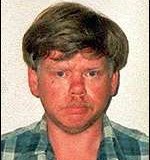
Russell Eugene Weston
Homicide Jack Kevorkian
Homicide · USA · 1990
Jack Kevorkian (born May 26, 1928) was a controversial American pathologist. He…
130 victims
Jack Kevorkian
Homicide · USA · 1990
Jack Kevorkian (born May 26, 1928) was a controversial American pathologist. He…
130 victims
 David Koresh
Homicide · USA · 1993
David Koresh (born Vernon Wayne Howell; August 17, 1959 – April 19, 1993) led t…
79 victims
David Koresh
Homicide · USA · 1993
David Koresh (born Vernon Wayne Howell; August 17, 1959 – April 19, 1993) led t…
79 victims
 Todd Hall
Homicide · USA · 1996
Todd Hall was described by neighbors as "mentally slow" and was said to have su…
9 victims
Todd Hall
Homicide · USA · 1996
Todd Hall was described by neighbors as "mentally slow" and was said to have su…
9 victims
 Joshua Jenkins
Homicide · USA · 1996
Joshua Jenkins was a 15-year-old American killer who killed five members of his…
5 victims
Joshua Jenkins
Homicide · USA · 1996
Joshua Jenkins was a 15-year-old American killer who killed five members of his…
5 victims
 Fiona Donnison
Murderer · United Kingdom · 2010
Fiona Donnison was 45 years old at the time she showed up in front of local aut…
2 victims
Fiona Donnison
Murderer · United Kingdom · 2010
Fiona Donnison was 45 years old at the time she showed up in front of local aut…
2 victims
 Jose DeJesus
Murderer · USA · 1997
Jose DeJesus was convicted of first-degree murder in July 1998 for the 1997 sho…
1 victim
Jose DeJesus
Murderer · USA · 1997
Jose DeJesus was convicted of first-degree murder in July 1998 for the 1997 sho…
1 victim
 Jesus Romero
Murderer · USA · 1984
Jesus Romero was convicted of capital murder of Olga Lydia Perales and was sent…
1 victim
Jesus Romero
Murderer · USA · 1984
Jesus Romero was convicted of capital murder of Olga Lydia Perales and was sent…
1 victim
 Ellizabeth Rainey
Murderer · USA · 2013
Ellyzabeth Rainey Ellyzabeth Rainey pleaded guilty and was sentenced to 41 year…
1 victim
Ellizabeth Rainey
Murderer · USA · 2013
Ellyzabeth Rainey Ellyzabeth Rainey pleaded guilty and was sentenced to 41 year…
1 victim
 Timothy McKinney
Murderer · USA · 1997
Timothy McKinney was the defendant, convicted in Tennessee. · Don Williams was…
1 victim
Timothy McKinney
Murderer · USA · 1997
Timothy McKinney was the defendant, convicted in Tennessee. · Don Williams was…
1 victim
- Gender
- male
- Country
- USA
- Location
- Capitol Hill, Washington, D. C., USA
- Date of birth
- December 28, 1956
- Age at first offence
- 42
- Characteristics
- mentally ill, history of mental illness
- Victim profile
- Officer Jacob Joseph Chestnut, 58, and Detective John Michael Gibson, 42 ( U.S. Capitol Police officers )
- Method of murder
- Shooting (.38 caliber ahndgun)
- Date(s) of murder
- July 24, 1998
- Years active
- 1998
- Date of arrest
- Same day (wounded by police)
- Status
-
Found incompetent to stand trial due to mental illness in 1999; in 2004, the court suspended (but did not dismiss) the criminal charges against him; remains in a mental institution
Case record: Russell Eugene Weston
Background
Russell Eugene Weston Jr. was born December 28, 1956 and used the nickname “Rusty.” He grew up in Valmeyer, Illinois, attended Valmeyer High School, and moved to Montana shortly after graduating in 1974, rarely returning to Valmeyer. The only attempt his high school classmates made at inviting him to a class reunion was returned with obscenities written across it.
Many of Weston’s Montana neighbors disliked him and often ignored him. They considered him to be unusual and sometimes eccentric. Weston had believed that a neighbor was using a television satellite dish to spy on his actions, and he believed that Navy SEALs were hiding in his cornfield. He was diagnosed as paranoid schizophrenic six years before the shooting, and he spent fifty-three days in a mental hospital after threatening a Montana resident. He was released after testing as being of no danger to himself or anyone else.
Weston moved back to Valmeyer from Montana eighteen months before the shooting. After returning home, he compulsively hacked at trees that filled his back yard following the Mississippi River floods of 1993; family members and neighbors described the resulting woodpile as excessive and sometimes needing to be halted.
Two days prior to the Capitol shooting, at his grandmother’s insistence to do something about nearby cats becoming a nuisance, Weston shot and killed his family’s cats; the material states that he shot and killed 14 cats with a single barreled shotgun, leaving several in a bucket and burying the rest.
Weston was known to the United States Secret Service prior to the incident as a person who had threatened the President of the United States.
His family described his life and mental illness. His relatives said they urged him to visit a doctor or get his prescription refilled when he complained about the CIA’s effort to kill him and about government spying through a neighbor’s satellite dish. His father described Weston as arguing with “a fence post,” and said that the only person he worried about was himself. The material describes that he had a distrust of the federal government and believed in conspirators out to get him, including beliefs that government agents were trying to assassinate him.
The material also describes financial and daily life details. His mental illness earned him federal disability benefits (SSI), and he received monthly payments of $494. His money was described as being gone in less than two weeks, spent on breakfast at Hardee’s, cigarettes, and other small purchases. He was described as a heavy smoker who drove about 11 miles into St. Louis County, Missouri, to buy cartons of Winston cigarettes at a tobacco shop known for low prices. His mother worked at Wal-Mart in Waterloo. His routine included having one meal a day at home around 2 p.m., with cold cuts and as many as eight slices of bread in a row.
The offence
On July 24, 1998, Russell Eugene Weston Jr. shot and killed two U.S. Capitol Police officers with a .38 caliber pistol at the U.S. Capitol.
Entry and initial shooting
On the day of the shooting, Officer Jacob Chestnut and another officer were assigned to operate an X-ray machine and magnetometer at the Document Door entrance located on the East Front of the Capitol, an entrance open only to Members of Congress and their staff. Detective John Gibson was assigned to the dignitary protection detail of Rep. Tom DeLay and was in his suite of offices near this door.
Weston entered the Document Door at 3:40 p.m. He was armed with a .38 caliber Smith & Wesson handgun. At the same time, Officer Chestnut was providing directions to a tourist and the tourist’s son while his partner escorted another tourist toward the restroom. Weston reportedly walked around the metal detector just inside the entrance, and Chestnut requested he go back through the detector.
Weston then suddenly produced the gun and shot Officer Chestnut in the back of the head at point-blank range. Witnesses described that after the shooting, Weston turned down a short corridor and pushed through a door that led to a group of offices used by senior Republican representatives, including then Majority Whip Tom DeLay and Representative Dennis Hastert.
Shooting of Detective Gibson and apprehension
Detective Gibson, described as in plainclothes, was shot after the suspect entered DeLay’s office. Despite being mortally wounded, Detective Gibson returned fire and wound the suspect, who was apprehended in that office.
A female tourist suffered minor injuries after bullets grazed her shoulder and face; she was treated and released. The material also states that U.S. Capitol Police Officer Douglas McMillian was injured during the incident.
The material describes that future Senate Majority Leader Bill Frist resuscitated Weston and accompanied him to D.C. General Hospital.
It further describes that after the shootings, Officers Chestnut and Gibson were the only two people killed in the attack, and after the shooting both officers received the tribute of lying in honor in the Rotunda of the United States Capitol. The material states that Chestnut was the first police officer—and the first African American—to receive the honor.
Statements and courtroom reporting details included in the material
The material includes a statement from House Speaker Newt Gingrich: “I want to emphasize that this building is the keystone of freedom, that it is open to the people because it is the people's building. No terrorist, no deranged person, no act of violence will block us from preserving our freedom and keeping this building open to people from all over the world.”
It includes a statement from President Bill Clinton praising the officers: “Every American should be grateful to them for the freedom and the security they guard with their lives,” and it describes Clinton as praising the two men as heroes who “laid down their lives for their friends, their co-workers and their fellow citizens.”
The material includes a quote attributed to Sgt. Dan Nichols: “He was shot without warning,” and it includes another quote attributed to Nichols: “It's been a trying couple of days for us,” along with “It's a difficult time, and the officers are going to rely on each other. ... But the gunman didn't get very far into the building, and that was our intention.”
It includes a quote from McMillan: “I don't really consider myself a hero,” and it includes DeLay statements describing Chestnut and Gibson, including: “He tried to teach me hockey,” and “I never did understand hockey.”
The material includes witness descriptions of shouted pleas in the hallway: “Help! Help! Help!”
Investigation
The material describes an FBI agent’s affidavit filed in court and security videotapes that captured some images of the incident.
The material states that law enforcement sources and court documents added details including that after bursting through a Capitol security checkpoint and shooting Chestnut, Weston chased a screaming woman down a hallway until he was confronted by Gibson. It also describes that, according to law enforcement sources, Gibson and another officer, identified as Douglas B. McMillan, fired at Weston several times.
The material states that authorities charged Weston under a federal statute covering cases in which federal law enforcement officers are slain during the performance of their official duties.
The material describes the Capitol Police as working almost around the clock on the investigation along with officers from the FBI, D.C. police, and other agencies. It also describes that the arrest warrant for Weston was signed at 2 a.m. and that federal agents executed a search warrant for Weston’s shack.
The material also describes retrieval of guns, gunpowder, ammunition, assorted books and documents, maps, and a receipt from a McDonald’s where Weston ate en route to Washington. It states that material seized may have been significant, and it mentions inventory entries labeled “FREEMAN - CNN,” and books including “Spy Game” and “Don't Bug Me.” It further mentions the existence of two file cabinets that Weston kept locked.
Arrest
Weston was apprehended after Detective Gibson wound him in DeLay’s office.
The material states that Weston was held without bond following a brief hearing in D.C. Superior Court.
Treatment and mental health history
After the Capitol incident, Weston underwent surgery twice for gunshot wounds to the torso, buttocks and legs. The material describes a “50-50” chance of survival and states that he was initially downgraded from stable to critical after surgery.
The material states that Weston was transferred to a psychiatric center at Butner Federal Correctional Institution in Butner, North Carolina, after the shooting.
A contentious issue described in the material was forced medication. Weston refused to take medications voluntarily. In May 2001, a federal judge authorized doctors to treat Weston involuntarily. The material states that an appeals court panel ruled in July 2001 that Weston could be forced to take the drugs for 120 days, and he remained in the Butner facility indefinitely.
Trial and competency proceedings
In 1999, Weston was found incompetent to stand trial due to mental illness. The material describes him as being schizophrenic who stopped taking his medication.
A federal judge of the United States District Court for the District of Columbia ordered in 2001 that Weston be treated with antipsychotic medication without his consent, and an appellate court upheld the decision.
In 2004, the court determined that Weston still was not competent to be tried despite ongoing treatment, and it suspended (but did not dismiss) the criminal charges against him.
The material also describes a hearing request and a hearing on mental status. On March 6, 2008, Weston filed a motion requesting a hearing on his mental status. The hearing was held on May 6 with Weston appearing via teleconference from the Federal Medical Center. He had his public defender Jane Pierce and two witnesses he selected: a psychologist and a vocational rehabilitation specialist. Federal judge Earl Britt denied Weston’s request to be released from the federal facility, arguing that Weston failed to present enough evidence that he no longer needed to be committed.
During the hearing, the defense psychologist Holly Rogers stated, “sometimes there are individuals who simply do not respond to medication,” implying that Weston was not ready for release.
Psychiatric evaluation disclosures
In April 1999, the material describes that Weston told a court-appointed psychiatrist that he stormed the U.S. Capitol to prevent the United States from being annihilated by disease and legions of cannibals.
It states that the psychiatrist wrote that Weston believed time was running out and that if he did not come to Washington, D.C., he would become infected with “Black Heva.” The material states that he called this imaginary ailment the “most deadliest disease known to mankind” and said it was spread by rotting corpses of cannibals’ victims.
The material states that Weston told the psychiatrist that he went to the Capitol to gain access to what he called “the ruby satellite,” a device he said was kept in a Senate safe.
It further describes that Weston told another doctor he fatally shot officers Jacob J. Chestnut and John M. Gibson on July 24 because they were cannibals who were keeping him from the satellite.
The material describes that these accounts were included in materials unsealed by a judge in U.S. District Court and that Judge Emmet G. Sullivan released them after finding Weston was not mentally competent to stand trial. It states that Sullivan ordered Weston, then 42, to spend the next four months in a federal correctional facility for psychiatric treatment and set a follow-up hearing for Sept. 9.
The material states that Weston described “the ruby satellite system” as a means of reversing time and that he told one doctor that Chestnut and Gibson are “not permanently deceased.”
The materials also describe an interview videotape from July 1996 in which Weston showed up unannounced at the Central Intelligence Agency and told a note-taking CIA employee that President Clinton “is a Russian clone, brought to the United States for the purposes of communist insurgency.” In the same tape, the material says Weston began by saying that he, too, was a clone.
The material describes that Weston said he opposed raising an insanity defense and viewed trial as his best chance to defeat the cannibals. It also states that he could accurately recite the charges against him: two counts of murder, one of attempted murder, and three of unlawful use of a weapon, and that he said he had faced this trial many times in the past.
The material includes Weston’s statements to a defense psychiatrist Phillip J. Resnick, including: “We are just going to let the federal court system know that we know what's going on, and we make sure that they are awake and make sure that they know what's going on, and we give them a chance to turn it over,” and it includes Weston’s additional statement: “You know, I guess you might call that, in the style of the French Revolution, which it is, a coup d'etat of the government with as little bloodshed as possible.”
People involved
Victims and law enforcement roles
Detective John Michael Gibson (March 29, 1956 – July 24, 1998) was a United States Capitol Police officer assigned to the dignitary protection detail of Congressman Tom DeLay. The material states he was buried in Arlington National Cemetery after lying in honor with Chestnut in the U.S. Capitol. It also states that Gibson served for 18 years, was native of Massachusetts, married the niece of Representative Joe Moakley (Democrat of Massachusetts), and had three children: a 17-year-old daughter and two boys aged 15 and 14.
Officer Jacob Joseph Chestnut (April 28, 1940 – July 24, 1998) was the first African American to lie in honor in the U.S. Capitol. The material states Chestnut was buried in Arlington National Cemetery, that his funeral included a speech by President Bill Clinton, and that the funeral included a fly-over by military jets in a missing man formation. It also states that in 2000 a building housing the U.S. Air Force’s 20th Security Forces Squadron at Shaw Air Force Base, South Carolina was dedicated to Officer Chestnut, and that Chestnut had been a former member of the Air Force Security Forces.
The material also mentions Officer Douglas McMillian (described as injured during the incident) and states that McMillan fired back at Weston.
Congressman and political figures mentioned
Rep. Tom DeLay was referenced as having a suite of offices near the Document Door entrance, and it is described that DeLay and staff hid in his private bathroom and locked the door. The material describes Representative Dennis Hastert and then Majority Whip Tom DeLay as using offices in the area Weston entered.
The material includes Bill Frist as having presided on the Senate floor just before the shooting and as resuscitating the gunman. It includes Newt Gingrich as House Speaker and it includes President Bill Clinton as having praised the officers. It includes Senate Majority Leader Bill Frist and a reference to then Majority Leader Bill Frist, R-Tennessee.
Family members and related individuals mentioned
Weston’s father was Russell Eugene Weston Sr. Weston’s mother was Arbah Jo. The material names Weston’s daughter as April Callahan and describes Weston’s grandmother as Lillie Weston.
The material also names Weston’s public defender Jane Pierce, defense psychologist Holly Rogers, and federal judge Earl Britt. It names psychiatrist Sally C. Johnson and U.S. District Court judge Emmet G. Sullivan. It also names defense attorneys A.J. Kramer and L. Barrett Boss and defense psychiatrist Phillip J. Resnick.
A named spiritual adviser was Rev. Robin Keating. A named family spokesperson event includes “the Rev. Robin Keating” reading a statement by Weston’s family.
Quotes and statements from named individuals
Russell Eugene Weston Sr. said: “He would argue with a fence post,” and said: “Most of the time, we would try to say to him, 'Rusty, you know that's not true,' and he would say, 'You're the one that's sick.' ”
The material includes the statement read by Rev. Robin Keating from Weston's family apologizing profusely: “It is with great sorrow that we speak today – sorrow for the families that lost their loved ones, sorrow for the children that lost their daddies,” “Our apologies to the nation as a whole, for the trauma our son has caused.”
DeLay was quoted as: “a great man and a great patriot” and Gibson as “quite simply the finest man I've ever known.” DeLay also said: “He tried to teach me hockey,” and “I never did understand hockey.”
Weston’s father was quoted in relation to the wood-chopping: “Please, Rusty,” he pleaded with his son, “don't bring any more wood. I just got so much.”
Weston’s father was quoted regarding instructions and jobs: “He didn't take instructions real well,” the father said.
Sentencing
No sentence was imposed because the material states Weston was found incompetent to stand trial and the court suspended (but did not dismiss) the criminal charges against him in 2004.
Appeals
The material states an appellate court upheld a 2001 decision allowing involuntary antipsychotic medication. It also describes that in 2004 the court determined he still was not competent and suspended the charges.
Outcome
Weston remained in psychiatric custody and was never tried in court as of the material’s later references.
The material states that he was found incompetent to stand trial due to mental illness in 1999, that antipsychotic medication without his consent was authorized in 2001 and upheld on appeal, and that in 2004 the court suspended (but did not dismiss) the criminal charges against him. The material also states that as of 2008 he remained in a mental institution.
Aftermath
The shooting led to the creation of the United States Capitol Police Memorial Fund, a nonprofit organization managed by the Capitol Police Board that provided funds for the families of Chestnut and Gibson. In November 2005, the fund expanded to include the family of Sgt. Christopher Eney, a USCP officer killed during a training accident in 1984.
The shooting was cited as one reason for the development of the Capitol Visitors Center. The legislation authorizing construction was introduced by Washington, D.C. Delegate Eleanor Holmes Norton, and was entitled the Jacob Joseph Chestnut-John Michael Gibson United States Capitol Visitor Center Act of 1998.
The material states the door where Weston entered was renamed in honor of the two officers, from the Document Door to the Chestnut-Gibson Memorial Door.
The material describes Congress creating memorial funds and donations being sent to the U.S. Capitol Police Memorial Fund in Washington, D.C. 20510.
The material also describes that visitors were allowed to leave flowers on the House steps in honor of the fallen officers.
On July 24 and immediately after the incident, it states that the Capitol reopened with flags at half staff and Capitol Police guarding doors as usual, and it describes leaders’ statements about preserving public access to the building.
Other details
The material states Weston was charged with killing two officers and it describes that he had additional ammunition for his six-shot revolver in his pocket.
The material describes that Weston had once accused his frail 86-year-old landlady of assault and battery and allegedly harassed several county and state officials when they refused to press charges. It also describes allegations that Weston spent years in Montana living on disability benefits in a cabin 40 miles from a shack where Theodore Kaczynski built bombs.
The material describes that in early 1996 he was interviewed by the Secret Service about unusual comments made about President Clinton and delusional letters written about the federal government, that Weston was entered into the Secret Service’s computer files as a potential low-level threat, and that the agency did not contact other law enforcement agencies about Weston.
It also describes that in October 1996 a judge committed Weston to a state mental hospital for evaluation after he threatened a Helena resident, and he was released after 52 days when a medical team concluded he no longer posed a danger.
The material describes that in early 1996 Weston had told authorities government officials were following him and that he warned he would kill Clinton if Clinton tried to kill him; the Secret Service then interviewed him and he denied making such threats.
The material states that in May Weston showed up at a hospital emergency room and complained that federal agents were poisoning him with soap; authorities determined he did not meet criteria for civil commitment and released him even though he declined medication.
The material describes that in spring 1996 he warned that he would kill Clinton if Clinton tried to kill him, and that during CIA interactions he linked Clinton to the 1963 assassination of President John F. Kennedy and warned that Clinton would detonate an atomic bomb to stay in the White House.
The material describes that in October 1996 he was involuntarily committed to a Montana mental hospital after he went to a hospital to complain he had been brainwashed.
The material describes that Weston told psychiatrist Resnick that Judge Sullivan “was involved with black market racketeering. Murder and cannibalism also.”
The material states that Weston expressed fear that Sullivan would attempt to influence jury composition to include cannibals, and that he told Resnick he would not talk to the prosecution’s psychiatrist because she was a cannibal.
The material describes that Weston asked Resnick about a competency test involving holding one’s tongue out and waiting longer than a minute, and that he said if the tongue turns purple it suggests brain problems. It includes Weston’s questions and Resnick’s response: Weston asked: “Since I told you about this test, did you do any studies on it and hunt for it?” and Resnick replied, “I did, and I didn't run into anyone who is familiar with it.”
The material includes Weston's statements about statutes and codes on cannibalism and describes his psychiatric beliefs and conspiratorial statements, including statements that Clinton was dispatched from Navy SEALs to silence him for good, and that the prosecution’s psychiatrist was a cannibal.
The material also describes that after surgery and his transfer, the building containing the U.S. Air Force’s 20th Security Forces Squadron dedicated a building to Officer Chestnut in 2000.
The material describes that Weston filed his motion on March 6, 2008, and the hearing occurred on May 6 with teleconference appearance from the Federal Medical Center.
The material contains multiple dated events and references, including a May 1 to mid-June year mention (without year) that Weston returned to his cabin in Montana.
The material includes a statement that Weston had yet to be tried in court as of 2008.
Spotted an error, or have more information about this case?