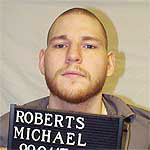
Michael Donald Roberts
Murderer Brian Kevin Rosenfeld
Murderer · USA · 1985
Brian Kevin Rosenfeld Brian Kevin Rosenfeld was sentenced to three concurrent l…
23 victims
Brian Kevin Rosenfeld
Murderer · USA · 1985
Brian Kevin Rosenfeld Brian Kevin Rosenfeld was sentenced to three concurrent l…
23 victims
 Yahweh ben Yahweh
Murderer · USA · 1980
Yahweh ben Yahweh was born and legally named Hulon Mitchell Jr. (October 27, 19…
23 victims
Yahweh ben Yahweh
Murderer · USA · 1980
Yahweh ben Yahweh was born and legally named Hulon Mitchell Jr. (October 27, 19…
23 victims
 Russell Ellwood
Murderer · USA · 1991
Russell Ellwood was a former taxi driver. Authorities suspected him of killing…
20 victims
Russell Ellwood
Murderer · USA · 1991
Russell Ellwood was a former taxi driver. Authorities suspected him of killing…
20 victims
 Robert Martines Perez
Murderer · USA · 1994
Name: Robert Martines Perez · Other name used in proceedings: Robert Martinez P…
15 victims
Robert Martines Perez
Murderer · USA · 1994
Name: Robert Martines Perez · Other name used in proceedings: Robert Martinez P…
15 victims
 Frank Spisak
Serial killer · USA · 1982
Frank W. Spisak Jr. was a transvestite who was wanted to be Hitler. He was friz…
3 victims
Frank Spisak
Serial killer · USA · 1982
Frank W. Spisak Jr. was a transvestite who was wanted to be Hitler. He was friz…
3 victims
 Ronald Fluke
Murderer · USA · 1997
Ronald Dunaway Fluke was convicted of three counts of First Degree Murder in vi…
3 victims
Ronald Fluke
Murderer · USA · 1997
Ronald Dunaway Fluke was convicted of three counts of First Degree Murder in vi…
3 victims
 Wayne Clifford Boden
Serial killer · Canad a · 1969
Wayne Clifford Boden was a Canadian serial killer and rapist active from 1968 t…
4 victims
Wayne Clifford Boden
Serial killer · Canad a · 1969
Wayne Clifford Boden was a Canadian serial killer and rapist active from 1968 t…
4 victims
 Edward Brian Capetillo
Homicide · USA
Edward Brian Capetillo was a Latino male who was 17 years of age at the time of…
1995 victims
Edward Brian Capetillo
Homicide · USA
Edward Brian Capetillo was a Latino male who was 17 years of age at the time of…
1995 victims
 Randy Schoenwetter
Murderer · USA · 2000
Name: Randy Schoenwetter Date of birth: 10/27/81 Eighteenth Judicial Circuit: B…
2 victims
Randy Schoenwetter
Murderer · USA · 2000
Name: Randy Schoenwetter Date of birth: 10/27/81 Eighteenth Judicial Circuit: B…
2 victims
- Gender
- male
- Country
- USA
- Location
- Oklahoma County, Oklahoma, USA
- Date of birth
- August 11, 1957
- Age at first offence
- 31
- Characteristics
- robbery
- Victim profile
- Lula Mae Brooks (female, 80)
- Method of murder
- St abbing with knife
- Date(s) of murder
- January 16, 1988
- Years active
- 1988
- Date of arrest
- —
- Status
-
Executed
Executed by lethal injection on February 10, 2000 in Oklahoma
Case summary
Michael Donald Roberts was executed by lethal injection in Oklahoma on February 10, 2000.
Roberts was convicted of murder for the January 16, 1988 murder of Lula Mae Brooks, 80. Brooks was found dead on the living room floor of her home. Authorities said she drowned in her own blood after being stabbed in the head and neck and that her throat was slit. Prosecutors said the killing occurred during the burglary of her home.
Roberts lived three houses down from Brooks and confessed to the killing in a statement to Oklahoma City police. Roberts also admitted to 19 other burglaries. Attorney General Drew Edmondson called Roberts a "walking crime wave" and said Roberts also confessed to a count of sexual assault. Roberts told police that he entered Brooks' house after he saw the door open. Roberts claimed he stabbed Brooks when she charged at him with a knife, and he said he slit her throat with another knife when she came at him a second time. Roberts said he tossed Brooks on the floor and that she then asked him to "finish the job," authorities said. Police and prosecutors said Brooks had lost too much blood to speak and that Roberts killed Brooks because she could identify him.
Roberts recanted his confession during his trial and said he confessed because detectives offered him a 15-year sentence to clear up the killing and a string of robberies. Police denied the claim.
Prosecutors and police said Roberts killed Brooks to avoid arrest and prosecution because Brooks could identify him.
Timeline
- January 16, 1988 — Lula Mae Brooks, 80, was murdered in her home during a burglary; her throat was slit and she was stabbed in the head and neck.
- January 25, 2000 — The Oklahoma Pardon and Parole Board held a clemency hearing at the Lexington Center; the Board voted 3-1 against recommending clemency.
- February 10, 2000 — Roberts was executed by lethal injection in Oklahoma State Penitentiary; he was pronounced dead at 12:21 a.m.
Investigation
Police said Brooks was murdered in her home during a burglary and that her throat had been slit. After seven or eight days of interrogation, without an attorney present, Roberts confessed to the murder. He later recanted his confession.
Arrest and confession
Roberts confessed to the killing in a statement to Oklahoma City police. He said he entered Brooks' house after he saw the door open. He claimed he stabbed Brooks when she charged at him with a knife and that he slit her throat with another knife when she came at him a second time.
Attorney General Drew Edmondson called Roberts a "walking crime wave" who also confessed to a count of sexual assault.
Roberts recanted his confession during his trial. He said he confessed because detectives offered him a 15-year sentence to clear up the killing and a string of robberies, and police denied the claim.
Trial
Roberts was sentenced to death for the January 16, 1988 murder of Lula Mae Brooks, 80.
A clemency argument discussed custodial confession reliability and loss of evidence later used at trial:
Roberts' attorney, Gary Chubbeck, argued that Roberts' confession was coerced. Chubbeck noted that custodial confessions are notoriously unreliable. He also pointed out that physical evidence, which was used in the trial, had subsequently been lost. If available, this evidence could now be DNA tested and might prove the innocence of Roberts. Chubbeck claimed that the case against Roberts was weaker than the case against Ronald Williamson, who was released from prison last year after DNA evidence cleared him. Williamson had been imprisoned for 12 years, nine of which he spent on death row.
An additional account described prosecution witnesses and lineup issues and stated that fingernail-clippings were inconclusive. It also stated that in one of the three confessions Roberts claimed to have committed twenty other crimes including rape and burglary, and that prosecutors used this to show that he would commit further criminal acts of violence. The account described the "continuing threat to society" aggravating factor leading to the death sentence.
The same account described a prosecution witness who saw a man entering the victim's house on the day of the murder but was unable to identify Roberts in a line-up. It also stated that the defendant's attorney failed to raise the issue on direct appeal. It further stated that some of the state's witnesses for the twenty crimes refused to testify at trial because they were sure their attacker was white, and that only eleven of twenty possible witnesses agreed to take the stand; eight said the criminal they saw was black, one said he was white, and two gave no indication one way or the other.
Sentencing
Appeals and clemency
The U.S. Supreme Court, the 10th U.S. Circuit Court of Appeals, and Gov. Frank Keating all denied requests for a stay of execution or to reconsider earlier appeal denials.
The state Pardon and Parole Board denied Roberts' clemency request.
A clemency hearing held by the Oklahoma Pardon and Parole Board on January 25, 2000, at the Lexington Center resulted in a decision against clemency:
The Board voted against recommending clemency in a 3-1 decision. Susan Bussey voted in favor of clemency. Currie Ballard, Flint Breckinridge and Stephanie Chappelle voted against clemency. Patrick Morgan, a former Oklahoma County prosecutor, recused himself from the proceedings.
Outcome
Roberts was executed by lethal injection in Oklahoma on February 10, 2000, at Oklahoma State Penitentiary shortly after midnight. He was pronounced dead at 12:21 a.m.
Aftermath and related events
Prayer vigils and protests were held in several cities across the state. Approximately 50 people attended the prayer vigil outside the gates of the penitentiary in McAlester.
Attorneys for Roberts, as well as numerous groups and individuals, asked Governor Keating to grant a stay of execution until a study of the death penalty could be carried out in Oklahoma. It was stated that Illinois Governor George Ryan declared a moratorium in that state in part due to the fact that 13 innocent persons had been released from death row. Representative John Sellers of Enid introduced a bill that would impose a two-year moratorium on executions in Oklahoma to allow Oklahoma's death penalty process to be studied. It was stated that, on a per-capita basis, Oklahoma had released the second highest number of inmates from death row, and that Attorney General Drew Edmondson stated:
"I don't support a moratorium because we don't have a problem with the appeals process in Oklahoma."
A total of seven Oklahoma inmates had been exonerated.
Other details
Roberts was described as an Oklahoma County death row inmate and as being executed in 2000; it was also stated he was the 3rd Oklahoma inmate to be executed in 2000 and the 22nd inmate executed since Oklahoma resumed capital punishment in 1977. It was also stated that he was the 13th inmate to be executed nationally that year and the 611th to be executed since 1976.
It was stated that Michael D. Roberts, 42, was executed at Oklahoma State Penitentiary and that he was condemned for the death of Lula Mae Brooks, who drowned in her own blood after being stabbed in her neck and head.
One account stated that a witness for the prosecution saw a man entering the victim's house the day of the murder but was unable to identify Michael Roberts in a line-up. That account also stated that fingernail-clippings of the victim were inconclusive and that Michael's attorney failed to raise the issue on direct appeal.
The same account stated that the defendant had been driven from home at the age of 11 by an abusive stepfather and that he had to fend for himself on the streets from then on. It also stated that Michael Roberts had no relationship to his real father and that his adoptive father died early.
Spotted an error, or have more information about this case?