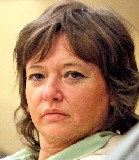
Shawna Forde
Murderer Miranda Barbour
Murderer · USA · 2013
Miranda Barbour, 19, defendant. · Elytte Barbour, 22, defendant and husband of…
100 victims
Miranda Barbour
Murderer · USA · 2013
Miranda Barbour, 19, defendant. · Elytte Barbour, 22, defendant and husband of…
100 victims
 Tiffany Hall
Murderer · USA · 2006
Tiffany Hall was 24 when she was charged in September 2006. She later entered a…
5 victims
Tiffany Hall
Murderer · USA · 2006
Tiffany Hall was 24 when she was charged in September 2006. She later entered a…
5 victims
 Banita Jacks
Murderer · USA · 2007
Banita Jacks was a Washington, DC resident convicted of murdering her four daug…
4 victims
Banita Jacks
Murderer · USA · 2007
Banita Jacks was a Washington, DC resident convicted of murdering her four daug…
4 victims
 Holly Grigsby
Murderer · USA · 2011
Holly Grigsby was sentenced to life in prison without parole on July 15, 2014.…
4 victims
Holly Grigsby
Murderer · USA · 2011
Holly Grigsby was sentenced to life in prison without parole on July 15, 2014.…
4 victims
 Jessica Tata
Murderer · USA · 2011
Jessica Tata was a Houston home day care owner who fled to Nigeria after a fire…
4 victims
Jessica Tata
Murderer · USA · 2011
Jessica Tata was a Houston home day care owner who fled to Nigeria after a fire…
4 victims
 Amanda Bennett
Murderer · USA · 2011
Amanda Bennett was an Indiana woman who shot her three children and set the fam…
3 victims
Amanda Bennett
Murderer · USA · 2011
Amanda Bennett was an Indiana woman who shot her three children and set the fam…
3 victims
 Marlon DeWayne Williams
Murderer · USA · 1993
Marlon DeWayne Williams was a drug dealer. Williams was black. He was 26 when e…
1 victim
Marlon DeWayne Williams
Murderer · USA · 1993
Marlon DeWayne Williams was a drug dealer. Williams was black. He was 26 when e…
1 victim
 Alexander Bedford
Homicide · USA · 2001
April 8, 2005 — Alexander Bedford pleaded guilty to killing his mother, Juanita…
1 victim
Alexander Bedford
Homicide · USA · 2001
April 8, 2005 — Alexander Bedford pleaded guilty to killing his mother, Juanita…
1 victim
 Velma West
Murderer · USA · 1927
Velma West killed her husband, Thomas Edward West. She was a 21-year-old Clevel…
1 victim
Velma West
Murderer · USA · 1927
Velma West killed her husband, Thomas Edward West. She was a 21-year-old Clevel…
1 victim
 James Hunt
Murderer · USA · 2004
James Hunt was sentenced to death on July 28, 2006 in Floyd County for Burglary…
1 victim
James Hunt
Murderer · USA · 2004
James Hunt was sentenced to death on July 28, 2006 in Floyd County for Burglary…
1 victim
 Colin Richard Forman
Mass murderer · Australia · 1977
5 January 1977 — Colin Richard Forman carried out an aircraft suicide attack at…
4 victims
Colin Richard Forman
Mass murderer · Australia · 1977
5 January 1977 — Colin Richard Forman carried out an aircraft suicide attack at…
4 victims
- Gender
- female
- Country
- USA
- Location
- Arivaca, Pima County, Arizona, USA
- Date of birth
- December 6, 1967
- Age at first offence
- 42
- Characteristics
- convicted rapist, domestic violence, drugs, kidnapping, robbery, fugitive, hate crime, armed robbery, member of the "texas seven, mentally ill, mentally retarded, juvenile, juvenile (12), juvenile (13), juvenile (14), juvenile (15), juvenile (16), juvenile (17), serial rapist, sexual abuse, to avoid arrest, to collect insurance money
- Victim profile
- Raul "Junior" Flores, 29, and his daughter, Brisenia, 9
- Method of murder
- Shooting
- Date(s) of murder
- May 30, 2009
- Years active
- 2009
- Date of arrest
- —
- Status
-
Sentenced to death
Sentenced to death on February 22, 2011
Case information
Shawna Forde was sentenced to death on February 22, 2011. She was convicted of first-degree murder and other charges in connection with the May 2009 home invasion in Arivaca, a desert community about 10 miles north of Mexico, in which Raul “Junior” Flores, 29, and his daughter Brisenia Flores, 9, were killed. The case involved an attempted murder of Gina Marie Gonzalez, 31, and convictions for aggravated assault, burglary, armed robbery, and aggravated robbery.
Status
Shawna Forde was found guilty on February 14, 2011, and was sentenced to death on February 22, 2011 by a Tucson jury, becoming the 3rd woman on Arizona’s death row.
Timeline
- May 30, 2009 — Raul “Junior” Flores, 29, and his daughter Brisenia, 9, were murdered during a home-invasion by Shawna Forde and accomplices in Arivaca, Arizona. Gina Marie Gonzalez, 31, was attacked and survived.
- June 13, 2009 — Shawna Forde, then 41, and two associates were charged with two counts of first-degree murder, one count of first-degree burglary and one count of aggravated assault.
- June 17, 2009 — Officials released a tape of a 911 call made during the May 30 home-invasion robbery, and violence was described as leading to first-degree murder charges for Forde.
- January 2008 — Forde accused members of a drug cartel of sexually assaulting and shooting her; the case was closed due to insufficient evidence.
- February 14, 2011 — Shawna Forde was found guilty of all eight counts for which she was being prosecuted, including two counts of first degree murder, one count of attempted first degree murder, two counts of aggravated assault, and one count each of burglary, armed robbery, and aggravated robbery.
- February 22, 2011 — Shawna Forde was sentenced to death by a Tucson jury.
The offence
On May 30, 2009, Raul “Junior” Flores, 29, and his daughter Brisenia Flores, 9, of Arivaca, Arizona, were murdered during a home-invasion. Gina Marie Gonzalez, 31, Junior’s wife, was in the home during the attack and survived.
Home-invasion and killings
Forde and her accomplices forced entry by posing as law enforcement officers looking for a fugitive. Raul Flores was shot and killed, and Gonzalez was wounded in the leg during gunfire. Later, Brisenia was shot and killed. One Flores daughter, 12, had been at her grandmother’s home in Sahuarita, Arizona, during the attack.
An early exchange within the 911 call was as follows:
- Gonzalez: “They shot me and I pretended like I was dead. My daughter was crying. They shot her, too. Operator: "Are they still there, the people who, that shot them?" Gonzalez: "They're coming back in! They're coming back in!" (Gunfire.)”
During the trial-related account of the 911 tape, an injured woman described the attackers as having been dressed in camouflage clothing, including:
- “a tall man with his faced painted black”
- another as tall and “Mexican”
- and “a shorter, fat woman” who was white
The victim described being shot, getting a handgun, and driving the attackers away, after which the attackers returned while she was on the phone with the emergency dispatcher. Gunfire and shouts were captured on the tape, and she said her husband and her daughter were shot multiple times. She asked the dispatcher if she could be in trouble for shooting the intruders. The dispatcher reassured her. The victim said she was “really scared they're going to come back.”
Motive and claimed purpose of the raid
Prosecutors said Forde and accomplices considered Raul Flores a drug smuggler and wanted to use his drug proceeds for a paramilitary organization to seal off the border to immigrants. Prosecutors portrayed Forde as the ringleader and said she planned the raid and murders to steal weapons, money and drugs to finance a new anti-illegal immigration outfit.
Defense arguments included that Gonzalez could not positively identify Forde as the woman who invaded her home, and that prosecutors had no direct evidence that Forde was even there that day, with no fingerprints or DNA found to tie Forde to the murders.
Authorities also presented evidence that Forde had attempted to recruit people to go after drug dealers, including text messages left on her phone. Authorities also presented jewelry that belonged to Gonzalez found in Forde’s possession. Prosecutors said Flores had a history of drug-related offenses, but “no drugs were found in the house.”
Forde maintained her innocence and said the investigation involved racial profiling and improper investigatory work. Forde also claimed that she believed Raul Flores was involved with drug dealing and that she had planned to use stolen money to fund her border vigilante group.
Investigation and evidence
Pima County Sheriff Clarence Dupnik said the attackers hoped to rob the Flores-Gonzalez family and that Forde planned and ordered the murder of Junior Flores.
During the release of the 911 tape in June 2009, officials described that the victim told dispatchers the attackers had forced their way into her home by claiming to be law enforcement officers looking for a fugitive, and she provided physical descriptions of the attackers.
Authorities alleged the home invasion and killings were planned by Forde as part of a scheme to get drugs and money to fund her border-watch group, Minutemen American Defense. Prosecutors also presented evidence including:
- text messages left on her phone
- jewelry that belonged to Gonzalez found in Forde’s possession
During trial accounts described in the case summary, the defense said there were no fingerprints in the home and no DNA tying Forde to the murders.
People involved
Victims
- Raul “Junior” Flores (29) — killed in Arivaca, Arizona.
- Brisenia Flores (9) — killed in Arivaca, Arizona.
- Gina Marie Gonzalez (31) — shot and wounded in the leg; survived and was the only witness described in the case accounts.
A Flores daughter, 12, was at her grandmother’s home in Sahuarita, Arizona, during the attack.
Defendant
Shawna Forde (43; born December 6, 1967; age 44 in some accounts) was convicted and sentenced to death. She was a member of the anti-illegal immigration group Minutemen Civil Defense Corps and later founded and served as Executive Director for a splinter group, Minutemen American Defense (M.A.D.), to pursue political goals.
Forde’s supporters and Forde maintained she was innocent, citing racial profiling and improper investigatory work.
Forde was portrayed in some accounts as having served time in juvenile lock-ups for repeated convictions involving theft, burglary and prostitution. She was described as having been involved in vigilantism since 2007 and being removed from Minutemen Civil Defense Corps in February 2007 after members described her as “unstable.” Forde later founded Minutemen American Defense, which had 14 members at the time of the raid on the Flores family residency. Forde also unsuccessfully ran for a seat on the Everett, Washington City Council in 2007.
Forde also had several run-ins with law enforcement prior to her arrest for the double murder. In 1989, her boyfriend sought court protection from her, claiming she physically attacked him and threatened to hurt herself with a knife. In 2007, she was charged with theft, which she described as a misunderstanding. While running for the Everett City Council, her son was convicted of assaulting her employer.
In January 2008, she accused members of a drug cartel of sexually assaulting and shooting her; she later suggested the alleged culprits were actually criminal associates of her son. Her brother alleged she fabricated the story, and authorities closed the case due to insufficient evidence.
Forde had been involved in the “Minuteman” movement, had protests and armed border patrolling described, and had formed more extreme activity through Minutemen American Defense.
In one statement reproduced in the case accounts, Forde wrote in an e-mail message to supporters: “I will stay the course and lead in this fight with every once (sic) of strength and conviction I have,” she wrote. “I will not waist (sic) it on matters that do not pertain to this very mission. It is time for Americans to lock and load.”
During the arrest proceedings described, Forde said: “No, I did not do it,” the newspaper quoted her as she was led out of the sheriff’s office in front of reporters.
Accomplices and other named individuals
Jason Eugene “Gunny” Bush (born August 11, 1974; age 38 in one account) — Meadview, Arizona; described as M.A.D.’s National Director of Operations and Forde’s second in command. He was shot in the leg during the same time frame as the attack. Bush had ties to the Aryan Nation and was also charged in June 2009 with the 1997 murder of Hector Lopez Partida in Wenatchee, Washington. Bush was also charged with the September 1997 execution-style killing of his Aryan Nation associate, Jonathan Bumstead, also of Wenatchee, Washington, for supposedly committing the “crime” of “being a 'race-traitor'”.
After he was released in 2003, Bush moved to Sandpoint, Idaho, where he lived until 2007. He was suspected in at least 2 additional killings in the latter part of 1997. Information provided to Washington state detectives alleged that on two separate instances Bush showed up at acquaintances’ residences covered in blood and asked to be allowed to clean up, saying he had “just finished taking care of some business.” Detectives were attempting to find any links to unresolved cases.
In one account, Bush was described as being charged quietly with second-degree murder in the 1997 stabbing and beating death of a Hispanic man from Wenatchee.
Albert Robert Gaxiola (born February 9, 1967; age 45 in one account) — of Arivaca, Arizona; described as believed to have provided intelligence about drug activities in the area to M.A.D. Gaxiola had been imprisoned on marijuana charges from 1992 to 2000. According to Gonzalez, Gaxiola and Flores had an ongoing dispute originating in 2008 over marijuana belonging to Gaxiola stored at Flores’s residence. Gaxiola was found guilty of the murders and sentenced to life without parole plus 54 years.
Other officials and witnesses
- Pima County Sheriff Clarence Dupnik — said the attackers hoped to rob the Flores-Gonzalez family; said Forde planned and ordered the murder of Junior Flores.
- DEA head of Tucson office Anthony Coulson — told the Arizona Daily Star: “Raul Flores was a drug-trafficker.”
- Detective Jimmy Gilchrist — identified as president of the California-based Minuteman Project in one account; he posted condolence and said his group was separate and that “we disassociate any affiliation between her, her organization and ours.”
- Jeff Schwilk — described as founder of San Diego Minutemen and a critic of Gilchrist; he said the warning had been out in Arizona to stay away from Forde and quoted: “The warning had been out in Arizona to stay away from this woman,” and “Unfortunately, this conclusion was very tragic.”
- Jesus Romo — civil rights attorney; believed the verdict and Barnett lawsuit would deter extreme border vigilante groups and quoted: “If we link this verdict with the civil cases I think it’s going to affect the Minutemen because their impunity is chipping away,” and “On the one hand, criminal justice is taking care of convicting some of them and on the other through the civil cases we are hitting their pocket book,” he added.
- Marilyn Mayo of the Anti-Defamation League (ADL) — quoted: “She came onto our radar because she was increasingly taking more extreme action,” and “She came onto our radar because she was increasingly taking more extreme action.”
- Isabel Garcia — director of Derechos Humanos, quoted: “This is the start of a positive path for our state,”
- Carlos Galindo — pro-immigrant activist and talk show host on Radio KAZA; said the community was more progressive than in Maricopa County and described Maricopa County as a “petri dish” of hateful acts.
- Pima County attorneys Rick Unklesbay and Kelly Johnson — presented evidence that Forde had attempted to recruit people to go after drug dealers.
- Defense attorneys Eric Larsen and Jill Thorpe — argued Gonzalez could not positively identify Forde and that prosecutors had no direct evidence linking Forde to the murders.
- Jill Thorpe — argued Forde suffered a stroke that resulted in brain damage impacting judgment, leaving her open to manipulation; also argued she had suffered sexual and physical abuse from one of her husbands.
- Gunny Bush and Albert Gaxiola were identified by name in descriptions of the attack.
Charges and verdict
On February 14, 2011, Shawna Forde was found guilty of all eight counts for which she was being prosecuted:
- two counts of first degree murder for Raul and Brisenia
- one count of attempted first degree murder for Brisenia’s mother, Gina Gonzalez
- two counts of aggravated assault
- one count each of burglary, armed robbery, and aggravated robbery
During the trial stage described, she had pleaded not guilty to the charges of first-degree murder, attempted first-degree murder and home-invasion.
In other counts described during pre-sentencing reporting, a jury convicted Forde on eight counts including:
- two counts of murder for the shooting deaths of Raul Flores and his daughter Brisenia
- the attempted murder of Brisenia’s mother, Gina Gonzales
Sentencing
On February 22, 2011, a Tucson jury sentenced Shawna Forde to death. The sentencing made her the 3rd woman on Arizona’s death row.
Before the jury imposed the death penalty, defense arguments were presented to spare her life, including claims that she suffered sexual and physical abuse from one of her husbands and that she suffered a stroke resulting in brain damage affecting judgment and making her vulnerable to manipulation.
Prosecutors presented arguments that challenged her moral character, and additional statements during the trial accounts said prosecutors aimed to present evidence including text messages and other material linking her to the offense.
Appeals
No appeals information appeared in the provided case material.
Outcome and related proceedings
- Albert Robert Gaxiola was found guilty of the murders and sentenced to life without parole plus 54 years.
- Jason Eugene “Gunny” Bush was described as to be tried later and could also be sentenced to death if found guilty in the later proceedings described in the case material.
Other details
Arrest and pretrial information
Forde was arrested without incident in Sierra Vista, a few miles from the Mexican border, in connection with the charges.
Prosecutors said Forde and accomplices picked the Flores home because of a claim made by Gaxiola they would find drugs there. Flores had a history of drug-related offenses, but no drugs were found in the house.
Gonzales called 911 during moments when the assailants were away from the home and described that the attackers were coming back in. During the attack, Gonzalez fired a handgun of her husband’s, wounding one of the assailants.
Organization and alleged funding aims
Minutemen American Defense (M.A.D.) was described as a militant nativist splinter group founded in the late 2000s by Forde after she was expelled from Minutemen Civil Defense Corps.
Various Forde family members and some associates said that Forde began to rob presumed drug dealers in 2009 to raise funds to benefit her vigilante group. A former member described M.A.D. as having about 14 members and said Forde termed its covert missions “Delta One Operations.”
Forde intended to fund the purchase of a 40-acre (16 ha) property in southern Arizona to establish a base for her group’s border operations.
Prior and family history referenced in the case material
Forde’s run-ins with law enforcement included juvenile convictions for felonies, prostitution and other street crime, and court records showing that she served time in juvenile lock-ups for repeated convictions involving theft, burglary and prostitution.
She had married four times.
Her boyfriend in 1989 sought court protection from her, claiming she physically attacked him and threatened to hurt herself with a knife.
Her son’s conviction for assaulting her employer was mentioned during the 2007 City Council campaign period.
In January 2008, allegations were described involving accusations against a drug cartel for sexually assaulting and shooting her, followed by later statements shifting who she claimed were responsible and the case closure due to insufficient evidence after her brother alleged she fabricated the story.
In one account, her ex-husband was seriously wounded during a Dec. 22 shooting in Everett, and she was found in a north Everett alley on Jan. 15 with apparent gunshot wounds; Everett police Sgt. Robert Goetz was quoted as saying they were investigating and working with Arizona officials.
Additional described investigative leads involving group activity
In June 2009 reporting, police were investigating whether members of the group also committed a home invasion in Northern California. Police continued to investigate the Dec. 22 shooting of Forde’s ex-husband at the home they'd earlier shared and her Jan. 15 shooting in a north Everett alley.
Detectives in Everett were working with Arizona officials since before Forde’s arrest, and Goetz said: “We are taking the information that Arizona has to see if any of it is helpful to any of our cases,” and “So far, he said, no firm suspects have emerged in the Everett cases involving Forde.”
Contested claims and allegations about the case
Forde and supporters maintained her innocence and claimed racial profiling and improper investigatory work. Defense attorneys argued Gonzalez could not positively identify Forde and that prosecutors had no direct evidence of Forde’s presence at the home, with no fingerprints or DNA to tie her to the murders.
Authorities presented evidence including text messages, attempted recruitment, and jewelry found in her possession.
Forde alleged that she was the promoter of a grunge rock band and worked as a youth counselor, aircraft factory worker, and as a cosmetologist and esthetician, and she had been removed from Minutemen Civil Defense Corps after members described her as “unstable.”
Quotes from the case material attributed to individuals
- Forde quoted during arrest proceedings: “No, I did not do it,”
- Forde e-mail message to supporters: “I will stay the course and lead in this fight with every once (sic) of strength and conviction I have,” “I will not waist (sic) it on matters that do not pertain to this very mission.
- Anthony Coulson (DEA) quote: “Raul Flores was a drug-trafficker.”
- Isabel Garcia quote: “This is the start of a positive path for our state,”
- Jim Gilchrist quote: “we disassociate any affiliation between her, her organization and ours.”
- Jeff Schwilk quote: “The warning had been out in Arizona to stay away from this woman,” and “Unfortunately, this conclusion was very tragic.”
- Jesus Romo quotes: “If we link this verdict with the civil cases I think it’s going to affect the Minutemen because their impunity is chipping away," and “On the one hand, criminal justice is taking care of convicting some of them and on the other through the civil cases we are hitting their pocket book,”
- Marilyn Mayo quote: “She came onto our radar because she was increasingly taking more extreme action,”
- Mike O’Connor statement attributed in the case material about Raul Flores connections: “People in the Minuteman movement reacted to news of the arrests with sadness -- and some contempt for Forde.”
- Detective quote attributed to Everett police Sgt. Robert Goetz: “We are taking the information that Arizona has to see if any of it is helpful to any of our cases,” and “So far, he said, no firm suspects have emerged in the Everett cases involving Forde.”
- Caudle quote attributed in the case material: “She was going to kick in their doors and take away the money and the drugs.”
- Caudle quote attributed in the case material describing Forde’s call: “She says, 'I'm in hiding.' I said, 'What is going on?' She said. 'You won't believe what is going down here … The mafia, they are kicking down doors and they are shooting people and they are looking for me.'”
- Clarence Dupnik quote included in the case material as summary of his statements: “Forde was trying right up until her arrest Friday "to get together a large amount of money to further sophisticate the type of operation she's interested in."”

Spotted an error, or have more information about this case?