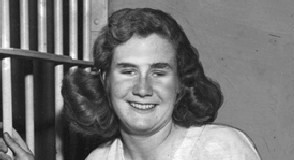
Beulah Louise Overell
Homicide? Robert Allen Weitzel
Homicide? · USA · 1995
Robert Allen Weitzel was a psychiatrist charged in relation to the deaths of fi…
5 victims
Robert Allen Weitzel
Homicide? · USA · 1995
Robert Allen Weitzel was a psychiatrist charged in relation to the deaths of fi…
5 victims
 Nannie Doss
Serial killer · USA · 1954
Nannie Doss Nannie Doss pleaded guilty on May 17, 1955, and was sentenced to li…
11 victims
Nannie Doss
Serial killer · USA · 1954
Nannie Doss Nannie Doss pleaded guilty on May 17, 1955, and was sentenced to li…
11 victims
 Marie Noe
Murderer · USA · 1949
Marie Noe was convicted in June 1999 of murdering eight of her children. Betwee…
8 victims
Marie Noe
Murderer · USA · 1949
Marie Noe was convicted in June 1999 of murdering eight of her children. Betwee…
8 victims
 Constance Fisher
Homicide · USA · 1954
Constance Fisher · 3 August 1954 — Constance Fisher drowned her three children…
6 victims
Constance Fisher
Homicide · USA · 1954
Constance Fisher · 3 August 1954 — Constance Fisher drowned her three children…
6 victims
 Robert Cordell
Murderer · USA · 2002
Robert Cordell was an Ohio man who pleaded guilty and was sentenced to 81 years…
3 victims
Robert Cordell
Murderer · USA · 2002
Robert Cordell was an Ohio man who pleaded guilty and was sentenced to 81 years…
3 victims
 Michael McLendon
Spree killer · USA · 2009
Michael McLendon died of self-inflicted gunshot wound after shootout with autho…
10 victims
Michael McLendon
Spree killer · USA · 2009
Michael McLendon died of self-inflicted gunshot wound after shootout with autho…
10 victims
 John Zawahri
Mass murderer · USA · 2013
John Zawahri carried out a killing spree in Santa Monica, California, on 7 June…
5 victims
John Zawahri
Mass murderer · USA · 2013
John Zawahri carried out a killing spree in Santa Monica, California, on 7 June…
5 victims
 Perry Alexander Taylor
Murderer · USA · 1988
Perry Alexander Taylor was convicted and sentenced to death for the murder of G…
1 victim
Perry Alexander Taylor
Murderer · USA · 1988
Perry Alexander Taylor was convicted and sentenced to death for the murder of G…
1 victim
 Robert Lee Yates
Serial killer · USA · 1975
Robert Lee Yates Jr. (born May 27, 1952) was an American serial killer from Spo…
18 victims
Robert Lee Yates
Serial killer · USA · 1975
Robert Lee Yates Jr. (born May 27, 1952) was an American serial killer from Spo…
18 victims
- Gender
- female
- Country
- USA
- Location
- Newport Harbor, Orange County, California, USA
- Date of birth
- 1929
- Age at first offence
- 18
- Characteristics
- juvenile (17), abduction
- Victim profile
- Walter E. Overell, 62, and his wife Beulah, 57 (her parents)
- Method of murder
- Beating with a ballpeen hammer - Bomb ( dynamite)
- Date(s) of murder
- March 15, 1947
- Years active
- 1947
- Date of arrest
- Next day
- Status
-
Acquitted / overturned
Not guilty (jury verdict announced on October 5, 1947 after 19 weeks of trial)
Overview
Beulah Louise Overell was charged with the homicide of her parents after a yacht explosion in Newport Harbor killed Walter E. Overell and his wife. Overell and her boyfriend George “Bud” Gollum were named as defendants in the case brought before Judge Kenneth Morrison, and after a five-month trial Overell and Gollum were acquitted.
Timeline
- March 15, 1947 — Beulah Louise Overell and her fiancé, 21-year-old George Gollum, stood on shore while the Mary E., a 47-foot yacht moored in Newport Harbor, exploded; their parents, wealthy financier Walter E. Overell and his wife, were aboard.
- March 19, 1947 — Beulah Louise Overell and Bud returned to Newport Beach to retrieve the family automobile from the police; Newport Beach Police Chief H. R. Hodgkinson placed the couple under arrest on suspicion of murder.
- May 26, 1947 — The trial commenced in Santa Ana Superior Court, Judge Kenneth E. Morrison presiding.
- June 25, 1947 — Proceedings included an assault story told by juror Mrs. Uvon Putnam.
- August 12, 1947 — Millicent Naylor, a New Jersey secretary, visited the trial.
- October 5, 1947 — After 19 weeks of trial, the jury announced a verdict of not guilty; the courthouse and surrounding area were crowded with spectators.
Background
Walter E. Overell and his wife owned the yacht Mary E. in Los Angeles, and the couple’s deaths occurred during the explosion of the yacht while it was moored in Newport Harbor. Their daughter Beulah Louise Overell and her boyfriend George “Bud” Gollum became prime suspects after the explosion.
The prosecution and media coverage centered on the alleged plan to cover up the crime by dynamiting the yacht. The trial was described as the longest in Orange County history and also as the longest criminal trial in United States’ history at the time.
The offence
The Mary E., a 47-foot yacht moored in Newport Harbor, exploded and sank, killing Walter E. Overell and his wife. Beulah Louise Overell and George Gollum had escaped the blast because they had gone ashore about half an hour earlier for a late-night snack, including hamburgers.
Investigators found dynamite and related materials connected to the blast. A clock attached to the boat’s battery was reported to have been stopped at 11:46 P.M., the moment of the explosion, and investigators said a clock-based timing device detonated explosives on board. The prosecution also pointed to heavy support posts called stanchions, described as used to beat Walter Overell before his death, and described that Walter Overell had been impaled on a plank while his wife died of multiple skull fractures. A ball-peen hammer was described as fitting neatly into wounds on Mrs. Overell’s skull.
The defence advanced theories including that Walter Overell may have accidentally set off the explosion himself, or that the yacht blew up due to gas fumes, and a theory that the deaths could have involved a murder-suicide.
Investigation
Orange County Sheriff James Musick announced evidence to the press, including that 31 unexploded sticks of Trojan Brand dynamite had been found on board the Mary E, along with detonators, lengths of electrical wire and adhesive tape, and an alarm clock rigged as a timing device with hands stopped at 11:46 P.M. The sheriff speculated that the explosive may have been rigged by an amateur who did not realize each dynamite stick required its own individual blasting cap to explode.
Newport Beach Police Chief H. R. Hodgkinson later placed Overell and Gollum under arrest on suspicion of murder. Newport Beach Police Captain Harry Lace was described as the officer in charge of the investigation.
Coroner’s autopsies were described as revealing multiple skull fractures delivered by the same implement, with a second autopsy conducted after burial and a third autopsy refused by the court. The autopsy report also stated there was no water in the lungs of the victims, indicating they may have died prior to the sinking of the vessel. The coroner could not determine whether the fractures had been the cause of death, although they seemed to correspond with a ball-peen hammer found on board the Mary E.
Arrest
After the explosion and after the couple returned to Newport Beach to retrieve the family automobile from the police, Newport Beach Police Chief H. R. Hodgkinson placed Beulah Louise Overell and her boyfriend George “Bud” Gollum under arrest on suspicion of murder.
Trial
Court and parties
Beulah Louise Overell and George Gollum were charged with homicide and ordered to stand trial before Judge Kenneth Morrison in Santa Ana Superior Court. The prosecution included Eugene Williams, described as an Assistant U.S. Attorney General and special prosecutor, and the defence team included Otto Jacobs and Z. B. West for Overell and S. B. Kaufman and W. B. Berne for Gollum.
The jury was described as consisting of six men and six women, with jury selection involving five weeks and 567 prospective jurors. The jury deliberated for 19 weeks.
Prosecutor’s opening statement
Eugene Williams told the jury in his opening statement:
“We have lust, we have greed, we have frustration. Ladies and gentlemen, these are the raw materials out of which murders are made.”
During trial, the prosecution characterized the defendants as enjoying an illicit, perverted, sadistic sexual passion amounting to frenzy. Williams told the court:
“The defendants enjoyed an illicit, perverted, sadistic sexual passion amounting almost to frenzy,” special prosecutor Eugene Williams told the court. “Lust, greed, frustration. Ladies and gentlemen, these are the raw materials of which murders are made.”
In connection with the love letters, one prosecutor said:
“We find lust, lust and more lust . . . greed, greed and more greed . . . perversion and continuing perversion . . . money . . . jealousy . . . thoughts of suicide and jailbreak . . . ”We find a passion so strong that it transcends all morals. But do we find any expression whatever of innocence? Any expression whatever of horror? No!”
Love letters and jail correspondence
The Los Angeles Examiner obtained private love letters written by Overell and Gollum while they were in jail. The letters included plans for jailbreak with a map.
George wrote to Beulah:
“I'll kidnap and carry you off somewhere so that no one will ever be able to find us and there I'll make passionate and violent love to you. If you ever marry another person, I will kill him,”
Beulah wrote to George:
“O my darling, O my pops, popsie, darling, my beautiful, handsome, intelligent pops, I adore you always, eternally...”
Additional letters were described as including a promise to marry if the recipient was broke. One letter included:
“Would you still marry me if I were broke? Oh Pops darling, please promise you will marry me,”
Another letter included:
“You're an uplifted human being. You're the most intelligent person I ever heard of. Einstein was a moron compared to you. . . . Yes, sir, you're the object of my adoration and the creature of my determination.”
A letter from Gollum included:
" . . . If you ever leave me or are unfaithful to me or stop loving me, I will take that overdose of sleeping pills. After I have killed the man you turned to from me. That is a promise. . . ."
Jacobs argued that the couple were entrapped into writing the letters so that they would fall into the hands of the prosecutors and be used against them.
Evidence and forensic testimony
Investigators found 32 sticks of dynamite on the yacht with a clock attached to the boat’s battery in one account, while another account stated 31 sticks of unexploded dynamite were found on board. The prosecution presented photographs and forensic evidence.
Prosecution witnesses included:
- A local mortician, described as receiving and embalming the bodies at Baltz Mortuary at 2:45 A.M., March 16, and testifying that he believed the bodies had been dead for approximately six hours at the time he first saw them; he also testified that Mr. Overell’s clothing “reeked of gasoline.”
- Lawrence Mathes, described as chief resident surgeon of the Orange County Hospital and acting county coroner, who testified that the Overells’ death resulted from multiple skull fractures occurring before the explosion and who identified a metal rod, approximately 3 inches in diameter, as the probable murder weapon.
- Ray Pinker, described as a Los Angeles County Police Department forensic chemist.
A prosecution expert testified that he found a unique hard-to-find screw in Gollum’s car that could only have come from the clock used in the explosion. During cross-examination, Jacobs went to a local jewelry store and bought a barrel of the screws; he then pulled a handful of the screws out and tossed them over the courtroom in a theatrical move to refute the testimony.
The defence also criticized medical examinations and challenged the prosecution’s timeline and interpretation of bodily injuries.
Defence case and theories
Otto Jacobs entered pleas of Not Guilty and Not Guilty By Reason of Insanity. The defence theory included that Walter Overell, depressed by financial reverses, asked Gollum to purchase dynamite to use in a suicide attempt, that the dynamite exploded prematurely, and that the prosecution was motivated not by a desire for justice but by the political ambition of California State Attorney General Fred Howser.
Defense counsel Otto Jacobs took the position that the evidence did not establish that Mrs. Overell had been attacked with a ball peen hammer and did not establish that a stanchion from the boat—allegedly the murder weapon used on Walter Overell—had been removed from the vessel.
Juror incident
On June 25, proceedings included testimony from juror Mrs. Uvon Putnam about an assault at her Balboa Island home. She described that an unidentified man with dark hair forced entry, beat her, and threatened her with:
“This isn’t all you’ll get if you find those kids guilty.”
Putnam could give no clues to the identity of the man at first. A known associate of Bud Gollum, Edward Louis Davis, was identified from a photograph, but Davis was never located and there was no evidence he was in California at the time of the assault. Defence counsel issued a statement denying any implication in the assault, suggesting it might have been an attempt by the prosecution to discredit the defence. A private speculation described that Putnam might have acquired her injuries in a domestic dispute.
Trial publicity
The trial attracted large crowds, daily press coverage, and radio broadcasts. Microphones concealed in the courtroom and in the judge’s chambers broadcast the trial.
Millicent Naylor, a New Jersey secretary vacationing in Southern California, visited the trial and told reporters she had come to see the show. Two photographs were published in the September 1 issue of Life magazine.
Adela Rogers St. Johns wrote columns about the trial, including commentary about Overell’s appearance and discussion of the jury selection atmosphere. She wrote:
“I came to see whether these two of our children could be guilty of such a crime and if so were we, as a civilization, guilty too. Or to see if some touchstone of truth guards and protects their very youth. . . . But the first thing that freezes you in your chair ... is that there is no youth in them. . . .”
and:
“Louise . . . you ought not to sit there in a bright, striped blue-green dress with your arms bare to the shoulder . . . your arms aren't your best point . . . they look too strong.”
She also wrote about the jury selection process:
“These are the doldrums of jury selection. . . . Through the jammed courtroom you can feel a thought sweeping. What are we doing here? What's the matter with our world . . .? What's the matter with everybody?”
Sentencing
No sentencing was imposed because the jury returned acquittals.
Appeals
No appeal history was provided.
Outcome
After 19 weeks of trial, with 107 witnesses and over one million words of testimony filling nearly 6,000 pages, the jury announced verdicts of not guilty on October 5, 1947. The verdict was read in a crowded courtroom with spectators who spilled into hallways and outside onto the courthouse lawn. People cheered and yelled despite Judge Morrison’s efforts to keep them quiet, and the verdict was described as “not guilty.”
Aftermath
New regulations were enacted regarding the sale and purchase of explosives as a result of the case.
After the acquittal, a reporter asked Overell whether she still planned to marry George Gollum; she answered “no.” George Gollum responded: “We'll see.”
The fortune was described as being revealed a year later as less than originally estimated. Overell later married twice, moved to Las Vegas, and drifted into drink.
Overell was found dead in 1965 in her bed in her Las Vegas home, with two empty quart bottles of vodka near her head and a loaded, unfired rifle at her feet. Acute alcoholism was ruled the cause of death, and the official death certificate read “death by mischance.”
George Gollum later served prison time after being caught while riding with another fellow “who was in a car that wasn't his,” spending nine months in the federal penitentiary in Tallahassee. He later said he eventually earned a Ph.D. in biophysics and that he declined to disclose where he earned the degree, entering school under an assumed name. He worked for a company involved in development of “over-the-shoulder toss weapons,” describing it as an early nuclear device for the Navy, and he left the field about 1970 for reasons including that he did not like his involvement in nuclear weapons.
Gollum’s later life was described as involving buying up large chunks of real estate and residing on 640 acres in a small town in the Sierra Nevada near Lake Tahoe, where he enjoyed piloting small aircraft, fishing, and photography.
Other details
Beulah Louise Overell was described as 17 years old at the time of the explosion in one account and as an only child. She was described as 5 feet 6 inches tall and 155 pounds, with brown hair; she was described as a journalism major. She was also described in another account as a 17-year-old heiress and as the sole heir to her parents’ fortune.
George “Bud” Gollum was described as 21 years old, 6 feet 2 inches tall, and 220 pounds, and as handsome. He was described as a returned Pacific War hero who received the Bronze Star for bravery during the battle of the Leyte Gulf and as a pre-med student at Los Angeles City College.
The Overell-Gollum trial involved courtroom dramatics, including the screw demonstration described above. It was also described as involving out-of-courtroom dramatics, including intercepted and published jailhouse love letters.
A grand jury returned unanimous indictments of murder against the accused couple on March 26, as described in one account.
The prosecution team included discussion that California State Attorney General Fred Howser removed Orange County District Attorney Davis from the prosecution on April 4 and took over the prosecution himself, naming Eugene Williams as Special Prosecutor.
Spotted an error, or have more information about this case?