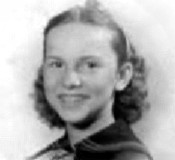
Constance Fisher
Homicide Cheryl Crane
Homicide · USA · 1958
Cheryl Christina Crane (born July 25, 1943) was the only child of actress Lana…
1 victim
Cheryl Crane
Homicide · USA · 1958
Cheryl Christina Crane (born July 25, 1943) was the only child of actress Lana…
1 victim
 Lena Baker
Homicide · USA · 1944
Lena Baker was born on June 8, 1901, and was executed on March 5, 1945. She was…
1 victim
Lena Baker
Homicide · USA · 1944
Lena Baker was born on June 8, 1901, and was executed on March 5, 1945. She was…
1 victim
 Andrea Yates
Homicide · USA · 2001
Andrea Pia Yates (born Andrea Pia Kennedy on July 2, 1964) was a former Houston…
5 victims
Andrea Yates
Homicide · USA · 2001
Andrea Pia Yates (born Andrea Pia Kennedy on July 2, 1964) was a former Houston…
5 victims
 Christine Falling
Homicide · USA · 1980
Christine Falling (1980-1982) was a 17-year-old babysitter from Perry, Florida.…
5 victims
Christine Falling
Homicide · USA · 1980
Christine Falling (1980-1982) was a 17-year-old babysitter from Perry, Florida.…
5 victims
 Coleen Thompson
Homicide · USA · 2002
Coleen Thompson was a former intensive care nurse at Shady Grove Adventist Hosp…
5 victims
Coleen Thompson
Homicide · USA · 2002
Coleen Thompson was a former intensive care nurse at Shady Grove Adventist Hosp…
5 victims
 Obie Weathers
Murderer · USA · 2000
Name: Obie Weathers · TDCJ number: 999396 · Date of birth: 08/11/1981 · Age at…
1 victim
Obie Weathers
Murderer · USA · 2000
Name: Obie Weathers · TDCJ number: 999396 · Date of birth: 08/11/1981 · Age at…
1 victim
 Tracy Garrison
Murderer · USA · 2001
Tracy Garrison was convicted of first degree murder in 2004. She was sentenced…
1 victim
Tracy Garrison
Murderer · USA · 2001
Tracy Garrison was convicted of first degree murder in 2004. She was sentenced…
1 victim
 Kelly Lamont Rogers
Murderer · USA · 1990
Kelly Lamont Rogers was executed by lethal injection in Oklahoma on March 23, 2…
1 victim
Kelly Lamont Rogers
Murderer · USA · 1990
Kelly Lamont Rogers was executed by lethal injection in Oklahoma on March 23, 2…
1 victim
 Olesya Mostovschikova
Murderer · Russia · 2009
Olesya Mostovschikova was a 27-year-old woman who was arrested in Russia after…
1 victim
Olesya Mostovschikova
Murderer · Russia · 2009
Olesya Mostovschikova was a 27-year-old woman who was arrested in Russia after…
1 victim
- Gender
- female
- Country
- USA
- Location
- Waterville, Kennebeck County, Maine, USA
- Date of birth
- 1929
- Age at first offence
- 25
- Characteristics
- history of mental illness, child abuse
- Victim profile
- H er children Richard, 6, Daniel, 4, and Deborah, 1 / Her children Kathleen, 6, Michael, 4, and Nathalie, 9 months
- Method of murder
- Drowning
- Date(s) of murder
- March 8, 1954 / June 30, 1966
- Years active
- 1954–1966
- Date of arrest
- Same day
- Status
-
Acquitted / overturned
Found innocent as a result of mental illness in 1954; committed at the Augusta State Hospital; released in 1959; found not guilty by reason of insanity in 1966; recommitted at the State Hospital; on the night of Oct. 1, 1973 she slipped off the hospital grounds and threw herself into the Kennebec River, and her body was found nearly a week later in South Gardiner
Case identification
Constance Fisher
Timeline
- 3 August 1954 — Constance Fisher drowned her three children in the bathtub of her family's second-floor apartment in Waterville.
- 1959 — Constance Fisher was released from the Augusta State Hospital.
- 1966 — Constance Fisher was found not guilty by reason of insanity.
- 1 October 1973 — Constance Fisher slipped off the hospital grounds and threw herself into the Kennebec River.
- Nearly a week later — Constance Fisher's body was found in South Gardiner.
Background
Constance Fisher was twice committed to the Augusta Mental Health Institute in Augusta, Maine. Her husband was Carl Fisher.
Her diagnosis changed over the years from paranoid schizophrenic to postpartum psychosis to sociopathic to dissociative disorder, whereby she stood outside herself and watched as she killed her children. She was troubled and deeply religious. She had been adopted and was afraid that her children would be doomed and not go to heaven once they grew up to be adults.
Her depression and nervous spells began in the winter before she took her children's lives, right after she stopped breast-feeding her baby. She made visits to her family doctor and to a psychiatrist. Both told the family to move from a two-room cabin where they were living on a pond with no running water and no toilet. In the winter, they chipped ice to draw water. The family moved to Waterville, where they would be closer to relatives and a downtown.
She did not show remorse for what she had done. She said the children were better off because she couldn't care for them properly and now they were in heaven. A voice, a presence, kept telling her that.
After entering the state hospital, she was both a curiosity among other patients and a patient much in demand by doctors because of her highly-publicized actions. Five years after entering the state hospital, she was released, despite some misgivings from her medical team. There was no real follow-up plan for her, and no real regimen for continued sanity.
The hospital superintendent at the time was Dr. Francis Sleeper, who invited members of the community to picnics on the grounds, sent out press releases, and helped patients start a newspaper. He gave keys to the buildings to Brooks Hamilton, a reporter at Kennebc Journal, telling him to roam the hospital at-will, day or night.
Constance Fisher spent five years in these surroundings, along with about 1,500 other patients in more than 50 buildings. The work described relied heavily on Dr. Isaac Ray, a superintendent at the hospital who believed the brain could become ill just like any other organ. An agitated or sick brain would respond to a healthy lifestyle, sports and games, music and art, among other activities.
The hospital included large working farms with fresh air, recreation, good food from the hospital's working farm, and medications available at the time. The grounds included fruit trees, shade trees, shrubs and other landscaping to encourage peace of mind.
She received insulin shock therapy that nearly killed her at one point. That therapy was later abandoned because it was ineffective. It was recommended by at least one doctor that Constance be sterilized.
Two years after her release she became pregnant. She gave birth to a second baby and, within three years, a third child. These children were Kathleen, Michael and Natalie.
The offence
1954 drowning of three children (Waterville)
On March 8, 1954, Constance Fisher drowned her three children in the bathtub of her family's second-floor apartment in Waterville.
The 24-year-old Fisher, distraught and severely depressed, took the life of her 11-month old baby, then wrapped the child in a blanket in her crib. Daniel Fisher, 4, was the second child to die before being placed on the couch in a blanket.
When the oldest child, Richard, 6, arrived home from school anxious to see his mother, she offered to run a warm bath for him on the chilly afternoon. After playing with him for a few minutes in the tub, she put her hand around his neck and submerged his head under water. He struggled so hard that Constance had to climb into the tub with him to force him under.
After drowning the children, she drank part of a bottle of poisonous shampoo and crawled under the bed in an electric blanket.
1966 drowning of three children (Fairfield Center)
In 1967, she drowned three more of her children in rural Fairfield Center, Maine.
On June 30, 1966, Constance Fisher again drowned her three children in a bathtub. This incident was described as the most bizarre murder story in the history of New England.
Her husband Carl came home and saw his beautiful older daughter face down in the tub. He ran out of the house and never returned again.
Father Joseph Brannigan went in and found not only the three children, but Constance in a coma from an overdose of pills. The house was described as a shambles of rotting food, toys and clutter.
Constance's condition worsened in the state hospital. She spent most of her time watching television and mumbling to herself. She did not mingle with other patients as she had before, and visitors, including Carl, came less frequently. This time, she knew she was in the state hospital for good.
Investigation and arrest
No investigation or arrest details were included.
Trial
Constance Fisher was found by the court to be not guilty by reason of insanity in the deaths of the three children.
She was found innocent as a result of mental illness in 1954.
She was found not guilty by reason of insanity in 1966.
Sentencing
Constance Fisher was sent to a state hospital after the 1954 killings.
After numerous appeals from her husband Carl Fisher, and having been declared “cured” and sent home, she repeated the drowning of her children and was recommitted.
The record described her being committed at the Augusta State Hospital after being found innocent as a result of mental illness in 1954, then released in 1959. It further described recommitment at the State Hospital after she was found not guilty by reason of insanity in 1966.
Appeals
Numerous appeals from her husband Carl Fisher were described.
Outcome
On the night of Oct. 1, 1973, Constance Fisher slipped off the hospital grounds and threw herself into the Kennebec River. Her body was found nearly a week later in South Gardiner.
Constance Fisher had been released in 1959 after five years at the Augusta State Hospital. Her release was described as marking the beginnings of a new era in the treatment of the mentally ill in America, as the nation moved to phase out the large state-run mental hospitals.
Aftermath
Duck hunters found her body nearly a week later in 1973 in a stream near the hospital, about seven miles downriver from the hospital.
Karlene K. Hale wrote “The Constance Fisher Tragedy,” dated October 2, 2011.
Carl became even more reclusive, although he continued to work. He eventually died from cardiac problems, described as “a broken hear.”
Father Joseph Brannigan later left the priesthood and started a halfway house for the mentally ill in Portland. He later became a legislator and state senator.
Other details
The record described Constance's diagnosis changing over the years from paranoid schizophrenic to postpartum psychosis to sociopathic to dissociative disorder.
It described her as being afraid that her children would be doomed and not go to heaven once they grew up.
It described the house in 1954 as her family's second-floor apartment in Waterville.
It described her as having stopped breast-feeding her baby before her children were killed.
It described her actions in 1954 as occurring after she offered to run a warm bath for Richard on a chilly afternoon.
It described the 1954 deaths as becoming a state and national scandal, with public reactions ranging from outrage to sympathy.
It described her being stonewalled when a book author tried to access her medical records after trying for three months.
It named Louise Bowker as her sister.

Spotted an error, or have more information about this case?