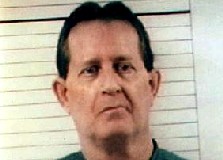
Gary Lee Davis
Murderer Brian Kevin Rosenfeld
Murderer · USA · 1985
Brian Kevin Rosenfeld Brian Kevin Rosenfeld was sentenced to three concurrent l…
23 victims
Brian Kevin Rosenfeld
Murderer · USA · 1985
Brian Kevin Rosenfeld Brian Kevin Rosenfeld was sentenced to three concurrent l…
23 victims
 Yahweh ben Yahweh
Murderer · USA · 1980
Yahweh ben Yahweh was born and legally named Hulon Mitchell Jr. (October 27, 19…
23 victims
Yahweh ben Yahweh
Murderer · USA · 1980
Yahweh ben Yahweh was born and legally named Hulon Mitchell Jr. (October 27, 19…
23 victims
 Russell Ellwood
Murderer · USA · 1991
Russell Ellwood was a former taxi driver. Authorities suspected him of killing…
20 victims
Russell Ellwood
Murderer · USA · 1991
Russell Ellwood was a former taxi driver. Authorities suspected him of killing…
20 victims
 James Lee Beathard
Murderer · USA · 1984
Name: James Lee Beathard Case role: Capital murder defendant; accomplice to Gen…
3 victims
James Lee Beathard
Murderer · USA · 1984
Name: James Lee Beathard Case role: Capital murder defendant; accomplice to Gen…
3 victims
 Isabella Guzman
Murderer · USA · 2013
Isabella Guzman was an 18-year-old who lived in an Aurora home with her mother,…
1 victim
Isabella Guzman
Murderer · USA · 2013
Isabella Guzman was an 18-year-old who lived in an Aurora home with her mother,…
1 victim
 David Stevenson
Murderer · USA · 1995
David Stevenson was sentenced to death on February 3, 2006. He was convicted fo…
1 victim
David Stevenson
Murderer · USA · 1995
David Stevenson was sentenced to death on February 3, 2006. He was convicted fo…
1 victim
 John Couey
Murderer · USA · 2005
Name: John Evander Couey · Lifespan: September 19, 1958 – September 30, 2009 ·…
1 victim
John Couey
Murderer · USA · 2005
Name: John Evander Couey · Lifespan: September 19, 1958 – September 30, 2009 ·…
1 victim
 Kathrine Dufresne
Murderer · Canada · 2011
Kathrine Dufresne was the mother of seven-year-old Sophie Fitzpatrick, her adop…
1 victim
Kathrine Dufresne
Murderer · Canada · 2011
Kathrine Dufresne was the mother of seven-year-old Sophie Fitzpatrick, her adop…
1 victim
- Gender
- male
- Country
- USA
- Location
- Arapahoe County, Colorado, USA
- Date of birth
- 1944
- Age at first offence
- 42
- Characteristics
- kidnapping, rape
- Victim profile
- Virginia May (female, 34)
- Method of murder
- Shooting (rifle)
- Date(s) of murder
- July 21, 1986
- Years active
- 1986
- Date of arrest
- —
- Status
-
Executed
Executed by lethal injection in Colorado on October 13, 1997
Case details
Defendant: Gary Lee Davis (1944 - 13 October 1997) Victim: Virginia May
Timeline
- 21 July 1986 — Gary Davis and Rebecca Fincham kidnapped their neighbor, Virginia May, from in front of her children; they drove her to a deserted field where Davis raped May and then shot her 14 times with a rifle.
- 21 July 1987 — Davis was sentenced to death exactly one year after the murder.
- 1990 — Davis’s death sentence was upheld by state courts.
- 1993 — Davis was moved into the state’s new supermax, the Colorado State Penitentiary.
- 1995 — Davis’s death sentence was upheld by federal courts.
- 13 October 1997 — Davis was executed by lethal injection at the Colorado State Penitentiary.
Background
Gary Lee Davis was born in Wichita, Kansas. Although raised by his mother, he later claimed that he had suffered sexual abuse from an early age at the hands of his older stepbrothers. After dropping out of school in the ninth grade, Davis joined the United States Marine Corps in 1961. He married Tonya Ann Tatem and had two sons with her before their divorce.
At the age of thirty, Davis married Leona Coates; at their marriage in 1974, she was 17 years old. They had four children. Davis later made statements acknowledging predatory sexual behavior, including an estimate that he had raped 15 women.
The offence
On 21 July 1986, Gary Davis and Rebecca Fincham kidnapped their neighbor Virginia May. They kidnapped her from in front of her children, drove her to a deserted field, raped May, and shot her 14 times with a rifle.
In federal habeas proceedings, the court summarized that Davis and Fincham kidnaped, sexually assaulted, and murdered Virginia May. The court stated that Davis never challenged his conviction and did not dispute his involvement.
Investigation and arrest
Federal habeas review recounted that after May disappeared, the police and family members attempted to question the Davises about her whereabouts. It included Davis insisting on being allowed to talk to Fincham before making statements about May, and a brief conversation in a small library at the station.
Trial
Davis and Fincham were tried separately. The state sought the death penalty against Davis but not Fincham. When Davis’s appointed state public defender withdrew because of a conflict of interest, Craig Truman was appointed as counsel. Against Truman’s advice, Davis testified during the guilt/innocence phase and emphasized his own culpability.
The jury found Davis guilty of:
- murder in the first degree after deliberation,
- felony murder,
- conspiracy to commit murder in the first degree,
- second degree kidnaping,
- conspiracy to commit second degree kidnaping.
The trial court sentenced Davis to life imprisonment on the conspiracy and second degree kidnaping convictions.
In the penalty phase, the jury was presented with six aggravating factors and eight mitigating factors. The jury found all six aggravating circumstances proven and made no findings on the existence of any mitigating factors, and concluded beyond a reasonable doubt that death was the proper punishment.
Counsel testimony and jury verdict timing
The record described that the jury took only three hours to reach a verdict and that it also took another three hours to sentence him to death.
Closing arguments and quoted statements
During the penalty phase closing argument, Craig Truman stated:
Now it's my turn to come and ask you for Gary Davis's life. That's what I'm here to do. For 14 long years I have practiced law in these criminal courts and up and down these mean halls. You think you have seen just about everything. You think you have seen everything once. I have never seen a case like this. I never have, and I hopefully never will. R. Vol. V, Vol. 33 at 51.
Truman continued:
There are times in this case that I hate Gary Davis, I am going to tell you that, and I think you know it. There are times I hate the things that he has done, and I have told him, and I tell you, there's no excuse for it. There's no excuse for it whatsoever. In the times that we have seen these cases come and go, they get worse and worse instead of better, and I'm not kidding anybody, this is one of the worst ones I have ever seen or heard of. I can't recall a case where I have never made a closing argument, and I can't recall a case where we have spoken as little to you as we have this one, and there's a reason for it. That reason is that in December, when I first saw Gary Davis, I knew that sometime or other I was going to be standing here asking for 12 people's mercy. That's all he has got. That's all we can seek. . . . I, too, think killing is wrong, and it's killing, whether it's the state, and it's killing, whether it's Gary Davis. . . . It says, "Thou shalt not kill," and if I or you . . . or anybody who was there, and if Ginny May would have lived -- she didn't, she died -- and if I thought -- if I thought that Brandon and Krista May would have five seconds of peace by Gary Davis's death, I would choke the life out of him right now, and he knows it, but it won't help. . . . Some of the times I hate Gary Davis is because of what he has done to me. I have been on this case since December, when the public defender got off. The public defender got off because of Gary Davis's lies, and Gary Davis has lied to me. Gary Davis set up the public defender for failure. In a lot of respects he set me up for failure. I guess I'm too prideful, worried about my reputation. Maybe that's why I hated him the other day. Id. at 51-53.
Truman also told the jury:
As bad as Gary Davis is -- and you won't hear me say otherwise -- there's someone equally as bad, maybe worse. That someone continues to lie. . . . Anything to save Becky Davis [Fincham]. That demonstration alone, of watching him testify, I submit to you shows who's wearing the pants in this family. I'm not saying that forgives Gary Davis. Nothing forgives Gary Davis. He deserves to get what she got. Sauce for the goose is sauce for the gander. They're in the same position, I submit to you, and I submit to you that both ought either to look at the gas chamber, or both ought to spend the rest of their lives in the penitentiary. Id. at 55.
Truman concluded:
I have never had a case like this before, and I have never been able not to talk to juries, as I almost wasn't able to talk to you at the start. I guess I'm a prideful man. I have been doing this a long time and I think I'm good at it, and I haven't said anything during this trial and I have watched you, some of you looking at me, wondering, when are you going to get started? When are you going to start representing your client? When are you going to get up? I have seen that in your eyes. I know what you mean. You can't change what's happened and I am not going to twist or fudge anything for you. Now's the time for me to be heard. Now's the time I'm talking to you, and each one of you has it in your hand to spare Gary Davis or to kill him, for if one of you says no, stop the killing, there's been too much, that's the way it will be. And if all of you believe that the only thing for Gary Davis is to put him in the gas chamber, drop those pellets into the cyanide bath, watch him choke to death, that's what will happen. Is there a man so bad that he's irredeemable? That's the question here. There's no question about what happened. It's a question about what's going to happen. I have never begged a jury before for anything, but I'm begging you now, and I am asking you please not to kill Gary Davis. Id. at 56.
Appeals
Davis alternately encouraged and suspended appeals of his death sentence. The sentence was upheld by state courts in 1990 and by federal courts in 1995.
In the federal appeal summarized by the Tenth Circuit, Gary Lee Davis appealed from the district court’s denial of his first petition for a writ of habeas corpus seeking to overturn his sentence of death. The appellate court affirmed denial of the habeas petition and held as follows:
- Davis was not abandoned by his attorney in the closing argument of the penalty phase.
- Davis suffered no prejudice from his attorney’s failure to pursue and present certain additional mitigating evidence.
- The statutory aggravators presented were either valid or, if invalid or otherwise erroneously submitted, were harmless.
- The penalty phase jury instructions neither misled nor confused the jury concerning evaluation of mitigating evidence.
- No error occurred in removal for cause of three prospective jurors.
Quote attributed to Governor Roy Romer
Colorado Governor Roy Romer refused to grant clemency to Davis, stating:
[T]here undoubtedly has been some rehabilitation of his character and his demeanor. But I do not believe that whatever remorse or rehabilitation that is displayed here justifies reaching that extraordinary event that would cause this governor to give him clemency.
Sentencing
Davis was sentenced to life imprisonment on conspiracy and second degree kidnaping convictions. He was sentenced to death on 21 July 1987 for the murder conviction.
Execution and outcome
Davis was executed by lethal injection at the Colorado State Penitentiary in Colorado. He was pronounced dead at 8:33 p.m. on 13 October 1997.
The record included that Davis’s last meal before execution was vanilla and chocolate ice cream, and that he requested a cigarette shortly before execution; as a smoking ban was in place, his request was denied. Davis made no final statement before being executed.
The record described media coverage and protests outside the prison as Davis was executed, including about 200 anti-death-penalty protesters and a smaller group of death penalty supporters.
Other details
- Davis estimated that he had raped 15 women in the course of his adult life.
- The record described a prior conviction for grand larceny and burglary in Kansas in 1970 and 1971, and menacing in Colorado in 1979.
- In 1982, Davis was jailed on a sexual assault conviction in Colorado.
- During his imprisonment, Davis corresponded with Rebecca Fincham; they married in 1984 while Davis was still in prison.
- Davis was released in 1985 and moved with Fincham to Byers, Colorado.
- The federal appellate record stated that Davis and Fincham were tried separately, and that the state sought the death penalty against Davis but not Fincham.
- The federal appellate record identified three prospective jurors excused for cause: Thelma Wolfe, Michael Bradbury, and Abie Olivas, including quoted voir dire statements by Olivas about not being able to impose the death penalty in alcohol-related crimes:
- “No, I won't be able to.”
- “That's right. Because if alcohol is involved, I don't think the death penalty.”
- “Yes, only to a certain extent. Life in prison, 200 years in prison, but not the death penalty.”
- The federal appellate record included a statement attributed to Davis: “The ball game's over, babe. Don't tell 'em shit. We'll get a lawyer.”
- The record included several dated letters from Davis, including:
- “I was molested dozens of times as a child,”
- “I think people use that as a crutch. Everyone wants to blame what they do on other people or things.”
- “I have already contacted a lawyer about putting a stop to my appeals. It has NOTHING to do with being chicken. I don't think a chicken could do it.”
- “I can't say goodbye, so I'll say see you later. A friend, Gary”
Spotted an error, or have more information about this case?