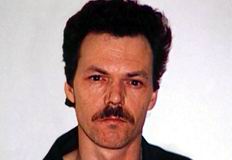
Douglas Beamish
Murderer Allan Legere
Murderer · Canada · 1986
Name: Allan Legere · Citation: R. v. Legere (1988), 89 N.B.R. (2d) 361 · Other…
5 victims
Allan Legere
Murderer · Canada · 1986
Name: Allan Legere · Citation: R. v. Legere (1988), 89 N.B.R. (2d) 361 · Other…
5 victims
 Angelo Colalillo
Murderer · Canada · 1993
Angelo Colalillo was suspected of committing serial sexual assaults and murders…
3 victims
Angelo Colalillo
Murderer · Canada · 1993
Angelo Colalillo was suspected of committing serial sexual assaults and murders…
3 victims
 Denis Lortie
Murderer · Canada · 1984
Denis Lortie was a Canadian army corporal in the Royal 22 e Régiment of the Can…
3 victims
Denis Lortie
Murderer · Canada · 1984
Denis Lortie was a Canadian army corporal in the Royal 22 e Régiment of the Can…
3 victims
 Douglas Donald Moore
Murderer · Canada · 2003
Douglas Donald Moore died of an apparent suicide in a cell at the Maplehurst De…
3 victims
Douglas Donald Moore
Murderer · Canada · 2003
Douglas Donald Moore died of an apparent suicide in a cell at the Maplehurst De…
3 victims
 Nicholas Vernage
Murderer · Canada · 1991
Nicholas Vernage (26) murdered Sgt Alan King and also killed Lorna Bogle and Ja…
3 victims
Nicholas Vernage
Murderer · Canada · 1991
Nicholas Vernage (26) murdered Sgt Alan King and also killed Lorna Bogle and Ja…
3 victims
 Aubrey Dennis Adams
Murderer · USA · 1978
Aubrey Dennis Adams, Jr. was tried in a Florida court and was convicted of firs…
1 victim
Aubrey Dennis Adams
Murderer · USA · 1978
Aubrey Dennis Adams, Jr. was tried in a Florida court and was convicted of firs…
1 victim
 William Marrufo
Homicide · USA · 2005
William Jesus Marrufo was a former drummer for the band Ozomatli. Marrufo’s fam…
1 victim
William Marrufo
Homicide · USA · 2005
William Jesus Marrufo was a former drummer for the band Ozomatli. Marrufo’s fam…
1 victim
 Mario Celaire
Murderer · United Kingdom · 2001
Mario Celaire was convicted of a sexual offence when he was 15 and served four…
1 victim
Mario Celaire
Murderer · United Kingdom · 2001
Mario Celaire was convicted of a sexual offence when he was 15 and served four…
1 victim
 Mark Anthony Guglielmo
Murderer · USA · 1994
December 12, 1968 — Mark Anthony Alexander Guglielmo was born in Westchester Co…
1 victim
Mark Anthony Guglielmo
Murderer · USA · 1994
December 12, 1968 — Mark Anthony Alexander Guglielmo was born in Westchester Co…
1 victim
 Shelby Shamblin
Homicide · USA · 1980
Shelby Glenn Shamblin was a Homeland man. He was convicted in June of first-deg…
1 victim
Shelby Shamblin
Homicide · USA · 1980
Shelby Glenn Shamblin was a Homeland man. He was convicted in June of first-deg…
1 victim
 Arthur Thomas
Murderer · USA · 1953
Arthur Thomas was convicted by a trial jury in Arizona of first-degree murder a…
1 victim
Arthur Thomas
Murderer · USA · 1953
Arthur Thomas was convicted by a trial jury in Arizona of first-degree murder a…
1 victim
- Gender
- male
- Country
- Canada
- Location
- Prince Edward Island, Canada
- Date of birth
- 1957
- Age at first offence
- 37
- Characteristics
- —
- Victim profile
- Shirley A. Duguay, 32 (his common-law wife)
- Method of murder
- Beating
- Date(s) of murder
- October 3, 1994
- Years active
- 1994
- Date of arrest
- May 6, 1995
- Status
-
Life imprisonment
Sentenced to 18 years-to-life in prison on July 19, 1996
Case record: Douglas Beamish
Background
Shirley Duguay lived on Prince Edward Island, Canada. In 1994, she went missing and was later found dead in a shallow grave.
Douglas Beamish was the estranged husband and common-law husband of Shirley Duguay. He was the father of three of her children. He had lived at his parents’ home after he and Duguay split about two years earlier.
In an interview at his parents’ home, Douglas Beamish insisted he had no idea where Shirley Duguay might have gone after she vanished.
Investigators recalled that during a previous interview with Douglas Beamish, he had a white cat that he named Snowball.
The offence
In 1994, Shirley Duguay disappeared and was later found dead in a shallow grave.
Her body was found in a shallow grave almost a year later.
A military team about six miles from Shirley Duguay’s house stumbled upon a plastic bag containing a man’s leather jacket. Shirley Duguay’s blood was on the jacket, and several white hairs were in the jacket’s lining.
Later details described that Shirley Duguay’s hands had been tied behind her back and that she had been beaten about the head with such force that a tooth was propelled into one lung.
Investigation
Prince Edward Island had a case in which investigators used nonhuman DNA evidence.
Blood spattered in Shirley Duguay’s car was sent to the forensics labs of the Royal Canadian Mounted Police, and tests showed that the blood came from the missing woman.
A clue turned up in the woods: a bag containing a pair of sneakers and a leather jacket stained with Shirley Duguay’s blood. The shoes were Douglas Beamish’s size, and the soles had been worn in a way consistent with his walk. Investigators also found 20 white hairs embedded in the jacket lining.
A lab test revealed that the hairs were from a cat.
Constable Roger Savoie noticed a white cat wandering around Douglas Beamish’s house during an earlier interview, identifying it as the family pet Snowball. Savoie reasoned that if the hair on the jacket came from Snowball, it might provide a link between Douglas Beamish and the bloody jacket.
Savoie tried to have scientists perform DNA testing on cat hairs and faced refusals. He eventually found Dr. Stephen J. O’Brien, who was the chief of the Laboratory of Genomic Diversity at the National Cancer Institute in Frederick, Md. Dr. O’Brien had expertise on cats and their genes and had not previously done a forensic DNA analysis.
Dr. O’Brien began by attempting to extract DNA from the hairs found on the jacket lining. Of the eight hairs found in the jacket, only one had usable DNA in its root.
Dr. O’Brien then analyzed Snowball’s blood and said it looked like a perfect match, while considering whether all cats on the island might have inbred DNA that was essentially identical.
To address that concern, Dr. O’Brien asked Savoie to round up 20 cats from the neighborhood and send their blood to his lab. Dr. O’Brien said he and colleagues found abundant genetic diversity. The testing included a fail-safe method of randomly testing 20 other cats from isolated Prince Edward Island to establish the degree of genetic diversity among cats on the island and rule out the possibility that the hairs found in the jacket came from a close relative of Snowball, or that all cats on the island had a common ancestor, rendering the DNA test useless.
Dr. O’Brien estimated the chance of another cat having that same genetic profile as about 45 million to one.
Evidence analysis included the DNA obtained from the cat hairs and the DNA comparison to Snowball’s blood, producing a matching genetic paw print.
After the forensic work, Beamish was subsequently convicted for the murder of his wife.
Arrest
On May 6, 1995, a trout fisherman found a shallow grave about 10 miles from where the car was found. The grave held Shirley Duguay’s body.
Police arrested Douglas Beamish and charged him with first-degree murder.
Trial
Douglas Beamish’s eight-week-long trial included a letter in which he had threatened to kill Shirley Duguay. The letter’s signature was apparently written in blood.
The trial also included testimony from an old girlfriend who described “a horrible beating at the hands of the defendant.”
Another point of evidence at trial involved expert testimony about DNA obtained from Snowball’s hair and blood comparison.
At trial, Douglas Beamish’s attorney said:
“Without the cat, the case falls flat.”
The jury found Douglas Beamish guilty of second-degree murder.
Sentencing
Douglas Beamish was sentenced to 18 years to life on July 19, 1996.
After conviction, he was described as sentenced to 18 years in a maximum security prison, without parole.
Appeals
Douglas Beamish lost an appeal of his conviction.
Outcome
Douglas Beamish was convicted for the murder of Shirley Duguay.
Aftermath
Douglas Beamish later appeared before the National Parole Board on July 26 for a hearing to determine release on day or full parole.
The National Parole Board denied his release. The board stated Douglas Beamish’s lack of understanding as to why he acted out violently brought into question his ability to not repeat the same behaviour.
The board described Douglas Beamish as having a medium level of motivation and low reintegration potential.
The board said his conduct in prison appeared satisfactory but was described as demanding and confrontational, with a negative view toward the justice system.
The board stated he did not have a history of institutional violence but had numerous charges for disobeying prison rules and had 17 disciplinary convictions. These included 10 refusals to give urine samples.
The board noted Douglas Beamish had two suspensions from the prison’s education centre, and that in May he made inappropriate comments to a female correctional officer.
His request for a transfer to a minimum-security prison was denied.
The board said a psychiatric risk assessment from September 2012 suggested Douglas Beamish represented a low-moderate risk for violence toward the general public, but an elevated risk to intimate partners.
The board said his behaviour could be described as having a negative attitude.
When Douglas Beamish was asked to attend an interview, he responded that his hours were Monday to Friday from 8 a.m. to 4 p.m. and he refused to attend.
The board stated it was informed at the start of the hearing that Douglas Beamish did not expect to get a conditional release and his intention for having the hearing was to familiarize himself with the process.
The board said Douglas Beamish was not cooperating with his case management team while incarcerated, leading the board to believe he would not be able to work with anyone attempting to monitor his reintegration into the community.
The board denied Douglas Beamish’s requests for day and full parole.
Other details
The case was described as the first in which animal DNA had been introduced in court.
The case was also told on The New Detectives on December 10, 2002, on episode 3 of season 8.
Stephen J. O’Brien and colleagues Victor David and Marilyn Menotti-Raymond later published a brief description of their work in the scientific journal Nature.
As for Snowball, it was said to remain with Douglas Beamish’s parents, and “He’s still the family cat.”
Spotted an error, or have more information about this case?