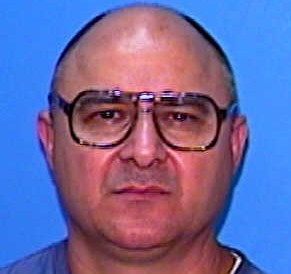
Gerardo Manso
Murderer Brian Kevin Rosenfeld
Murderer · USA · 1985
Brian Kevin Rosenfeld Brian Kevin Rosenfeld was sentenced to three concurrent l…
23 victims
Brian Kevin Rosenfeld
Murderer · USA · 1985
Brian Kevin Rosenfeld Brian Kevin Rosenfeld was sentenced to three concurrent l…
23 victims
 Russell Ellwood
Murderer · USA · 1991
Russell Ellwood was a former taxi driver. Authorities suspected him of killing…
20 victims
Russell Ellwood
Murderer · USA · 1991
Russell Ellwood was a former taxi driver. Authorities suspected him of killing…
20 victims
 Robert Martines Perez
Murderer · USA · 1994
Name: Robert Martines Perez · Other name used in proceedings: Robert Martinez P…
15 victims
Robert Martines Perez
Murderer · USA · 1994
Name: Robert Martines Perez · Other name used in proceedings: Robert Martinez P…
15 victims
 Billy Frank Vickers
Murderer · USA · 1993
Billy Frank Vickers Vickers was executed by lethal injection in Texas on Januar…
14 victims
Billy Frank Vickers
Murderer · USA · 1993
Billy Frank Vickers Vickers was executed by lethal injection in Texas on Januar…
14 victims
 John Ronald Brown
Homicide · USA · 1998
John Ronald Brown (July 14, 1922 – May 16, 2010) was a former United States sur…
1 victim
John Ronald Brown
Homicide · USA · 1998
John Ronald Brown (July 14, 1922 – May 16, 2010) was a former United States sur…
1 victim
 Garland Milam
Murderer · USA · 2005
Garland Milam was a drifter who lived in the woods behind a strip mall. He was…
3 victims
Garland Milam
Murderer · USA · 2005
Garland Milam was a drifter who lived in the woods behind a strip mall. He was…
3 victims
 Piper Rountree
Murderer · USA · 2004
Piper Rountree was convicted of first-degree murder for the shooting death of h…
1 victim
Piper Rountree
Murderer · USA · 2004
Piper Rountree was convicted of first-degree murder for the shooting death of h…
1 victim
 Carole Tregoff
Murderer · USA · 1959
Carole Tregoff was convicted in connection with the murder of Barbara Finch. Sh…
1 victim
Carole Tregoff
Murderer · USA · 1959
Carole Tregoff was convicted in connection with the murder of Barbara Finch. Sh…
1 victim
 Yang Jiaqin
Homicide · China · 2010
Yang Jiaqin carried a kitchen cleaver and attacked students and bystanders outs…
2 victims
Yang Jiaqin
Homicide · China · 2010
Yang Jiaqin carried a kitchen cleaver and attacked students and bystanders outs…
2 victims
- Gender
- male
- Country
- USA
- Location
- Dade County, Florida, USA
- Date of birth
- April 22, 1952
- Age at first offence
- 39
- Characteristics
- revenge
- Victim profile
- Luis Gutierrez (his wife's lover) / Miguel Roca (co-worker)
- Method of murder
- Shooting
- Date(s) of murder
- August 16, 1991 / October 14, 1993
- Years active
- 1991–1993
- Date of arrest
- —
- Status
-
Life imprisonment
Sentenced to life in prison on July 3, 1995
Case overview
Gerardo Manso was convicted of one count of first-degree murder and four counts of attempted first-degree murder. He appealed the trial court’s judgment and sentence imposing a death sentence.
The Florida Supreme Court affirmed Manso’s convictions of guilt, but reversed Manso’s death sentence and remanded for a new competency determination and penalty proceeding. Manso’s new sentencing required a determination that he was competent to proceed under Florida Rules of Criminal Procedure 3.211 and 3.212.
Timeline
- October 14, 1993 — Manso placed a twelve-gauge shotgun in his car, modified it by grinding off identifying serial numbers and markings and cutting off the stock, loaded shells, went to the roof of Aircraft Modular Products, waited for co-workers to return, and fired at multiple occupants. Miguel Roque died as a result of a gunshot, and Douglas Zamora and Ray Cruz were severely injured.
- About a week after the shootings — Police confronted Manso with evidence linking him to the murder weapon, and Manso confessed to the shooting.
- November 20, 1997 — The Florida Supreme Court issued a per curiam decision affirming Manso’s convictions of guilt and reversing the death sentence, remanding for a new competency determination and penalty proceeding.
- September 5, 1995 — A circuit court granted a petition to have Manso involuntarily committed to the Corrections Mental Health Institution in Chattahoochee, finding that Manso was suffering from major depression with psychotic features.
- July 3, 1995 — Manso was sentenced to life in prison.
Background
Gerardo Manso worked as a night shift foreman at Aircraft Modular Products in Miami, where he worked for six years. He believed he had been treated unfairly in being passed over for a promotion and was concerned about the possibility of losing his job.
The offence
On October 14, 1993, Manso placed a twelve-gauge shotgun in his car. After other employees left the shop for an evening meal, he retrieved the shotgun and five shotgun shells from his car, entered the shop, ground off identifying serial numbers and markings, and cut off the stock of the gun. After modifying the gun, he picked up plastic covers because it was raining.
Manso left the building and climbed two separate ladders to the roof. On the way, he loaded five shells into the gun and threw the empty box down a drain. He waited for Miguel Roque, Jorge Sanchez, Douglas Zamora, Ray Cruz, and George Moussa to return from a computer training class. Manso knew they would return about 9 p.m. while waiting, and he stationed himself on the roof directly over the area where the vehicle would arrive.
When the vehicle arrived, Manso fired directly at four occupants. Manso stated in his confession that he aimed at the person in the vehicle whom he believed to be Jorge Sanchez and fired two shots, intending to kill that person. That person actually was Miguel Roque, who died as a result of the gunshot.
When Douglas Zamora got out of the car, Manso fired one shot at him, causing severe injuries. When Ray Cruz got out of the car, Manso also fired one shot at him, causing severe injuries.
Manso then shot through the roof of the vehicle, intending to kill George Moussa, who was not injured because Roque’s body was on top of him.
After the shootings, Manso discarded the plastic, threw the gun into a yard beside the building, descended the two ladders, and returned to the shop. He mingled with other employees.
Investigation and police contact
When police arrived, Manso told police that he had seen a Cadillac carrying three Colombians who asked about Jorge Sanchez just before the shooting.
Manso knew Sanchez had been arrested on drug charges, and Manso wanted police to believe the shooting was narcotics-related.
Approximately a week after the shootings, after police confronted him with evidence linking him to the murder weapon, Manso confessed to the shooting. He told police that he intended to kill Sanchez and Moussa because they were making his job impossible and he heard a rumor that he was going to be fired.
Manso maintained that he did not intend to kill Cruz, Zamora, or Roque.
Arrest and confession behavior during proceedings
During direct examination at the penalty proceeding, Manso admitted shooting his co-workers and expressed remorse. During direct examination, Manso told the jury, “I have no right to live,” and the following exchange occurred:
Q. Let me ask you this, do you think that you?re crazy?
A. Huh? No, no. Q. You don’t think so? A. No. Who knew they?re sitting there -- everybody there and they?re the people above them and now they make themselves be good, and they think about one thing, in what way have they put me there in order be able to kill five people. Yeah, that is all and I don’t want to keep talking. I already asked for the electric chair so everyone would be happy. What else do they want?
MR. CARTER : I don’t have anything further.
THE DEFENDANT : And that way I?m going to go to a place where no one can bother me and I can be calm.
The prosecutor attempted to cross-examine Manso, who stated, “Tell the fat lady I don’t want to answer any of her questions.”
Manso threw the witness-stand microphone at the prosecutor. The court excused the jury. Manso got down on the floor and began screaming and shaking violently.
Trial
Charges and verdict
A jury found Manso guilty of one count of first-degree murder and four counts of attempted first-degree murder. The jury recommended a death sentence by a ten-to-two vote. The trial court followed the jury’s recommendation and sentenced Manso to death.
Guilt-phase issues raised on appeal
Manso raised one guilt-phase claim. He challenged the court’s denial of motions for acquittal of the charges of attempted first-degree murder as to Cruz and Zamora, arguing that the State failed to establish that Manso had a specific intent to kill Cruz and Zamora. The Florida Supreme Court rejected the contention because the record contained sufficient facts regarding Manso’s intent, concluding that the jury could determine the charges of attempted first-degree murder.
The Florida Supreme Court affirmed Manso’s convictions of one count of first-degree murder and four counts of attempted first-degree murder.
Sentencing
Aggravating circumstances found by the trial court
The trial court found the following aggravating circumstances:
- Manso had previously been convicted of another capital felony or of a felony involving the use or threat of violence to the person (murder of his wife’s lover, Luis Gutierrez, and four contemporaneous attempted murders).
- Manso knowingly created a great risk of death to many persons.
- The murder was committed in a cold, calculated, and premeditated manner (CCP).
Statutory mitigators found by the trial court
The court found the following statutory mitigators:
- Manso was under the influence of extreme mental and emotional disturbance.
- Manso’s capacity to appreciate the criminality of his acts and conform his conduct to the requirements of the law was substantially impaired.
Nonstatutory mitigators found by the trial court
The judge found the following nonstatutory mitigators:
- Manso had a history of childhood abuse and neglect.
- Manso was a good parent and family man.
- Manso cooperated with the police.
- Manso was contrite and remorseful.
- Manso had a capacity for rehabilitation.
Competency during the penalty phase and penalty-phase appeal
Manso raised twelve claims on direct appeal. The Florida Supreme Court held that the dispositive issue was that the trial court should have granted a continuance during the penalty phase so that Manso’s competence could be further examined. Because the court ordered a new sentencing proceeding upon a new determination that Manso was competent to proceed, it did not reach the other penalty-phase claims.
Competency procedures and expert testimony
In the competency claim, Manso contended that the court erred during the penalty phase by failing to continue the proceedings for hospitalization and further observation to determine Manso’s competency as two examining mental health experts recommended. The Florida Supreme Court agreed that a continuance was required.
During the penalty proceeding, the trial court assessed Manso’s behavior and relevant testimony and found that a competency hearing was necessary under Fla. R. Crim. P. 3.210.
The Florida Supreme Court stated that, first, Manso’s sister and brothers testified to:
- Manso’s mother being a paranoid schizophrenic who was periodically hospitalized.
- Manso, while in the Cuban military, having received psychiatric treatment, being hospitalized, and being given electric shock treatments.
- Manso’s siblings observing him to be depressed and thinking he acted strangely.
- Manso often expressing the belief that people were laughing at him and ridiculing him.
- Manso self-medicating for a number of years to calm himself with his mother’s anti-psychotic drugs.
Manso then took the stand, admitted shooting his co-workers, and expressed remorse. He also testified about his personal history, including his mother’s schizophrenia and his own psychological problems.
After Manso’s outburst on the witness stand, the court granted defense counsel’s oral motion for recess to hold a competency evaluation. The court immediately appointed psychologists Dr. Merry Haber and Dr. Lazaro Garcia, who had been retained by the defense and the prosecution, respectively, to testify at the penalty phase. Dr. Haber and Dr. Garcia were at the courthouse and performed evaluations that afternoon. The two psychologists interviewed Manso for about two hours.
Later that same day, each psychologist orally reported findings to the court in an evidentiary hearing in which both experts testified.
Dr. Haber concluded Manso was not competent to proceed because he had experienced a psychotic break and should be hospitalized and medicated until restored to competency.
Dr. Garcia disagreed about the psychotic break and concluded that he had a “strong suspicion that [Manso was] malingering” because Manso’s statements were self-serving.
Dr. Garcia concluded Manso was competent, but stated: “I discussed this with Dr. Haber, and I think in the case of prudence that involuntary hospitalization for observation is recommended.”
The trial court also heard testimony from an interpreter and two corrections officers who had contact with Manso. The prosecution argued that Manso was malingering, and defense counsel argued Manso should be hospitalized based on both psychologists’ testimony.
The court found Manso competent to proceed based upon Dr. Haber and Dr. Garcia’s testimony and the court’s own observation that Manso was feigning psychosis.
Holding on appeal
The Florida Supreme Court held that the court abused its discretion in failing to grant a continuance based on the recommendations of the two psychologists that Manso should be observed in a hospital setting.
Accordingly, it affirmed Manso’s convictions of guilt but reversed the death sentence and remanded to the trial court for a complete new penalty proceeding on the first-degree murder conviction with new counsel representing him.
Manso’s new sentencing could proceed only after the circuit court determined he was competent to proceed in accord with Florida Rules of Criminal Procedure 3.211 and 3.212.
Outcome
The Florida Supreme Court affirmed Manso’s convictions of guilt and reversed his death sentence, remanding for a new competency determination and penalty proceeding.
The decision date was November 20, 1997 and it was issued as a per curiam opinion.
Other details
Party names and appellate details
The Florida Supreme Court case was:
- Florida Supreme Court Case No. 93-35736
- GERARDO MANSO, Appellant, vs. STATE OF FLORIDA, Appellee
- No. 85,529
- November 20, 1997
The opinion included a jurisdictional statement referencing Art. V, § 3(b)(1), Fla. Const. and indicated “We have jurisdiction.”
Additional post-trial mental health commitment
Subsequent to the trial, the Superintendent of Union Correctional Institution petitioned to have Manso involuntarily committed to the Corrections Mental Health Institution in Chattahoochee. On September 5, 1995, the circuit court in Union County granted the petition, finding that Manso was suffering from major depression with psychotic features.
List of claims raised by Manso on appeal (as enumerated in the opinion)
Manso claimed:
- The trial court erred in failing to grant Manso’s motion for judgment of acquittal on two charges of attempted first-degree murder.
- The trial court erred in finding Manso competent to proceed at the penalty phase without granting a continuance for further observation.
- The State improperly used the competency examination to rebut mental mitigation.
- The testimony of a prosecution expert, Dr. Garcia, exceeded the proper scope of rebuttal.
- Manso was denied his right to counsel and to a fundamentally fair sentencing hearing because trial counsel’s ineffectiveness is apparent from the record and counsel was suspended from practice in Florida three days after Manso was sentenced.
- The trial court erred in restricting Manso’s ability to elicit testimony regarding his family history of mental illness.
- The trial court erred in permitting the State’s rebuttal witness to testify to a previously undisclosed oral statement by Manso.
- The trial court erred in sustaining the State’s objection to defense counsel’s closing argument regarding alternatives to the death penalty.
- The trial court erred in imposing a death sentence.
- The trial court erred in relying on the nonstatutory aggravator of future dangerousness.
- The standard jury instructions misled the jury as to the significance of its verdict.
- Florida’s death penalty statute is unconstitutional.
Notes on sentencing duration and disposition fragments
The record included fragments indicating:
- “22 years on one count, 1994; condemned on second count + four life terms for attempted murder, 1995.”
Spotted an error, or have more information about this case?