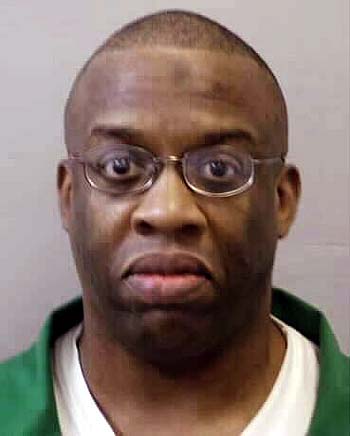
James Earl Reed
Murderer Brian Kevin Rosenfeld
Murderer · USA · 1985
Brian Kevin Rosenfeld Brian Kevin Rosenfeld was sentenced to three concurrent l…
23 victims
Brian Kevin Rosenfeld
Murderer · USA · 1985
Brian Kevin Rosenfeld Brian Kevin Rosenfeld was sentenced to three concurrent l…
23 victims
 Russell Ellwood
Murderer · USA · 1991
Russell Ellwood was a former taxi driver. Authorities suspected him of killing…
20 victims
Russell Ellwood
Murderer · USA · 1991
Russell Ellwood was a former taxi driver. Authorities suspected him of killing…
20 victims
 Robert Martines Perez
Murderer · USA · 1994
Name: Robert Martines Perez · Other name used in proceedings: Robert Martinez P…
15 victims
Robert Martines Perez
Murderer · USA · 1994
Name: Robert Martines Perez · Other name used in proceedings: Robert Martinez P…
15 victims
 Billy Frank Vickers
Murderer · USA · 1993
Billy Frank Vickers Vickers was executed by lethal injection in Texas on Januar…
14 victims
Billy Frank Vickers
Murderer · USA · 1993
Billy Frank Vickers Vickers was executed by lethal injection in Texas on Januar…
14 victims
 Nicole Guyette
Murderer · USA · 2008
Nicole Guyette was a Newark woman who pleaded not guilty to murder, aggravated…
1 victim
Nicole Guyette
Murderer · USA · 2008
Nicole Guyette was a Newark woman who pleaded not guilty to murder, aggravated…
1 victim
 Larry Dale Potts
Murderer · USA · 1987
Larry Dale Potts was sentenced to death on October 6, 1988. While separated, Sh…
2 victims
Larry Dale Potts
Murderer · USA · 1987
Larry Dale Potts was sentenced to death on October 6, 1988. While separated, Sh…
2 victims
 Jose Vicente Matias
—
Jose Vicente Matias fue descrito como un asesino en serie brasileño que se las…
Jose Vicente Matias
—
Jose Vicente Matias fue descrito como un asesino en serie brasileño que se las…
- Gender
- male
- Country
- USA
- Location
- Charleston County, South Carolina, USA
- Date of birth
- November 26, 1958
- Age at first offence
- 36
- Characteristics
- revenge, history of mental illness
- Victim profile
- Joseph and Barbara Lafayette ( his ex-girlfriend’s parents )
- Method of murder
- Shooting
- Date(s) of murder
- May 15, 1994
- Years active
- 1994
- Date of arrest
- —
- Status
-
Executed
Executed by electrocution in South Carolina on June 20, 2008
Case overview
James Earl Reed was convicted of murdering Joseph Lafayette and Barbara Lafayette in their home. Reed was arrested for driving a car into an Army officer trying to help an individual. He was sentenced to 37 months in prison after pleading guilty to assault and wrote threatening letters to Laurie Rego while in prison. After he was released, Reed bought a gun and hitchhiked to the Lafayettes' house looking for Rego. Reed was supposed to be on a bus on his way to a federal halfway-house program, but instead killed Joseph Lafayette and Barbara Lafayette in their Adams Run home in 1994 while he was looking for his ex-girlfriend.
Reed denied the killings and argued that no physical evidence placed him at the scene. Reed acted as his own lawyer during his 1996 trial. He denied the killings despite a confession and despite three witnesses who said they saw him come out of the couple’s home after the shooting. Police found in Reed's bag a diagram of the Lafayettes' home and tennis shoes of the same make as shoe prints found in the Lafayettes' yard.
The jury took only 30 minutes to convict him. Reed made post-conviction-related requests about ending appellate proceedings and being executed. Reed was executed by electrocution in South Carolina, pronounced dead at 11:27 p.m.
Timeline
- June 20, 2008 — James Earl Reed was executed by electrocution in South Carolina; he was pronounced dead at 11:27 p.m.
- Saturday, June 21, 2008 — Reed’s execution was described as carried out in the death chamber in Columbia; it had been delayed and then allowed to proceed after last-ditch legal efforts were denied.
- Sunday, June 22, 2008 — The Lafayettes’ youngest daughter, Marsha Lafayette Aleem, spoke after the execution.
- June 9, 1996 — Reed was convicted after a trial that included a hearing on competency and a guilt phase in which the jury found him guilty of both murders.
- 1994 — Reed killed Joseph Lafayette and Barbara Lafayette in their Adams Run home while looking for his ex-girlfriend.
- May 1994 — Reed was released from prison after serving time for an assault charge.
- April 25, 1994 — Reed was released from prison on an assault charge.
- May 18, 1994 — Reed showed up at the Lafayettes' house looking for Laurie Rego.
- June 2–9, 1996 — Reed’s trial took place over this period, described as a seven-day trial.
The offence
Reed murdered Joseph Lafayette and Barbara Lafayette in their home in 1994 while looking for his ex-girlfriend. The couple refused to tell Reed the whereabouts of their daughter. Prosecutors said Reed was looking for his ex-girlfriend when he killed them.
According to reports, Reed shot Joseph Lafayette and Barbara Lafayette multiple times, including execution-style shots in the heads, and they were shot at point-blank range. Reed acted as his own lawyer during his 1996 trial and denied the killings. He argued that no physical evidence placed him at the scene.
Investigation
Prosecutors alleged Reed had drawn out a diagram of the interior of the house. Detectives found in Reed's bag a diagram of the Lafayettes' home and tennis shoes of the same make as shoe prints found in the Lafayettes' yard. Police found that neither the gun nor the spent casings were found.
Witnesses testified they saw a man run in and out of the victim’s house into the woods and then, during the trial, they said they saw James Reed. Other statements included that three witnesses testified they saw Reed leave the house and drive away in the victims’ car after shots were heard. Reed denied the killings.
Reed argued that no physical evidence linked him to the scene. He also argued that the witnesses’ testimony was inconsistent with their prior statements, including claims that they could not identify his glasses, shirt, pants, or tennis shoes/sneakers, and that they could not compare their testimony to their statements.
Arrest and earlier assault case
Reed was arrested for driving a car into an Army officer trying to help her. Reed was sentenced to 37 months in prison after pleading guilty to assault. In prison, Reed wrote threatening letters to Laurie Rego. After Reed was released, he bought a gun and hitchhiked to the Lafayettes' house looking for Rego.
Reed was arrested the following day and confessed to the crime.
Trial
Reed was allowed to represent himself during the guilt phase of his capital trial. The trial court found him competent to stand trial after a hearing. Dr. Behrmann examined Reed during his two month hospitalization at Hall Institute and concluded that, within a reasonable degree of medical certainty, Reed was competent to stand trial and had the ability to understand the nature of criminal proceedings and the charges against him and to assist his counsel. Dr. Behrmann did not find paranoia and concluded Reed's failure to cooperate with appointed counsel was voluntary. Dr. Behrmann also examined Reed about forty-five minutes several months prior to trial and concluded Reed continued to be competent to stand trial, including that he had factual knowledge of the charges, potential penalty, and options in pleading. The judge concluded Reed had factual understanding of the charges and rational understanding of the proceedings and how the court works, based on medical reports and testimony and staffing entries showing ability to cooperate.
After the court found Reed competent to stand trial, Reed requested to waive representation by appointed counsel and represent himself. The trial judge questioned Reed in camera about his knowledge of the proceedings and what it would mean to represent himself. The trial judge warned Reed of the dangers and disadvantages of self-representation, and Reed continued to assert that he understood what he was waiving and chose to waive counsel.
In the guilt phase, Reed waived his right to testify. The jury found him guilty of both murders.
Before the penalty phase began, Reed sought to change his relationship with standby counsel. Reed claimed he would be too emotional to cross-examine the victims' family. The trial judge refused to appoint counsel because it was too late in the proceeding and counsel would be unable to adequately prepare on short notice, and concluded that Reed was not entitled to either the appointment of counsel or to have standby counsel cross-examine the victim-impact witnesses. Standby counsel objected that Reed was not competent to represent himself at sentencing and asked to be appointed. The trial judge declined to appoint any counsel for Reed at sentencing since Reed had waived his right to counsel.
Standby counsel stated that while he would do his best to prepare to cross-examine witnesses, he was not prepared to represent Reed during the sentencing phase. Standby counsel stated he had not investigated the case for victim impact evidence or mitigation. The court found allowing standby counsel to step in and cross-examine on less than twenty-four hours preparation would place standby counsel in a hybrid position without full preparation and would delay the proceeding. The court declined to appoint counsel but allowed standby counsel to sit beside Reed as standby counsel and aid him to the extent desired.
At the conclusion of the penalty phase, the jury recommended and the judge sentenced Reed to death for both murders.
During his trial, Reed denied the killings despite a confession and testimony by three witnesses who said they saw him come out of the couple’s home after the shooting. Reed argued that no physical evidence placed him at the scene. Prosecutors said Reed had drawn out a diagram of the interior of the house and had to stop and buy a gun in Greenville and hitchhike to the area.
Prosecutors presented a confession and three eyewitnesses who testified they saw Reed leave the house and drive away in the victims’ car after shots were heard. The jury took only 30 minutes to convict Reed.
Reed pleaded for a lawyer to represent him in the sentencing phase, and the judge refused.
Sentencing
The jury recommended and the judge sentenced Reed to death for both murders after the penalty phase. Reed requested a postponement in the sentencing phase at one point, and reports described him as offering no final statement. Reed did not request a last meal or a spiritual adviser.
Appeals
Direct appeal
Reed appealed his capital murder conviction and death sentence in State v. Reed, 332 S.C. 35, 503 S.E.2d 747 (S.C. 1998). The Supreme Court affirmed.
The Supreme Court held:
- evidence supported the determination that Reed was competent to stand trial;
- Reed knowingly and voluntarily waived his right to counsel;
- Reed's inculpatory statements were made knowingly and voluntarily;
- the trial court did not abuse its discretion in refusing to allow standby counsel to take over on the eve of sentencing.
The appeal included issues: I. whether it was error to find Reed competent to stand trial and waive his right to counsel; II. whether it was error to allow Reed's statement into evidence; III. whether it was error to refuse to appoint counsel to represent him at sentencing; IV. whether it was error to fail to obtain a waiver of Reed's right to testify at the sentencing phase.
During the discussion of the statement into evidence issue, the Supreme Court described police testimony that Detectives Coaxum and Hale read Reed his Miranda rights and obtained Reed’s signature on the advisement of rights form, that Reed did not invoke his right to silence, and that after returning to the sheriff’s office, Detective Hale made a written statement based on Reed’s verbal statement, which Reed read and signed.
The Supreme Court described that the trial court found Reed knowingly, intelligently, and voluntarily made his statement after waiver of his rights and after being accorded procedural safeguards required under Miranda v. Arizona.
On the competency and waiver issues, the Supreme Court described the test for competency based on Dusky v. United States, and it described the trial judge’s reasoning and medical support from Dr. Behrmann and others.
On the sentencing counsel issue, the Supreme Court stated that a trial judge was not required to permit hybrid representation and described the court’s concerns about delay and preparation and about ineffective assistance concerns.
On the right to testify issue, the Supreme Court stated that a capital defendant has the right to testify at the sentencing phase and that the waiver must be knowingly and intelligently made, and it found the record reflected Reed waived his right to testify during the sentencing phase.
The Supreme Court concluded that it conducted proportionality review under S.C. Code Ann. § 16-3-25 (1985) and held that the sentences were not the result of passion, prejudice, or any other arbitrary factor, that the evidence supported the aggravating circumstance, and that the sentences were not disproportionate to those imposed in similar cases. The Supreme Court affirmed the convictions and sentences.
Post-conviction relief (PCR)
Reed later sought post-conviction relief in Reed v. Ozmint, 374 S.C. 19, 647 S.E.2d 209 (S.C. 2007) (PCR). In the background, following affirmance of his murder convictions and death sentence, Reed filed an application for post-conviction relief, which was denied after an evidentiary hearing. Reed sought to waive appellate review of the order denying his PCR application and to be executed. The Circuit Court, Charleston County, A. Victor Rawl, J., found Reed competent to waive appellate review and determined that his decision was knowing and voluntary.
Upon review, the Supreme Court held:
- Reed was competent to waive his right to appeal the order denying his PCR application;
- Reed failed to make a knowing and intelligent waiver of his right to appeal.
The Supreme Court affirmed in part and reversed in part; motion denied.
Outcome
Reed’s convictions and sentences were affirmed on direct appeal. Reed remained on South Carolina death row since 1996.
Reed was executed by electrocution in South Carolina on June 20, 2008. He was pronounced dead at 11:27 p.m. After a scheduled execution time of 6 p.m. was delayed, a federal judge granted a stay motion at 5:40 p.m., and then the stay was vacated by the 4th U.S. Circuit Court of Appeals, after which last-ditch appeals were pursued, including an appeal filed to the U.S. Supreme Court. The U.S. Supreme Court ultimately allowed the execution to proceed.
Reed chose to be executed by electric chair rather than lethal injection.
Reed made no final statement at the time he was pronounced dead. He did not request a last meal or a spiritual adviser.
Aftermath and related statements
Marsha Lafayette Aleem, the victims’ youngest daughter, spoke after the execution. She described it as “a day about justice” and as starting the family’s healing process. She also discussed sacrifices her parents made raising three children and putting them through college, and that all three chose careers in the military.
Aleem said:
"Today is not a celebration for my family. This is a day about justice," she said. "Today starts our healing process."
She also stated:
"They're not here to see the grandchildren," Aleem said. "They weren't here to share the happiest moments of our lives. They are the ones that made the ultimate sacrifice."
Aleem later said by telephone:
"My reasoning for witnessing the execution is that my brother, sister and I were away in the military and unable to defend them," Aleem said by telephone Saturday. "My duty is to see justice delivered to him."
Joseph and Barbara Lafayette were described as having three children, including Aleem and two uncles who witnessed the execution. Aleem said her brother and sister were away in the military.
The execution was witnessed by Aleem and two of her uncles. Eight people protested the execution.
State prison spokesman Josh Gelinas was quoted:
"The execution of James Earl Reed was carried out at 11:27 p.m.," state prison spokesman Josh Gelinas said.
Defense attorney Diana L. Holt was quoted minutes before Reed was put to death:
"What in the world is the rush," she said minutes before Reed was put to death. "They won't let Mr. Reed have a conversation with me or the other attorney."
Assistant Public Defender Fielding Pringle was quoted:
"His competency has been hotly disputed since Day 1," Pringle said Monday. "It is in the court transcript that he has an IQ of 77 and suffers from neurological impairment."
Ron Kaz was quoted:
"I don't believe the state should be killing people," Kaz said. "They do it in my name and I resent it."
Prosecutor David Schwacke was quoted:
"He apparently had drawn out a diagram of the interior of the house. He had to stop and buy a gun in Greenville, then hitchhike here."
Schwacke also said:
"To him, it's probably a more flashy way to go out and akin to what he said he wanted to do in the first place, being tied to a tree and shot," Schwacke said.
Joseph L. Savitz was quoted:
"James is kind of a posterchild for competency," said Joseph L. Savitz, chief appellate defender of the S.C. Office of Appellate Defense, who represented Reed during his first direct appeal. "He is right on the borderline. He becomes competent, then he is incompetent."
Savitz also said:
"A lot of people don't like James. James could be difficult to get along with," Savitz said. "James never quite really figured out the system he's playing with. I think James thought the system cared about him more than it actually did," he said.
Former 9th Circuit Solicitor David P. Schwacke was quoted:
"One of the hardest types of cases to prosecute is when a person represents himself," Schwacke said. "The fear is there is some sympathy engendered to them."
Reed’s letter to the Associated Press was quoted verbatim:
"I am standing upon my word that this case be dismiss [sic] or I be killed."
Lafayette son Joseph Charles Lafayette was quoted:
"I just can't let the house go," he said. "That would really deter everything they worked for."
He also said:
"There's a lot of sorrow," he said. "My kids will never see their grandparents."
Laurie Rego was quoted by telephone:
"My mom was very much into God and her church. She was the go-to person for a lot of people who needed help."
She also said:
"We've managed but it's been difficult," Rego said.
Rego was described as having met Reed when they were both in the Army and later living in Georgia as a battalion commander for a unit that trains Reserve and National Guard members for war.
Joseph L. Savitz also said:
"I have no idea why he would do that other than to be contrarian to the end," Savitz said.
People
- James Earl Reed — defendant; represented himself during his 1996 trial; was executed by electrocution.
- Joseph Lafayette — murder victim; described as Joseph Charles Lafayette, age 39; recently retired from the Navy; lived in his parents’ brick home; son of Joseph and Barbara Lafayette.
- Barbara Lafayette — murder victim; described as Barbara Ann Lafayette; described as a receptionist at a health clinic and also worked as a self-employed insurance agent; mother of Aleem and her siblings.
- Marsha Lafayette Aleem — youngest daughter of Joseph and Barbara Lafayette; age 37; served in the Air Force and lived in Tampa, Fla.; witnessed the execution.
- Laurie Rego — described as the Lafayettes' daughter; age 42; was in the Army and had briefly dated Reed; lived in Georgia; battalion commander for a unit that trained Reserve and National Guard members for war.
- Josh Gelinas — state prison spokesman.
- Diana L. Holt — attorney who filed an appeal with the U.S. Supreme Court.
- Henry F. Floyd — U.S. District Judge who granted Holt’s motion to stay the execution.
- Joseph L. Savitz — chief appellate defender of the S.C. Office of Appellate Defense; represented Reed during his first direct appeal.
- Fielding Pringle — attorney who filed motions to intervene along with Holt; quoted regarding Reed’s competency.
- Ron Kaz — protestor quoted about not believing the state should be killing people.
- David Schwacke — prosecutor quoted about the case.
- Josh Gelinas — quoted regarding the execution time.
- Mark Plowden — communications director for the S.C. Attorney General’s office; quoted regarding ability to seek a stay.
- Joel Sawyer — spokesman quoted regarding clemency.
Other details
- Reed was described as Black and identified with SCDC ID 00005041 and DOB: 11/26/58. He was listed as received 06/09/96 and housed within Ridgeville S.C. at Lieber Corr. Inst. The record also stated the County of Conviction as Charleston and that the judge was Wm. L. Howard (also styled William L. Howard, Sr.).
- Reed was described as having an IQ of 77 in the context of competency arguments; other discussion described a normal IQ range and how an IQ of 70 could be considered mild retardation, with a ceiling due to standard error.
- The record stated “Last Meal: Inmate did not request a last meal” and “Final Statement: Inmate made no final statement.”
- The record included that Reed did not request clemency from the governor’s office, according to Joel Sawyer.
- In the context of execution method, the record described that South Carolina allowed inmates to choose between the electric chair or lethal injection and that Reed chose the electric chair.
- The record included that Reed had dropped his appeals and that he had one federal appeal left which was denied by the Supreme Court late into the night.
- A letter on his Web site included Reed’s statement:
"The big issue within this death penalty case/trial was that I would be representing myself which I have come to find out this hasn't been done, until I became the first! ... I didn't become my own lawyer for no type of fame nor glory! Yet to save my life period!"
- The record also included Reed’s web-site statement asserting he did not want anyone to believe him and requested that viewers compare witness testimony and forensic analysis, including extensive listed forensic items such as “Human blood – Insufficient,” “No blood identified,” “Inconsistent with subject,” “No gunshot residue found,” “Samples from the hands of James Reed insufficient to determine gunshot residue,” and “Miranda Rights - Witnesses Only one police officer sign when it takes both Partners. One backing up the other one. Plus on the stand the officer stated that 2 officers must sign.”
- Prosecutors presented forensic and evidence content as part of the trial context including a confession and eyewitnesses.
- The direct appeal decision in State v. Reed consolidated direct appeal with mandatory review provisions of S.C. Code Ann. § 16-3-25 (1985) and concluded “We affirm.”
- The record included citations: State v. Reed, 332 S.C. 35, 503 S.E.2d 747 (S.C. 1998) (Direct Appeal) and Reed v. Ozmint, 374 S.C. 19, 647 S.E.2d 209 (S.C. 2007) (PCR).
Spotted an error, or have more information about this case?