Louis Voisin
Murderer Albert Burrows
Murderer · United Kingdom · 1920
Albert Burrows (also named Albert Edward Burrows): married farm labourer who to…
4 victims
Albert Burrows
Murderer · United Kingdom · 1920
Albert Burrows (also named Albert Edward Burrows): married farm labourer who to…
4 victims
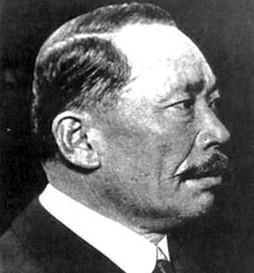 Lock Ah Tam
Murderer · United Kingdom · 1925
Lock Ah Tam was 54 when he killed his wife and two daughters. He had been a suc…
3 victims
Lock Ah Tam
Murderer · United Kingdom · 1925
Lock Ah Tam was 54 when he killed his wife and two daughters. He had been a suc…
3 victims
 Sada Abe
Murderer · Japan · 1936
Sada Abe ( 阿部 定 , Abe Sada ) was a Japanese woman who erotically asphyxiated he…
1 victim
Sada Abe
Murderer · Japan · 1936
Sada Abe ( 阿部 定 , Abe Sada ) was a Japanese woman who erotically asphyxiated he…
1 victim
 Robert Bierenbaum
Murderer · USA · 1985
Robert Bierenbaum was a plastic surgeon who was convicted in October 2000 of mu…
1 victim
Robert Bierenbaum
Murderer · USA · 1985
Robert Bierenbaum was a plastic surgeon who was convicted in October 2000 of mu…
1 victim
 Ronald Jebson
Murderer · United Kingdom · 1970
Ronald Jebson (born 1939) was a convicted pedophile who was also known as Ronal…
3 victims
Ronald Jebson
Murderer · United Kingdom · 1970
Ronald Jebson (born 1939) was a convicted pedophile who was also known as Ronal…
3 victims
 Anthony Ayres
Murderer · United Kingdom · 1993
Anthony Ayres was a 49-year-old man when he was sentenced for the murder of Kel…
2 victims
Anthony Ayres
Murderer · United Kingdom · 1993
Anthony Ayres was a 49-year-old man when he was sentenced for the murder of Kel…
2 victims
 Patrick Burris
Spree killer · USA · 2009
Patrick Tracy Burris (August 8, 1967 – July 6, 2009) was an American spree kill…
5 victims
Patrick Burris
Spree killer · USA · 2009
Patrick Tracy Burris (August 8, 1967 – July 6, 2009) was an American spree kill…
5 victims
- Gender
- male
- Country
- United Kingdom
- Location
- London, England, United Kingdom
- Date of birth
- 1875
- Age at first offence
- 42
- Characteristics
- dismemberment
- Victim profile
- Emilliene Gerard, 32 (his Belgian mistress)
- Method of murder
- Strangulation
- Date(s) of murder
- October 31, 1917
- Years active
- 1917
- Date of arrest
- —
- Status
-
Executed
Executed by hanging in Pentonville prison on March 2, 1918
Background
Louis Voison was a French butcher who worked in London. He was forty two years old at the time of his execution.
Louis Voison had been living in the basement of 101 Charlotte Street. The rent of Mme. Gerard's room in Munster Square was paid by Voisin, and he also had a key to the room. He stated that he called there on 2 November to feed the cat. While there, he told the landlord that Mme Gerard would be away for a week or two and that he was expecting delivery of a sack of potatoes.
Berthe Roche was a woman who was present when police questioned Voison. During the events leading to Mme Gerard’s death, Roche struck Gerard several blows with a poker. Berthe Roches was later tried and found guilty of being an accessory after the fact.
The offence
Emilienne Gerard (32) was a Belgian mistress of Louis Voison. Her husband was away fighting in the French Army. Gerard had been missing since 31 October 1917, when there had been an air raid by German Zeppelins.
On the night of 31 October 1917, during the air raid, Gerard had gone to shelter with Voisin in his basement in Charlotte Street. Once she had arrived, she found Berthe Roche with her lover. Gerard had known Voisin for far longer.
A heated argument occurred. Gerard probably threatened Voisin with exposure, and Roche struck Gerard several blows with a poker. It was felt that Voisin had not struck the blows because, given his expertise and strength, there would have been one powerful blow instead of several blows to Gerard's head.
When Gerard cried out, Voisin grabbed her from behind and smothered her cries with a towel while Roche continued the attack with the poker. After killing her, Gerard’s body was dismembered and some remains were conveyed to Mme Gerard's rooms at Munster Square. Voison then smeared some blood around Gerard’s kitchen and took away a sheet from the bed.
Intending to confuse subsequent investigations, Voison wrote a note that included a spelling mistake and left the sack, sheet and note in Regent Square. The intention was to throw the police of the scent. The head and hands were still recognisable, so they were kept by Voison in his cellar.
Investigation
On an early morning of 2 November 1917, a roadman known as Jack the Sweeper found a bundle in Regent Square, in Bloomsbury. The bundle had been done up in sacking and dropped over the railings of the central garden, the garden tended to by Jack the Sweeper. After untying the bundle, Jack the Sweeper found it contained the trunk and arms of a woman, but the head, legs and hands were all missing.
Jack the Sweeper ran and found a police constable. A further search of the garden in Regent Square found a paper parcel containing both missing legs. There was no sign of the head and both hands. The sacking containing the torso was a meat sack stencilled with the words “Argentina La Plata Cold Storage”. A sheet included a laundry mark sewn in red cotton that read “II H.” With the remains were pieces of course muslin, silk and lace underwear, and a scrap of brown paper on which the words “Blodie Belgiam” were roughly scrawled.
The Metropolitan Police quickly traced the laundry mark to 50 Munster Square, located in the neighbourhood east of Regent's Park. Examination of Gerard's rooms located a number of small bloodstains in both the kitchen and bedroom.
In Gerard's rooms, a table contained an IOU for £50 signed by Louis Voisin, whose portrait also hung over the mantelpiece. Based on the knowledge that the dismemberment had been performed by someone with an understanding of anatomy, the police considered the meat sack wrapping and noted that Voisin was a butcher. They decided to question Voisin.
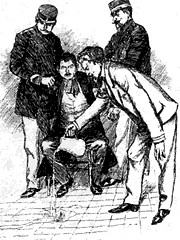
Louis Voison lived in the basement of 101 Charlotte Street, which was less than half a mile from Munster Square and a mile from Regent Square. When the police arrived to question Voisin, he was seated in the kitchen with a woman called Berthe Roche. Both were taken for further questioning at Bow Street Police Station.
Chief Inspector Wensley led the investigation. Chief Inspector Wensley asked Voisin if he would write the phrase “Bloody Belgium”. After some hesitation, Voison wrote the phrase five times and made the identical spelling mistake each time. The handwriting in each example closely matched the example found on the brown paper.
More incriminating evidence was soon discovered. Voison had paid the rent of Mme. Gerard's room in Munster Square and held a key to that room. Voison stated that he called there on 2 November to feed the cat, and he explained to the landlord that Mme Gerard would be away for a week or two and that he was expecting delivery of a sack of potatoes.
Voison's own kitchen was stained, and an earring later identified as Mme Gerard’s was found in a blood-stained towel. Among the keys taken from Voison was that of a coal cellar underneath the pavement of Charlotte Street. In that cellar, police found a cask containing the missing head and both hands.
The pathologist Bernard Spilsbury reconstructed how Mme Gerard died after examining the remains and having visited both Munster Square and Charlotte Street rooms. She had been struck by at least 8 blows on the head and face. These blows had not killed her, though her head was a mess. They were followed by an attempt at strangulation, for which the towel served to muffle her cries; the earring became caught in the towel. Spilsbury confirmed that the dismemberment had been performed by a butcher with a butcher's knife.
After examining the rooms at Munster Square and Charlotte Street, it was evident the later place that the attack had occurred. In the back room there was human blood everywhere, mingled with traces of animal blood. Chiefly it lay in lines and splashes on the floor and wall round a door leading into a back-yard. There was human blood found on the door and the ceiling above the door. There were also further stains of human blood found on the sink and draining board.
Trial
Voisin’s case was tried at the Old Bailey in January. The judge ruled that Berthe Roche should she held on remand. Voison was found guilty of the murder of Mme Gerard.
Voison was sentenced to death by hanging by Mr Justice Darling. He was hanged by John Ellis and Edward Taylor.
She was sentenced to 7 years' imprisonment. She went mad in prison, was committed to a hospital for the insane, and died on 22 March 1919.
Sentencing
Louis Voison was sentenced to death by hanging by Mr Justice Darling.
Outcome
On 2 March 1918, Louis Voisin (aged 42) was executed at London's Pentonville Prison. The Chief Executioner was John Ellis.
Timeline
- 31 October 1917 — An air raid by German Zeppelins occurred; Gerard went to shelter with Voisin in his basement in Charlotte Street, where she was later killed.
- 1 November 1917 — Gerard was missing after 31 October 1917.
- 2 November 1917 — Jack the Sweeper found a bundle in Regent Square containing the trunk and arms of a woman; police traced evidence to 50 Munster Square and questioned Voison; further searches found the missing legs in a paper parcel.
- January — Voison was convicted at the Old Bailey.
- 2 March 1918 — Louis Voison was executed at Pentonville Prison.
- 22 March 1919 — Berthe Roche died in a hospital for the insane.
Other details
A bag containing the remains also contained a crude note scrawled on a scrap of paper and planted with the intention of throwing the police of the scent; it assisted the police because, when Voison wrote the words that appeared on the note, his handwriting and poor spelling matched. The note included the words “Blodie Belgiam”.
The sacking containing the torso was stencilled “Argentina La Plata Cold Storage”. The laundry mark read “II H.” The scrap of brown paper had the words “Blodie Belgiam”.
During the questioning at Bow Street Police Station, Berthe Roche understood little English, and a police officer who spoke French was used during the questioning. Voison spoke broken English. He was described as a powerfully-built man, short and thick-set, with a heavy jaw and dark upturned moustaches.
Voison wrote the phrase “Bloody Belgium” five times and made the identical spelling mistake each time. His handwriting closely matched the example found on the brown paper.

Spotted an error, or have more information about this case?