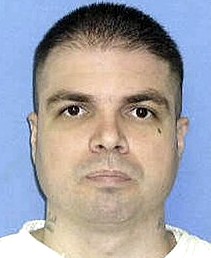
Yosvanis Valle
Murderer Russell Ellwood
Murderer · USA · 1991
Russell Ellwood was a former taxi driver. Authorities suspected him of killing…
20 victims
Russell Ellwood
Murderer · USA · 1991
Russell Ellwood was a former taxi driver. Authorities suspected him of killing…
20 victims
 Robert Martines Perez
Murderer · USA · 1994
Name: Robert Martines Perez · Other name used in proceedings: Robert Martinez P…
15 victims
Robert Martines Perez
Murderer · USA · 1994
Name: Robert Martines Perez · Other name used in proceedings: Robert Martinez P…
15 victims
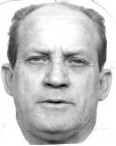 Billy Frank Vickers
Murderer · USA · 1993
Billy Frank Vickers Vickers was executed by lethal injection in Texas on Januar…
14 victims
Billy Frank Vickers
Murderer · USA · 1993
Billy Frank Vickers Vickers was executed by lethal injection in Texas on Januar…
14 victims
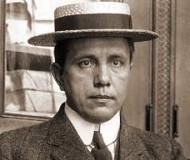 Harry Thaw
Murderer · USA · 1906
Harry Kendall Thaw (February 12, 1871 - February 22, 1947) was the son of Pitts…
1 victim
Harry Thaw
Murderer · USA · 1906
Harry Kendall Thaw (February 12, 1871 - February 22, 1947) was the son of Pitts…
1 victim
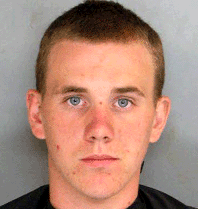 Nathaniel Dickson
Mass murderer · USA · 2008
Nathaniel Casey Dickson was 20 years old when he pleaded guilty and was sentenc…
4 victims
Nathaniel Dickson
Mass murderer · USA · 2008
Nathaniel Casey Dickson was 20 years old when he pleaded guilty and was sentenc…
4 victims
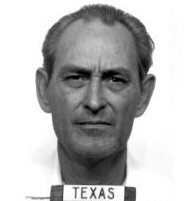 Doyle Skillern
Murderer · USA · 1974
Doyle Edward Skillern was a Texas state prisoner who was executed by lethal inj…
1 victim
Doyle Skillern
Murderer · USA · 1974
Doyle Edward Skillern was a Texas state prisoner who was executed by lethal inj…
1 victim
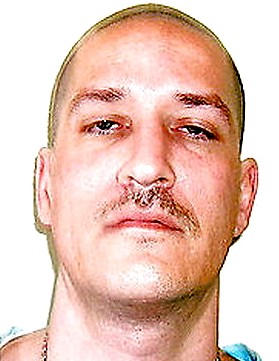 Michael William Lenz
Murderer · USA · 2000
Michael William Lenz was convicted of capital murder for the willful, deliberat…
1 victim
Michael William Lenz
Murderer · USA · 2000
Michael William Lenz was convicted of capital murder for the willful, deliberat…
1 victim
 Kelvin Jordan
Murderer · USA · 1995
Kelvin Jordan (also known as Kelvin L. Jordan) was convicted of capital murder…
2 victims
Kelvin Jordan
Murderer · USA · 1995
Kelvin Jordan (also known as Kelvin L. Jordan) was convicted of capital murder…
2 victims
 Amanda Kaur
Murderer · USA · 2010
Amanda Kaur was 28 at sentencing and was a mother of two. Her husband, 26-year-…
1 victim
Amanda Kaur
Murderer · USA · 2010
Amanda Kaur was 28 at sentencing and was a mother of two. Her husband, 26-year-…
1 victim
- Gender
- male
- Country
- USA
- Location
- Harris County, Texas, USA
- Date of birth
- September 7, 1975
- Age at first offence
- 24
- Characteristics
- robbery, gangs
- Victim profile
- Jose “Yogi” Junco, 28 ( known drug dealer) / Raymond Duenas / Carlos Escamilla / Gregory García (gang related murders)
- Method of murder
- Shooting
- Date(s) of murder
- June/August, 1999
- Years active
- 1999
- Date of arrest
- —
- Status
-
Executed
Executed by lethal injection on November 10, 2009 in Texas
Background
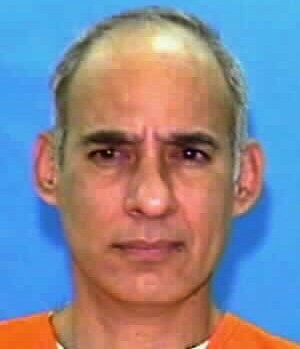
Yosvanis Valle was born on 09/07/1975. He was a Hispanic male and was from Havana, Cuba. At the time of the offense on 06/07/1999, he was 23. He later grew up in Cuba and came to the United States at age 14 to join his father. That move was nearly a decade after his father had been expelled from Cuba and came to the United States as part of the Marielitos immigration wave in 1980.
Valle had an education of 8 years. His occupation included construction, carpentry, and laborer.
The offence
On 06/07/1999 in Pasadena, Valle forced his way into a 28-year-old Hispanic male victim’s residence at gunpoint. The victim was robbed and shot several times, resulting in his death.
Valle met with four other men on 06/07/1999 to discuss robbing Jose “Yogi” Junco, a known drug dealer. Valle led the meeting and assigned roles to the participants. The group understood that because Junco would see one of the men’s faces, someone would have to kill Junco.
Sometime around 11 p.m., Junco’s girlfriend heard dogs barking outside of their house and saw men outside whom she assumed wanted to buy drugs. Junco went outside but soon returned with his hands in the air, followed by four or five men with guns. Junco told his girlfriend not to look at the men, and one of them covered her face. The men argued with Junco about drugs and money, then shot him eight or nine times.
Amy Lindgren testified that she and her one-year-old daughter lived at Junco’s house and were present at the time of the murder. Lindgren was on the couch in the living room, her daughter was sleeping in a playpen in the back bedroom, and Junco was in the bathroom when, at about 11:00 p.m., Lindgren heard a car honk its horn, which was usually a signal that someone wanted to buy cocaine. Junco went out the front door and came back with his hands up with a man following behind with a gun to Junco’s back. Junco told Lindgren not to look at the men, but she looked at one, whom she later identified as Estrada. Estrada threatened Lindgren and pointed his gun at her. A pillow was placed over her head, she was moved to the floor, and a blanket was thrown on top of her. She then heard yelling, several gunshots, the men running out of the house, and a car driving away. Lindgren went to the bedroom, found her daughter unharmed, and saw Junco still alive, kneeling by the bed with gunshot wounds to his back and neck. She then called 911.
According to testimony about the meeting at Valle’s apartment, on 06/07/1999 a meeting took place at Valle’s apartment between Valle, Valdez, Arenazas, a man named Flaco, and Estrada. Also present were Valle’s girlfriend, Christina, and Estrada’s girlfriend, Anna Sanchez. Arenazas testified that he met Estrada in February or March 1999 and “ran with” Estrada, Fernando Valdez, and Yosvanis Valle, who was considered the leader of the group. Arenazas testified that, at the meeting, he had a .357 magnum revolver, Valle had a 9 millimeter pistol, and Estrada had a small chrome .22 caliber pistol. During the meeting, Valle announced that Estrada had shown some weakness and Valle wanted to test Estrada to “see if he had any heart.” Estrada proposed that the men rob Junco because Estrada knew Junco kept money and narcotics at his house. Valle told Estrada that Estrada must follow through with the plan or Arenazas would “take care of him.” Arenazas took this to mean that he would have to shoot Estrada. Estrada told Valle he was committed to going through with the robbery and he would kill Junco if Junco recognized Estrada. Arenazas further testified that he was assigned as the driver of the car for the robbery and he gave his .357 revolver to Estrada. Arenazas, Valdez, Flaco, Valle and Estrada drove to Junco’s house and honked the car’s horn. Junco came outside, and Estrada got out of the car, approached Junco, and asked him for an “eight-ball,” or $100 worth of cocaine. When Valle got out of the car, Estrada pulled out his gun and pointed it at Junco. Valdez, Flaco, Valle and Estrada forced Junco back into the house. After about five minutes, Arenazas heard multiple gunshots and saw the men come running out of the house. On the drive back to Valle’s apartment, Valle asked Estrada if he shot Junco. Estrada showed them a sock he had on his hand with a hole in it as proof he fired his gun. Valle boasted that he shot Junco ten times, but he was angry that they only had stolen $100 and a quarter ounce of cocaine. After the men returned to the apartment, Arenazas took back the .357 revolver and saw that only one shot had been fired by Estrada.
Estrada’s girlfriend, Anna Sanchez, testified that she and Estrada were living with Valle at the time of the murder. During the January 7, 1999 meeting, she heard Estrada suggest robbing Junco. She had previously heard Valle tell Estrada that if he was going to stay in his house, he would have to rob people and do whatever Valle told him to do. Sanchez testified that Estrada told her that Valle had previously threatened to kill Estrada if he did not do what Valle wanted. After the shooting, Estrada told Sanchez he shot his gun at Junco but was not certain that the bullet had hit Junco. After Estrada was in jail, he asked Sanchez to lie about his activities on the night of the murder, make up an alibi that he was with another man, and state that she and Estrada were in a common law marriage. Although he asked her to refuse to testify, she testified voluntarily. Estrada did not testify.
After the men drove away, Lindgren stayed on the floor until the men left, then discovered Junco’s dead body and called 9-1-1.
The assailants stole two rifles and a cookie tin containing money, drugs, and sexually explicit photographs. Valle commented on the small amount of drugs they stole. Valle bragged that he emptied his entire clip into Junco. Evidence also indicated that Estrada shot the victim once. Valle was identified as the shooter in trial testimony, and Valle admitted that he “was the one that really shot Junco.”
Investigation and arrest
Based on a tip, police conducted a lineup, where Junco’s girlfriend identified one of the murderers.
Valle was arrested when his fingerprint was found in a car tied to another slaying, one of several authorities tied to him. Valle was arrested two months after the killing when he went to Pasadena to bail a fellow gang member of out jail. Valle was unaware that his friend had implicated him in the murder. When Valle learned of the arrest of one of his accomplices, he was amused and admitted that he “was the one that really shot Junco.”
Trial
A Harris County jury convicted Valle and sentenced him to death.
On April 24, 2001, a Harris County jury convicted Valle and sentenced him to death for the capital murder of Jose Junco. The Texas Court of Criminal Appeals affirmed Valle’s conviction. The Court of Criminal Appeals also denied Valle’s state habeas application.
At Valle’s punishment hearing, prosecutors presented evidence linking Valle to three other murders and evidence that Valle was a member of a prison gang operating both inside and outside the prison system. The prosecution also presented evidence that Valle had possession of a “shank,” or homemade knife, during pretrial detention. The jury heard evidence regarding Valle’s extensive criminal history, including juvenile and misdemeanor weapons-related convictions.
The jury was asked special issues under Texas Code of Criminal Procedure art. 37.071 §§ 2(b) and 2(e). The direct appeal record described challenges to the constitutionality of the Texas death penalty scheme, sufficiency review of special issues, jury selection procedures, and evidentiary rulings.
During the punishment-phase evidentiary dispute, the trial court excluded an audio portion of a videotaped interview of Valle’s mother and the transcript of that interview. Valle argued admissibility as a basis for expert testimony, admissibility under Texas Rule of Evidence 804 as a statement of personal or family history, and due process violations based on the exclusion. The Court of Criminal Appeals found that the videotaped interview was hearsay and that the excluded matters did not fall within Rule 804(b)(3). The Court of Criminal Appeals also addressed a balancing analysis under Texas Rule of Evidence 705(d) and ruled that the trial court did not abuse discretion by declining to admit the evidence under Rule 705. The Court of Criminal Appeals further addressed due process arguments and concluded points of error fourteen through sixteen were overruled.
The Court of Criminal Appeals also addressed a complaint regarding the court reporter’s failure to record bench conferences. The opinion included the following exchange during the punishment phase:
Mr. Goodhart: Judge, at this time, the state would move to introduce States's exhibit 36, 37, 39 through 41. (State's Exhibit(s) No. 36, 37, 39 through 41 offered) (discussion off the record between defense and prosecutor)
Mr. Morrow: May we approach, your Honor?
The Court: You may. (At the bench, off the record) (Open court, defendant and jury present)
Mr. Morrow: Judge, subject to the argument we made at the bench, we have no objections to 36, 40, 41, and 37.
The Court: They will be admitted into evidence. (State's Exhibit(s) No. 36, 37, 39 through 41 admitted)
The Court of Criminal Appeals held the record did not reflect Valle made an objection to the court reporter’s failure to record the bench conferences and that Valle failed to preserve the complaint.
The Court of Criminal Appeals also addressed relevance testimony and included trial testimony about fear:
Q. Are you scared about testifying against Cubano?
A. Yes, sir.
Q. Are you in fear of your life?
Mr. Cunningham: I object to relevance, Your Honor.
The Court: That will be overruled.
Q. (By Mr. Goodhart) What did you say?
Q. Listen carefully. Sometime after August 15th of 1999, did you approach the police?
Q. Why did you approach the police and with what?
A. I was scared.
Q. Scared of what?
A. That maybe I was going to be killed.
The Court of Criminal Appeals affirmed the trial court’s judgment.
Sentencing
On April 24, 2001, Valle was sentenced to death.
Appeals
The Texas Court of Criminal Appeals affirmed Valle’s conviction and sentence on direct appeal.
A U.S. district court denied federal habeas relief and a certificate of appealability (COA). The United States Court of Appeals for the Fifth Circuit also denied COA.
The United States Supreme Court denied certiorari review on April 27, 2009.
In state habeas proceedings, a Texas Court of Criminal Appeals per curiam order on December 7, 2005 denied relief. The order stated that the trial judge had entered findings of fact and conclusions of law and recommended denial; the Court adopted them and denied the relief sought.
In federal habeas proceedings, a per curiam opinion dated in 2008 denied a COA and described three claims: (1) ineffective assistance of counsel based on failure to obtain a psychological evaluation and present evidence of PTSD, (2) due process challenge to exclusion of the audio and transcript of the interview with Valle’s mother, and (3) Eighth Amendment challenge to Texas’s capital-sentencing statutory scheme. The Fifth Circuit denied the petition for a certificate of appealability.
Other criminal history and related conduct presented at trial
The jury heard evidence regarding Valle’s extensive criminal history:
- Valle was convicted for aggravated assault with bodily injury using a deadly weapon as a juvenile on December 8, 1991.
- Valle went to jail for ten days in July 1993 for unlawfully carrying a weapon.
- Valle went to state prison for an eight-year sentence on November 11, 1993, for possession of a prohibited weapon.
- He received thirty days in jail on February 4, 1999, for failure to identify himself to a police officer.
- While awaiting trial for the capital murder, the Harris County Sheriff’s Department found a homemade weapon hidden in Valle’s mattress in his jail cell.
- Valle had numerous disciplinary problems while incarcerated in the Texas Youth Commission and state prison.
- Valle was a member of a prison gang operating both inside and outside the prison system.
The jury also heard evidence regarding prior acts of violence, gang membership, and murder:
- Valle orchestrated the August 5, 1999 murder of gang member Raymond Duenas so Valle could take control of the gang’s operations in Houston.
- On August 15, 1999, Valle arranged the murder of Carlos Escamilla.
- On August 22, 1999, Valle pulled out a sawed-off shotgun in a parking lot of a convenience store and fatally shot Gregory Garcia.
Valle was not charged with Garcia’s slaying in the capital murder case for Jose Junco. Prosecutors presented Garcia’s slaying to the jury to show propensity for violence, which jurors had to consider in punishment.
Outcome
The Texas Attorney General announced that Valle was scheduled for execution after 6 p.m. on November 10, 2009.
Valle was executed by lethal injection on November 10, 2009 in Texas. He was pronounced dead at 6:21 p.m., nine minutes after the lethal drugs began flowing.
In the death chamber, Valle spoke to witnesses alternately in English and Spanish and made statements including:
“I blame myself. I am not going to blame nobody,” he said. “I understand why I am paying this price. I am sorry with all my heart.”
“I never wanted to kill your family,” he said. “I was forced to do it. I was a gang member.”
Valle also said:
“My people turned on me,” he told The Associated Press recently from a small visiting cage outside death row. “I know one thing: I know the person I am. I'm not this monster that the state of Texas is trying to make me look like.”
Another report included statements:
“I'm not going to blame nobody; I'm going to blame myself,” Valle said from the death chamber gurney, speaking alternately in English and Spanish. “I'm sorry from all my heart. "That's the reality of life. I am sorry. I got to pay for it."
He addressed the parents of a man whose death he was blamed for but for whose killing he was not convicted.
“I was forced to do it,” he said. “I was a gang member.”
He apologized for his broken English, thanked the warden and chaplain and expressed loved to everyone.
“I feel good. I love my family. I love you Jesus,” he said.
“I am sorry with all my heart,” Valle said in his last statement. “That's the reality of life. I am sorry. I got to pay for it.”
Concluding his statement, he told the warden, “I am ready.”
Members of Valle’s family and relatives of Gregory Garcia attended the execution. Jose Junco’s relatives did not attend.
Timeline
- June 7, 1999 — Valle forced his way into Jose “Yogi” Junco’s residence in Pasadena, robbed him, and Junco was shot eight or nine times, resulting in his death.
- April 24, 2001 — A Harris County jury convicted Valle of capital murder and sentenced him to death.
- April 27, 2009 — The United States Supreme Court denied certiorari review.
- November 10, 2009 — Valle was executed by lethal injection in Texas and pronounced dead at 6:21 p.m.
Other details
- Valle’s Texas Department of Criminal Justice (TDCJ) number was 999384.
- The Texas Attorney General media advisory said Valle was scheduled to be executed after 6 p.m. on November 10, 2009.
- The procedural history included automatic direct appeal and denial of state habeas, federal habeas, and certificate of appealability requests, as well as denial of certiorari review.
- Valle’s prior prison record included #714912 on an 8-year sentence from Harris County for one count of possession of a firearm; he was released on mandatory supervision on 05/09/1997.
- Co-defendants were listed as none in the case summary.
Spotted an error, or have more information about this case?