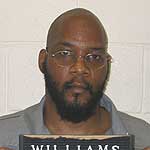
Marcellus Williams
Murderer Russell Ellwood
Murderer · USA · 1991
Russell Ellwood was a former taxi driver. Authorities suspected him of killing…
20 victims
Russell Ellwood
Murderer · USA · 1991
Russell Ellwood was a former taxi driver. Authorities suspected him of killing…
20 victims
 Robert Martines Perez
Murderer · USA · 1994
Name: Robert Martines Perez · Other name used in proceedings: Robert Martinez P…
15 victims
Robert Martines Perez
Murderer · USA · 1994
Name: Robert Martines Perez · Other name used in proceedings: Robert Martinez P…
15 victims
 Billy Frank Vickers
Murderer · USA · 1993
Billy Frank Vickers Vickers was executed by lethal injection in Texas on Januar…
14 victims
Billy Frank Vickers
Murderer · USA · 1993
Billy Frank Vickers Vickers was executed by lethal injection in Texas on Januar…
14 victims
 Sharon Carr
Homicide · United Kingdom · 1992
Sharon Louis Carr was born 21 December 1979. She was twelve years old when she…
1 victim
Sharon Carr
Homicide · United Kingdom · 1992
Sharon Louis Carr was born 21 December 1979. She was twelve years old when she…
1 victim
 Clinton Bankston
Homicide · USA · 1987
15 August 1987 — Ann Morris (63), her sister Sally Nicholson (59), and Sally’s…
5 victims
Clinton Bankston
Homicide · USA · 1987
15 August 1987 — Ann Morris (63), her sister Sally Nicholson (59), and Sally’s…
5 victims
 Morris Solomon
Serial killer · USA · 1986
Morris Solomon was an Oak Park handyman and serial killer. He was convicted of…
7 victims
Morris Solomon
Serial killer · USA · 1986
Morris Solomon was an Oak Park handyman and serial killer. He was convicted of…
7 victims
 Wayne DuMond
Murderer · USA · 1972
Wayne Eugene DuMond (September 10, 1949 - August 31, 2005) was an American crim…
3 victims
Wayne DuMond
Murderer · USA · 1972
Wayne Eugene DuMond (September 10, 1949 - August 31, 2005) was an American crim…
3 victims
 Caryl Chessman
R obber and rapist · USA · 1947
Caryl Whittier Chessman (May 27, 1921 in St. Joseph, Michigan – May 2, 1960 at…
0 victims
Caryl Chessman
R obber and rapist · USA · 1947
Caryl Whittier Chessman (May 27, 1921 in St. Joseph, Michigan – May 2, 1960 at…
0 victims
 Elizabeth Ramsey
Murderer · USA · 2011
Elizabeth Ramsey was the 33-year-old stepmother of Johnathan Ramsey. Johnathan…
1 victim
Elizabeth Ramsey
Murderer · USA · 2011
Elizabeth Ramsey was the 33-year-old stepmother of Johnathan Ramsey. Johnathan…
1 victim
- Gender
- male
- Country
- USA
- Location
- St. Louis City, Missouri, USA
- Date of birth
- December 30, 1968
- Age at first offence
- 30
- Characteristics
- robbery, kidnapping
- Victim profile
- Felicia Gayle
- Method of murder
- St abbing with a large butcher knife 43 times
- Date(s) of murder
- August 11, 1998
- Years active
- 1998
- Date of arrest
- November 1999
- Status
-
Sentenced to death
Sentenced to death on March 31, 2000
Parties and case identifiers
Marcellus Williams was convicted in the State of Missouri case styled State of Missouri, Respondent v. Marcellus Williams, Appellant (Case Number: SC83934). The handdown date was 14/01/2003. The appeal came from the Circuit Court of St. Louis County, Hon. Emmett M. O'Brien. The counsel for appellant was Rosemary E. Percival, and the counsel for respondent was Evan J. Buchheim.
Timeline
- August 11, 1998 — Williams drove his grandfather’s Buick LeSabre to a bus stop, caught a bus to University City, looked for a house to break into, and attacked Felicia Gayle in her home.
- A day or two after the murder (date not specified) — Williams sold the laptop computer to Glenn Roberts.
- The next day (date not specified) — Laura Asaro retrieved clothes from the trunk of the Buick; she snatched a purse and found Felicia Gayle’s Missouri state identification card and a black coin purse.
- On August 31, 1998 — Williams was arrested on unrelated charges and incarcerated at the St. Louis City workhouse.
- From April until June 1999 — Williams shared a room with Henry Cole.
- In May 1999 (date not specified) — After watching a television news report about Gayle’s murder, Williams told Henry Cole that he had committed the crime.
- In June 1999 (after Cole was released from jail; date not specified) — Cole went to the University City police and told them about Williams’ involvement in Gayle’s murder.
- In November 1999 (date not specified) — University City police approached Asaro to speak with her about the murder.
- The next day after the November 1999 approach (date not specified) — Police searched the Buick LeSabre and found the Post-Dispatch ruler and calculator belonging to Gayle, and recovered the laptop computer from Glenn Roberts.
- January 28, 2000 (date used in aggravator findings) — Williams was convicted of first degree robbery and armed criminal action in the Circuit Court of the City of St. Louis.
- April 13, 1998 (date used in aggravator findings) — Williams was convicted of second degree assault in the Circuit Court of the City of St. Louis.
- May 25, 2001 (date used in aggravator findings) — Williams was convicted of first degree robbery and armed criminal action in the Circuit Court of the City of St. Louis.
- March 4, 2003 — The opinion was modified by the court’s own motion on March 4, 2003; this substitution did not constitute a new opinion.
- 14/01/2003 — The Supreme Court of Missouri handdown date for the opinion.
- March 31, 2000 — Williams was sentenced to death on the murder conviction.
Background
On direct appeal, the Supreme Court of Missouri accepted as true all evidence favorable to the verdict, including all favorable inferences from the evidence.
Williams was tried for Felicia Gayle’s murder and convicted. He was sentenced to death on the murder conviction.
The offence
Entry and attack
On August 11, 1998, Williams drove his grandfather’s Buick LeSabre to a bus stop and caught a bus to University City. He began looking for a house to break into and came across the home of Felicia Gayle. Williams knocked on the front door but no one answered. He knocked out a window pane near the door, reached in, unlocked the door, and entered Gayle’s home.
Williams went to the second floor and heard water running in the shower. It was Gayle. He went back downstairs, rummaged through the kitchen, found a large butcher knife, and waited. Gayle left the shower and called out, asking if anyone was there. She came down the stairs. Williams attacked Gayle by stabbing and cutting her forty-three times, inflicting seven fatal wounds.
After the attack: cleaning and concealment
Afterwards, Williams went to an upstairs bathroom and washed off. He took a jacket and put it on to conceal the blood on his shirt. Before leaving, he placed Gayle’s purse and her husband’s laptop computer and black carrying case in his backpack. The purse contained, among other things, a St. Louis Post-Dispatch ruler and a calculator. Williams left out the front door and caught a bus back to the Buick.
After returning to the car, Williams picked up his girlfriend, Laura Asaro. Asaro noticed that, despite the summer heat, Williams was wearing a jacket. When he removed the jacket, Asaro noticed that Williams’ shirt was bloody and that he had scratches on his neck. Williams claimed he had been in a fight.
Later in the day, Williams put his bloody clothes in his backpack and threw them into a sewer drain, claiming he no longer wanted them. Asaro also saw a laptop computer in the car.
Threats to Asaro and alleged motive
Asaro demanded that Williams explain why he had Gayle’s purse. Williams confessed that the purse belonged to a woman he had killed. He explained in detail how he went into the kitchen, found a butcher knife, and waited for the woman to get out of the shower. He further explained that when the woman came downstairs from the shower, he stabbed her in the arm and then put his hand over her mouth and stabbed her in the neck, twisting the knife as he went. After relaying details of the murder, Williams grabbed Asaro by the throat and threatened to kill her, her children, and her mother if she told anyone.
Investigation
Sale of the laptop and recovery of items
A day or two after the murder, Williams sold the laptop to Glenn Roberts. The next day, Asaro went to retrieve some clothes from the trunk of the car. Williams did not want her to look in the trunk and tried to push her away. Before he could, Asaro snatched a purse from the trunk and looked inside. She found Gayle’s Missouri state identification card and a black coin purse.
The day after Cole’s release from jail in June 1999, he went to the University City police and told them about Williams’ involvement in Gayle’s murder, reporting details of the crime that had never been publicly reported. In November 1999, University City police approached Asaro to speak with her about the murder. Asaro told the police that Williams admitted to her that he had killed Gayle.
The next day, police searched the Buick LeSabre and found the Post-Dispatch ruler and calculator belonging to Gayle. The police also recovered the laptop computer from Glenn Roberts. The laptop was identified as the one stolen from Gayle’s residence.
Items and locations described
The investigation included the Buick LeSabre and items later found there, including:
- the St. Louis Post-Dispatch ruler,
- a calculator,
- Gayle’s Missouri state identification card, and
- a black coin purse.
Police recovered Gayle’s husband’s laptop computer from Glenn Roberts.
Arrest and custody
On August 31, 1998, Williams was arrested on unrelated charges and incarcerated at the St. Louis City workhouse. From April until June 1999, Williams shared a room with Henry Cole.
Statements and witness accounts
Williams’ confession to Laura Asaro
After Asaro snatched Gayle’s purse from the trunk, she demanded an explanation. Williams confessed and provided detailed description of entering the kitchen, finding a butcher knife, waiting for Gayle to get out of the shower, stabbing Gayle in the arm, putting his hand over her mouth, stabbing her in the neck, and twisting the knife as he went. Williams then threatened to kill Asaro, her children, and her mother if she told anyone.
Williams’ statements to Henry Cole
One evening in May (during Williams’ shared room with Cole), Cole and Williams were watching television and saw a news report about Gayle’s murder. Shortly after the news report, Williams told Cole that he had committed the crime. Over the next few weeks, Cole and Williams had several conversations about the murder. Williams went into considerable detail about how he broke into the house and killed Gayle.
After Cole was released from jail in June 1999, he went to the University City police and told them about Williams’ involvement in Gayle’s murder, including details that had never been publicly reported.
Trial
Charges and verdict
Williams was tried for:
- one count of first-degree murder,
- first-degree burglary,
- first-degree robbery,
- and two counts of armed criminal action.
The jury found him guilty of each count and recommended the death penalty for the murder conviction.
Evidence issues raised on appeal
Williams alleged ten points of trial court error relating to evidentiary rulings, voir dire, instructional error, and closing argument. He did not challenge the sufficiency of the evidence.
Sentencing
Williams was sentenced to death on the murder conviction.
During the penalty phase, the state offered victim impact evidence from seven witnesses. The state also introduced photos of Gayle and her family, programs from the memorial service, birthday and holiday cards Gayle had sent her family, and a letter Gayle wrote concerning the disposition of her personal items in the event of her death.
The jury found ten statutory aggravating circumstances, including:
- Whether the murder involved depravity of mind,
- Whether the murder was committed during a burglary,
- Whether the murder was committed during a robbery,
- Whether Williams murdered Gayle in order to receive money or something of value from her,
- Whether the murder was committed in order to prevent the lawful arrest of Williams,
- Whether Williams was convicted of second degree assault on April 13, 1998, in the Circuit Court of the City of St. Louis,
- Whether Williams was convicted of first degree robbery on January 28, 2000, in the Circuit Court of the City of St. Louis,
- Whether Williams was convicted of armed criminal action on January 28, 2000 in the Circuit Court of the City of St. Louis,
- Whether Williams was convicted of first degree robbery on May 25, 2001 in the Circuit Court of the City of St. Louis,
- Whether defendant was convicted of armed criminal action in the Circuit Court of the City of St. Louis on May 25, 2001.
The court’s independent review required determination under Section 565.035 of Missouri whether the sentence was imposed under the influence of passion, prejudice, or any other arbitrary factor; whether the evidence supports the jury’s findings of a statutory aggravating circumstance; and whether the sentence of death was excessive or disproportionate in comparison to penalties imposed in similar cases.
Appeals
The judgment was affirmed. The Supreme Court of Missouri conducted review and held:
- The court did not abuse its discretion in preventing Williams from soliciting self-serving hearsay evidence during his cross-examination of the man to whom he sold the laptop computer. Because the state did not introduce into evidence any statements or confessions Williams made to the man during the sale of the laptop, the rule of completeness did not apply.
- The court properly allowed the state to admit evidence that Williams tried to escape from the workhouse after he was indicted on charges that included Gayle’s murder, even though the escape attempt and accompanying assault on a guard may constitute a separate uncharged crime. The escape attempt was admissible to bear on Williams' consciousness of guilt as to the pending charges.
- The court did not clearly err in admitting evidence of items found in a warrantless search of Williams' grandfather's car. The grandfather told police he owned the car and gave permission for the search after police told him that Williams was a suspect in a crime.
- Williams failed to object during the penalty phase to what he argued was excessive victim impact evidence elicited by the state. This evidence was admissible and was not so prejudicial as to render the trial fundamentally unfair. Evidence of the circumstances of Williams' prior convictions also was admitted properly during the penalty phase as aggravating evidence.
- Williams had not shown manifest injustice resulting from the prosecutor's use, during jury selection, of a "three-door analogy" to explain the decision-making process in a death penalty case. The prosecutor explained the analogy was not an instruction on the law, and the court properly instructed the jury about what findings it had to make before it could return a death sentence.
- The court properly overruled Williams’ Batson challenges to the state's peremptory strike of three African-American prospective jurors. The prosecutor offered race-neutral reasons and Williams did not prove pretext or that the strikes were racially motivated.
- The court failed to provide the jury with a written instruction about taking notes, but this was not plain error because the court read the jury the proper instruction and no miscarriage of justice occurred.
- The court properly refused to submit a statutory mitigating instruction enabling the jury to find that Williams was an accomplice in or only played a minor role in the crime. The evidence did not support such an instruction.
- The court did not err in submitting an instruction listing 10 statutory aggravating circumstances. The jury found that all 10 circumstances existed. Ring v. Arizona did not apply because the jury determined the existence of the aggravating factors by determining whether he had been convicted of the previous crimes listed.
- The court did not err in not stopping the prosecutor's closing argument explaining why Williams' girlfriend was afraid to come forward and tell anyone what Williams had confessed to her. Williams did not demonstrate prejudice warranting reversal regarding the prosecutor's closing arguments.
- The punishment imposed was not the product of passion, prejudice, or any other arbitrary factor. The evidence supported, beyond a reasonable doubt, the existence of at least one statutory aggravating factor. The death sentence was neither excessive nor disproportionate compared with punishment imposed in similar cases.
Opinion author was Richard B. Teitelman, Judge. The vote was AFFIRMED, and all concur.
Opinion modified by the court’s own motion
The opinion stated: “Opinion modified by Court's own motion on March 4, 2003. This substitution does not constitute a new opinion.”
Other details
Evidence concerning the laptop sale (rule of completeness)
During the guilt phase, the state elicited testimony from Glenn Roberts that Williams sold him the laptop in August of 1998. On cross-examination, defense counsel attempted to elicit hearsay testimony from Roberts regarding Williams’ alleged statement that he was selling the laptop on behalf of Laura Asaro. The prosecutor objected, and the trial court sustained the objection.
The trial court dialogue included these verbatim portions:
- “[Defense Counsel]: Judge, it is relevant as to what the agreement was and who he actually believed was in ownership or possession of this computer. It goes to the completeness doctrine.”
- “[COURT]: Who had possession? To his state of mind who was in possession of the computer?”
- “[DEFENSE COUNSEL]: Who was in possession of the computer. [Roberts] is going to say that he received the computer on behalf of Marcellus through Laura. Laura -- this witness is going to say it was Laura that --”
- “[COURT]: How would we know that?”
- “[DEFENSE COUNSEL]: Because Marcellus told him that.”
- “[COURT]: Then Marcellus can tell us that. You are attempting to get in self-serving hearsay statements. The objection is sustained.”
The appellate discussion indicated that the prosecutor did not ask Roberts about statements Williams made to him during the sale, and the questions were limited to the mechanics of the transaction.
Escape evidence and guard assault
The state’s evidence described that Williams attempted to escape approximately three weeks after he had been indicted on multiple charges, including first-degree murder of Felicia Gayle. The state’s evidence also described that on the day of the attempted escape, Williams had been sentenced to twenty years in prison on separate charges. During the escape, Williams assaulted a guard with a metal bar, and the state introduced testimony describing the assault and injuries inflicted on the guard.
Warrantless search consent
Williams moved to suppress evidence of the Post-Dispatch ruler and calculator seized during a warrantless search of the Buick he was driving on the day of the murder. The police relied upon consent given by Williams’ grandfather, Walter Hill. The appellate discussion stated that the police went to Hill’s residence, informed him that Williams was a suspect in a crime, asked for permission to search the Buick parked on a lot adjacent to Hill’s residence, and Hill stated that he was the owner of the vehicle and consented to the search.
Voir dire and instructional rulings
The court addressed Williams’ arguments regarding:
- the three-door analogy used during voir dire,
- Batson challenges to three African-American prospective jurors,
- juror notetaking where the written instruction had not been provided but the instruction was read to the jury,
- refusal of a statutory mitigating accomplice instruction,
- and submission of an instruction listing 10 statutory aggravating circumstances.
Closing argument issues
The court addressed Williams’ claims regarding:
- a closing argument in which the prosecutor asked jurors to imagine fear Laura Asaro must have felt as Williams choked her and threatened her not to tell anyone about his confession, and
- an argument that Williams was the “judge, jury and executioner,” including Williams’ challenge that it was an improper commentary on his constitutional right to remain silent.
Independent review conclusions
The appellate court concluded that the punishment imposed was not the product of passion, prejudice, or any other arbitrary factor, that the evidence supported statutory aggravating circumstances, and that the death sentence was not excessive or disproportionate compared to similar cases. Williams was characterized in this context as having confessed to the murder, and the crime was described as involving a vicious attack during a burglary, with Williams having a lengthy and violent criminal record.


Spotted an error, or have more information about this case?