
Christa Pike
Murderer Megan Huntsman
Murderer · USA · 1996
Megan Huntsman was 40 at sentencing. She was a mother of three children who wer…
6 victims
Megan Huntsman
Murderer · USA · 1996
Megan Huntsman was 40 at sentencing. She was a mother of three children who wer…
6 victims
 Angela Johnson
Murderer · USA · 1993
Angela Jane Johnson was convicted in federal court of aiding and abetting the m…
5 victims
Angela Johnson
Murderer · USA · 1993
Angela Jane Johnson was convicted in federal court of aiding and abetting the m…
5 victims
 Catherine May Wood
Murderer · USA · 1987
Catherine May Wood was an American caregiver who worked at the Alpine Manor Nur…
5 victims
Catherine May Wood
Murderer · USA · 1987
Catherine May Wood was an American caregiver who worked at the Alpine Manor Nur…
5 victims
 Michele Kalina
Murderer · USA · 1996
Michele Kalina pleaded guilty to murder for one of five infants she initially w…
5 victims
Michele Kalina
Murderer · USA · 1996
Michele Kalina pleaded guilty to murder for one of five infants she initially w…
5 victims
 Amy Bishop
Murderer · USA · 1986
Amy Bishop — biology professor and perpetrator · James Anderson — Bishop’s husb…
4 victims
Amy Bishop
Murderer · USA · 1986
Amy Bishop — biology professor and perpetrator · James Anderson — Bishop’s husb…
4 victims
 Susan Eubanks
Murderer · USA · 1996
Susan Dianne Eubanks, also referred to as Susan Eubanks, was convicted by a jur…
4 victims
Susan Eubanks
Murderer · USA · 1996
Susan Dianne Eubanks, also referred to as Susan Eubanks, was convicted by a jur…
4 victims
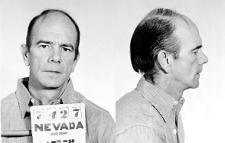 Earl Lewis Steward
Murderer · USA · 1957
Earl Lewis Steward was executed by asphyxiation-gas in Nevada on February 24, 1…
1 victim
Earl Lewis Steward
Murderer · USA · 1957
Earl Lewis Steward was executed by asphyxiation-gas in Nevada on February 24, 1…
1 victim
 Assia Wevill
Murderer · United Kingdom · 1969
Assia Wevill (May 15, 1927 – March 23, 1969) was a German-born woman who escape…
1 victim
Assia Wevill
Murderer · United Kingdom · 1969
Assia Wevill (May 15, 1927 – March 23, 1969) was a German-born woman who escape…
1 victim
 Brian Dugan
Serial killer · USA · 1983
Brian Dugan (born September 23, 1956) was an American rapist and serial killer…
3 victims
Brian Dugan
Serial killer · USA · 1983
Brian Dugan (born September 23, 1956) was an American rapist and serial killer…
3 victims
 Richard Dinkins
Murderer · USA · 1990
Richard Dinkins was executed in Texas on January 29, 2003. He was convicted of…
2 victims
Richard Dinkins
Murderer · USA · 1990
Richard Dinkins was executed in Texas on January 29, 2003. He was convicted of…
2 victims
 Ershad Sikder
Murderer · Bangladesh · 1990
Ershad Sikder was an influential political figure in the south-western city of…
30 victims
Ershad Sikder
Murderer · Bangladesh · 1990
Ershad Sikder was an influential political figure in the south-western city of…
30 victims
- Gender
- female
- Country
- USA
- Location
- Knoxville, Tennessee, USA
- Date of birth
- March 10, 1976
- Age at first offence
- 19
- Characteristics
- torture, convicted rapist
- Victim profile
- Colleen Slemmer, 19
- Method of murder
- Bashing her skull with chunks of asphalt (and taking a piece of bone as a trophy)
- Date(s) of murder
- January 12, 1995
- Years active
- 1995
- Date of arrest
- 2 days after
- Status
-
Sentenced to death
Sentenced to death on March 29, 1996
Case overview
Christa Gail Pike was sentenced to death on March 29, 1996. She was the youngest woman to be sentenced to death in the United States during the post-Furman period. Pike was 20 when convicted for a torture and murder committed when she was 18.
Pike told her friend Kim Iloilo that she intended to kill another student, Colleen Slemmer, because she “had just felt mean that day.” The killing occurred in January 1995 while Pike was a student at the Job Corps Center in Knoxville. The jury convicted Pike of premeditated first degree murder and conspiracy to commit first degree murder.
Timeline
- January 11, 1995 — Pike told Kim Iloilo that she intended to kill Colleen Slemmer because she “had just felt mean that day.”
- January 12, 1995 — Pike, Colleen Slemmer, Shadolla Peterson, and Tadaryl Shipp were observed leaving and later returning to the Job Corps Center; Pike later told Iloilo that she had killed Slemmer and brought back a piece of skull.
- January 13, 1995 — An employee of the University of Tennessee Grounds Department discovered Slemmer’s body near the greenhouses on the agricultural campus; law enforcement officers secured the scene; Investigator Randy York began investigating and Pike was questioned and waived Miranda rights.
- January 14, 1995 — York interviewed Pike and Shipp; Pike’s statement was tape-recorded and transcribed in some forty-six pages; pictures of Pike and Shipp wearing pentagram necklaces were introduced.
- March 22, 1996 — Pike was found guilty on both counts (murder and conspiracy to commit murder).
- March 29, 1996 — Pike was sentenced to death by electrocution for the murder charge.
- March 30, 1996 — Pike was sentenced to death by electrocution for the murder charge (as stated in the provided material).
- June 6, 1996 — Pike was given 25 years for conspiracy (as stated in the provided material).
- June 2001 — Pike asked the courts to drop her appeal and sought to be executed via electrocution against the advice of her lawyers.
- June 2002 — Pike again asked the courts to drop her appeal and sought to be executed via electrocution against the advice of her lawyers.
- July 8, 2002 — Defense lawyers filed a motion to allow the appeal process to continue.
- August 2, 2002 — A three-judge state appeals court panel ruled that the proceedings should be continued and the execution was not carried out.
- December 2008 — Pike’s latest request for a new trial was turned down and she was returned to death row.
- December 21, 2008 — A ruling by Judge Mary Beth Leibowitz rejected Pike’s bid to have her death sentence tossed (as stated in the provided material).
- September 1998 term — The Tennessee Supreme Court heard the case at the September 1998 term.
- October 5, 1998 — The Tennessee Supreme Court issued its decision in State of Tennessee v. Christa Gail Pike.
- July 6, 1998 — The Tennessee Supreme Court entered an Order limiting review at oral argument to three issues.
- January 1995 (during the incident) — Pike admitted she and another person forced Slemmer to remove her blouse and bra to keep her from running away and tied a rag around Slemmer’s mouth at one point.
Background
Christa Gail Pike was born March 10, 1976. She dropped out of high school and later joined the Job Corps, a government program aimed at helping low-income youth by offering vocational training and career skills. Pike attended the Job Corps center in Knoxville, Tennessee.
Pike fell for a young man named Tadaryl Shipp, one year her junior. Pike and Shipp “dabbled” in the occult and devil worship.
Pike became jealous of fellow student Colleen Slemmer, 19, because Pike thought Slemmer was trying to “steal” her boyfriend. Friends of Slemmer denied the accusations, but Pike planned a vendetta.
Pike’s family and witnesses described her upbringing as troubled. Her aunt Carrie Ross testified that Pike had experienced no maternal bonding because she was premature and was raised by her paternal grandmother until her death in 1988. Ross testified that Pike’s maternal grandmother was an alcoholic who was verbally abusive to Pike, and that after the death of Pike’s paternal grandmother Pike was shuffled between her mother and father. Ross testified that Pike’s mother’s home was very dirty, that her mother set no rules, and that Pike had behaved as a “little girl” with her eleven-year-old cousin.
On cross-examination, Ross admitted she had previously described Pike as a pathological liar and had been afraid to allow Pike to associate with her own children. Ross admitted Pike had been out of control since she was twelve years old.
Glenn Pike testified that he kicked the defendant out of his house twice, the last time in 1989, and that he had signed adoption papers for the defendant prior to her eighteenth birthday. On cross-examination, he admitted he had forced Pike to leave because there had been an allegation that Pike had sexually abused his two-year-old daughter from his second marriage. Glenn Pike testified that Pike had been disobedient, dishonest, and manipulative.
Pike’s mother, Carissa Hansen, a licensed practical nurse, testified that Pike had lived with her 95 percent of the time since her paternal grandmother’s death. Hansen testified that she smoked marijuana with the defendant to “establish a friendship,” and that Pike attempted suicide by taking an overdose shortly after her paternal grandmother’s death. Hansen testified that one of her boyfriends had whipped Pike with a belt and Hansen said that boyfriend was arrested. On cross-examination, Hansen admitted Pike’s behavior had been problematic for years. Hansen testified Pike began growing marijuana in pots in her home at age nine; after threatening to run away and live on the street, Pike was allowed to have a live-in boyfriend at age fourteen. Hansen testified Pike wielded a “butcher-knife” against the boyfriend, who had been arrested for whipping her, and that Pike had lied and stolen on numerous occasions and had quit high school. Hansen conceded Pike had been out of control since she was eight years old.
The offence
Pike told her friend Kim Iloilo on January 11, 1995 that she intended to kill student Colleen Slemmer because Pike “had just felt mean that day.” On the night of January 12, 1995, Iloilo observed Pike with Slemmer, Shadolla Peterson, and Tadaryl Shipp (Pike’s boyfriend) walking away from the Job Corps Center toward 17th Street. At approximately 10:15 p.m., Iloilo observed Pike, Peterson, and Shipp return without Slemmer.
That night Pike told Iloilo that she had killed Slemmer and brought back a piece of the victim’s skull as a “souvenir.” Pike told Iloilo that she cut the victim’s throat six times, beat her, and threw asphalt at the victim’s head. Pike told Iloilo that Slemmer begged “them” to stop cutting and beating her, and that Pike did not stop because Slemmer continued talking. Pike told Iloilo that she threw a large piece of asphalt at the victim’s head, and when it broke into smaller pieces, Pike threw those at the victim as well. Pike told Iloilo that a meat cleaver had been used to cut the victim’s back and a box cutter had been used to cut her throat. Pike told Iloilo that a pentagram had been carved onto the victim’s forehead and chest. Pike said she was “dancing in a circle, smiling, and singing ‘la, la, la’” while she related these details about the murder.
The State’s description of the events included that Pike lured Slemmer to an isolated steam plant/area on the University of Tennessee campus by offering marijuana. Upon arrival at the steam plant, Pike and the other participants attacked Slemmer. Pike’s statement to Investigator York described exchanging words with Slemmer at the steam plant, then hitting Slemmer and banging Slemmer’s head on her knee, throwing Slemmer to the ground, and kicking her repeatedly. Slemmer asked, “Why are you doing this to me?” Pike stated she kicked Slemmer and prevented Slemmer from running by holding her down with another person. Pike told Investigator York that she began to hear voices telling her she had to do something to prevent Slemmer from telling on her and sending her to prison for attempted murder. Pike said she cut Slemmer’s stomach with the box cutter and later cut Slemmer’s back. Pike stated Slemmer bargained for her life by telling Pike that if Pike would let her go, Slemmer would walk back to her home in Florida without returning to the Job Corps facility for her belongings. Pike told Slemmer to “shut up” because it “was harder to hurt somebody when they’re talking to you.”
Pike said she left the scene to check out the surrounding area to ensure no one was around and then returned to begin cutting Slemmer across the throat. Pike stated Slemmer continued to talk and beg even after the throat cuts, and that Pike and another person would push her back on the ground when Slemmer tried to run away. Pike stated she threw a rock hitting Slemmer in the back of the head, and “the other person” also hit Slemmer in the head with a rock. Pike said she continued to hit Slemmer, eventually left Slemmer near some trees and left her body on a pile of dirt and debris, and left clothing in surrounding bushes. Pike stated the episode lasted “for about thirty minutes to an hour.”
Pike admitted that she and the other person forced Slemmer to remove her blouse and bra to keep Slemmer from running. Pike also admitted removing a rag from her hair and tying it around Slemmer’s mouth at one point to prevent Slemmer from talking. Pike denied carving a pentagram in the victim’s chest, but said the other person had cut the victim on her chest.
After disposing of the body, Pike and the other person washed their hands and shoes in a mud puddle. Pike discarded the box cutter and returned the miniature meat cleaver.
Investigation
Following the discovery of Slemmer’s body on January 13, 1995, Investigator Randy York began investigating the case. York separately interviewed Pike and Shipp at the Knoxville Police Department on January 14, 1995. York advised Pike of her Miranda rights, and Pike waived them and made a statement.
Pike’s statement was tape-recorded and transcribed in some forty-six pages. Copies of the transcription were given to the jury, and jurors were allowed to listen to the tape through individual headphones.
In her statement, Pike described how the killing had occurred and also described concealment actions. Pike told York the blood-stained jeans she had worn during the incident were still in her room and said they were covered in mud because she rubbed mud from the bottom of her shoes onto the jeans to conceal the blood. Pike also admitted she had discarded two forms of identification belonging to the victim and the victim’s black gloves in a trash can at a Texaco station on Cumberland Avenue. Pike gave Investigator York consent to search her room and then retraced her steps, describing what occurred on the night of the killing. Investigator York testified Pike eventually directed him to the exact location where the victim’s body was found.
After Pike’s statement was played, the State introduced pictures of Pike and Shipp taken at the Knoxville Police Department on the day the statement was given, January 14, 1995, in which both Pike and Shipp were wearing pentagram necklaces.
An officer, Mark A. Waggoner, testified that he retrieved black gloves and two of Slemmer’s I.D. cards from the Texaco station on Cumberland Avenue and that these items were made exhibits. Another officer, Lanny Janeway, used a chart to illustrate locations where blood or evidence was found. Photographs of bloody chunks of asphalt, blood drippings on leaves, and pools of blood were introduced. The bloody piece of asphalt and the victim’s bloody clothing were introduced into evidence.
Special Agent Raymond A. DePriest, a forensic scientist employed by the Tennessee Bureau of Investigation, testified that he received blood samples taken from the shoes and clothing of Pike and Shipp. Those items he determined had human blood on them were sent to the DNA unit. Margaret Bush testified she was unable to perform a DNA analysis on blood taken from the shoes of Pike and Shipp but determined the blood samples taken from clothing matched the DNA profile of the victim.
Pike’s jacket and a skull fragment were part of the forensic evidence. Robert A. Pollock, an orientation specialist at Knoxville Job Corps, testified he spoke with Pike on January 13, 1995, concerning a misplaced I.D. card and later noticed a black leather jacket hanging on the chair where Pike sat; he turned it over after learning Pike was a suspect. The jacket was turned over to Officer Arthur Bohanan, who discovered a small piece of bone in the inside pocket and took it to Dr. Marks at the University of Tennessee. Dr. Marks testified the bone fragment fit perfectly into the reconstructed skull. The piece of skull utilized by Dr. Elkins had been taken from the pocket of a jacket witnesses identified as belonging to Pike.
Arrest
Pike and Shipp were questioned on January 14, 1995. In the materials provided, Pike was said to have been arrested within 36 hours of the killing, and that only three of the group returned after leaving together.
Trial
Pike was charged with murder and conspiracy to commit murder. Pike was found guilty on both counts after only a few hours of deliberation, with the provided material describing two and a half hours of deliberation in one account.
The case went through a jury trial with a guilt phase and sentencing phase.
Guilt-phase evidence and Pike’s statement
The proof at the guilt phase included testimony from Kim Iloilo and medical and forensic evidence. Pike’s statement described the attack, the use of a box cutter and a miniature meat cleaver, forcing Slemmer to remove her blouse and bra, tying a rag around Slemmer’s mouth, hearing voices telling her to prevent Slemmer from reporting her, kicking Slemmer, cutting Slemmer’s stomach/back/throat, throwing rocks, and leaving the victim’s body near trees. Pike also admitted concealment actions such as washing in a mud puddle, discarding the box cutter, returning the meat cleaver, and disposing of victim identification and gloves.
The medical evidence was presented by Dr. Sandra Elkins, the Knox County Medical Examiner, who performed the autopsy. The autopsy evidence included that Slemmer was nude from the waist up, clothed only with jeans, socks, and shoes, and that she had multiple slashes and stabs, a six inch gaping wound across the middle of the neck penetrating fat and muscles, and ten other slash wounds on the throat. Dr. Elkins described defensive wounds on the right arm and purple contusions on the knees consistent with crawling. The area around wounds was red in appearance, and Dr. Elkins concluded Slemmer’s heart had been beating when the wounds were inflicted and that the victim would not have been rendered unconscious by any of the stab or slash wounds. Dr. Elkins determined death was caused by blunt force injuries to the head, with multiple skull fractures and a minimum of four blows to the head, and that parts of skull were embedded in the brain. She noted black particles in small divots in the skull from an asphalt chunk later determined to have been used in the blows. She also used a piece of skull taken from Pike’s jacket to show how it fit into the reconstructed skull.
Dr. Sandra Elkins stated the cause of death was blunt force trauma to the head. The record described a pentagram carved onto the victim’s chest.
Defense expert testimony
For the defense, clinical psychologist Dr. Eric Engum testified and described Pike as an “extremely bright young woman.” Engum testified Pike had a full scale IQ score of 111 and characterized it as “remarkable” given she had only completed the ninth grade. Engum testified tests showed no symptoms of brain damage and that she was not insane. He concluded Pike suffered from a very severe borderline personality disorder and exhibited signs of cannabis (marijuana) dependence and inhalant abuse. Engum opined that Pike did not act with deliberation or premeditation but instead lost control after the attack began. He stated her emotional release in describing the murder to Iloilo related to having assured her relationship with Shipp through the killing.
On cross-examination, Engum agreed Pike deliberately enticed Slemmer to the park, carved a pentagram onto Slemmer’s chest, bashed Slemmer’s head against the concrete, and beat Slemmer’s head with asphalt, and he conceded Pike had time to calm down and consider her actions when she left Slemmer to investigate a noise and determine whether anyone else was in the area.
Medical director William Bernet, reviewed statements and reports and concluded that while there were satanic elements, the pattern was of an adolescent dabbling in Satanism. He described “collective aggression” as a phenomenon where groups become emotionally aroused and then engage in violent behavior. On cross-examination, Bernet admitted he had spoken to neither Pike nor other witnesses and that he lacked enough information to offer an expert opinion on whether Pike acted with intent or premeditation.
Jury findings
The jury found Pike guilty of first degree murder and conspiracy to commit first degree murder.
Sentencing phase
In mitigation, the defense called Pike’s aunt Carrie Ross. Ross and other family members testified about Pike’s upbringing, substance abuse history, and difficulties with maternal bonding. Pike’s father Glenn Pike testified about kicking her out twice and the allegation involving his two-year-old daughter from his second marriage. Pike’s mother Carissa Hansen testified about smoking marijuana to “establish a friendship,” an overdose suicide attempt, being whipped by a boyfriend with the boyfriend arrested, marijuana growing in pots starting at age nine, and her statements about Pike being out of control since she was eight years old.
In rebuttal, the State presented testimony from Harold James Underwood, Jr., a University of Tennessee police officer assigned to secure the crime scene on January 13, 1995. Underwood testified Pike came to the scene with three to five other females between 4:00 p.m. and 5:00 p.m. that day. Pike asked why the area had been marked off, questioned Underwood about the identity of the victim and whether police had suspects, and moved around while appearing amused and giggled. Underwood noticed Pike was wearing an unusual pentagram necklace and, after learning at roll call on January 14, 1995 that a pentagram had been carved on the victim’s chest, reported Pike’s behavior and necklace.
Aggravating circumstances and sentence
In sentencing, the jury found two aggravating circumstances beyond a reasonable doubt:
- “[t]he murder was especially heinous, atrocious or cruel in that it involved torture or serious physical abuse beyond that necessary to produce death;”
- “[t]he murder was committed for the purpose of avoiding, interfering with or preventing a lawful arrest or prosecution of the defendant or another.”
The materials also state that the jury found the aggravating circumstances outweighed mitigating circumstances beyond a reasonable doubt. As a result, the jury sentenced Pike to death by electrocution. The trial court entered judgment consistent with the jury, and the Court of Criminal Appeals affirmed.
For the conspiracy to commit first degree murder conviction, the materials describe that the trial judge imposed a consecutive twenty-five-year sentence.
Direct appeal in Tennessee Supreme Court
The Tennessee Supreme Court described the case as a capital case in which Pike was convicted of premeditated first degree murder and conspiracy to commit first degree murder. The court stated it affirmed the Court of Criminal Appeals and affirmed the judgment that Pike’s death sentence by electrocution would be carried out as provided by law on the 5th day of February, 1999, unless otherwise ordered by the court or other authorities.
Appeals
Pike “launched, canceled and then relaunched” an appeal of her conviction in the Tennessee state courts.
In June 2001, and again in June 2002, against the advice of her lawyers, Pike asked the courts to drop her appeal and sought to be executed via electrocution. Criminal Court Judge Mary Beth Leibowitz granted the request and set an execution date of August 19, 2002.
Pike later changed her mind. On July 8, 2002, defense lawyers filed a motion to allow the appeal process to continue, and this motion was denied. The materials state that on August 2, 2002, a three-judge state appeals court panel ruled the proceedings should be continued and that the execution was not carried out.
In December 2008, Pike’s latest request for a new trial was turned down and she was returned to death row. The materials describe the denied request as believed to be the final allowed under Tennessee appeals procedures.
Aftermath and other convictions described in the materials
The provided material also described additional events while Pike was on death row:
Attempted murder conviction
On August 24, 2001, Pike attacked and attempted to strangle fellow inmate Patricia Jones with a shoe string. The materials state she was convicted of attempted first degree murder on August 12, 2004. The materials also state it was the position of the Tennessee Department of Corrections that Natasha assisted, but investigators concluded there was insufficient evidence to charge Natasha with helping Pike attack Jones.
Attempted prison break
In March 2012, it was revealed that Pike had made escape plans involving corrections officer Justin Heflin and a New Jersey man named Donald Kohut. The materials state the attempted prison break was thwarted by a joint investigation involving the Tennessee Department of Corrections, the Tennessee Bureau of Investigation and the New Jersey State Police. The materials also state that Kohut had visited Pike in prison, but complete details of his relationship to Pike were not immediately known.
Quotations (verbatim)
Kim Iloilo testified that Pike said: “That little whore has to be taught a lesson.” Pike said to Iloilo while relating the murder: “la, la, la” Pike said, regarding the piece on her shoes: “that ain’t mud on my shoes, that’s blood.” Pike told Slemmer: “shut up” because it “was harder to hurt somebody when they’re talking to you.” Pike’s confession included that she considered voices telling her to do something to prevent Slemmer from reporting the assault and causing her to go to prison for attempted murder. In a letter to Tadaryl Shipp, Pike wrote: “Ya see what I get for trying to be nice to the hoe? I went ahead and bashed her brains out so she’d die quickly instead of letting her bleed to death and suffer more, and they f—in FRY me!!! Ain’t that some shit,” A juror at Pike’s trial said: “She has an angel’s face and a devil’s heart.” Catherine Crier described Pike as having a “sweet voice and childlike manner.” Pike told Iloilo at breakfast: “And, yes, I’m eating breakfast with it.”
Other details
Pike was observed wearing pentagram necklaces, and a pentagram was carved onto Slemmer’s chest. The materials describe that the crime scene eventually encompassed an area 100 feet long by 60 feet wide and included a large pool of blood about 30 feet from the victim’s body. The materials describe that Pike displayed a piece of Slemmer’s skull and took it as a “souvenir.” The materials describe that Pike repeatedly told police that she heard a voice telling her she had to do something to prevent Slemmer from reporting the assault and causing Pike to go to prison for attempted murder.


Spotted an error, or have more information about this case?