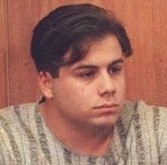
Anthony & Damian Clemente
Murderers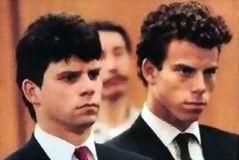 Lyle & Erik Menendez
Murderers · USA · 1989
Joseph Lyle Menendez (born January 10, 1968) and Erik Galen Menendez (born Nove…
2 victims
Lyle & Erik Menendez
Murderers · USA · 1989
Joseph Lyle Menendez (born January 10, 1968) and Erik Galen Menendez (born Nove…
2 victims
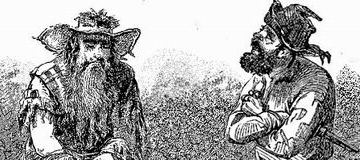 Harpe brothers
Murderers · USA
Micajah “Big” Harpe (1748? – August 1799) and Wiley “Little” Harpe (1750? – Feb…
50 victims
Harpe brothers
Murderers · USA
Micajah “Big” Harpe (1748? – August 1799) and Wiley “Little” Harpe (1750? – Feb…
50 victims
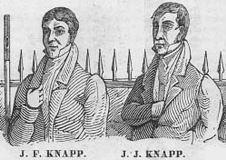 Francis & Joseph Knapp
Murderers · USA · 1930
Francis Knapp and Joseph Jenkins Knapp were the brothers known as the Knapps. T…
1 victim
Francis & Joseph Knapp
Murderers · USA · 1930
Francis Knapp and Joseph Jenkins Knapp were the brothers known as the Knapps. T…
1 victim
 Joan & Elizabeth Shannon
Murderers · USA · 2002
July 23, 2002 — Elizabeth Shannon shot and killed her father, Army Maj. David S…
1 victim
Joan & Elizabeth Shannon
Murderers · USA · 2002
July 23, 2002 — Elizabeth Shannon shot and killed her father, Army Maj. David S…
1 victim
 Robert & Jonathan Maskell
Murderers · United Kingdom · 2005
January 2004 — Robert and Jonathan Maskell and Dwane Johnston left their birthd…
1 victim
Robert & Jonathan Maskell
Murderers · United Kingdom · 2005
January 2004 — Robert and Jonathan Maskell and Dwane Johnston left their birthd…
1 victim
 Gameel Al-Batouti
Mass murderer · USA · 1999
Gameel Al-Batouti (also rendered “Gamil ElBatouty” or “El Batouty” in U.S. offi…
216 victims
Gameel Al-Batouti
Mass murderer · USA · 1999
Gameel Al-Batouti (also rendered “Gamil ElBatouty” or “El Batouty” in U.S. offi…
216 victims
 Earl Matthews
Murderer · USA · 1984
Earl Matthews, Jr. was convicted and sentenced to death for the 1985 killing of…
1 victim
Earl Matthews
Murderer · USA · 1984
Earl Matthews, Jr. was convicted and sentenced to death for the 1985 killing of…
1 victim
 Zhao Zhihong
Serial killer · China · 1996
Zhao Zhihong received a death sentence in February 2015 for crimes including ra…
10 victims
Zhao Zhihong
Serial killer · China · 1996
Zhao Zhihong received a death sentence in February 2015 for crimes including ra…
10 victims
 James Huberty
Mass murderer · USA · 1984
James Oliver Huberty was a 41-year-old unemployed security guard. He was born i…
21 victims
James Huberty
Mass murderer · USA · 1984
James Oliver Huberty was a 41-year-old unemployed security guard. He was born i…
21 victims
 Erin Caffey
Homicide · USA · 2008
Erin Caffey (juvenile daughter of Terry Caffey and Penny Caffey; charged in con…
3 victims
Erin Caffey
Homicide · USA · 2008
Erin Caffey (juvenile daughter of Terry Caffey and Penny Caffey; charged in con…
3 victims
 William Herrera
Murderer · USA · 1988
Defendant: William Herrera Victim: Caucasian (Deputy Sheriff Vernon Marconnet)…
1 victim
William Herrera
Murderer · USA · 1988
Defendant: William Herrera Victim: Caucasian (Deputy Sheriff Vernon Marconnet)…
1 victim
- Gender
- male
- Country
- USA
- Location
- Boston, Massachusetts, USA
- Date of birth
- Anthony: 1954 - Damian: 1975
- Age at first offence
- 41
- Characteristics
- domestic violence, disputes, argument
- Victim profile
- Robert C. Luisi Sr., 55; his son, Roman, 26; their relative, Antonio Sarro, 32; and a family friend, Anthony Pelosi. 53
- Method of murder
- Shooting
- Date(s) of murder
- November 6, 1995
- Years active
- 1995
- Date of arrest
- Anthony: Next day - Damian: Same day
- Status
-
Life imprisonment
Sentenced to life in prison without parole (1997)
Case record: Commonwealth v. Anthony P. Clemente and Damian A. Clemente
Timeline
- November 6, 1995 — Anthony and Damian went to the 99 Restaurant; Anthony used a nine millimeter handgun and shot multiple men; Richard Sarro was shot in the stomach and survived; four men were shot to death and the gunmen fled.
- November 7, 1995 — Anthony attended his son’s arraignment hearing at Charlestown District Court, was interviewed by Boston police Sergeant Detective Daniel Keeler, waived Miranda rights, and was arrested after the arraignment.
- May 11, 1997 — A Suffolk Superior Court jury convicted Anthony P. Clemente Sr. and his son, Damian, of first-degree murder for the Charlestown restaurant massacre involving four men shot to death and a fifth survived only because the elder Clemente ran out of bullets.
- 12 May 1997 — Anthony and Damian were given mandatory life sentences for a lunchtime shooting spree; Vincent Perez was acquitted of murder charges and was to be sentenced later on weapons charges.
- May 8, 2008 — The Supreme Judicial Court issued its decision upholding the convictions and rejecting a call for a new trial in the 1995 restaurant attack (SJC docket noted as “May 8, 2008”).
- September 5, 2008 — The SJC decision rejected the request for a new trial and declined to exercise power under G. L. c. 278, § 33E.
Background
Anthony Clemente was aware of problems between his son Damian and the Luisi family and their associates, the Sarro family, for approximately one year prior to the shootings. The Luisis and the Sarros were following, harassing, and threatening Damian because Damian was selling drugs in the North End section of Boston and was not being properly respectful, meaning paying money to the Luisis.
Anthony discussed the problem with Robert Luisi three times during the year preceding the shootings. At the last of these meetings, Anthony brought a loaded nine millimeter handgun. Roman Luisi, Richard Sarro, and Anthony Sarro were also at that meeting. When those three men became aggressive (the record did not describe any specific acts of aggression), Anthony reached “in [his] back” where his gun was hidden, but did not pull out his gun.
Robert Luisi did not assure Anthony that his son was safe. Anthony was convinced that the Luisis were going to kill Damian. As a result, Anthony nailed the windows in his house shut, loaded a shotgun and placed it in his bedroom, and put his loaded nine millimeter handgun in his bed. Anthony bought a cellular telephone for Damian.
The offence
On November 5, 1995, Damian and Vincent Perez were in a fight with Robert Luisi’s nephew, Joseph Ferlito, in a North End coffee shop. Ferlito was backed into a stairwell and was later seen bleeding from a head laceration.
On November 6, 1995, Damian and Perez went to the 99 Restaurant. Sometime thereafter, Robert Luisi, Roman Luisi, Anthony Sarro, Richard Sarro, and Sonny Pelosi came in. Damian telephoned his father and, in a terrified voice, reported the presence of the other group. Anthony instructed his son not to move, took his nine millimeter gun, and went to the 99 Restaurant to “get the boys out of there alive.”
Anthony approached the restaurant at approximately 1:25 P.M. He looked inside and saw the Luisis and Sarros sitting at a booth and noted that nothing had happened. Anthony entered the restaurant, went to the Luisi-Sarro group, and asked Robert Luisi, “What’s going on?” Robert Luisi replied: “It’s your fucking kid.” Anthony asked, “Why is it always my fucking kid? This kid is nothing to you.”
Roman Luisi jumped from the booth, and the look in his eyes changed. Anthony stuck out his left hand and backed up somewhat, saying to Roman Luisi, “It [doesn’t] have to be this way.” Anthony saw Damian and Perez walking toward the Luisi table. Anthony also saw Roman Luisi put both his hands down toward the fanny pack he was wearing in front. Roman Luisi said something about no one getting out of there alive.
Anthony shoved his son and Perez behind him and shot Roman Luisi. Sonny Pelosi yelled, and Robert Luisi stood up. Anthony shot Sonny Pelosi. Robert Luisi reached for Anthony, who shot him in the head.
Anthony heard the sound of shots and believed he was being shot, but was not certain of the source. Anthony saw Roman Luisi lying on the ground and shot him twice more, once in the back and once in the head. Anthony then saw Anthony Sarro moving and shot him again.
Anthony went “to drop the hammer on [Richard Sarro],” but his gun was now empty. Richard Sarro was shot in the stomach and survived only because Anthony Clemente ran out of ammunition for his 9mm pistol.
Earlier reporting described the attack as occurring at about 1:20 p.m., when the gunmen walked in, went to a booth, and after a brief argument opened fire, peppering the victims with at least 13 shots. As diners dove for cover and the gunmen fled, a pair of Everett police officers gave chase, subdued two suspects in the parking lot, and held them at gunpoint. Police Commissioner Paul F. Evans said the shootings followed an argument between the killers and victims inside the busy restaurant, and Police Superintendent Jack Boyle said the shootings did not have the hallmarks of a mob hit.
Witnesses remained inside the restaurant with the bodies until investigators moved the witnesses to a nearby Knights of Columbus hall for questioning.
Investigation
Police described the suspects and victims as local underworld associates with roots in the North End. Police said they were searching for a third man, a possible accomplice.
Law enforcement sources described both the victims and the suspects as local underworld associates. Police identified the suspects as Damian A. Clemente, 20, of Medford, and Vincent J. Perez, 27, of Boston. The victims were identified as Robert Luisi, his son Roman, their cousin Anthony Sarro, and their friend Anthony Pelosi. Sarro’s brother Richard was wounded and listed in critical but stable condition at Massachusetts General Hospital, where he was under guard.
Police said they interviewed about 40 witnesses and collected ballistics information. Police last reported that both suspects were carrying guns at the time of their arrest. A bullet fired from Damian’s gun was recovered from the body of Robert Luisi.
Police said the shootings followed an argument between the killers and victims inside the restaurant. Evans downplayed suggestions it was a premeditated contract killing and said, “If it was a hit, it was a very sloppy hit, in broad daylight inside a crowded restaurant,” and Boyle said, “At noontime, with 50 witnesses?” and “That’s not how they normally operate.”
Police said they were surprised that neither of the suspects had a serious record. Police said Perez had no record. Police said Clemente had been arrested three times for assault and battery with a dangerous weapon and for possessing fireworks, and that two of the assault arrests involving knives were dismissed.
Police reported that Perez listed his occupation as “transportation,” while Clemente said he was a laborer. Perez’s lawyer, Philip A. Tracy Jr., said Perez worked for the city of Boston.
Police believed Clemente’s baby blue Cadillac El Dorado was the intended getaway car. Police said that Clemente was involved in a fight with Roman Luisi at Caffe Vittoria the night before.
Investigators were pursuing possible motives for the shootings, including a dispute involving a bar that Bobby Luisi wanted to buy and a beating of Joseph (Joe Black) Lamattina in a North End social club Lamattina ran. An investigator said, “Bobby hit Joe Black with a tire iron,” and said, “It took 80 stitches to close.” Police said Bobby Luisi had made many enemies and that he began collecting tribute for local Mafia figures. Law enforcement sources described Bobby Luisi as a former associate of the Angiulo brothers, who ran the local Mafia until their arrests in 1983, and said he was observed with John Salemme, who represented the interests of Salemme’s incarcerated brother, Francis (Cadillac Frank) Salemme, reputed godfather of the Patriarca crime family. Frank Salemme was awaiting trial for racketeering.
Clemente was described by sources as “a wannabe wiseguy,” and police described him as “a chubby young man with an earring and an attitude.” Police said Perez was Clemente’s cousin, and Perez had worked as a chef at a North End eatery.
Arrest
Off-duty Everett police Officer Robert Hall was in plain clothes eating lunch at the 99 Restaurant with Officer Paul Durant. Hall was carrying a gun. After hearing the gunfire, Hall saw two men with dark jackets identified later as Damian and Perez running to the door. Hall gave chase, heard three or four more shots behind him, continued to pursue the two men, and yelled, “Police, stop.” Both men stopped and were arrested.
Damian was found with a .45-caliber pistol, and Perez was found with a fully loaded .38-caliber gun. After the shootings, Anthony left the restaurant and discarded his sneakers, jacket, and gun in a plastic bag in a dumpster near North Station.
Arrest following arraignment
Anthony left the restaurant and was arrested the following day at Charlestown District Court to attend the arraignment of his son. Prior to the arraignment, he was interviewed by Boston police Sergeant Detective Daniel Keeler and claimed that he had acted in self-defense at the 99 Restaurant. When Keeler asked, “How could it be self-defense? They were unarmed,” Anthony answered, “How were we supposed to know?”
Following the arraignment, Anthony was arrested, received and waived Miranda rights, and explained to police that his family had been in fear of the Luisi family and that Damian had told Anthony about rumors that Robert Luisi was going to hurt either his son or a friend.
Two Everett police officers who were in the restaurant at the time of the shooting arrested Damian Clemente and Vincent Perez in the restaurant parking lot.
Trial
The Suffolk Superior Court jury trial resulted in convictions for murders arising from the Charlestown restaurant massacre. In the later consolidated appellate decision, Anthony’s conviction and Damian’s conviction are described as follows:
Anthony P. Clemente was convicted in Superior Court of four counts of murder in the first degree on the theory of deliberate premeditation. Anthony was also convicted of armed assault with intent to murder and assault and battery with a dangerous weapon on a fifth man, Richard Sarro, who survived. In addition, Anthony was convicted of unlawful possession of a firearm and unlawful possession of ammunition.
Damian A. Clemente was convicted of one count of murder in the first degree on the theory of deliberate premeditation and two counts of murder in the second degree. Damian was found not guilty on a fourth count of murder. Damian was also convicted of armed assault with intent to kill and assault and battery by means of a dangerous weapon; unlawful possession of a firearm; and unlawful possession of ammunition.
The later SJC decision states the central issue at trial involved whether the defendants acted in self-defense and whether Anthony acted in defense of another. The defendants presented evidence of specific acts of violence by the victims and evidence of victims’ reputations for violence.
Sentencing
Anthony and Damian were sentenced to mandatory life sentences in May 1997. The current status is “Sentenced to life in prison without parole, 1997.”
The elder Clemente was convicted of the four murders; the fifth surviving victim was Richard Sarro. The younger Clemente and Perez were captured outside the restaurant by two plainclothes officers who were eating at the restaurant. Perez was acquitted of murder charges and was described as to be sentenced later on weapons charges.
Appeals
The Supreme Judicial Court issued a unanimous ruling that upheld the convictions and denied a request for a new trial.
The SJC decision states: “The central issue at trial was whether the defendants acted in self-defense and whether Anthony acted in defense of another,” and it stated: “We perceive no reason to exercise our extraordinary powers to reduce the verdict or order a new trial.” The court also described one gunman as firing until his gun ran out of bullets.
In the consolidated appeal, the defendants jointly raised 16 legal issues, including a request that the court retroactively apply a 2005 ruling known as the Adjutant Case. The court refused to apply the Adjutant rule retroactively, stating it was a new common-law rule of evidence applied prospectively only.
Anthony’s appellate claims included:
- the exclusion or limitation of “first aggressor” evidence to corroborate his self-defense claim and related jury instruction;
- due process rights being violated by denial of access to a “fanny pack” worn by Roman Luisi;
- denial of access to reports and grand jury testimony concerning Alfred Sapochetti;
- exclusion of grand jury testimony of an unavailable witness;
- exclusion of certain testimony relevant to self-defense under the Sixth Amendment;
- erroneous jury instructions regarding provocation, including whether excessive force would mitigate murder to manslaughter;
- denial of a motion for change of venue;
- retaining a juror who saw a newspaper article slipped under the door of the jury deliberating room; and
- ineffective assistance of counsel in relation to waiver of a motion to suppress statements and failure to file a motion to suppress a photographic identification.
Damian’s appellate claims included:
- the use against Damian of Anthony’s statements to police made after Damian’s arrest and alleged prosecutorial exploitation;
- refusal to allow Damian to introduce grand jury testimony of an unavailable witness;
- incorrect instructions regarding joint venture, defense of another, consciousness of guilt, and the Commonwealth’s burden on provocation.
The SJC also discussed the “Adjutant issue,” stating that because the trial judge permitted substantial evidence of specific acts of violence and admitted such evidence without limitation at trial, and because the defendants did not object to the jury instruction limiting consideration to acts known to the defendants, it declined to apply the Adjutant rule retrospectively.
Access to the fanny pack (due process claim)
When police responded to the 99 Restaurant, no weapons were found on any victims. A “leather pouch” or fanny pack was found under the body of Richard Sarro. The fanny pack contained a pocket knife, a small plastic razor, a cellular telephone, four sets of keys, a wallet, over $2,000 in cash, a battery, and two loose pills. No witness recalled who recovered the fanny pack. Police believed it to be of “no evidentiary value” and returned it to Roman Luisi’s wife. The receipt for the return of the fanny pack was not dated.
The SJC described the due process framework for potentially exculpatory evidence, concluding the defendants failed the initial burden of presenting concrete evidence that access would have benefited them.
Withheld evidence claim (Sapochetti)
The defendants claimed the Commonwealth withheld discovery concerning Alfred Sapochetti, an alleged drug dealer to Roman Luisi immediately prior to the shootings, including a State police report, a DEA report, and grand jury testimony. The SJC addressed that Sapochetti’s cooperation involved matters unrelated to the defendants’ case and described interview and report dates and preparation dates:
- Sapochetti was interviewed by agents of the State police on March 31, 1997.
- A State police report of that interview was prepared on April 28, 1997.
- A second “verbatim recitation” of the State police report was prepared by DEA agents on April 28, 1997.
The motion judge concluded there was no obligation to disclose and the SJC agreed. The SJC also stated that months after the trial, Sapochetti testified before a Federal grand jury in Boston and described selling cocaine to Roman Luisi at the 99 Restaurant in Charlestown within an hour of the shootings, and left the restaurant minutes prior to the shootings.
Exclusion of grand jury testimony of unavailable witness (Joseph Ferlito)
At trial, the parties sought to call Joseph Ferlito, Robert Luisi’s nephew. Ferlito engaged in a fight with Damian and Perez in a North End coffee shop the night before and left bleeding from a head laceration. Before the grand jury, Ferlito said he recounted the beating to his friends and family including his uncle, Robert Luisi; his cousin, Roman Luisi; and Richard Sarro. Robert Luisi told Ferlito to “let Roman handle it.”
Anthony wanted to introduce Ferlito’s grand jury testimony to buttress a defense theory that the defendants were in danger from the Luisis. At trial, Ferlito claimed privilege and, after a voir dire, the trial judge ruled he had a valid Fifth Amendment claim. The judge denied admitting Ferlito’s grand jury testimony as prior recorded testimony. The SJC declined to adopt a general rule admitting prior recorded testimony from a grand jury when a witness becomes unavailable.
Jury instructions issues (voluntary manslaughter and provocation; excessive force)
The SJC addressed Anthony’s claim about jury instructions on voluntary manslaughter, concluding that the instruction was incorrect because it treated “heat of passion” as an element. The court stated the correct rule and then held the error was not prejudicial because the evidence did not warrant a manslaughter instruction based on provocation.
In discussing provocation, the SJC described Anthony arming himself, going to the restaurant where he knew he would find the victims, seeing nothing untoward, approaching and asking “What’s going on?”, receiving answers including “It’s your fucking kid,” Roman Luisi jumping from the booth, seeing Damian and Perez coming down the aisle, seeing Roman Luisi’s eyes change and both of his hands go toward the fanny pack, and the subsequent pushing of the younger men behind him and reaching, cocking, and firing. The SJC concluded the belief the son might be in danger and Roman Luisi reached for his fanny pack did not constitute provocation sufficient for a manslaughter instruction.
The SJC also addressed Anthony’s claim that the judge’s instructions about excessive force in defense of another made it “an all or nothing proposition” by use of language: “A person may not use excessive force when intervening on behalf of another person. The actor's justification is lost if he uses excessive force.” The SJC stated it found no objection and reviewed accordingly, but the excerpt ended before completing the analysis.
Outcome
The Supreme Judicial Court upheld the convictions and affirmed the orders denying the motions for a new trial. The court also declined to exercise its power under G. L. c. 278, § 33E.
In the 1997 case described in reporting, on May 11, 1997 the jury convicted Anthony P. Clemente Sr. and Damian of first-degree murder for the Charlestown restaurant massacre, in which four men were shot to death and a fifth survived only because the elder Clemente ran out of bullets. On 12 May 1997, they received mandatory life sentences, and Perez was acquitted of murder charges and would be sentenced later on weapons charges.
The SJC stated the jury could have found that Anthony shot multiple men and that Damian shot Roman Luisi once with a .45-caliber pistol, based on ballistic evidence referenced in the appellate decision.
Other details
Victims and ages
Four men were killed and a fifth was wounded. Later SJC descriptions identified the dead as:
- Robert C. Luisi Sr., 55-year-old
- Roman Luisi, 26-year-old
- Antonio “Anthony” Sarro, 32-year-old
- Anthony Pelosi, 53-year-old
The fifth victim was Richard Sarro, who was shot in the stomach but survived only because Anthony ran out of ammunition for his 9mm pistol. Sarro was sent to prison for 60 days for contempt of court after refusing to testify against the Clementes during their joint trial in 1997.
People involved at the restaurant and in the response
Everett police officers Robert Hall and Paul Durant chased and subdued the suspects in the parking lot outside the restaurant. Boston Officer Thomas Hennessey commandeered a truck and directed it to the scene after a man in a pickup truck reported seeing a man waving a gun outside the 99.
Boston Officer Stephen Green arrived at the scene and moved in with Hennessey and took handguns from the two suspects.
Police Commissioner Paul F. Evans and Police Superintendent Jack Boyle gave public statements about the nature of the shootings. The SJC decision included references to Justice Judith Cowin writing for a unanimous court.
Quotations
Paul F. Evans said: “If it was a hit, it was a very sloppy hit, in broad daylight inside a crowded restaurant,” and Police Superintendent Jack Boyle said: “At noontime, with 50 witnesses?” and “That’s not how they normally operate.”
Anthony Clemente testified and the SJC recorded the questions and answers, including Keeler asking: “How could it be self-defense? They were unarmed,” and Anthony answering: “How were we supposed to know?”
A witness described the event as “It went deadly silent,” and “Believe me. There wasn’t any commotion or people screaming or anything. It was a total sense of helplessness.”
In the SJC discussion of evidentiary materials, the juror quote was that the elder Clemente was convicted of all four murders because he “hunted them down and killed them.”
In the background testimony described in the SJC decision, Joseph Blazo testified to a remark by Anthony Sarro: “If you get involved in this fight with Joe Ferlito [Robert Luisi], Roman [Luisi] will kill you,” and Kenneth McCracken testified to Roman Luisi saying: “Don’t even try it, Kenny.”
Spotted an error, or have more information about this case?