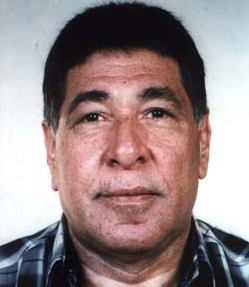
Gameel Al-Batouti
Mass murderer Timothy McVeigh
Mass murderer · USA · 1995
Timothy James McVeigh (April 23, 1968 – June 11, 2001) was a United States Army…
168 victims
Timothy McVeigh
Mass murderer · USA · 1995
Timothy James McVeigh (April 23, 1968 – June 11, 2001) was a United States Army…
168 victims
 Julio Gonzalez
Mass murderer · USA · 1990
Julio Gonzalez was sentenced to 174 twenty-five-year sentences (a total of 4,35…
87 victims
Julio Gonzalez
Mass murderer · USA · 1990
Julio Gonzalez was sentenced to 174 twenty-five-year sentences (a total of 4,35…
87 victims
 Seung-Hui Cho
Mass murderer · USA · 2007
Seung-Hui Cho was a mass murderer who shot and killed 32 people and wounded man…
32 victims
Seung-Hui Cho
Mass murderer · USA · 2007
Seung-Hui Cho was a mass murderer who shot and killed 32 people and wounded man…
32 victims
 George Jo Hennard
Mass murderer · USA · 1991
George Jo Hennard carried out a mass killing at a Luby’s Cafeteria in Killeen,…
23 victims
George Jo Hennard
Mass murderer · USA · 1991
George Jo Hennard carried out a mass killing at a Luby’s Cafeteria in Killeen,…
23 victims
 Eric Harris
Mass murderer · USA · 1999
Eric Harris committed suicide by gunshot to the roof of the mouth on April 20,…
13 victims
Eric Harris
Mass murderer · USA · 1999
Eric Harris committed suicide by gunshot to the roof of the mouth on April 20,…
13 victims
 Jiverly Wong
Mass murderer · USA · 2009
December 8, 1967 — Jiverly Antares Wong was born. · late 1980s — Wong first cam…
13 victims
Jiverly Wong
Mass murderer · USA · 2009
December 8, 1967 — Jiverly Antares Wong was born. · late 1980s — Wong first cam…
13 victims
 Terry Blair
Serial killer · USA · 1982
Terry Blair (born September 16, 1961) was an American serial killer who raped a…
9 victims
Terry Blair
Serial killer · USA · 1982
Terry Blair (born September 16, 1961) was an American serial killer who raped a…
9 victims
 Kenneth Allen McDuff
Serial killer · USA · 1966
Kenneth Allen McDuff was executed by lethal injection in Texas on November 17,…
14 victims
Kenneth Allen McDuff
Serial killer · USA · 1966
Kenneth Allen McDuff was executed by lethal injection in Texas on November 17,…
14 victims
 John Duffy
Murderer · United Kingdom · 1985
John Duffy was convicted of two murders and four rapes and was sentenced to lif…
3 victims
John Duffy
Murderer · United Kingdom · 1985
John Duffy was convicted of two murders and four rapes and was sentenced to lif…
3 victims
 Raymond Ratima
Mass murderer · New Zealand · 1992
Raymond Wahia Ratima was an unemployed shearer and was aged 25. At the beginnin…
7 victims
Raymond Ratima
Mass murderer · New Zealand · 1992
Raymond Wahia Ratima was an unemployed shearer and was aged 25. At the beginnin…
7 victims
 Gaile Owens
Murderer · USA · 1985
Gaile Kirksey Owens was convicted of accessory before the fact to wit: murder i…
1 victim
Gaile Owens
Murderer · USA · 1985
Gaile Kirksey Owens was convicted of accessory before the fact to wit: murder i…
1 victim
 Debbie Fornuto
Murderer · USA · 1972
Deborah Fornuto was the mother of six children whose deaths were initially rule…
7 victims
Debbie Fornuto
Murderer · USA · 1972
Deborah Fornuto was the mother of six children whose deaths were initially rule…
7 victims
- Gender
- male
- Country
- USA
- Location
- Atlantic Ocean 60 miles SE of Nantucket Island, Massachusetts, USA
- Date of birth
- February 2, 1940
- Age at first offence
- 59
- Characteristics
- history of mental illness
- Victim profile
- 14 crew members and 203 passengers
- Method of murder
- Deliberately crashing Flight 990 into the ocean
- Date(s) of murder
- October 31, 1999
- Years active
- 1999
- Date of arrest
- —
- Status
-
All 217 aboard were killed when EgyptAir Flight 990 crashed into the Atlantic Ocean on October 31, 1999; the NTSB determined the probable cause was the airplane’s departure from normal cruise flight and subsequent impact with the Atlantic Ocean as a result of the relief first officer’s flight control inputs, and the reason for the relief first officer’s actions was not determined.
Case record: Gameel Al-Batouti
Background
Gameel Al-Batouti (also rendered “Gamil ElBatouty” or “El Batouty” in U.S. official reports) was born on February 2, 1940, and died on October 31, 1999. He was a pilot for EgyptAir, his home country’s national airline, and a former officer for the Egyptian Air Force.
Al-Batouti came from a socially elite family in Egypt. His father was a mayor and a landowner, and family members were well educated and affluent. Al-Batouti was married and had five children. The youngest, Aya, was ten at the time of the crash and suffered from lupus. Aya was undergoing medical treatment in Los Angeles. Efforts had been made at EgyptAir, both at a company level and at an employee level, to provide assistance to help defray the medical expenses.
Al-Batouti was approaching retirement. Aviation regulations prevented him from flying as a commercial airline pilot after age 60. He had planned to split his time between a 10-bedroom villa outside of Cairo and a beach house near El Alamin.
Other details
Career
Al-Batouti had been drafted into the Egyptian army, where he was trained as a pilot and flight instructor. He worked for a time as an instructor at the Egyptian Air Institute. His position there was described by one colleague as “high profile”.
While in the Army, Al-Batouti served as a pilot in both the 1967 Six-Day War and the 1973 Yom Kippur War.
Batouti hired on with EgyptAir on September 8, 1987. He held type ratings for the Boeing 737-200, Boeing 767-200 and the 767-300.
At the time of the crash, he had logged 12,538 hours of flight time, with 5,755 as pilot in command and 5,191 in the 767. At the time of his death, Al-Batouti was the most senior first officer (F/O) flying the 767 at EgyptAir.
He was not promoted to captain because he declined to sit for the exam for his Air Transport Pilot (ATP) rating. The ATP study materials and exam are conducted in English, and Al-Batouti did not have sufficient English proficiency. Once he reached 55, the possibility of promotion was further hindered by EgyptAir policy, which prevented promotions after that age.
Colleagues told the NTSB during the Flight 990 investigation that he did not want to be promoted. As senior F/O, he could get preferred flight schedules, which assisted in his family situation.
Despite not being promoted to captain, he was often referred to by that title because of his previous experience at the Egypt Air Institute.
The offence
EgyptAir Flight 990 was suspected of a deliberate crash by the National Transportation Safety Board (NTSB). The assertion was denied by Egyptian authorities.
According to the NTSB, Al-Batouti seized the plane’s controls and turned off the autopilot after the captain left the cockpit. He led the plane into a dive, continually repeating, “I rely on God”. The pilot then came back into the cockpit and tried to stop the dive, but could not prevent the plane from crashing into the ocean. The cockpit voice recorder recorded the First Officer repeating “I rely on God” eleven times while the Captain asked repeatedly “What is this?” during the dive.
Some investigators learned that he was supposedly reprimanded for inappropriate behavior with female guests at the Hotel Pennsylvania, a New York City hotel often used by EgyptAir crews. Hatem Roushdy, an EgyptAir official described as responsible for the alleged reprimand, was reported as a passenger on Flight 990. The details of the reprimand included the removal of Gameel Al-Batouti’s privilege of flying any flight to the United States, and that Flight 990 would be his last.”
There was western media speculation that Batouti may have been a terrorist. His family and friends indicated that he had no strong political beliefs.
The Egyptian Civil Aviation Authority disputed the cause of the crash, blaming technical problems rather than any action of Al-Batouti.
Timeline
- September 8, 1987 — Batouti was hired on with EgyptAir.
- February 2000 — EgyptAir 767 captain Hamdi Hanafi Taha sought political asylum in London after landing his aircraft there.
- March 21, 2002 — The NTSB final report was issued after a two-year investigation.
- October 31, 1999 — EgyptAir Flight 990 crashed into the Atlantic Ocean, killing all 217 people on board.
Flight 990 details
EgyptAir Flight 990 (MSR990) was a regularly scheduled Los Angeles–New York–Cairo flight.
On October 31, 1999, at around 1:50 a.m. EST, Flight 990 dived into the Atlantic Ocean about 60 miles south of Nantucket Island, Massachusetts, in international waters, killing all 217 people on board.
The Flight Route Designation for New York to Cairo is now Flight 986 as a Boeing 777-200ER.
Flight 990 was being flown in a Boeing 767-366ER aircraft with the registration SU-GAP, named Tuthmosis III after a pharaoh from the 18th Dynasty.
The flight carried 14 crew members and 203 passengers from seven countries (Canada, Egypt, Germany, Sudan, Syria, United States, and Zimbabwe).
Included in the passenger manifest were over 30 Egyptian military officers. Among them were two brigadier-generals, a colonel, major, and four other air force officers. Newspapers in Cairo were prevented by censors from reporting the officers’ presence on the flight.
Flight 990 was crewed by 14 people, 10 flight attendants, and four flight crewmembers. Because of the scheduled flight time, the flight required two complete flight crews (each consisting of one captain and one first officer).
EgyptAir designated one crew as the “active crew” and the other as the “cruise crew” (sometimes also referred to as the “relief crew”). It was customary for the active crew to make the takeoff and fly the first four to five hours of the flight. The cruise crew then assumed control of the aircraft until about one to two hours prior to landing, at which point the active crew returned to the cockpit and assumed control of the airplane.
EgyptAir designated the captain of the active crew as the Pilot-in-Command or the Commander of the flight.
The active crew consisted of Captain Mahmoud El Habashy and First Officer Adel Anwar. The cruise crew were Captain Amal El Sayed and First Officer Gameel Al-Batouti (the NTSB reports use the spelling “El Batouty”).
Investigation
ATC tracking
U.S. Air Traffic Controllers provided transatlantic flight control operations as a part of the “New York Center” (referred to in radio conversations simply as “Center” and abbreviated in the reports as “ZNY”). The airspace was divided into “areas,” and “Area F” oversaw the airspace through which Flight 990 was flying.
Transatlantic commercial air traffic traveled via North Atlantic Tracks, and Flight 990 was the only aircraft assigned to fly North Atlantic Track Zulu.
There were also military operations areas over the Atlantic called “Warning Areas,” which were monitored by New York Center, but records showed that these were inactive the night of the accident.
Interaction between ZNY and Flight 990 was routine.
After takeoff, Flight 990 was handled by three different controllers as it climbed in stages to its assigned cruising altitude. The aircraft was equipped with a Mode C transponder that automatically reported the plane’s altitude when queried by ATC radar.
At 1:44, the transponder indicated Flight 990 had leveled off at FL330. Three minutes later, the controller requested Flight 990 switch communications radio frequencies for better reception. A pilot on Flight 990 acknowledged on the new frequency. This was the last transmission received from Flight 990.
Radar returns then indicated a sharp descent:
- 0649:53Z — FL329
- 0650:05Z — FL315
- 0650:17Z — FL254
- 0650:29Z — FL183 (last altitude report received by ATC)
In a span of 36 seconds, the plane dropped 14,600 feet (nearly three miles). Several subsequent “primary” returns were received by ATC, the last being at 0652:05.
At 0654, the ATC controller tried notifying Flight 990 that radar contact had been lost, but received no reply. Two minutes later, the controller contacted ARINC to determine if Flight 990 had switched to an oceanic frequency too early. ARINC attempted to contact Flight 990 on SELCAL with no response.
The controller then contacted a nearby aircraft, Lufthansa Flight 499, asking it to see if it could raise Flight 990. The German carrier responded that it had no radio contact and was not receiving any ELT signals.
Air France Flight 439 was asked to overfly the last known position of Flight 990, but reported nothing out of the ordinary.
Center provided coordinates of Flight 990’s last-known position to Coast Guard rescue aircraft.
Nationalities of passengers were reported as:
- Canada — 21 passengers, 0 crew, total 21
- Egypt — 75 passengers, 14 crew, total 89
- United States — 100 passengers, 0 crew, total 100
- Germany — 4 passengers, 0 crew, total 4
- Syria — 3 passengers, 0 crew, total 3 Total — 203 passengers, 14 crew, total 217
Crash dynamics
Flight data showed that flight controls were used to move the elevators to initiate and sustain the steep dive.
The flight deviated from its assigned altitude of 33,000 feet (FL330). It dove to 16,000 feet over 44 seconds, then climbed to 24,000 and began a final dive, hitting the Atlantic Ocean about two and a half minutes after leaving FL330.
Radar and radio contact was lost 30 minutes after the aircraft departed JFK Airport in New York on its flight to Cairo.
There were no other aircraft in the area. There was no indication that an explosion occurred on board.
The engines operated normally for the entire flight until they shut down. The left engine was torn from the wing from the stress of the maneuvers.
Search and rescue efforts
Search and rescue operations began within minutes of the loss of radar contact, with the bulk of the operation conducted by the United States Coast Guard (USCG).
At 3:00 AM, an HU-25 Falcon jet took off from Airbase Cape Cod Mass, becoming the first rescue party to reach the last known position of the plane.
All USCG cutters in the area were diverted to search for the aircraft, and an urgent marine information broadcast requested mariners in the area keep a lookout for the downed aircraft.
At sunrise, the U.S. Merchant Marine Academy training vessel King’s Pointer found an oil sheen and some small pieces of debris. Rescue continued by air and sea.
A group of USCG cutters covered 10,000 square miles on October 31 in the hope of locating survivors, although all that could be recovered was a single body in the debris field.
Atlantic Strike Team members brought two truckloads of equipment from Fort Dix to Newport to set up an incident command post. Officials from the Navy and the National Oceanic and Atmospheric Administration were dispatched to join the command.
The search and rescue operation was suspended on November 1, 1999. Rescue vessels and aircraft moved to recovery operations.
Recovery operations ceased when naval vessels USS Grapple and USNS Mohawk and NOAA research vessel Whiting arrived to take over salvage efforts, including recovery of the bulk of the wreckage from the seabed.
In total, the C-130, an H-60 helicopter, the HU-25 Falcon, and the cutters USCGC Monomoy, USCGC Spencer, USCG Reliance, USCG Bainbridge Island, USCG Juniper, USCG Point Highland USCG Chinook, and USCG Hammerhead (and supporting helicopters) participated in search.
A second salvage effort was made in March 2000 that recovered the aircraft’s second engine and some of the cockpit controls.
Investigation process and participants
Under the International Civil Aviation Organization treaty, the investigation of an airplane crash in international waters was under the jurisdiction of the country of registry of the aircraft.
At the request of the Egyptian government, the U.S. National Transportation Safety Board (NTSB) took the lead in the investigation, with the Egyptian Civil Aviation Authority (ECAA) participating.
The investigation was supported by the Federal Aviation Administration, the Federal Bureau of Investigation, the United States Coast Guard, the U.S. Department of Defense, the National Oceanic and Atmospheric Administration, Boeing Commercial Airplanes, EgyptAir, and Pratt & Whitney Aircraft Engines.
Two weeks after the crash, the NTSB proposed declaring the crash a criminal event and handing the investigation over to the FBI. Egyptian government officials protested. Omar Suleiman, head of Egyptian intelligence, traveled to Washington to join the investigation.
Hamdi Hanafi Taha defection
In February 2000, EgyptAir 767 captain Hamdi Hanafi Taha sought political asylum in London after landing his aircraft there.
In his statement to British authorities, he claimed to have knowledge of the circumstances behind the crash of Flight 990.
He was reported to have said that he wanted to “stop all lies about the disaster,” and to put much of the blame on EgyptAir management.
Reaction was swift. The NTSB and FBI sent officials to interview Taha.
Osama El-Baz, an advisor to Egyptian President Hosni Mubarak, said, “This pilot can’t know anything about the plane, the chances that he has any information [about the crash of Flight 990] are very slim.”
EgyptAir officials dismissed Taha’s claim immediately. Taha’s information was reportedly of little use to the investigators, and his application for asylum was turned down.
Investigation conclusions
NTSB
The NTSB’s final report was issued on March 21, 2002 after a two-year investigation.
Their conclusion was:
The National Transportation Safety Board determines that the probable cause of the EgyptAir flight 990 accident is the airplane's departure from normal cruise flight and subsequent impact with the Atlantic Ocean as a result of the relief first officer's flight control inputs.
The reason for the relief first officer's actions was not determined.
ECAA
The ECAA’s final report, based largely on the NTSB’s, came to distinctly different conclusions:
- The Relief First Officer (RFO) did not deliberately dive the airplane into the ocean. Nowhere in the 1,665 pages of the NTSB’s docket or in the 18 months of investigative effort is there any evidence to support the so called “deliberate act theory.” In fact, the record contains specific evidence refuting such a theory, including an expert evaluation by Dr. Adel Fouad, a highly experienced psychiatrist.
- There was evidence pointing to a mechanical defect in the elevator control system of the accident. The best evidence was the shearing of certain rivets in two of the right elevator bellcranks and the shearing of an internal pin in a power control actuator (PCA) that was attached to the right elevator. Although this evidence, combined with certain data from the Flight Data Recorder (FDR), pointed to a mechanical cause for the accident, reaching a definitive conclusion was not possible because of the complexity of the elevator system, the lack of reliable data from Boeing, and the limitations of the simulation and ground tests conducted after the accident. Additional evidence of relevant Boeing 767 elevator malfunctions in incidents involving Aero Mexico (February 2000), Gulf Air, and American Airlines (March, 2001). There were also two incidents on a United Airlines airplane in 1994 and 1996.
- Investigators could not rule out the possibility that the RFO may have taken emergency action to avoid a collision with an unknown object. Although plausible, this theory could not be tested because the United States refused to release certain radar calibration and test data necessary to evaluate various unidentified radar returns in the vicinity of Flight 990.
Investigation criticism
The investigation and its results drew criticism from the Egyptian Government, which advanced several alternative theories about mechanical malfunction of the aircraft.
In Western countries, Egypt’s rejection of the NTSB report was attributed to a strong Egyptian cultural aversion to suicide.
The theories proposed by Egyptian authorities were tested by the NTSB and none were found to match the facts.
An example elevator assembly hardover theory proposed by the Egyptians was discounted because flight recorder data showed the elevator was in a “split condition.” In this state, one side of the elevator was up and the other down; on the 767 this condition was only possible through flight control input (for example, one yoke was pushed forward while the other was pulled backward).
Nevertheless, the investigation was commonly held to have reached incorrect conclusions, especially but not only in Egypt. Many Egyptians were convinced that sabotage was the likeliest cause of the crash of a flight carrying 33 Egyptian army officers.
Another theory proposed the aircraft was passing through a military zone without proper co-ordination and suffered from electromagnetic interference.
Outcome
All 217 aboard Flight 990 were killed when EgyptAir Flight 990 crashed into the Atlantic Ocean.
The NTSB concluded the probable cause was the airplane’s departure from normal cruise flight and subsequent impact with the Atlantic Ocean as a result of the relief first officer’s flight control inputs, and the reason for the relief first officer’s actions was not determined.
The ECAA reached different conclusions and did not find evidence supporting a deliberate act theory. The ECAA identified evidence pointing to a mechanical defect in the elevator control system and could not rule out emergency action to avoid an unknown object.
Aftermath
Media coverage
While the official investigation was proceeding, speculation about the crash ran in Western media and Egyptian press.
Western media speculation began long before the NTSB issued its final report. Speculation focused on the meaning of taped cockpit conversations and possible motives including suicide and terrorism behind Al-Batouti’s actions on the flight.
The speculation in part was based on leaks from an unnamed federal law enforcement official that the crew member in the co-pilot’s seat was recorded as saying, “I made my decision now. I put my faith in God's hands.”
During a press conference held on November 19, 1999, the NTSB’s Jim Hall denounced such speculation and said that it had “done a disservice to the long-standing friendship between the people of the United States of America and Egypt.”
On November 20, 1999, the Associated Press quoted senior American officials as saying that the quote was not in fact on the tape.
It was believed that the speculation arose from a mistranslation of an Egyptian Arabic phrase meaning “I rely on God.”
Egyptian media reaction included outrage. The state-owned Al Ahram Al Misai called Al-Batouti a “martyr.” The Islamist Al Shaab covered the story under a headline that stated, “America's goal is to hide the truth by blaming the EgyptAir pilot.”
At least two Egyptian newspapers, Al Gomhuriya and Al Musawwar, offered theories that the aircraft was accidentally shot down by the U.S.
Other theories were advanced, including an Islamist Al Shaab speculation that a Mossad/CIA conspiracy was to blame because, supposedly, EgyptAir and El Al crews stay at the same hotel in New York.
Al Shaab accused U.S. officials of secretly recovering the FDR, reprogramming it, and throwing it back into the water to be publicly recovered.
Unifying Egyptian press was a belief that it was “inconceivable that a pilot would kill himself by crashing a jet with 217 people aboard. 'It is not possible that anyone who would commit suicide would also kill so many innocent people alongside him,' said Ehab William, a surgeon at Cairo's Anglo-American Hospital,” as reported in the Cairo Times.
Egyptian media also reacted against Western speculation of terrorist connections. The Cairo Times reported, “The deceased pilot's nephew, Walid Al Batouti, has lashed out in particular against speculation that his uncle could have been a religious extremist. 'He loved the United States,' the nephew said. 'If you wanted to go shopping in New York, he was the man to speak to, because he knew all the stores.' The family adopted Donald Duck ( Batout in Arabic, from batt, or duck ) as its emblem, and toy Donalds are scattered throughout the nephew's and the uncle's houses.”
Documentaries
The story of the flight was featured in the Discovery Channel Canada/National Geographic television show Mayday (Air Crash Investigation, Air Emergency). The flight was dramatized based on ATC tapes and CVR recordings.
In interviews for the program, Al-Batouti’s family members continued to dispute the suicide/deliberate crash theories and dismiss them as biased.
The program implied he crashed the plane for personal reasons. It depicted him as having been severely reprimanded by his boss for sexual harassment, and that this boss was actually on the plane. The dramatization also depicted Al-Batouti forcing the plane down while the pilot attempted to pull the plane up.
Upon conclusion, the program stressed the official NTSB conclusion, which made no mention of a suicide mission or a deliberate crash and stated that the crash was a direct result of actions made by the co-pilot.
NTSB release statement
Wikipedia.org contained an NTSB releases statement dated March 21, 2002 with the following content:
The National Transportation Safety Board today determined that the probable cause of the crash of EgyptAir flight 990 was the airplane's departure from normal cruise flight and subsequent impact with the Atlantic Ocean as a result of the relief first officer's flight control inputs.
EgyptAir flight 990, a Boeing 767-366ER, SU-GAP, crashed into the Atlantic Ocean off the coast of Nantucket, Massachusetts on October 31, 1999. The scheduled flight was being operated from John F. Kennedy International Airport (JFK), New York, to Cairo International Airport, Cairo, Egypt. There were 14 crewmembers and 203 passengers. All on board were killed and the airplane was destroyed.
Because the crash occurred in international waters, the Egyptian government was initially responsible for the investigation under the provisions of Annex 13 to the Convention on International Civil Aviation. However, the Egyptian government delegated the conduct of the investigation to the NTSB under the provisions of Annex 13.
The investigation into the cause of the crash has been quite extensive and has involved months of testing and research during which investigators evaluated various scenarios to determine the circumstances leading up to the crash.


Spotted an error, or have more information about this case?