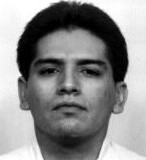
Guadalupe Esparza
Murderer Russell Ellwood
Murderer · USA · 1991
Russell Ellwood was a former taxi driver. Authorities suspected him of killing…
20 victims
Russell Ellwood
Murderer · USA · 1991
Russell Ellwood was a former taxi driver. Authorities suspected him of killing…
20 victims
 Robert Martines Perez
Murderer · USA · 1994
Name: Robert Martines Perez · Other name used in proceedings: Robert Martinez P…
15 victims
Robert Martines Perez
Murderer · USA · 1994
Name: Robert Martines Perez · Other name used in proceedings: Robert Martinez P…
15 victims
 Billy Frank Vickers
Murderer · USA · 1993
Billy Frank Vickers Vickers was executed by lethal injection in Texas on Januar…
14 victims
Billy Frank Vickers
Murderer · USA · 1993
Billy Frank Vickers Vickers was executed by lethal injection in Texas on Januar…
14 victims
 Kevin Dunlap
Murderer · USA · 2008
Kevin Wayne Dunlap (DOB 5-15-72) was sentenced to death on March 19, 2010 in Li…
3 victims
Kevin Dunlap
Murderer · USA · 2008
Kevin Wayne Dunlap (DOB 5-15-72) was sentenced to death on March 19, 2010 in Li…
3 victims
 Leopoldo Narvaiz
Mass murderer · USA · 1988
Leopoldo Narvaiz Leopoldo Narvaiz declined to make a last statement. Narvaiz wa…
4 victims
Leopoldo Narvaiz
Mass murderer · USA · 1988
Leopoldo Narvaiz Leopoldo Narvaiz declined to make a last statement. Narvaiz wa…
4 victims
 Gerald Edward Marshall
Murderer · USA · 2003
Gerald Edward Marshall was identified as the appellant in the Texas Court of Cr…
1 victim
Gerald Edward Marshall
Murderer · USA · 2003
Gerald Edward Marshall was identified as the appellant in the Texas Court of Cr…
1 victim
 William L. Thompson
Murderer · USA · 1976
William L. Thompson was convicted and sentenced to death for the 03/30/76 kidna…
1 victim
William L. Thompson
Murderer · USA · 1976
William L. Thompson was convicted and sentenced to death for the 03/30/76 kidna…
1 victim
- Gender
- male
- Country
- USA
- Location
- Bexar County, Texas, USA
- Date of birth
- November 21, 1964
- Age at first offence
- 35
- Characteristics
- convicted rapist, abduction, rape, burglary, sexual assault, kidnapping
- Victim profile
- Alyssa Vasquez (female, 7)
- Method of murder
- Strangulation
- Date(s) of murder
- June 6, 1999
- Years active
- 1999
- Date of arrest
- —
- Status
-
Sentenced to death
Executed by lethal injection in Texas on November 16, 2011; sentenced to death on May 25, 2001.
Case record: Guadalupe Esparza
Background
Guadalupe Esparza was a Hispanic male born on 11/21/1964. He had black hair and brown eyes. He was 5' 4" tall and weighed 193.
He had 10 years of education. He worked as a bricklayer, cook, and laborer.
The Texas Department of Criminal Justice inmate number for Esparza was 999385.
Esparza had a prior prison record including:
- #398586 on a 12 year sentence from Bexar County for one count of aggravated sexual assault.
- He was released on parole on 07/27/1990.
- He returned from parole on 08/29/1993.
- #646560 on an 8 year sentence from Bexar County for possession of cocaine.
- He was released on mandatory supervision on 1/12/1996.
Other details
A media advisory stated that Guadalupe Esparza was scheduled for execution on Wednesday, November 16, 2011, after 6 p.m., pursuant to a court order by the 175th District Court of Bexar County.
A jury found Esparza guilty of the kidnapping, sexual assault and murder of seven-year-old Alyssa Vasquez.
In a letter appearing under the name “Guadalupe Esparza,” Esparza stated:
“Hello, My name is Guadalupe Esparza. I am an American-Hispanic born and raised in San Antonio, Texas - U.S.A. I have brown eyes and black hair, I'm 5'5 in heigth and I weight 160 pounds. I am catholic by religion, and I believe in "Christ" very much! I am looking for a pen pal friend, someone that I can share my daily thoughts with and they can shere the outside world with me, through letters: Female or male are all welcome to write me. I will be honest, sincere, and I will respect all your views. When I was in the free world I was a bricklayer building houses in the day and at night I was a part-time "cook", during my off days I liked to go camping and swimming also enjoyed cooking food at bar-b-que's. Here my hobbies I like jogging and exercising, doing "art work " and listing to classic Rock and R&B music, country music, too. I don't get much mail or visits and it's very lonely for a person on death row. So I hope that who ever reads letter ad will want to start a pen pal friendship ! I thank you for your time and may "God" Bless you ! Respectfully your friend, Lupe Esparza #999385”
The offence
On June 6, 1999, Esparza kidnapped and abducted Alyssa Vasquez, a seven-year-old Hispanic female, from her home while her mother was out and the babysitter was next door. He raped and strangled her with his hands, causing her death. He abandoned her body in a nearby field.
The Texas Court of Criminal Appeals described the murder as follows:
“…[O]n June 6, 1999, appellant [Esparza] abducted Alyssa Vasquez from her home while her mother was out and the babysitter was next door. He raped and strangled her, and abandoned her body in a nearby field…”
The Court of Criminal Appeals also described the night of the offense:
“…[O]n the night of the offense, before Alyssa Vasquez was discovered missing, appellant [Esparza] telephoned her residence several times and came by looking for her mother and asking when she was going to return home.”
It further described the search and police findings:
“The babysitter discovered that Vasquez was missing at around 2:30 a.m. and later observed appellant [Esparza] running down the street away from the residence. Police found appellant [Esparza] at his residence, which was one and one-half to two miles from Vasquez’s apartment, at approximately 4:00 a.m., and found appellant’s [Esparza’s] blood-spotted shirt and boxer shorts in a trash can outside the residence.”
Scientific testing revealed that Esparza’s DNA was consistent with DNA extracted from spermatozoa on Vasquez’s oral swab.
Investigation
Police found Esparza’s blood-spotted shirt and boxer shorts in a trash can outside his residence, located about one and one-half to two miles from Vasquez’s apartment.
A reporter account described investigators determining:
“Investigators determined that blood on Esparza’s clothing retrieved from the trash was his and not the slain girl’s.”
The discarded clothing was described in the Court of Criminal Appeals opinion as evidence of consciousness of guilt and timing.
The evidence also included statements made by Esparza:
- The Court of Criminal Appeals stated that Esparza admitted his involvement in the offense to a detention guard and to a fellow inmate at the Bexar County Jail, and implied his involvement to another inmate.
- The only contrary evidence described was Esparza’s own testimony denying making those statements.
Arrest
A police location of Esparza was described by the Court of Criminal Appeals as occurring at approximately 4:00 a.m. at his residence.
Trial
A Texas grand jury returned an indictment charging Esparza with the capital murder of 7-year-old Alyssa Vasquez while in the course of committing aggravated sexual assault, kidnapping, and burglary. The indictment was in the 175th District Court of Bexar County.
Esparza was indicted on November 9, 1999 for capital murder.
A Bexar County jury found Esparza guilty of the capital murder on March 6, 2001.
The Court of Criminal Appeals described the capital murder conviction and sentencing:
“On March 27, 2001, appellant was convicted of capital murder for raping and strangling a seven-year old girl, Alyssa Vasquez. Tex. Penal Code Ann. § 19.03(a)(2). Pursuant to the jury's answers to the special issues set forth in Texas Code of Criminal Procedure Article 37.071, sections 2(b) and 2(e), the trial judge sentenced appellant to death.”
A punishment hearing resulted in a death sentence:
“On March 15, 2001, following a separate punishment hearing, Esparza was sentenced to death.”
Esparza faced a five-day trial described as a murder trial in which he took the stand twice against the advice of his lawyers.
Evidence and motions
Esparza challenged admission of an oral statement he made to Sergeant Edward Gonzalez while incarcerated at the Bexar County Jail awaiting trial on the capital murder indictment. He argued that Sergeant Gonzalez failed to read warnings required by Miranda v. Arizona and Article 38.22. He also argued the oral statement was inadmissible because it was not electronically recorded.
Sergeant Gonzalez testified at a hearing outside the presence of the jury that he was in charge of the second floor of the detention center when he received an inmate request form from Esparza in December 1999. The Court of Criminal Appeals described the interaction:
“When Gonzalez asked appellant why he feared for his safety, appellant replied that it was because he had "killed a Mexican Mafia family member."”
The trial court denied the motion to suppress and Gonzalez testified before the jury.
Esparza also argued that Rule of Evidence 404(b) was violated by introduction of testimony about an unadjudicated extraneous offense during the guilt or innocence phase. The Court of Criminal Appeals described the State’s rebuttal evidence:
- Manuel Longoria testified and his daughter, Teresa, testified that in late May 1999, about a week or two prior to the instant offense, Esparza came to the house in the middle of the night looking for a place to stay because his girlfriend had kicked him out.
- Teresa testified that she woke up because Esparza was touching her under her shirt.
- She ran to her cousins’ room and Esparza followed her into the room, offered her a dollar bill, and told her to go into the bathroom with him.
- Teresa then ran to the living room and woke Manuel.
- Manuel testified that he went to the bedroom and found Esparza lying on the floor.
- Manuel testified that when he asked what Esparza was trying to do with his daughter, Esparza replied: “I didn't do nothing. I don't know what you are talking about.”
- Manuel and Esparza then got into an altercation and Manuel’s brother made Esparza leave the house.
- Esparza denied the incident on rebuttal and testified that Manuel and Teresa made false allegations because of “bad blood” between Manuel and Esparza.
A Rule 403 objection was raised to photographs introduced during Officer Carlos Ortiz’s testimony. The photographs were State’s Exhibits 24, 25, and 26 and depicted Alyssa Vasquez’s partially clothed body as found at the crime scene. The Court of Criminal Appeals held the trial court did not abuse its discretion in admitting the photographs and quoted the described injuries as gruesomeness.
The trial court reminded Esparza in front of the jury that he was not required to testify. The exchange was:
THE COURT: Thank you. Please be seated. Ladies and gentlemen, the Defense has requested to reopen their case. That request has been granted. Mr. McDonald?
[DEFENSE COUNSEL]: At this time, the Defendant calls Guadalupe Esparza to the stand.
THE COURT: Mr. Esparza? Mr Esparza, I need to remind you, again, that you are not required to testify.
[ESPARZA]: Yes, ma'am.
Sentencing
After separate punishment proceedings, the jury answered special issues and the trial judge sentenced Esparza to death pursuant to Article 37.071. Esparza was sentenced to death on March 15, 2001.
Appeals
Direct appeal
On June 4, 2003, the Texas Court of Criminal Appeals affirmed Esparza’s conviction and death sentence. It was an opinion delivered: June 4, 2003, en banc, and the court said: “We will affirm. We affirm the judgment of the trial court.”
Esparza raised multiple points of error on direct appeal, including:
- Admission of his oral statement to Sergeant Edward Gonzalez without Miranda warnings and without electronic recording.
- Admission of rebuttal evidence concerning other incidents of attempts to molest other little girls under Rule 404(b).
- Exclusion of defense exhibits relating to GeneScan reports.
- Denial of questioning a State’s witness, Ernest Rodriguez, about his juvenile record.
- A trial-court remark about Esparza not being required to testify.
- Admission of photographs under Rule 403.
- Denial of a challenge for cause against veniremember Michael Trujillo.
- Constitutional challenges to Texas’s death penalty scheme and special issues.
The opinion overruled all points of error and affirmed the judgment.
U.S. Supreme Court
On November 10, 2003, the U.S. Supreme Court rejected Esparza’s direct appeal by denying his petition for writ of certiorari.
On May 16, 2011, the U.S. Supreme Court again denied Esparza’s petition for certiorari.
State habeas proceedings
After a state habeas filing in March 2003, the Texas Court of Criminal Appeals adopted the trial court’s findings and conclusions recommending denial of initial state habeas relief, and it adopted conclusions about a subsequent application filed in December 2003 being dismissed as an abuse of the writ.
The timing in the record included:
- February 28, 2007: Texas Court of Criminal Appeals adopted findings and conclusions and denied initial state habeas relief; dismissed the subsequent application as an abuse of the writ.
- October 19, 2011: Texas Court of Criminal Appeals again dismissed Esparza’s subsequent state habeas application as an abuse of the writ.
Federal habeas proceedings
Esparza attempted to appeal his conviction and sentence by filing a pro se petition for federal habeas relief in the U.S. District Court for the Eastern District of Texas on June 8, 2007. The case was transferred to the Western District of Texas, San Antonio Division.
On September 21, 2007, with the aid of counsel, Esparza filed an amended petition.
On March 24, 2010, the federal district court denied relief requested in his federal habeas petition and denied a certificate of appealability (COA).
On November 9, 2010, the U.S. Court of Appeals for the Fifth Circuit affirmed the district court’s denial of relief, rejecting Esparza’s request for a COA in an unpublished opinion.
COA request and Atkins-related litigation
In the Fifth Circuit proceeding, the court denied a certificate of appealability.
The per curiam disposition described:
- Esparza requested a COA.
- The court denied a COA, stating that Esparza was not entitled to COA with respect to a claim that he was mentally retarded and ineligible for the death penalty and was not entitled to COA regarding ineffective assistance.
The Fifth Circuit per curiam disposition concluded:
“Finding that Esparza has not made a substantial showing of the denial of a constitutional right, we DENY a COA.”
Outcome
Esparza was executed on November 16, 2011.
A media report said:
- The lethal dose began at 6:21 p.m. and Esparza was pronounced dead at 6:21 p.m. CST, about 11 minutes after lethal drugs were administered.
A description of the execution included the number of scheduled inmates:
- Esparza became the 13th and last scheduled inmate to be executed in Texas that year.
Statements by Esparza and relatives
Esparza offered condolences and asked for forgiveness before his execution. He said:
“To the family of Alyssa Vasquez, I hope you will find peace in your heart,”
“My sympathy goes out to you. I hope you find it in your heart to forgive me. I don’t know why all of this happened.”
In another account, he said:
“I hope you will find peace in your heart,”
A relative, Alyssa Vasquez’s mother Diana Berlanga, said before the lethal drugs were administered:
“He is going to get what he deserved,”
As the execution occurred, Berlanga was described entering the death chamber and saying:
“He's going to get what he deserves.”
Aftermath
A clemency petition was rejected Monday by the Texas Board of Pardons and Paroles.
A reporter account stated that no late legal maneuvers were made leading up to the execution and that appeals were exhausted.
The Court of Criminal Appeals opinion included a statement that DNA results were consistent with evidence during the 2001 trial, where Esparza’s attorneys had challenged the validity of the results.

Spotted an error, or have more information about this case?