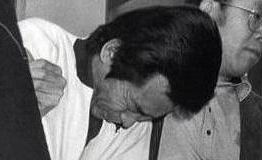
Kiyotaka Katsuta
Serial killer Kiyoshi Okubo
Serial killer · Japan · 1971
Kiyoshi Okubo was executed by hanging on January 22, 1976. Kiyoshi Okubo (大久保 清…
8 victims
Kiyoshi Okubo
Serial killer · Japan · 1971
Kiyoshi Okubo was executed by hanging on January 22, 1976. Kiyoshi Okubo (大久保 清…
8 victims
 Yoshio Kodaira
Serial killer · Japan · 1932
Yoshio Kodaira ( 小平 義雄 , Kodaira Yoshio , January 28, 1905 - October 5, 1949) w…
10 victims
Yoshio Kodaira
Serial killer · Japan · 1932
Yoshio Kodaira ( 小平 義雄 , Kodaira Yoshio , January 28, 1905 - October 5, 1949) w…
10 victims
 Genzo Kurita
Serial killer · Japan · 1948
Genzo Kurita ( 栗田 源蔵 , Genzo Kurita , 1926 - October 14, 1959) was a Japanese s…
8 victims
Genzo Kurita
Serial killer · Japan · 1948
Genzo Kurita ( 栗田 源蔵 , Genzo Kurita , 1926 - October 14, 1959) was a Japanese s…
8 victims
 Sataro Fukiage
Serial killer · Japan · 1906
Sataro Fukiage (吹上 佐太郎, Fukiage Satarō) was born in February 1889. He was born…
7 victims
Sataro Fukiage
Serial killer · Japan · 1906
Sataro Fukiage (吹上 佐太郎, Fukiage Satarō) was born in February 1889. He was born…
7 victims
 John Wayne Conner
Homicide · USA · 1982
John Wayne Conner John Wayne Conner was sentenced to death in July 1982. · Janu…
1 victim
John Wayne Conner
Homicide · USA · 1982
John Wayne Conner John Wayne Conner was sentenced to death in July 1982. · Janu…
1 victim
 Charles Douglas Raby
Murderer · USA · 1992
October 15, 1992 — Charles Douglas Raby was convicted of killing Edna Franklin;…
1 victim
Charles Douglas Raby
Murderer · USA · 1992
October 15, 1992 — Charles Douglas Raby was convicted of killing Edna Franklin;…
1 victim
 Cary Stayner
Murderer · USA · 1999
Cary A. Stayner (born August 13, 1961) was an American serial killer. Stayner w…
4 victims
Cary Stayner
Murderer · USA · 1999
Cary A. Stayner (born August 13, 1961) was an American serial killer. Stayner w…
4 victims
 William Horton
Murderer · USA · 1974
William R. Horton was born August 12, 1951 in Chesterfield, South Carolina. On…
1 victim
William Horton
Murderer · USA · 1974
William R. Horton was born August 12, 1951 in Chesterfield, South Carolina. On…
1 victim
 Christina Riggs
Murderer · USA · 1997
Christina Riggs was executed in Arkansas by lethal injection. Riggs was convict…
2 victims
Christina Riggs
Murderer · USA · 1997
Christina Riggs was executed in Arkansas by lethal injection. Riggs was convict…
2 victims
- Gender
- male
- Country
- Japan
- Location
- Nagoya, Aichi Prefecture, Japan
- Date of birth
- August 29, 1948
- Age at first offence
- 24
- Characteristics
- robbery, arsonist, rape, rape?, shooting spree
- Victim profile
- Two chauffeurs and six bar hostesses
- Method of murder
- Shooting
- Date(s) of murder
- 1972 - 1982
- Years active
- 1972–1982
- Date of arrest
- January 31, 1983
- Status
-
Executed
Executed by hanging on November 30, 2000
Case record: Kiyotaka Katsuta
Kiyotaka Katsuta (勝田 清孝; Katsuta Kiyotaka; August 29, 1948 - November 30, 2000) was a Japanese serial killer and thief.
Background
Katsuta was described as a serial killer and thief who committed several murders and robbed several houses before being apprehended. The exact number of murders he committed was presented as unknown. He was described as a firefighter.
He was said to have been mistrustful of fellow inmates in prison. During incarceration, he met a Christian woman known as Yūko Kurusu, who later became his sister-in-law. After that, he changed his name to Kiyotaka Fujiwara.
A 1984 film, Renzoku satsujinki: Reiketsu (連続殺人鬼 冷血; Renzoku satsujinki: Reiketsu), was described as being based on his crimes. In the film, the murderer was named Kiyoshi Tatsuta, and Kazuya Nakayama portrayed Tatsuta.
The offence
From 1972 to 1982, Katsuta went on a killing spree, murdering and robbing eight people.
The police were said to have accused him of eight murders, while he might have killed 22 people. He killed his victims by strangling and shooting them.
The police suspected that Katsuta raped some of his victims before killing them, but were not able to prove this. The suspicion was also presented with uncertainty as “rape?”.
It was stated that Katsuta “shot two chauffeurs and six bar hostesses.”
He also stole a ring from a victim, Yoshiko Shikina, a beautician from Showa-ku, Nagoya, in August 1977 after killing her.
Investigation
The incident was described as being officially named Metropolitan Designated Case 113.
The police suspected Katsuta raped some victims before killing them, but were not able to prove this. Katsuta was initially thought to have only killed his victims while robbing them, but later confessed to seven other murders.
Arrest
On January 31, 1983, Katsuta was arrested while threatening a man with a handgun.
Before the arrest, it was stated that on October 27, he hit a police officer with a car and stole a handgun. On October 31, he attempted to commit a robbery but killed a man with a handgun during the failed attempt. On November 1, he shot another man, who survived. Because he was armed, Katsuta was described as continuing to elude capture.
Trial
On January 17, 1994, the Supreme Court sentenced Katsuta to two death penalties for the first time in the history of the Japanese Supreme Court. It was stated that one death penalty was for seven murders between 1972 and 1980, and the other was for killing a man with a handgun in 1982.
It was also stated that the Supreme Court upheld his two death penalty convictions, a first in the history of the Japanese Supreme Court.
Sentencing
The Supreme Court imposed two death penalties on January 17, 1994:
- one for seven murders between 1972 and 1980
- one for killing a man with a handgun in 1982
Outcome
Katsuta was executed by hanging on November 30, 2000.
Aftermath
A Nagoya District Court matter was described in connection with property from a victim. A diamond ring that belonged to one of eight victims of serial killer Kiyotaka Katsuta was described as having been sold in 1994 by a court official without the permission of the dead woman's family. It was later learned that the ring was found in a Nagoya antique shop and would be returned.
Officials at the Nagoya District Court said the 1-carat diamond ring was found in a Nagoya antique shop. The court notified the relatives of the victim, Yoshiko Shikina, who lived in Okinawa Prefecture, and the diamond was to be returned to its rightful heir. It was also stated that Katsuta stole the ring from Shikina in August 1977 after killing her.
Other details
Katsuta was described as having killed eight people for which he was charged, and the motive was presented as “PC-nonspecific.” The disposition was described as “Convicted; sentence unknown.”
Spotted an error, or have more information about this case?