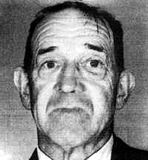
Walter James Bolton
Murderer David Tamihere
Murderer · New Zealand · 1972
David Tamihere was sentenced to life imprisonment with a 10-year non-parole per…
3 victims
David Tamihere
Murderer · New Zealand · 1972
David Tamihere was sentenced to life imprisonment with a 10-year non-parole per…
3 victims
 William Dwane Bell
Murderer · New Zealand · 2001
William Dwane Bell (born 1978) was a convicted murderer in New Zealand. Bell wa…
3 victims
William Dwane Bell
Murderer · New Zealand · 2001
William Dwane Bell (born 1978) was a convicted murderer in New Zealand. Bell wa…
3 victims
 Bruce Howse
Murderer · New Zealand · 2001
Bruce Howse was the partner of Charlene Aplin and the stepfather of Saliel Apli…
2 victims
Bruce Howse
Murderer · New Zealand · 2001
Bruce Howse was the partner of Charlene Aplin and the stepfather of Saliel Apli…
2 victims
 John Barlow
Murderer · New Zealand · 1994
16 February 1994 — Financial dealers Eugene and Gene Thomas, father and son, we…
2 victims
John Barlow
Murderer · New Zealand · 1994
16 February 1994 — Financial dealers Eugene and Gene Thomas, father and son, we…
2 victims
 Mark Edward Lundy
Murderer · New Zealand · 2000
Mark Edward Lundy was the husband and father of the victims Christine Marie Lun…
2 victims
Mark Edward Lundy
Murderer · New Zealand · 2000
Mark Edward Lundy was the husband and father of the victims Christine Marie Lun…
2 victims
 Sam Poo
Murderer · Australia · 1865
Sam Poo was a Chinese bushranger in Australia who was active in the Coonabarabr…
1 victim
Sam Poo
Murderer · Australia · 1865
Sam Poo was a Chinese bushranger in Australia who was active in the Coonabarabr…
1 victim
 James Cooke
Murderer · USA · 2005
James Cooke (James E. Cooke, Jr.; James Edward Cooke) James E. Cooke, Jr. was b…
1 victim
James Cooke
Murderer · USA · 2005
James Cooke (James E. Cooke, Jr.; James Edward Cooke) James E. Cooke, Jr. was b…
1 victim
 Patrick Fitzgerald Rogers
Murderer · USA · 1985
June 2, 1997 — Patrick Rogers was executed by lethal injection in Texas. · June…
1 victim
Patrick Fitzgerald Rogers
Murderer · USA · 1985
June 2, 1997 — Patrick Rogers was executed by lethal injection in Texas. · June…
1 victim
 William Smedley
Murderer · United Kingdom · 1947
William Smedley was executed by hanging at Armley Gaol on August 14, 1947. Stev…
1 victim
William Smedley
Murderer · United Kingdom · 1947
William Smedley was executed by hanging at Armley Gaol on August 14, 1947. Stev…
1 victim
- Gender
- male
- Country
- New Zealand
- Location
- Mangamahu, New Zealand
- Date of birth
- August 13, 1888
- Age at first offence
- 68
- Characteristics
- parricide, poisoner
- Victim profile
- His wife, Beatrice Mabel Jones, 64
- Method of murder
- Poisoning (arsenic)
- Date(s) of murder
- July 11, 1956
- Years active
- 1956
- Date of arrest
- —
- Status
-
Executed
Executed by hanging at Mount Eden Prison in Auckland on February 18, 1957
Overview
Walter James Bolton (13 August 1888 - 18 February 1957) was a New Zealand farmer who was found guilty of poisoning his wife, Beatrice Bolton. He was hanged at Mount Eden Prison in Auckland on 18 February 1957, aged 68, and he was the last person executed in New Zealand before the abolition of capital punishment.
Timeline
- 11 July 1956 — Beatrice Bolton died after a long and debilitating illness.
- September — Bolton was formally charged with her murder.
- 18 February 1957 — Bolton was hanged at Mount Eden Prison in Auckland for the murder of his wife.
Background
Walter James Bolton was born in Wanganui and grew up in nearby Mangamahu. He married Beatrice Mabel Jones in 1913. Beatrice died on 11 July 1956 after a long and debilitating illness. The case involved traces of arsenic found in Beatrice’s body and related evidence connecting arsenic to Bolton and the farm.
Bolton’s wife was known as Beatrice Bolton and had been married to him for 43 years. Bolton was also known as Jim. He had six children and paid large sums of money for his wife’s healthcare, including placing her in a private hospital. Bolton was the only member of the family to agree to an autopsy, which then revealed Beatrice’s organs were riddled with poison.
Bolton’s son, James Bolton, attempted to clear his father’s name.
The offence
Bolton was found guilty of murdering his wife by poisoning her with arsenic. The prosecution alleged that Bolton possessed arsenic intended for use on his farm and poisoned his wife with it. The prosecution also claimed that Bolton had an affair with his wife’s sister, Florence Doughty, who had moved in to help look after Beatrice, and that Bolton and Florence had destroyed Beatrice’s diary.
Traces of arsenic were found in small doses in Beatrice’s tea. The quantity consumed over the best part of a year was enough to kill her. Water on Bolton’s farm was tested and found to contain arsenic, and traces of arsenic were also found in Walter and one of his daughters.
The defence argued that Beatrice could have been poisoned accidentally, by arsenic entering the water supply. The defence also argued that sheep dip had inadvertently got into the farm’s water supply.
A newspaper story later claimed that Bolton’s execution had gone horribly wrong, alleging that rather than having his neck broken instantly when the trapdoor opened, Bolton allegedly slowly strangled to death.
Investigation
An autopsy found traces of arsenic in Beatrice’s body, and a police investigation was launched. Bolton was formally charged with her murder in September.
The prosecution’s case included evidence that Bolton admitted to having had an affair with Florence. New evidence described in later reporting stated that Bolton made statements to police at the time that were not shared with the jury, admitting he suffered from erectile dysfunction and recounting that Doughty seduced him on at least one occasion.
Arrest
Bolton was formally charged with Beatrice’s murder in September. No further arrest details were included in the provided text beyond this formal charging.
Trial
Bolton was tried in his hometown of Wanganui and was found guilty by an all-male jury. The jury returned a guilty verdict after deliberating for two hours and ten minutes. Bolton was sentenced to death.
When the judge asked Bolton why there was any reason he shouldn’t pronounce the death sentence, Walter Bolton replied, “I plead not guilty, sir.”
Sentencing
Bolton was sentenced to death.
He was hanged at Mount Eden Prison in Auckland on 18 February 1957, aged 68. He was hanged less than 13 weeks after being sentenced.
Appeals
Bolton lost a Court of Appeal case despite his claims of innocence. The provided text did not include the date of the appeal decision.
Outcome
Bolton was executed by hanging at Mount Eden Prison in Auckland on February 18, 1957.
The death penalty for murder was abolished in New Zealand in 1961. Bolton was known as the last person to be executed in New Zealand before the abolition of capital punishment, and he was also described as the last person to be sentenced to death in New Zealand.
Aftermath
Public and later debate about guilt
In recent times, there had been speculation as to whether Bolton was guilty.
Sherwood Young dealt with the issue in his history of capital punishment in New Zealand in 1998.
Investigate Magazine published an article in January 2001 suggesting that Florence, who committed suicide some time after the events, was responsible for her sister’s death and had also killed others. The article stated that it was claimed that a note existed in which she admitted this, but that the note was suppressed.
Further reporting stated that documentary maker Bryan Bruce questioned whether there had been enough reasonable doubt in the case and argued that the outcome might have been very different if the jury had heard all the evidence. The reporting stated: “A lot of the case [in court] depended on seeing Bolton as a sexual predator, which he didn’t seem to be capable of being. You could have argued a lot more vociferously for reasonable doubt, if you were defending him now,” and: “I think the Crown could equally have argued that Doughty had opportunity and motive to kill her sister.” It also stated: “He was probably convicted as much for his sexual morals as for whether he had killed his wife or not... I think that Jim Bolton deserved the benefit of the doubt.” It also stated: “From time to time, when someone commits a heinous crime in this country, kills a child perhaps, you hear people saying bring back the death pen- alty... But the law can get it wrong, and death is final.”
The reporting also described a case claiming the jury could not have found him guilty based on the evidence to hand, which failed.
Death penalty in New Zealand
The provided text stated that the death penalty was abolished for most crimes several years later and that the death penalty was abolished in 1941 but reinstated in 1950. It also stated that it would be another 32 years before the penalty was officially removed from the books of law. It stated that Prime Minister Helen Clark announced that New Zealand would support a UN initiative to abolish the death penalty worldwide, and included the statement: “capital punishment is the ultimate form of cruel, inhuman and degrading treatment”.
The text stated that fifty-three men and one woman were executed in New Zealand between 1842 and 1957. It also stated that Bolton was New Zealand’s last execution.
Other details
Bolton had multiple children and placed Beatrice in a private hospital. Florence was described as Beatrice’s sister and as having moved in to help look after Beatrice. Beatrice’s diary was alleged to have been destroyed by Bolton and Florence. The prosecution alleged Bolton concocted a potion of arsenic from sheep dip and laced Beatrice’s tea with it on several occasions, requiring hospital treatment, before a large dose killed her on July 11, 1956. The text also stated that experts agreed arsenic does not accumulate in the organs of the body and that scientists disagreed after 50 years on whether Bolton would have had knowledge of chemistry to make the poison. The text stated that the prosecution and defence positions included deliberate poisoning with arsenic versus accidental poisoning via sheep dip contamination of water.

Spotted an error, or have more information about this case?