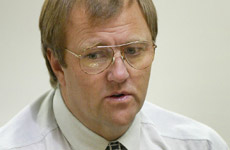
Mark Edward Lundy
Murderer William Dwane Bell
Murderer · New Zealand · 2001
William Dwane Bell (born 1978) was a convicted murderer in New Zealand. Bell wa…
3 victims
William Dwane Bell
Murderer · New Zealand · 2001
William Dwane Bell (born 1978) was a convicted murderer in New Zealand. Bell wa…
3 victims
 Bruce Howse
Murderer · New Zealand · 2001
Bruce Howse was the partner of Charlene Aplin and the stepfather of Saliel Apli…
2 victims
Bruce Howse
Murderer · New Zealand · 2001
Bruce Howse was the partner of Charlene Aplin and the stepfather of Saliel Apli…
2 victims
 John Barlow
Murderer · New Zealand · 1994
16 February 1994 — Financial dealers Eugene and Gene Thomas, father and son, we…
2 victims
John Barlow
Murderer · New Zealand · 1994
16 February 1994 — Financial dealers Eugene and Gene Thomas, father and son, we…
2 victims
 Scott Watson
Murderer · New Zealand · 1998
Scott Watson (born 28 June 1971) was a New Zealander who was convicted in May 1…
2 victims
Scott Watson
Murderer · New Zealand · 1998
Scott Watson (born 28 June 1971) was a New Zealander who was convicted in May 1…
2 victims
 Antonie Dixon
Murderer · New Zealand · 2003
Antonie Ronnie "Tony" Dixon (1968 – 4 February 2009) · 21 January 2003 — Dixon…
1 victim
Antonie Dixon
Murderer · New Zealand · 2003
Antonie Ronnie "Tony" Dixon (1968 – 4 February 2009) · 21 January 2003 — Dixon…
1 victim
 Christopher John Lewis
Murderer · New Zealand · 1996
Christopher John Lewis was found dead in his cell by Auckland Mt Eden prison st…
1 victim
Christopher John Lewis
Murderer · New Zealand · 1996
Christopher John Lewis was found dead in his cell by Auckland Mt Eden prison st…
1 victim
 Alex Ramon Maquera
—
Alex Ramón Maquera Atencio, alias “Loco del Martillo”, was convicted and senten…
Alex Ramon Maquera
—
Alex Ramón Maquera Atencio, alias “Loco del Martillo”, was convicted and senten…
 Jeffery Dana Sparks
Murderer · USA · 1998
Jeffery Dana Sparks was sentenced to death on May 14, 1999. Jeffery Dana Sparks…
1 victim
Jeffery Dana Sparks
Murderer · USA · 1998
Jeffery Dana Sparks was sentenced to death on May 14, 1999. Jeffery Dana Sparks…
1 victim
 Michael Angelo Morales
Murderer · USA · 1981
Michael Angelo Morales (born October 17, 1959) was a convicted murderer schedul…
1 victim
Michael Angelo Morales
Murderer · USA · 1981
Michael Angelo Morales (born October 17, 1959) was a convicted murderer schedul…
1 victim
 Jose Alfredo Rivera
Murderer · USA · 1993
Jose Alfredo Rivera was sentenced to death on June 2, 1994. His direct appeal r…
1 victim
Jose Alfredo Rivera
Murderer · USA · 1993
Jose Alfredo Rivera was sentenced to death on June 2, 1994. His direct appeal r…
1 victim
 Stephen Nethery
Murderer · USA · 1981
Stephen Ray Nethery was convicted of capital murder and sentenced to death by t…
1 victim
Stephen Nethery
Murderer · USA · 1981
Stephen Ray Nethery was convicted of capital murder and sentenced to death by t…
1 victim
 Jerry Lee Hogue
Murderer · USA · 1979
Jerry Lee Hogue was executed by lethal injection in Texas on March 11, 1998. He…
1 victim
Jerry Lee Hogue
Murderer · USA · 1979
Jerry Lee Hogue was executed by lethal injection in Texas on March 11, 1998. He…
1 victim
- Gender
- male
- Country
- New Zealand
- Location
- Palmerston North, Manawatu-Wanganui region, New Zealand
- Date of birth
- 1956
- Age at first offence
- 44
- Characteristics
- parricide
- Victim profile
- His wife Christine, 38, and daughter Amber, 7
- Method of murder
- Beating with a tomahawk
- Date(s) of murder
- August 29, 2000
- Years active
- 2000
- Date of arrest
- 6 months after
- Status
-
Life imprisonment
Sentenced to life in prison with a non-parole period of 20 years in April 2002
Case record: Mark Edward Lundy
Background
Mark Edward Lundy was the husband and father of the victims Christine Marie Lundy and Amber Grace Lundy. Christine Lundy was aged 38 and was described as a devoted mother involved in many community activities such as Girl Guides and well known within her community. Amber Grace Lundy was aged 7 and was described as an outgoing, bright child.
The offence
On Tuesday 29th August 2000, Christine Lundy and Amber Grace Lundy were killed in their home. After the deaths, a double homicide case was launched. Their bodies were described as having been “massacred,” with severe head and facial injuries attributed to a tomahawk-like weapon. Blood was described as splattered up the walls and floor. Amber was described as lying face-down in the doorway in her nightie, and her body was later described as being in the hallway with her feet in the master bedroom.
A funeral was later held for Christine and Amber at St Peters Anglican Church, after the release of bodies from autopsy.
Investigation
At the time the deaths were discovered, police launched a double homicide investigation involving 33 policemen.
Police described that the victims died about 7.10 and 7.15 pm, and that an early and realistic conclusion reached was that Amber entered her mother’s bedroom, saw what was happening to her mother, turned to leave the bedroom, and was caught and killed by the attacker as a witness to her mother’s murder.
Police described that Mrs Lundy suffered bruising, incisions and fractures to her forearms and hands as she tried to defend herself, and that she was struck at least nine or 10 times in the head with a tomahawk. One wound was described as 8cm deep.
A description of Amber’s injuries included at least seven wounds said to be caused by the same weapon.
Police later searched for items in the Manawatu River connected to the double murders. Police described the weapon as heavy, with a blade on at least one side and possibly a long handle. Grid searches near the Opiki Bridge began after police received new information, and dive conditions were described as challenging due to swift current and high silt levels. Nothing of interest was found by nightfall, and searching was to continue most of the week. Police appealed for the public to help identify people and vehicles seen near the Lundy home in Kelvin Grove about the time of the killings.
Police also reported that the search warrant executed on the flat he had been sharing with a friend since the murders resulted in an item seized from the house. Police were still searching for the murder weapon, clothing worn at the time of the killings, and a jewellery box that Lundy said was missing from the family home. Detective Sergeant Mark Painter stated that 90 per cent of forensic evidence had been analysed while awaiting further results expected within 10 days.
Arrest
Mark Lundy was arrested and charged under suspicion of the murder of his wife and daughter. He was remanded in custody without bail.
Police reported that Lundy was arrested about 1 pm and asked to be at the police station about 9 am for a further interview, with a search warrant executed on the flat he had been sharing with a friend since the murders. He had been in custody since the time of arrest.
Police described that the search warrant resulted in seizure of an item from the house.
Trial
The trial was held in the High Court in Palmerston North before Justice Anthony Ellis, with the Crown prosecutor Ben Vanderkolk and the defence led by Mike Behrens, QC.
Nearly 160 witnesses were expected to be called by the prosecution, with the prosecution case expected to take about 4 1/2 weeks and the defence another two or three weeks.
During the trial, Lundy spent 2 hours being cross-examined and changed several prior accounts of events. He also disputed evidence given by his own brother.
Lundy took the witness stand in his own defence and said he “definitely did not” kill his wife and daughter.
Lundy’s evidence included that he had not left Wellington the night of the murders. He said he read a book in his car at the Petone foreshore and later again in his motel room. He said he visited several customers in Wellington before finishing work at around 4.30pm. He said he brought a meal and some rum and went back to his Petone motel. He said that at about 5.30pm his daughter rang his cellphone to check if she could have takeaways for dinner, and that he then spoke to his wife. He said they discussed how the business had been going that day. He said he then drove about 500m to the foreshore to get fresh air. He said the next time his cellphone was used was at 8.30pm when he retrieved a message from a business associate. He said he had been in the toilet when the incoming call rang, and he called the associate back from his motel room.
Lundy said he phoned a nearby escort agency on the “spur of the moment” later that night, and that when asked how he felt about the action now he said:
“It makes me sick. Because it’s...I'm not proud of it at all. It was stupid.”
Lundy described his sexual relationship with his wife as “relaxed.”
Lundy also told the court that after the birth of Amber, the couple had found it difficult to conceive another child. They decided not to try IVF treatment because they did not “believe in interfering with the body that much”.
Lundy became emotional when he described the early morning she was born and told the court:
“When the surgeon said it was a girl, I went you beauty!”
He testified that the decision to not have another child was difficult.
When asked to describe his relationship with Christine in August 2000, he said it was “very good.” He denied speculation about separation, called it “absolute rubbish,” and said Christine always won when they did argue. He said they were rarely having arguments, were not having an affair, and described Christine and Amber as full of life and active, and said he missed her very much.
During the proceedings, the trial was delayed when a juror found evidence too gruelling.
The jury was confronted with the brutal reality of Christine and Amber’s deaths through post-mortem photographs, and the evidence was described as including conflict and contradiction for jurors to resolve.
The trial centred on Lundy’s movements on the night of the murders and a shirt described as having been found with brain tissue from Christine Lundy on it. The Crown described the polo shirt smeared with brain tissue as the silent witness to the killing and said there was only one explanation for the brain tissue and blood on the shirt: that the wearer killed Christine and Amber Lundy.
In closing address, prosecutor Ben Vanderkolk said:
“Any way you look at it, this shirt speaks volumes about the killing. It is the silent witness to the killing.”
The prosecutor strongly criticised the defence for suggesting police had contaminated the evidence and told jurors that Detective Sergeant Ross Grantham had allegedly had already made up his mind and embarked on a plan to frame the accused:
“The defence would have you believe that Detective Sergeant Ross Grantham had already made up his mind by 8.30pm [on the day the bodies were discovered], that Mark Edward Lundy, a man he had never met, was the killer ... Or that he would be, once Detective Sergeant Grantham had embarked on a plan to frame the accused, to concoct and effect a most corrupt plan of the most rotten kind that very night.”
The prosecutor said it was “just sheer hard work” and told jurors that the Crown did not have to prove a motive for the killings, only whether Lundy killed his wife and daughter.
Defence submissions included that the shirt’s brain tissue evidence could have been contaminated with the tissue while in police keeping, and that the trial was not about how brain tissue got on a shirt but about whether Lundy murdered his wife.
The judge’s directions included that jury members must not consider possible lies in isolation and short-cut around them, and that jurors were being asked to decide on a case of circumstantial evidence in which the Crown said it came together to prove guilt and the defence said it was flawed and fell far short of the required standard for conviction.
Justice Anthony Ellis said:
“But this is a trial by jury, not a trial by experts,” and: “For prosecution to succeed, a 7pm time of death is essential. If you have a reasonable doubt about this, it is fatal to the prosecution case.”
After summing up, the jury was sent out at 1.53pm.
Sentencing
After a guilty verdict, Mark Lundy was sentenced to life imprisonment with a minimum non-parole period. Justice Anthony Ellis handed down the mandatory life sentence with a minimum non-parole period.
One report described that Lundy was given a mandatory life sentence with a minimum non-parole period of 13 years by Justice Anthony Ellis. Another account described that he was sentenced to a 17-year minimum non-parole period from the murder of his wife Christine Lundy and his daughter Amber Lundy. The status outcome reflected the final non-parole period after appeal.
Appeals
Neither the Lundy side nor the Crown was satisfied with the outcome and both entered appeals. The Crown sought a longer non-parole period by 3 years, and Mark Lundy’s lawyer Mike Behrens said:
“the verdict is against the weight of evidence”
On 13.8.02, Mark Lundy lost his appeal in the Court of Appeal. The court did not accept that the weight of the evidence went against a guilty verdict. The Crown’s application to increase Lundy’s non-parole jail term by 3 years was accepted, resulting in a 20-year non-parole jail term to serve.
Outcome
Mark Lundy was found guilty of the double murder of Christine and Amber Lundy.
Police and court proceedings involved extensive evidence, including the presence of brain tissue described as being on Lundy’s polo shirt.
Lundy continued to protest his innocence after conviction and sentencing.
Aftermath and updates
A new witness was said to have come forth in an update dated 31.7.02, with David Stanley of the Petone Working’s Men’s Club questioning why the witness did not come forward earlier. The witness described seeing a man, identified as Mark Lundy, sitting on the foreshore in Petone reading a book at and after dusk on the night that he was meant to be murdering his wife and child.
The case included discussion of supporters’ questions about the alleged drive from Petone to Palmerston North and alleged timelines, lights in the house, and computer shutdown evidence.
Lundy wrote a letter from Kaitoke prison near Wanganui earlier in the year, describing that the world would know the truth of what happened on that August night. The letter included:
“Remember. Mark.”
A memorial-related detail described that the card was attached to a bunch of artificial flowers propped up against Christine and Amber’s mutual grave.
Spotted an error, or have more information about this case?