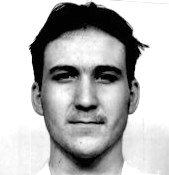
Jeffery Motley
Murderer Brian Kevin Rosenfeld
Murderer · USA · 1985
Brian Kevin Rosenfeld Brian Kevin Rosenfeld was sentenced to three concurrent l…
23 victims
Brian Kevin Rosenfeld
Murderer · USA · 1985
Brian Kevin Rosenfeld Brian Kevin Rosenfeld was sentenced to three concurrent l…
23 victims
 Marvin Gray
Murderer · USA · 1975
Marvin Gray was convicted killer who claimed responsibility for 23 slayings and…
23 victims
Marvin Gray
Murderer · USA · 1975
Marvin Gray was convicted killer who claimed responsibility for 23 slayings and…
23 victims
 Yahweh ben Yahweh
Murderer · USA · 1980
Yahweh ben Yahweh was born and legally named Hulon Mitchell Jr. (October 27, 19…
23 victims
Yahweh ben Yahweh
Murderer · USA · 1980
Yahweh ben Yahweh was born and legally named Hulon Mitchell Jr. (October 27, 19…
23 victims
 Russell Ellwood
Murderer · USA · 1991
Russell Ellwood was a former taxi driver. Authorities suspected him of killing…
20 victims
Russell Ellwood
Murderer · USA · 1991
Russell Ellwood was a former taxi driver. Authorities suspected him of killing…
20 victims
 Danny Lee King
Murderer · USA · 1990
Danny Lee King was found guilty of the 1990 capital murder of Mrs. Carolyn Roge…
1 victim
Danny Lee King
Murderer · USA · 1990
Danny Lee King was found guilty of the 1990 capital murder of Mrs. Carolyn Roge…
1 victim
 Daroyce Mosley
Mass murderer · USA · 1994
DaRoyce Lamont Mosley was convicted of capital murder for the death of Patricia…
4 victims
Daroyce Mosley
Mass murderer · USA · 1994
DaRoyce Lamont Mosley was convicted of capital murder for the death of Patricia…
4 victims
 John Anthony Silva
Homicide · USA · 2000
John Anthony Silva was convicted of first-degree murder for strangling a 12-yea…
1 victim
John Anthony Silva
Homicide · USA · 2000
John Anthony Silva was convicted of first-degree murder for strangling a 12-yea…
1 victim
 Toronto Patterson
Homicide · USA · 1995
1994 — Patterson was charged as a juvenile for unlawful weapon possession; the…
3 victims
Toronto Patterson
Homicide · USA · 1995
1994 — Patterson was charged as a juvenile for unlawful weapon possession; the…
3 victims
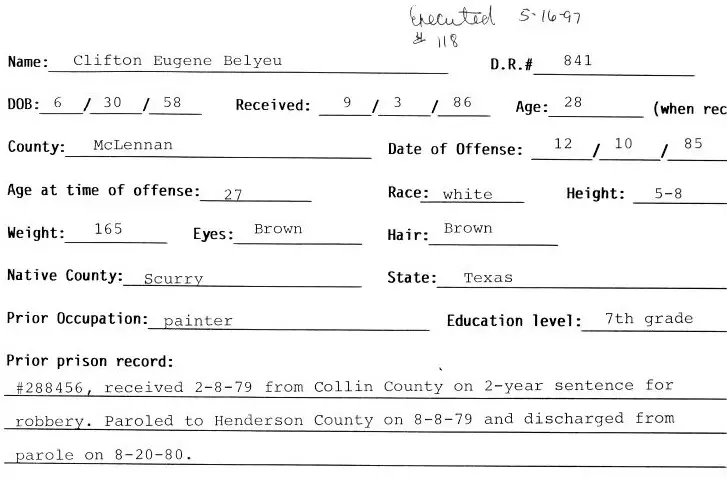 Clifton Eugene Belyeu
Murderer · USA · 1985
Clifton Eugene Belyeu was arrested, convicted, and put to death by lethal injec…
1 victim
Clifton Eugene Belyeu
Murderer · USA · 1985
Clifton Eugene Belyeu was arrested, convicted, and put to death by lethal injec…
1 victim
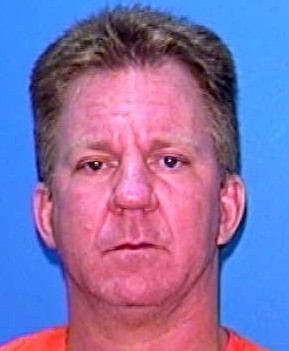 Donald Lee Bradley
Murderer · 1995
Donald Lee Bradley was convicted of first-degree murder and sentenced to death…
1 victim
Donald Lee Bradley
Murderer · 1995
Donald Lee Bradley was convicted of first-degree murder and sentenced to death…
1 victim
- Gender
- male
- Country
- USA
- Location
- Harris County, Texas, USA
- Date of birth
- September 17, 1965
- Age at first offence
- 19
- Characteristics
- rape, robbery, abuse, child abuse
- Victim profile
- Marie Edelia Duran (female, 30)
- Method of murder
- Shooting ( sawed-off shotgun)
- Date(s) of murder
- June 22, 1984
- Years active
- 1984
- Date of arrest
- 7 days after
- Status
-
Executed
Executed by lethal injection in Texas on February 7, 1995
Case details
- Offender: Jeffery (Jeffrey Dean) Motley
- Case number: 3 F.3d 781; Jeffrey Dean MOTLEY, Petitioner-Appellant, v. James A. COLLINS, Director, Texas Department of Criminal Justice, Institutional Division, Respondent-Appellee
- Court: United States Court of Appeals, Fifth Circuit
- Panel: KING, DAVIS and WIENER, Circuit Judges
- Date of appellate decision: Sept. 21, 1993
- Age at execution: 29 (18)
- Education level: 9th grade
- Victim: Maria Duran (Maria Adilia Duran)
- Victim age: 30
- Number of victims: 1
Timeline
- July 22, 1984 — Maria Duran left her home in the Houston area to drive to a friend's apartment to go swimming and never arrived.
- July 29, 1984 — Police arrested Jeffrey Motley while he was driving Duran's car.
- August 1, 1984 — Police found Duran's body in a field.
- May 24, 1989 — The Texas Court of Criminal Appeals denied rehearing.
- July 22, 1992 — A state court denied Motley’s petition for habeas corpus.
- February 7, 1995 — Motley was executed by lethal injection in Texas.
- February 8, 1995 — The New York Times published an article describing Motley’s execution.
Background
Maria Duran was last seen leaving her Houston-area home on July 22, 1984, when she drove to a friend's apartment to go swimming. Duran was killed with a shotgun, and her decomposing body was found in a field in La Porte. Duran’s identification, credit cards, and checkbook were found in a trash bin at an apartment complex where Motley was living.
Jeffrey Dean Motley was convicted of killing Maria Adilia Duran and sentenced to death. After serving 11 months of a 5-year term for burglary, Motley was on parole when he was captured while driving Duran’s car.
The offence
On the morning of July 22, 1984, Duran left her home to drive to a friend's apartment to go swimming. She never arrived. Duran’s body was later found in a field.
At the time of Motley’s arrest, evidence supported that Duran was killed with a shotgun, and her medical examiner determined the cause of death was a gunshot wound in the back. Investigators could not determine whether the shotgun slug that killed Duran was fired from the shotgun found in Duran’s car.
The prosecutor presented evidence and argument that the killing involved abduction and robbery: witnesses said Motley also had jewelry belonging to Duran, and a bank videotape showed Motley with Duran when she withdrew $300 from an automated teller machine. When Motley was arrested, he denied shooting Duran, even though it was not then certain that she was dead because her body had not been been found.
At sentencing, the jury heard evidence that Motley was physically and sexually abused as a child.
Investigation
Police began investigating Duran’s disappearance after her family called the police. Seven days later, on July 29, 1984, police arrested Motley as he was driving Duran’s car. A search of the car uncovered:
- a sawed-off shotgun
- a number of shotgun shells
- a hunting knife
Police discovered traces of human blood on the spare tire in the trunk of Duran’s car and on one of the tennis shoes that Motley was wearing. Duran’s credit cards, driver’s license, and social security card were found in a trash bin near the apartment complex where Motley was arrested.
On August 1, 1984, three days after Motley’s arrest, police found Duran’s body in a field. There were some signs that Duran had been sexually assaulted, and the evidence was ultimately found to be inconclusive.
Arrest
On July 29, 1984, police arrested Jeffrey Motley while he was driving Duran’s car. Witnesses said Motley had jewelry that belonged to Duran, and a bank videotape showed Motley with Duran when she withdrew $300 from an automated teller machine.
When he was arrested, Motley denied shooting Duran.
Trial
Conviction and capital sentencing issues
Based on evidence found in Duran’s car at the time Motley was arrested and other circumstantial evidence linking Motley to the crime, the jury convicted Motley of capital murder.
After hearing evidence on issues relevant to sentencing, including evidence that Motley was physically and sexually abused as a child, the jury was presented with two of the three Texas special issues under Texas law (as referenced: TEX. CODE CRIM. PROC. ANN. art. 37.071(b) (Vernon 1989)):
- Was the conduct of the Defendant that caused the death of the deceased committed deliberately and with the reasonable expectation that the death of the deceased would result?
- Is there a probability that the defendant would commit criminal acts of violence that would constitute a continuing threat to society?
The jury answered both questions affirmatively, and as a result Motley was automatically sentenced to death.
Direct appeal history
Motley’s conviction and sentence were affirmed on direct appeal: Motley v. State, 773 S.W.2d 283 (Tex.Crim.App.1989). The Texas Court of Criminal Appeals denied rehearing on May 24, 1989. Because Motley did not petition the Supreme Court for writ of certiorari, his conviction became final ninety days later.
Sentencing
At the punishment phase of trial, Motley testified about abuse he said he experienced as a child. He testified that his father began physically abusing him when he was about four or five years old. Motley recounted an instance when his father beat him until he was “bloody, all over,” and his father “had to put me in a tub of ice to stop the bleeding.” Motley testified that his father used his head as a battering ram and, on more than one occasion, slammed his head between doors.
Motley testified that other instruments of abuse included “belt buckles in the face” and a boxed-in wrench, which his father used to hit him “everywhere he could hit.”
Motley also testified that his father’s abuse included sexual and psychological abuse. He testified that his father had anal and oral sex with him until he was about thirteen, and that the sexual abuse stopped after his mother threatened to divorce his father.
Motley also recounted that his father squashed his gerbils to death in front of him after he was punished for not cleaning out his gerbil cage.
Motley testified that his mother often failed to protect him and, on at least one occasion, physically assaulted him herself. He recalled an incident where his mother came up behind him with a pool stick and “whacked” him in the back of the head, and when he turned around he “got whacked in the mouth.” He pointed to an F-shaped scar on his face which he contended was the result of being hit with a pool stick.
The defense called Dr. Fred Fason, a psychiatrist with experience treating child abuse victims, who testified about the likely effects of such abuse. The record included the following verbatim testimony excerpts:
- Motley’s witness statement framework included:
- Dr. Fason testified that victims of child abuse, “even at the age of eight or ten or twelve, were the kids that were most prone to pick a fight or beat up a younger child, or throw rocks at other kids and engage in behavior that we considered to be anti-social behavior, particularly in relationships to smaller children.”
- Dr. Fason explained the phenomenon of “identification with the aggressor” in these verbatim terms:
“The reason so many parents abuse the children who were abused is what psychoanalysts call identification with the aggressor. In their head, there is the play of the scene of the powerful person who is out to harm the smaller person. It is much better for them to be that powerful person, doing the harm, than the smaller person who is being terrorized. So, this is kind of what, in answer to your question, the effect on the child who is abused as a child, is to terrorize and at the same time to give him the feeling that no one really cares. And ... that combination leads him then to identify with the powerful figure, the way he conceptualizes the abusing parent, and then acts that out with other people in his life. This is why abused children so frequently get into difficulties with the law or difficulties with their own children, when they become parents.”
- Dr. Fason further testified on combined sexual and physical abuse in these verbatim terms:
“You have total separation of sexual feelings from soft and tender feelings to where [the child] becomes incapable of loving in a normal way.”
Motley’s stories of abuse were corroborated by neighbors the Howells, who had known Motley since he was three. Margaret Howell testified about Motley's childhood circumstances, including that when Motley was about eight he spent the night out on a busy highway, and she knew this because her son picked Motley up the next morning. She also testified that he was locked out of his home “on one of the bitterest [winter] nights,” and that on a winter day she saw him being hosed down with cold water by his father in the yard. She testified that on numerous occasions Motley came to her house bruised and bleeding and that she gave him food and shelter. Margaret Howell concluded, “He has had a hell of a life.”
Douglas Howell testified that although he never witnessed any abuse, he noticed blood or bruises on Motley’s face and skull on several occasions and remembered bars and padlocks on Motley’s bedroom window.
At the end of the punishment phase, the prosecutor argued that Motley’s child abuse may have made him “mean” and that aggression resulting from the abuse would probably continue because the time for effective treatment had passed. The prosecutor also made these verbatim statements during closing argument:
- “It doesn't excuse them from killing. It may make them mean. It may make them bitter, and I think you have seen a lot of meanness in this man. There is a lot of meanness there.”
Appeals
Habeas corpus petition and federal appeal
Motley proceeded to state habeas, which was denied on July 22, 1992 (cited as Ex Parte Motley, No. 23806 (Tex.Crim.App.1992)). He then proceeded to federal district court, where the judge denied habeas relief on all of his claims.
On appeal to the Fifth Circuit, the court addressed two arguments:
- Motley argued that the district court erred in rejecting his ineffective assistance of counsel claim.
- Motley argued that the district court erred in rejecting his Penry claim regarding jury consideration of mitigating evidence of child abuse.
Fifth Circuit decision
The Fifth Circuit reversed the district court’s denial of habeas relief. The appellate court concluded that the case fit “squarely within the small class of cases still controlled by Penry” and that the jurors were unable, as required by the Eighth and Fourteenth Amendments, to consider and give effect to substantial mitigating evidence that Motley “was abused as a child.” The Fifth Circuit therefore reversed the district court’s decision denying the writ and remanded with instructions to grant the writ unless the State retried Motley within 120 days from the issuance of the court’s mandate.
Ineffective assistance of counsel analysis
The appellate decision discussed the alleged ineffective assistance errors Motley raised in district court, including:
- agreeing with the State during voir dire that the term “deliberately” in the first special issue meant essentially the same thing as “intentionally” in the guilt/innocence phase
- calling Motley as a witness after the State rested with evidence Motley said was insufficient
- being unfamiliar with capital sentencing law, particularly admissibility of unadjudicated extraneous offenses at punishment
- failing to investigate and introduce evidence of Motley's brain damage during the punishment phase
The Fifth Circuit affirmed the district court’s rejection of ineffective assistance relief, concluding that Motley failed to show prejudice as required under Strickland.
The appellate court included verbatim quotes from the district court’s reasoning:
- “The state court found that Motley received effective assistance at all phases of his trial. Because the record supports those factual findings, they are presumed correct.”
It also included a verbatim excerpt from the Supreme Court case Penry’s quoted reasoning, including these verbatim excerpts:
- “punishment should be directly related to the personal culpability of the criminal defendant.”
- “consistent with the Eighth and Fourteenth Amendments, prevent the sentencer from considering and giving effect to evidence relevant to the defendant's background or character or to the circumstances of the offense that mitigate against imposing the death penalty.”
- “that it could consider and give effect to the mitigating evidence of Penry's mental retardation and abused background by declining to impose the death penalty....”
The appellate decision also reproduced verbatim quoted passages describing Penry’s “two-edged sword” language:
- Penry’s mental retardation and history of abuse is thus a two-edged sword: it may diminish his blameworthiness for his crime even as it indicates that there is a probability that he will be dangerous in the future.
Penry claim discussion and preservation
At the punishment phase of trial, Motley testified about childhood abuse, including physical and sexual abuse, and he presented corroboration from Margaret Howell and Douglas Howell, and testimony from Dr. Fred Fason.
The Fifth Circuit concluded that Motley properly preserved the Penry claim for collateral review.
In discussing the Penry claim, the appellate court also reproduced verbatim quotations and included the prosecutor’s closing statements already quoted above, plus additional verbatim statements attributed to Judge Reavley and district court commentary. It included this verbatim quote attributed to the district court’s Penry analysis:
- “His circumstances were pitiful as a child; therefore, he is not responsible for his acts. Freedom necessarily implies responsibility; Motley abused his freedom. He must bear the consequences the state of Texas has prescribed for this particular abuse, after he has been afforded every protection the procedures of a humane, reasonable people can offer.”
It also included this verbatim excerpt from the district court analysis:
- “Child abuse is tragic for anyone, but its ability to break the causal connection between the free will of the defendant and the fate of his victim has never been suggested.”
And included additional verbatim statements from the district court analysis:
- “If a defendant could argue that this experience as a youthful victim of abuse led him to react excessively to his perception of a threat, he could lend some support to an otherwise implausible assertion of self defense.”
- “These sorts of considerations were not present in this case.”
- “Motley's position is an insult to people everywhere who have overcome their injuries and deprivations to become successful contributing members of our community.”
- “Also, murders are committed by people who were not abused, contradicting the causal inference Motley wants the court to make.”
Dissent
A dissenting opinion by W. EUGENE DAVIS, Circuit Judge stated that the dissenting judge did not find sufficient evidence from the trial record to raise an inference that Motley's criminal conduct was “attributable to” his child abuse as required to establish a Penry claim and would have affirmed the denial of habeas relief.
The dissent included the following verbatim characterization of the trial record:
- “The record, however, is absolutely silent on the effect this abuse had on Motley.”
The dissent also included detailed verbatim discussion of Motley’s confession account and the crime narrative, including: “Motley took a sawed off shotgun to a shopping mall intending to rob someone.”
The dissent included the following verbatim quotation from the reasoning:
- “For these reasons, I conclude that the evidence is insufficient to allow a rational juror to attribute this murder to Motley's earlier child abuse.”
- “Accordingly, I would reject the Penry claim.”
Outcome
The Fifth Circuit reversed the district court’s decision denying Motley’s petition for a writ of habeas corpus and remanded with instructions to grant the writ unless the State retried Motley within 120 days from the issuance of the court’s mandate.
Despite the federal appellate reversal and remand, Motley was executed by lethal injection in Texas on February 7, 1995.
Aftermath
In a prison interview before his execution, Motley said: “to say I'm getting punished is imbecilic.” He added: “Once I get dead, I'm not going to worry about it. My friends, family, relatives -- they've got to live with it.”
In his final statement, Motley turned toward his mother, Joanne, and said: “I love you, Mom. Goodbye.” He then cried and repeated, “Goodbye, Mom.”
Mrs. Motley sobbed quietly in the death chamber, then broke into loud cries outside.
Other details
- Maria Duran left her apartment in the Houston area to swim with a friend on July 22, 1984.
- The jury convicting Motley of capital murder answered both special issues affirmatively.
- The Fifth Circuit decision referenced procedural default issues and discussed Texas special issues under TEX. CODE CRIM. PROC. ANN. art. 37.071(b) (Vernon 1989), and it discussed discussion of Texas law regarding empaneling a jury solely for penalty under TEX.CODE CRIM.PROC.ANN. art. 44.29(c) (Vernon Supp.1993).
- The dissent noted that Motley abducted Duran and forced her to withdraw money from her bank account, and that the first person who came along was Duran.
- The dissent stated the dissenting judge’s account of the only definitive evidence relative to the murder itself: that Motley shot Ms. Duran in the back with the shotgun from a distance of about thirty-five feet.
Spotted an error, or have more information about this case?