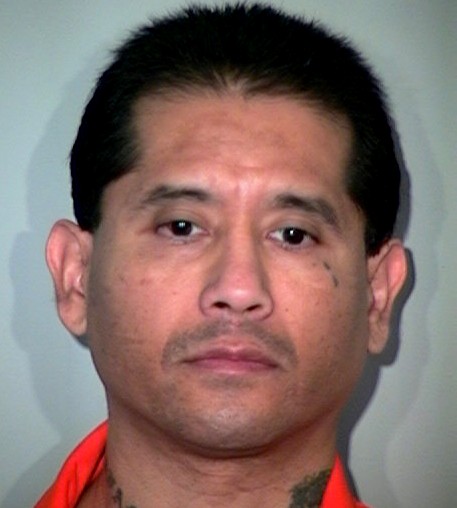
David Martinez Ramirez
Murderer Brian Kevin Rosenfeld
Murderer · USA · 1985
Brian Kevin Rosenfeld Brian Kevin Rosenfeld was sentenced to three concurrent l…
23 victims
Brian Kevin Rosenfeld
Murderer · USA · 1985
Brian Kevin Rosenfeld Brian Kevin Rosenfeld was sentenced to three concurrent l…
23 victims
 Yahweh ben Yahweh
Murderer · USA · 1980
Yahweh ben Yahweh was born and legally named Hulon Mitchell Jr. (October 27, 19…
23 victims
Yahweh ben Yahweh
Murderer · USA · 1980
Yahweh ben Yahweh was born and legally named Hulon Mitchell Jr. (October 27, 19…
23 victims
 Russell Ellwood
Murderer · USA · 1991
Russell Ellwood was a former taxi driver. Authorities suspected him of killing…
20 victims
Russell Ellwood
Murderer · USA · 1991
Russell Ellwood was a former taxi driver. Authorities suspected him of killing…
20 victims
 Robert Martines Perez
Murderer · USA · 1994
Name: Robert Martines Perez · Other name used in proceedings: Robert Martinez P…
15 victims
Robert Martines Perez
Murderer · USA · 1994
Name: Robert Martines Perez · Other name used in proceedings: Robert Martinez P…
15 victims
 David Mulcahy
Serial killer · United Kingdom · 1985
David Mulcahy (born 1959) was a British serial rapist and convicted murderer wh…
3 victims
David Mulcahy
Serial killer · United Kingdom · 1985
David Mulcahy (born 1959) was a British serial rapist and convicted murderer wh…
3 victims
 Ray McArthur Freeney
Murderer · USA · 2002
Ray McArthur Freeney was indicted for the murders of Kirshalynne Jones and Vick…
2 victims
Ray McArthur Freeney
Murderer · USA · 2002
Ray McArthur Freeney was indicted for the murders of Kirshalynne Jones and Vick…
2 victims
 Herman Drenth
Murderer · USA · 1931
Herman Drenth was also known by the aliases Harry F. Powers and Cornelius O. Pi…
5 victims
Herman Drenth
Murderer · USA · 1931
Herman Drenth was also known by the aliases Harry F. Powers and Cornelius O. Pi…
5 victims
 Charles Mayhew
Murderer? · USA · 1998
Charles “Chuck” Mayhew Jr. (age 49; son of Charles “Charlie” Mayhew Sr.) · Char…
1 victim
Charles Mayhew
Murderer? · USA · 1998
Charles “Chuck” Mayhew Jr. (age 49; son of Charles “Charlie” Mayhew Sr.) · Char…
1 victim
- Gender
- male
- Country
- USA
- Location
- Maricopa County, Arizona, USA
- Date of birth
- April 7, 1957
- Age at first offence
- 32
- Characteristics
- rape, sexual assault, torture, gang, drug addict
- Victim profile
- Mary Gortarez and her daughter, Candie Gortarez, 15
- Method of murder
- St abbing with knife
- Date(s) of murder
- May 25, 1989
- Years active
- 1989
- Date of arrest
- Same day
- Status
-
Sentenced to death
Sentenced to death on December 18, 1990
Defendant
David Martinez Ramirez was a parolee when he murdered Mary Gortarez and her 15-year-old daughter, Candie Gortarez, in their Phoenix apartment during the early morning hours of May 25, 1989.
The offence
David Ramirez murdered Mary Gortarez and her 15-year-old daughter, Candie Gortarez, in their Phoenix apartment. He stabbed Mary 18 times in the neck, in the back, in the stomach, and in the left eye. He stabbed Candie 15 times in the neck area. Neither Mary nor Candie died instantaneously. Neighbors heard sounds of a violent struggle for about half an hour coming from the apartment, and when police entered it they found blood smeared and spattered throughout. Ramirez also sexually assaulted Candie Gortarez while she was close to death. Ramirez was the only person alive in the apartment.
Investigation
Neighbors heard sounds of a violent struggle for about half an hour coming from the apartment. When police entered the apartment, they found blood smeared and spattered throughout.
Arrest
Ramirez was arrested at the scene.
Trial
The presiding judge was Thomas W. O’Toole. The prosecutor was Louis Stalzer. The start of trial was July 10, 1990, and the verdict was July 27, 1990. Ramirez was convicted of both murders.
Sentencing
Sentencing took place on December 18, 1990.
Aggravating Circumstances:
- Prior conviction involving violence
- Especially heinous/cruel/depraved
- Multiple homicides
Mitigating Circumstances:
- Ability to conform conduct to requirements of law impaired
- Unstable family background
- Poor educational experience
- Victim of sexual abuse
- Gang affiliation
- Substance abuse
- Psychological history
- Love of family
The court found the mitigating circumstances existed but were insufficiently substantial to call for leniency:
- (G)(1) Significant Impairment
- Difficult Childhood/Family History [including gang affiliation]
- Lack of Education
- Psychological history
- Chronic substance abuse
- Family Ties
The court found that the defendant failed to prove by a preponderance of the evidence the existence of the following mitigating circumstances:
- Remorse
- Model Prisoner
- Residual Doubt
Appeals
PROCEDURAL POSTURE: The defendant was convicted in Superior Court (Maricopa) of two counts of premeditated, first-degree murder, and sentenced to death. This was the defendant’s automatic, direct appeal to the Arizona Supreme Court.
PUBLISHED OPINIONS:
- State v. Ramirez, 178 Ariz. 116, 871 P.2d 237 (1994)
AGGRAVATING CIRCUMSTANCES UPHELD: (F)(2) (Prior Violent Felony) - UPHELD The defendant’s prior convictions were for aggravated assault and robbery. The court examined the statutes under which the defendant was convicted and found that the specific subsections of the statutes necessarily involved violence or the threat of violence to another. In State v. Fierro, 166 Ariz. 539, 804 P.2d 72 (1990), the court held that a conviction for aggravated assault under A.R.S. §13-1203 and §13-1204 did not qualify as an aggravating factor because it was possible to commit the crime without the use or threat of violence. Here, the state avoided that problem by proving the specific subsections that applied, and those subsections necessarily involved violence. The robbery statute also necessarily involved the use or threat of violence.
(F)(6) (Heinous, Cruel or Depraved) - UPHELD Cruel: Upheld. Mental Anguish: Found. The court found that the victims experienced great pain and suffering over a prolonged period of time. Neighbors heard “banging, screaming, cries for help, and running noises” for twenty to thirty minutes. 178 Ariz. at 129. Blood and murder weapons were scattered throughout the apartment. The victims were conscious during repeated stabbings. Each victim was stabbed fifteen to twenty times. Each victim was aware of the other victim’s suffering. Victim, Mrs. G., had defensive wounds from the struggle. Under these facts, the court found that F(6), “especially cruel,” applied to both murder counts. Physical Pain: Found. See Mental Anguish. Knew or Reason to Know that Victim Would Suffer: The court found the victim’s suffering to be inescapably foreseeable to defendant. Heinous or Depraved: Not addressed.
(F)(8) (Multiple Homicides) - UPHELD The defendant was convicted of stabbing a female acquaintance and her fifteen-year-old daughter to death. The court cited State v. Lavers, 168 Ariz. 376, 814 P.2d 333 (1991), and said it analyzes the temporal, spatial, and motivational relationships between the capital homicide and the collateral [homicide], as well as the nature of that [homicide] and the identify of its victim to determine if one murder was committed during the course of another. The court said that the murders occurred in same place, resulted from the same disturbance, and were committed in a relatively short period of time in what can be fairly viewed as one continuous course of criminal conduct. The trial court misstated the law by saying that the factor supports the death sentence on either conviction. The court noted that the factor, once proven, applies to each conviction.
Outcome
JUDGMENT: Convictions and sentences affirmed.
Other details
Ramirez had the following mitigating circumstances considered in the decision: ability to conform conduct to requirements of law impaired, unstable family background, poor educational experience, victim of sexual abuse, gang affiliation, substance abuse, psychological history, and love of family. The court also noted that the mitigating circumstances did not call for leniency.
David Martinez Ramirez was described as Hispanic, and the victims were described as Hispanic.


Spotted an error, or have more information about this case?