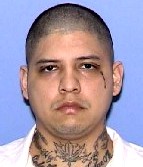
Juan Jose Reynoso
Murderer Robert Martines Perez
Murderer · USA · 1994
Name: Robert Martines Perez · Other name used in proceedings: Robert Martinez P…
15 victims
Robert Martines Perez
Murderer · USA · 1994
Name: Robert Martines Perez · Other name used in proceedings: Robert Martinez P…
15 victims
 Billy Frank Vickers
Murderer · USA · 1993
Billy Frank Vickers Vickers was executed by lethal injection in Texas on Januar…
14 victims
Billy Frank Vickers
Murderer · USA · 1993
Billy Frank Vickers Vickers was executed by lethal injection in Texas on Januar…
14 victims
 Robert Glen Jones
Murderer · USA · 1996
Defendant: Robert Glenn Jones (ADC#070566) · Co-defendant: Scott Nordstrom (ADC…
7 victims
Robert Glen Jones
Murderer · USA · 1996
Defendant: Robert Glenn Jones (ADC#070566) · Co-defendant: Scott Nordstrom (ADC…
7 victims
 Larry McKay
Murderer · USA · 1981
Larry McKay was convicted of two counts of felony murder each for the shooting…
2 victims
Larry McKay
Murderer · USA · 1981
Larry McKay was convicted of two counts of felony murder each for the shooting…
2 victims
 Marlon DeWayne Williams
Murderer · USA · 1993
Marlon DeWayne Williams was a drug dealer. Williams was black. He was 26 when e…
1 victim
Marlon DeWayne Williams
Murderer · USA · 1993
Marlon DeWayne Williams was a drug dealer. Williams was black. He was 26 when e…
1 victim
 Robert Excell White
Spree killer · USA · 1974
Robert Excell White was executed by lethal injection in Texas on March 30, 1999…
4 victims
Robert Excell White
Spree killer · USA · 1974
Robert Excell White was executed by lethal injection in Texas on March 30, 1999…
4 victims
 Timothy Titsworth
Murderer · USA · 1993
Timothy Titsworth was executed by lethal injection in Texas on June 6, 2006. ·…
1 victim
Timothy Titsworth
Murderer · USA · 1993
Timothy Titsworth was executed by lethal injection in Texas on June 6, 2006. ·…
1 victim
 Kevin Lloyd Artz
Murderer · USA · 1999
Kevin Lloyd Artz was married for 12 years to Patricia Artz. Patricia Artz was 4…
1 victim
Kevin Lloyd Artz
Murderer · USA · 1999
Kevin Lloyd Artz was married for 12 years to Patricia Artz. Patricia Artz was 4…
1 victim
- Gender
- male
- Country
- USA
- Location
- Harris County, Texas, USA
- Date of birth
- November 2, 1979
- Age at first offence
- 24
- Characteristics
- robbery, mentally ill
- Victim profile
- Adult female
- Method of murder
- Shooting
- Date(s) of murder
- March 2, 2003
- Years active
- 2003
- Date of arrest
- —
- Status
-
Sentenced to death
Sentenced to death on May 21, 2004
Case record: Juan Jose Reynoso
Background
Juan Jose Reynoso was identified in the case as having the TDCJ number 999477 and the date of birth 11/02/1979. He was received in the system on 05/21/2004, at the age of 24, and had an education level recorded as 09. His race and gender were recorded as Hispanic male. His hair color was recorded as Black, his height as 5 ' 06", weight as 173, and his eye color as Brown. His native county and native state were both recorded as Native. His prior occupation was listed as “Nueces Texas Laborer.” His prior prison record was listed as None. The case materials included a reference to “history of mental illness” in the characteristics and discussed waiver-related proceedings in capital-murder litigation.
The offence
On March 2, 2003, in Harris County, Texas, Reynoso approached an adult male and female. He pointed a gun at them and demanded their money. The male victim complied. The female victim told him that she did not have any money. Reynoso struck the female with his fist, causing her to fall to her knees, where he fatally shot her in the chest. Reynoso was convicted by a jury of capital murder. The jury answered the special issues submitted pursuant to Texas Code of Criminal Procedure article 37.071, and the trial court set punishment at death.
The case materials identified “co-defendants none.” The sex of the victim was recorded as female, and “race and gender of victim” was recorded as “Unknown” for race and “Female” for gender.
Investigation, arrest, and trial
The case materials placed the conviction and sentencing in the context of a post-conviction writ of habeas corpus application in the Texas Court of Criminal Appeals. The Court of Criminal Appeals of Texas proceedings referenced:
- Ex Parte Juan Jose Reynoso, No. AP-75,963, in an application for writ of habeas corpus in cause no. 941651-A in the 263rd Judicial District Court, Harris County.
- A per curiam decision, with a concurring opinion filed by Price, J.
The case materials described the timeline of Reynoso’s attempts to waive appeals and habeas corpus proceedings. The Court stated that the application for writ of habeas corpus was brought under Texas Code of Criminal Procedure article 11.071. The Court discussed repeated efforts to waive appeals that were interspersed with occasional desire to pursue those same appeals.
On May 12, 2004, a jury convicted Reynoso of the offense of capital murder. The trial court set punishment at death based on the jury’s answers to the punishment special issues. The trial court timely appointed both direct appeal counsel and habeas counsel. Reynoso refused to sign the oaths of indigency and orders appointing counsel. He immediately and consistently stated that he wanted to waive all of his appeals and have the trial court set an execution date. To ensure he was properly warned of the dangers of this path and to supplement the record with evidence that his choice was knowingly and voluntarily made, the Court abated the direct appeal and directed the trial court to address issues on the record and to answer certain questions.
The Court’s order to the trial court included instruction that if Reynoso knowingly and voluntarily waived his right to file a habeas application, the trial court should rescind its order appointing counsel on habeas. During a compliance hearing on November 8, 2004, Reynoso again stated he wanted to waive his right to habeas proceedings, and the trial court withdrew its order appointing Steven “Rocket” Rosen as habeas counsel.
Meanwhile, Reynoso’s direct appeal continued.
- November 18, 2004 — Counsel on direct appeal filed a brief (the Court materials stated that when informed the direct appeal could not be waived, Reynoso chose to allow counsel to proceed).
- November 28, 2004 — Reynoso wrote a letter to the trial court requesting that it set an execution date.
- February 8, 2005 — Reynoso sent another letter requesting an execution date.
- February 23, 2005 — The State filed its brief on direct appeal.
- March 2, 2005 — Reynoso wrote a letter to the trial court stating that he had changed his mind and wanted to pursue his appeals. As a consequence, even though his appointment had been withdrawn, Rosen requested a 90-day extension for filing Reynoso’s habeas application. The trial court granted the extension on March 29, 2005.
- April 4, 2005 — The trial court convened a hearing where Reynoso confirmed he wanted to pursue his Article 11.071 habeas action. The trial court re-appointed Rosen to represent him.
- April 9, 2005 (Saturday) — The original due date for the Article 11.071 application for writ of habeas corpus had no extension filed.
- May 1, 2005 — Reynoso wrote a letter stating: “again, once and for all, . . . I DO NOT want Rocket [Steven] Rosen to represent me. I wish to waive my appeals. I would like an execution date immediately.”
- May 4, 2005 — In a published order responding to the trial court’s notice of re-appointment, the Court held that when counsel’s initial timely appointment was withdrawn pursuant to Reynoso’s decision to waive his right to seek relief by writ of habeas corpus, Reynoso was considered to have chosen to proceed pro se for purposes of Article 11.071, at least until the filing deadlines had passed. The Court further held that because Reynoso changed his mind about waiving his right to habeas and asked the court to appoint counsel prior to the filing deadline, and because the trial court re-appointed Rosen, the re-appointment would be treated as a rescission of the November 2004 order allowing counsel to withdraw. In that same published order, the Court held that an appointment beyond the 30 days allowed by Article 11.071 § 2(c) was untimely and not allowed by the statute.
- May 19, 2005 — Attorney Sidney Crowley visited Reynoso in prison and discussed the habeas application with him. The Court materials stated that Reynoso told Crowley that he did not want a writ application filed on his behalf, and upon further questioning Reynoso reiterated his position.
- June 22, 2005 — Reynoso wrote another letter to the trial court asking it to disregard his last request to drop his appeals.
- July 11, 2005 (Monday) — Rosen filed an Article 11.071 habeas application on Reynoso’s behalf.
On December 14, 2005, the Court affirmed Reynoso’s conviction and sentence on direct appeal. On January 9, 2006, the State filed its answer on habeas. On October 11, 2006, the trial court entered findings of fact and conclusions of law recommending that relief be denied on the single claim raised in the habeas application. On October 19, 2006, Reynoso filed an application for the appointment of new habeas counsel in the trial court; the document appeared to have been mailed on October 12, 2006, one day after the court issued its findings and conclusions regarding the habeas application. On December 20, 2006, the Court ordered the trial court to resolve issues raised in Reynoso’s pro se application for new counsel. On May 4, 2007, the trial court addressed the issues raised in Reynoso’s pro se application for appointment of new counsel as directed, and the trial court issued findings and conclusions recommending that the pending application filed by Rosen be withdrawn and new counsel appointed. On June 27, 2007, the Court dismissed Reynoso’s habeas application as untimely. The Court later granted rehearing and issued the opinion included in the case materials.
Sentencing
On May 12, 2004, a jury convicted Reynoso of capital murder.
Appeals, habeas corpus, and procedural history
The Court described the habeas corpus application as governed by Texas Code of Criminal Procedure article 11.071. It stated that, in an order delivered on June 27, 2007, dismissing the application as untimely, the Court had previously set out a detailed account of Reynoso’s repeated attempts to waive his appeals, with an occasional desire to pursue those same appeals. In Ex parte Reynoso, 228 S.W.3d 163 (Tex. Crim. App. 2007), the Court held that, given timing and Reynoso’s repeated claims he did not want to pursue appeals, he could not show good cause for the untimely filing, dismissed the application in its entirety, and declined to appoint new counsel under Article 11.071 § 4A. The opinion also described Reynoso’s subsequent suggestion to reconsider on its own initiative under Texas Rule of Appellate Procedure 79.2(d), followed by rehearing and briefing on whether the calculation rule affected the due date of the habeas application.
The Court’s rehearing addressed:
- Whether the original due date was governed by the 45-day rule or the 180-day rule in Article 11.071 § 4(a).
- Whether Texas Rule of Appellate Procedure 4.1 or the Code Construction Act Chapter 311 controlled computation of time for the application filing when a 90-day extension under Article 11.071 § 4(b) had been granted.
- Whether there was “good cause” for the untimely filing under Article 11.071 § 4A(a) and the potential remedies under Article 11.071 § 4A(b).
Due date calculations and extension
The Court described Article 11.071 § 4(a) providing that an application for a writ of habeas corpus must be filed not later than the 180th day after the date the convicting court appoints counsel under Section 2, or not later than the 45th day after the date the State’s original brief is filed on direct appeal with the court of criminal appeals, whichever date is later.
The Court also described Article 11.071 § 2 requiring the convicting court, immediately after judgment in a death penalty case, to determine indigency and whether the defendant desires appointment of counsel for filing a writ of habeas corpus, and if both answers were yes, to appoint competent counsel at the earliest practical time but no later than 30 days after making those findings.
The Court concluded that the 45-day rule governed the due date. It stated that Reynoso was convicted by a jury on May 12, 2004, and the court sentenced him to death. The Court stated that, on May 19, 2004, the court appointed Rosen to represent Reynoso for purposes of filing a writ of habeas corpus. The Court stated that this appointment was made within the “immediately after judgment is entered” plus 30-day period. The Court then stated that the State’s brief was filed on February 23, 2005 and therefore the 45th day after that date provided the later date.
For computation of time and application of the extension, the Court described the original due date as April 9, 2005 (Saturday) under the 45-day rule. It then described that Reynoso requested and received a 90-day extension under Article 11.071 § 4(b) and that the dispute centered on when the extension began for calculation of the extended due date.
The Court discussed Texas Rule of Appellate Procedure 4.1(a) and Code Construction Act § 311.014. It also discussed the requirement under Article 11.071 § 4(b) that the convicting court grant the extension before the filing date applicable under Subsection (a), for good cause shown, after notice and an opportunity to be heard by the attorney representing the state. The Court held that neither the Code Construction Act § 311.014(b) nor Texas Rule of Appellate Procedure 4.1 could apply to the filing of an extension of time under Article 11.071 § 4(b), because applying them would create a logical impossibility.
The Court then held that Section 311.014 and Rule 4.1 did not apply to the calculation of an original due date under Article 11.071 § 4(b) when an extension had been granted under that provision. The Court concluded that, under the facts of this case, the 90-day extension began on April 9, 2005. It stated that excluding April 9 from the 90 days resulted in the extended due date falling on Friday, July 8, 2005. The Court stated that Reynoso filed his application on July 11, 2005, and therefore it was untimely under that due date calculation.
Good cause and reconsideration
The Court then addressed Article 11.071 § 4A and a showing of good cause when an untimely application was filed. It described that Article 11.071 § 4A allowed counsel to show cause, and at the conclusion of counsel’s presentation the Court could dismiss, permit continued representation with a new filing date, or appoint new counsel with a new filing date.
The Court referenced Ex parte Reynoso, 228 S.W.3d at 166, stating that in the earlier decision it had found delay attributable to Reynoso’s continued insistence upon waiving habeas corpus review. The Court stated that the record showed less than a week after counsel was timely appointed, Reynoso told the trial court he did not want to pursue habeas corpus review, maintained that position for nearly ten months until March 2, 2005, and that the trial court allowed counsel to withdraw in early November 2004. The Court further stated that, although counsel was re-appointed on April 4, 2005, less than a month later Reynoso again expressed desire to waive habeas relief, and that when co-counsel went to the prison to discuss the case, Reynoso told him he did not want to pursue habeas review, until nearly two months later when Reynoso told the court he did want to pursue habeas review.
The Court explained that, although it had focused on Reynoso’s behavior and actions in the earlier decision, it did not consider counsel’s role in habeas proceedings and filing the application. For purposes of this case, the Court stated that the primary fact to consider was the same fact on which it had granted reconsideration: the application of Rule 4.1 and Code Construction Act § 311.014 to calculation of time to file.
The Court stated that although it held earlier that counsel improperly applied the provisions resulting in an untimely filed application, it could not say in absence of controlling authority that counsel’s interpretation was completely unreasonable. It characterized the tardiness as due to a mistaken but not totally implausible interpretation of the law. The Court then found good cause for the tardy filing, accepted the application as timely filed as of July 11, 2005, and reviewed the merits of the claim raised. It stated that the application raised one claim, that the claim was raised and rejected on direct appeal and thus was not cognizable on habeas review. It cited Ex parte Torres, 943 S.W.2d 469, 475 (Tex. Crim. App. 1997). The Court denied relief.
Verbatim quoted material
Reynoso’s letter included this verbatim quoted statement:
“again, once and for all, . . . I DO NOT want Rocket [Steven] Rosen to represent me. I wish to waive my appeals. I would like an execution date immediately.”
Outcome
The Court denied relief on the writ. It held that because the claim was raised and rejected on direct appeal, it was not cognizable on habeas review. The Court found good cause for the tardy filing and accepted the application as timely filed as of July 11, 2005, but ultimately denied relief.
Aftermath
The case materials included the delivery date of the opinion as “Delivered: July 2, 2008.” The death sentence remained in place as reflected in the status field stating “Sentenced to death on May 21, 2004.”

Spotted an error, or have more information about this case?