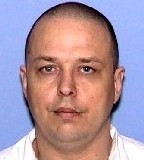
Robert Leslie Roberson
Murderer Robert Martines Perez
Murderer · USA · 1994
Name: Robert Martines Perez · Other name used in proceedings: Robert Martinez P…
15 victims
Robert Martines Perez
Murderer · USA · 1994
Name: Robert Martines Perez · Other name used in proceedings: Robert Martinez P…
15 victims
 Billy Frank Vickers
Murderer · USA · 1993
Billy Frank Vickers Vickers was executed by lethal injection in Texas on Januar…
14 victims
Billy Frank Vickers
Murderer · USA · 1993
Billy Frank Vickers Vickers was executed by lethal injection in Texas on Januar…
14 victims
 Stacey Newkirk-Smalls
Murderer · USA · 2012
Stacey Newkirk-Smalls was a Tacony mother accused in the May 2012 murders of he…
2 victims
Stacey Newkirk-Smalls
Murderer · USA · 2012
Stacey Newkirk-Smalls was a Tacony mother accused in the May 2012 murders of he…
2 victims
 Velma Ogden-Whitehead
Murderer · USA · 2005
Velma Ogden-Whitehead pleaded guilty to first-degree murder in the 2005 killing…
1 victim
Velma Ogden-Whitehead
Murderer · USA · 2005
Velma Ogden-Whitehead pleaded guilty to first-degree murder in the 2005 killing…
1 victim
 John Maloney
Murderer · USA · 1998
John Maloney — former police arson detective; Green Bay Police Department offic…
1 victim
John Maloney
Murderer · USA · 1998
John Maloney — former police arson detective; Green Bay Police Department offic…
1 victim
 Willie Leroy Jones
Murderer · USA · 1983
Willie LeRoy Jones was executed by electrocution in Virginia on September 11, 1…
2 victims
Willie Leroy Jones
Murderer · USA · 1983
Willie LeRoy Jones was executed by electrocution in Virginia on September 11, 1…
2 victims
 Jennifer Womac
Murderer · USA · 2009
Jennifer Lee Womac was 38 and was charged in a patricide murder case in Meigs C…
1 victim
Jennifer Womac
Murderer · USA · 2009
Jennifer Lee Womac was 38 and was charged in a patricide murder case in Meigs C…
1 victim
 Andrew Wamsley
Murderer · USA · 2003
Andrew Wamsley was sentenced to life in prison on March 10, 2006. Andrew Wamsle…
2 victims
Andrew Wamsley
Murderer · USA · 2003
Andrew Wamsley was sentenced to life in prison on March 10, 2006. Andrew Wamsle…
2 victims
- Gender
- male
- Country
- USA
- Location
- Anderson County, Texas, USA
- Date of birth
- November 10, 1966
- Age at first offence
- 36
- Characteristics
- rape
- Victim profile
- Nikki Curtis, 2 (his daughter )
- Method of murder
- Beating
- Date(s) of murder
- January 31, 2002
- Years active
- 2002
- Date of arrest
- —
- Status
-
Sentenced to death
Sentenced to death on February 21, 2003
Case record: Robert Leslie Roberson III (TDCJ #999442)
Other details
Robert Leslie Roberson III was a white male. His hair color was brown, his height was 6 ft 0 in, his weight was 269, and his eye color was blue. He was born 11/10/1966 and received the case on 02/21/2003 at age 36. The age at the offense was 35 on 01/31/2002. The county was Anderson and the state was Texas. He was described as having prior occupation as wood Texas cook, construction, welder, laborer.
Prior record
Roberson had a prior prison record noted as #527853 on a ten year sentence from Anderson County for burglary of a habitation. He was released on parole on 01/08/1991 to Smith County. He returned from parole from Smith County with a new conviction on 03/25/1993 for theft by check from Smith County and theft by worthless check from Gregg County, with a new concurrent term of 5 years and 7 years. He was released on parole on 12/15/1994 to McLennan County. He returned from parole from McLennan County without new conviction on 06/23/1999. He was released on parole to Anderson County on 12/12/2000.
The offence
On 01/31/2002, in Palestine, Texas, Roberson took his two year old white female daughter to Palestine Regional Medical Center, claiming she had fallen out of bed. The victim had suffered severe trauma to her head from being struck by Roberson. The victim was life flighted to Dallas Children's Hospital, where she died from her injuries the next day.
Roberson was in the course of committing or attempting to commit aggravated sexual assault on the victim.
The indictment alleged:
- Intentionally and knowingly murdering a child under the age of 6 by blunt force trauma.
- Intentionally murdering a person during a sexual assault.
- Intentionally or knowingly causing injury to a child under 14.
Co-defendants: none.
Timeline
- 01/30/2002 — Nikki Curtis was brought to a hospital in the context of reported injuries after Roberson picked her up.
- 01/31/2002 — Roberson brought his two year old daughter to Palestine Regional Medical Center, claiming she had fallen out of bed; she suffered severe head trauma.
- 02/01/2002 — The victim was life flighted to Dallas Children's Hospital; the victim died the next day; Roberson was placed under arrest and charged with Capital Murder the following day.
- 04/25/2002 — Roberson was indicted by the Anderson County Grand Jury for the January 30, 2002 murder of his daughter, Nikki Curtis.
- 06/20/2002 — Pre-trial hearing.
- 07/19/2002 — Pre-trial hearing.
- 07/31/2002 — Pre-trial hearing.
- 08/22/2002 — Pre-trial hearing.
- 09/04/2002 — Initial panel jury selection.
- 09/11/2002 — Commencement of individual voir-dire.
- 12/28/2002 — Jury strikes and final selection of petit jury.
- 02/03/2003 — First day of trial.
- 02/11/2003 — Conviction jury verdict returned.
- 02/14/2003 — Sentencing jury verdict returned.
- 02/19/2003 — Judgment signed.
- 02/16/2004 — Roberson’s opening direct appeal brief filed with the Court of Criminal Appeals (on time, by mail).
- 06/20/2007 — Delivered June 20, 2007 (do not publish).
- 02/21/2003 — Sentenced to death on February 21, 2003.
Background
Victim and relationships
The jury found Roberson guilty of the capital murder of Nikki Curtis, his two-year-old daughter.
Nikki Michelle Curtis was born on October 20, 1999, in Tarrant county, Texas, to a mother who was a habitual drug user and occasional prostitute. The father was not listed on the birth certificate, but was presumed to be another boyfriend of the mother. The biological father was Robert Roberson III. Care of the child was directly assumed by the maternal grandparents as the mother was unfit to maintain care of the child. The mother played no further role in the child’s life. Eventually, through intercession by Roberson’s mother, the real biological father was identified.
Initially, custody was held by the maternal grandparents, Mr. and Mrs. Bowman. There were visitations with the child by the paternal grandmother, Carolyn Roberson, and discord developed, resulting in numerous accusations and calls to Child Protective Services.
In November 2001, Roberson personally intervened in the custody situation, legally established paternity, and by virtue of an agreement between the Bowman’s and Roberson, Roberson was formally granted managing conservatorship of the child.
Roberson lived in a house with his girlfriend, Teddie Cox and her daughter, Rachel Cox, age 11. Teddie Cox assumed responsibility for the child while she was in their home. Roberson, while a parent of two other children much older, did not have experience in direct child care. Roberson was trying to support himself and Teddie and Rachel by engaging in a number of limited jobs, such as a paper route.
In the latter part of January 2002, Teddie Cox developed health issues that required significant surgery involving a full hysterectomy. This surgery required a three day hospital stay at Palestine Regional Medical Center. The Bowman’s had intended to keep Nikki during the hospital stay but were unable to do so due to illness. On January 30, 2002, Roberson left his girlfriend at the hospital and went to pick up Nikki.
Evidence and medical treatment
At approximately 10:00 a.m. on the morning of 31st, Roberson brought Nikki to the hospital and was met by Teddie Cox outside the building. This encounter had been arranged through a series of phone calls between Robert and Teddie regarding the unresponsive nature of the child. The normal entry doors to the hospital ER were locked, and they were forced to enter the ER through a circuitous route.
Upon presentation to the ER, the child was noted to be limp and without appropriate signs of life. The child was stabilized, and after a CT scan the degree of brain injury was detected. Trial testimony varied as to the degree of Roberson’s reaction, and Roberson reported to hospital personnel that the child fell from a bed and had been unresponsive for some time. The medical personnel did not accept the explanation and made a call to Palestine Police Department and Child Protective Services.
As the child’s condition was determined to be dire, physicians decided the child would be transferred to Children’s Medical Center in Dallas, Texas. The ER physician requested that the staff SANE nurse perform an examination for sexual assault. Nikki expired at Children’s Medical Center several hours later.
The hospital SANE nurse found a single abrasion near the anus that was not prominent enough to appear in photography, and an injury under the lip. The medical director at Children’s examined the child and did not find any evidence consistent with sexual assault. Later forensic autopsy examination also did not find any physical evidence consistent with sexual assault or other abuse.
The evidence described included that Nikki died from “blunt force head injuries.” Medical testimony also concluded injuries were consistent with non-accidental, intentionally inflicted trauma and concluded it would be “basically impossible” for the injury to have resulted from a fall off the bed as claimed.
Investigation and arrest
Palestine Police Department was called in. Detectives arrived at the hospital and asked Roberson questions about what had happened to Nikki. They also talked to family members. The detectives investigated and then wanted to go to Roberson’s house since that was where Nikki had gotten injured. Roberson was asked to give a statement and did give a statement.
Roberson was placed under arrest and charged with Capital Murder the following day after Nikki’s death at Children’s Medical Center on February 1, 2002.
Trial
A) The prosecution and proceedings The case proceeded to trial upon an indictment that alleged two capital counts: one predicated on the victim being under the age of 6 and the other being a death in the course of actual or attempted sexual assault. The indictment also included five other counts dealing with differing degrees of injuries to a child.
After four months of individual voir dire, with many potential jurors reacting with strong emotion, a jury was empanelled and trial began on February 3, 2003. The state abandoned four of five counts but continued with both capital counts. The state announced it would present sufficient evidence to support both counts, but abandoned the sexual assault and injury to a child counts at the conclusion of its case in chief, consistent with a motion to sever.
The state presented medical, expert, and lay witnesses, with testimony described as refuted by Dr. Janet Squires, M.D. A jury found Roberson guilty of capital murder in connection with the death of 2-year-old Nikki Curtis, who died of blunt force head injuries at Dallas Children's Hospital on Feb. 1, 2002.
B) The defense The defense asserted that the incident stemmed from Roberson losing control with the child and induced injury in an effort to stop the child’s crying and fussy behavior. The defense argued there was no evidence of prior abuse and no evidence sufficient beyond a reasonable doubt that a sexual assault had occurred or been attempted.
The defense argued Roberson acted out of poor impulse rather than deliberate or knowledge having death as the specific intentional outcome of his actions. The defense requested that lesser included level offenses be submitted for consideration, but the jury returned a verdict of guilty as to the capital murder count with less than four hours deliberation.
C) Motion to sever and trial court rulings Roberson filed a pre-trial motion to sever the two capital-murder paragraphs of the indictment, arguing that the state intended to introduce numerous incidents of extraneous conduct in support of the sexual-assault predicate count, which would be irrelevant to the other capital count and prejudicial due to the autopsy report finding no evidence of sexual assault. The trial court denied the motion. When the state rested its case-in-chief, it abandoned the sexual-assault predicate capital-murder count. Roberson moved for a mistrial based on the denial of severance; the motion was denied.
D) Exclusion of defense expert testimony Roberson sought to admit testimony of Dr. John Claude Krusz, M.D. Dr. Krusz testified on voir dire outside the presence of the jury that he examined Roberson and concluded Roberson suffered from organic brain syndrome (post-concussional syndrome) causing poor impulse control and difficulty making rational decisions. The state objected that this was a diminished-capacity defense. The trial court excluded Dr. Krusz’s testimony from the guilt-innocence phase.
The trial court expressed reservations about the admissibility of the testimony because it was concerned the testimony could negate intent and knowledge required for a crime. The trial court ultimately agreed with the state and excluded it.
Punishment phase
The punishment evidence included testimony from the ex-wife of Roberson and two individuals who alleged Roberson confronted them with what was in essence of a shoving match. The punishment evidence also included that Teddie Cox related an unverified incident involving Roberson’s use of a box cutter.
Three experts (Goodness, Allen, Burleson) viewed Roberson as a low risk for future violence potential. The jury answered special punishment issues without appropriate risk factor definitions by the defense, resulting in the application of the ultimate sanction of a death penalty.
Trial witnesses and testimony (as described)
Kelly Gurganus, a registered nurse, testified that she was working in the emergency room of Palestine Regional Medical Center when Roberson came in pushing a wheelchair with his girlfriend, Teddie Cox, holding something covered with a blanket or coat. Teddie told her, “She's not breathing,” at which point Gurganus removed the covering and saw Nikki Curtis lying limp and blue. Gurganus described Nikki as being like a rag doll and said she had never seen anyone appear that shade of blue. She took Nikki to a trauma room and called a doctor. Gurganus testified that she saw bruising on Nikki’s body including on her head and that the appellant told her the injuries were the result of falling off of the bed. She became suspicious because the story seemed implausible given the severity of injuries. She instructed the director of nurses to call the police. Gurganus said Roberson appeared nervous and anxious, and that he never once asked her about Nikki’s condition and was not crying. She testified that Roberson prevented her from speaking with Nikki’s maternal grandparents. Gurganus testified that later Roberson approached her to say he loved his daughter and that he would never mean to hurt her.
Robbin Odem, chief nursing officer at Palestine Regional Medical Center, testified to her observations of Nikki’s extensive head injuries and her similar interaction with Roberson in the emergency room.
Dr. John Ross, the pediatrician, testified that Nikki had bruising on her chin and along her left cheek and jaw and that she had a large subdural hematoma described as “bleeding outside the brain, but inside the skull.” He testified that in his opinion Nikki’s injuries were not accidental but intentionally inflicted. Dr. Thomas Konjoyan, the emergency room physician, testified to bruising on the left side of Nikki’s jaw and uncal herniation, described as “essentially a precursor to brain death.” He testified severity necessitated her transfer to Children’s Medical Center in Dallas and that it would be “basically impossible” for such an injury to have resulted from a fall out of bed.
Dr. Jill Urban, a forensic pathologist for Dallas County, testified that she performed the autopsy and concluded Nikki died as a result of “blunt force head injuries.”
Courtney Berryhill, Teddie Cox’s eleven-year-old niece, testified she once witnessed Roberson shake Nikki by the arms to make her stop crying. Rachel Cox testified Roberson had a “bad temper,” and that she witnessed him shake and spank Nikki when she was crying about ten times. Rachel also testified Roberson threatened to kill Nikki.
Teddie Cox testified that she loved Nikki as her own; Nikki did not like being around Roberson and cried when he tried to pick her up or play with her. She testified Roberson yelled at Nikki when she cried and testified he once yelled, “If you don't shut up I'm going to beat your ass.” She testified Roberson hit Nikki with his hand and once with a paddle, leaving bruising later noticed by the Bowmans. She testified Roberson promised her he would never hit Nikki again after she confronted him. She testified she witnessed Roberson pick Nikki up off the bed, shake her for a few seconds, and throw her back on the bed when he was angry. She briefly left the home with Rachel but returned after Roberson apologized and convinced her to return. She testified this incident happened within a month of Nikki’s death.
Teddie testified that on the evening of January 30, 2002, she was in the hospital after hysterectomy surgery. Nikki was staying with the Bowmans, but Mrs. Bowman became ill and Roberson picked up Nikki. She testified Roberson seemed mad about that development, and that he preferred staying with her in her hospital room watching television. She testified Roberson waited quite a while before leaving; when he left he seemed mad. She testified that when she spoke to Roberson about picking her up he said he was bringing Nikki to the hospital because she wasn’t breathing and he couldn’t get her to wake up. She testified Roberson did not seem upset, and she urged him to hurry. She testified Nikki was limp and blue and appeared not to be breathing. She testified Roberson said they fell asleep in bed while watching a movie and that he awoke to her crying near the foot of the bed on the floor. She testified she was skeptical of the story because she said Nikki always cried for her when the appellant tried to sleep in the bed with her. She testified Nikki died after being taken to the Dallas hospital. She testified that in the ensuing weeks she spoke with Roberson occasionally and he never once mentioned Nikki, and when she did he expressed no interest in talking about her. She testified that while Roberson was in the Anderson County Jail, she asked him directly if he had killed Nikki, and he responded: “if he did do it, he didn't remember; that he might have "snapped," but that he doesn't remember doing so.”
In the defense case-in-chief, Roberson called Patricia Conklin, Teddie Cox’s sister, who testified that Roberson had a loving relationship with Nikki and that she had never seen him spank Nikki, though she had seen Rachel do so. She also testified Teddie had a poor reputation for truthfulness.
Appeals
Roberson appealed to the Court of Criminal Appeals. The appeal raised thirteen points of error, and the Court of Criminal Appeals affirmed the judgment.
The Court discussed sufficiency of evidence on intent and held point of error six was overruled, reasoning that intent could be inferred from severity of injuries and other evidence including testimony that Roberson was alone with Nikki and had a bad temper and would be set off by Nikki’s crying.
The Court also held point of error seven was overruled in reviewing factual sufficiency.
The Court overruled point of error five (severance), holding the indictment did not allege two separate offenses but one offense (capital murder) under two different theories, and that Section 3.04(a) was inapplicable.
The Court overruled point of error eleven (exclusion of Dr. Krusz testimony), holding the proposed testimony regarding organic brain syndrome and poor impulse control was not relevant to ability to form the required mens rea for the offense.
The Court overruled point of error twelve regarding jury instructions on punishment and held it found no error in the instructions, including regarding special issue wording.
The Court overruled point of error thirteen regarding sufficiency of evidence supporting future dangerousness, finding a rational jury could answer “yes” to Special Issue No. 1.
The Court also overruled points of error one through four, rejecting facial challenges to Section 19.03(a)(8) under both the Texas and United States Constitutions.
The Court overruled point of error eight (in pari materia argument).
The Court overruled points of error nine and ten regarding jury instructions on death penalty and a lack of deliberateness requirement.
The Court concluded: “We find no merit in them, and we affirm the judgment.”
The opinion was delivered June 20, 2007 and was marked “Do not publish.”
Outcome
A jury found Roberson guilty of capital murder of Nikki Curtis. The jury rendered a verdict on punishment that required the trial court to sentence Roberson to death. The Court of Criminal Appeals affirmed the judgment.
Spotted an error, or have more information about this case?