
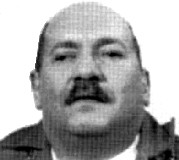
Larry Romine
Murderer Ervil LeBaron
Murderer · USA · 1972
Ervil Morrell LeBaron (1925 to August 16, 1981) was the leader of a polygamous…
35 victims
Ervil LeBaron
Murderer · USA · 1972
Ervil Morrell LeBaron (1925 to August 16, 1981) was the leader of a polygamous…
35 victims
 Brian Kevin Rosenfeld
Murderer · USA · 1985
Brian Kevin Rosenfeld Brian Kevin Rosenfeld was sentenced to three concurrent l…
23 victims
Brian Kevin Rosenfeld
Murderer · USA · 1985
Brian Kevin Rosenfeld Brian Kevin Rosenfeld was sentenced to three concurrent l…
23 victims
 Marvin Gray
Murderer · USA · 1975
Marvin Gray was convicted killer who claimed responsibility for 23 slayings and…
23 victims
Marvin Gray
Murderer · USA · 1975
Marvin Gray was convicted killer who claimed responsibility for 23 slayings and…
23 victims
 Yahweh ben Yahweh
Murderer · USA · 1980
Yahweh ben Yahweh was born and legally named Hulon Mitchell Jr. (October 27, 19…
23 victims
Yahweh ben Yahweh
Murderer · USA · 1980
Yahweh ben Yahweh was born and legally named Hulon Mitchell Jr. (October 27, 19…
23 victims
 Russell Ellwood
Murderer · USA · 1991
Russell Ellwood was a former taxi driver. Authorities suspected him of killing…
20 victims
Russell Ellwood
Murderer · USA · 1991
Russell Ellwood was a former taxi driver. Authorities suspected him of killing…
20 victims
 Leo Alexander Jones
Murderer · USA · 1981
Leo Alexander Jones (April 13, 1950 – March 24, 1998) was sentenced to death an…
1 victim
Leo Alexander Jones
Murderer · USA · 1981
Leo Alexander Jones (April 13, 1950 – March 24, 1998) was sentenced to death an…
1 victim
 Maurice Boucher
Murderer · Canada · 1997
Maurice "Mom" Boucher (born June 21, 1953) was a convicted murderer, a reputed…
2 victims
Maurice Boucher
Murderer · Canada · 1997
Maurice "Mom" Boucher (born June 21, 1953) was a convicted murderer, a reputed…
2 victims
 Stephen Nash
Serial killer · USA · 1955
Stephen Nash Stephen Nash was executed by asphyxiation-gas in California on Aug…
11 victims
Stephen Nash
Serial killer · USA · 1955
Stephen Nash Stephen Nash was executed by asphyxiation-gas in California on Aug…
11 victims
- Gender
- male
- Country
- USA
- Location
- Pickens County, Georgia, USA
- Date of birth
- 1951
- Age at first offence
- 30
- Characteristics
- parricide, robbery
- Victim profile
- Roy Lee, 48, and Aville R. Romine, 50 (his parents)
- Method of murder
- Shooting
- Date(s) of murder
- March 19, 1981
- Years active
- 1981
- Date of arrest
- 5 days after
- Status
-
Sentenced to death
Sentenced to death in April 1982; death sentences reversed on appeal in June 1983; resentenced to death in August 1985
Case record: Larry Romine
Background
Larry Romine, 45, was convicted for the shotgun slayings of his parents, Roy Lee Romine, 48, and Aville R. Romine, 50. Police said robbery was the motive for the March 19, 1981, double homicide.
Mr. Romine was sentenced to die in April 1982 in Pickens County. His death sentence was reversed by the Georgia Supreme Court in June 1983, but he was resentenced to death again in August 1985. His federal appeal challenging the fairness of his trial was filed in 1996.
The offence
Larry Romine was indicted in Pickens County for the murder of his parents and the armed robbery of his mother. His case was tried under the Unified Appeal Procedure.
The jury convicted him on all three counts and recommended that he be sentenced to death.
After an argument with his father the weekend before the murders, Larry Romine told Ginger not to worry about it; it would not go on much longer.
Larry Romine and his wife separated a few weeks prior to the murders. He spent most nights thereafter with Ginger McEntire. Larry Romine and Ginger McEntire met on Thursday, March 19, 1981, shortly after 6:30 p.m., and spent that night in a motel.
The next morning, Larry Romine told Ginger McEntire, “I bet you mama and daddy didn’t work today.” Avilee R. Romine and Roy Lee Romine did not work that day.
When Avilee failed to appear Friday morning, members of her carpool called her home. There was no answer. They contacted Reverend McClure, who lived nearby, and he entered the house through the open front door.
Inside, Reverend McClure found the bodies of Avilee R. Romine and Larry Romine’s father, Roy Lee Romine. Roy Lee Romine’s body lay in the kitchen and he had been shot in the back. Avilee R. Romine was in the bedroom and had been shot in the chest.
Two .16 gauge shotgun wadding were recovered from the kitchen and bedroom. They were later identified as having been fired from a shotgun owned by Ginger McEntire.
Avilee’s purse was missing, as was a paycheck she had received Thursday.
On Monday, March 23, Larry Romine was observed burning the contents of a box in a trash barrel. When law enforcement officers thereafter searched the trash barrel, they found a metal tool identical to one used by Avilee in her work, and a metal frame, rings and zipper that looked like the metal portions of her coin purse and pocket book.
Investigation and arrest
After Larry Romine was arrested Tuesday, March 24, he asked his wife to retrieve a packet of papers from his car. She did, and turned it over to the GBI.
The packet contained a $500 certificate of deposit payable to Avilee R. Romine, her paycheck of March 19, her savings passbook, and various title and insurance papers bearing her name or Roy Lee Romine’s.
In a statement given to law enforcement officers Tuesday evening, Larry Romine admitted borrowing Ginger McEntire’s shotgun, without her knowledge, on Thursday afternoon. He said that when he got home, he took two hits of LSD and loaded the gun. Then he walked the quarter mile from his house to his parents’ house. No one was home and he used his key to enter. Hearing his mother drive up, he waited for her to enter the bedroom, and then he shot her.
He went into the living room and waited on the couch. The next thing Larry Romine remembered was hearing his father drive up (other evidence presented at trial indicated that approximately two hours had elapsed). Roy Lee Romine entered the house and went to the kitchen, carrying several sacks of groceries. Larry Romine shot him and left.
Trial
Proceedings and jury
The “first proceeding,” contemplated by Rule 11 (A) of the Unified Appeal Procedure, was conducted June 19, 1981. Motion hearings were thereafter conducted on August 5, September 25 and October 5, 1981.
At the October 5 hearing, Larry Romine’s trial, originally scheduled for October, was continued until the March 1982 term of court.
On February 10, 1982, Larry Romine filed a motion to recuse Judge Frank C. Mills III, who had presided over all of the proceedings in the case. Larry Romine alleged in his motion that prior to being named to the bench in February of 1981, Judge Mills had been the district attorney for seven years; that because of his prosecutorial experience, Judge Mills was biased against the appellant; and that his bias was demonstrated by his conduct in handling the case.
In a supporting affidavit, Larry Romine alleged: “Specifically, in the pre-arraignment hearing on June 19, 1981, during the testimony of Ms. Linda Hames, the transcript shows that after five brief questions by the District Attorney, Judge Mills proceeded to ask eighteen questions. Further, in the pre-trial hearing held August 5, 1981, Judge Mills, after the District Attorney had completed his questions of [defense witness] Millard Farmer, engaged the witness in extensive questioning and argument as to the matters at issue.”
The trial court denied Larry Romine’s motion to recuse. The Georgia Supreme Court held the motion was untimely and that the trial court did not err in denying the motion to recuse or in denying the request to allow another judge to hear the motion.
Larry Romine also contended in his ninth enumeration of error that the Unified Appeal Procedure was unconstitutional. The Georgia Supreme Court did not agree with that contention and cited Brown v. State, 250 Ga. 66 (3) (295 SE2d 727) (1982) and Sliger v. State, 248 Ga. 316 (282 SE2d 291) (1981).
The trial court did not err by failing to grant a motion for change of venue. Of the 66 jurors impaneled, only 11 were excused for bias or prejudice. Those 11 jurors constituted 16.7% of the entire panel. The Georgia Supreme Court stated that this percentage corroborated the absence of such prejudicial publicity as would require the grant of a motion for new trial.
On July 21, 1981, Larry Romine filed a motion seeking discovery of relationships or other ties to prospective jurors by law enforcement officers, witnesses and bailiffs. The motion was granted.
The court’s order of February 12, 1982, contemplated that interrogatories be submitted to the district attorney for dissemination by him to witnesses, bailiffs and law enforcement officers, and that the interrogatories be returned to the defense prior to voir dire. A copy of the jury list was mailed to Larry Romine and his attorney on February 26, 1982. Larry Romine submitted his interrogatories to the district attorney. When voir dire commenced the morning of March 29, the completed interrogatories had not yet been furnished to Larry Romine because the district attorney had neglected to disseminate them to anyone.
Larry Romine moved to continue the case so that the interrogatories could be furnished prior to voir dire. The motion was denied, but the trial court ordered that the interrogatories be completed and furnished prior to selection of the jury. At 8:45 p.m. on March 29, 45 completed interrogatories were furnished to Larry Romine. Larry Romine made another motion for continuance so that he could have additional time to examine the interrogatories. This motion was denied. Voir dire continued the next day and the jury was selected March 31.
Larry Romine contended in his fifth enumeration of error that the trial court erred in denying his motions for continuance. The Georgia Supreme Court stated the district attorney should have complied with the February 12 order, but concluded there was no abuse of discretion.
Pace of trial and counsel
In his seventh enumeration of error, Larry Romine argued that the fast pace of the trial denied him effective assistance of counsel. The trial began with voir dire Monday morning and ended Saturday evening. The Georgia Supreme Court noted that Larry Romine’s attorney was appointed April 13, 1981, almost a year prior to the trial. The court stated counsel’s investigation was aided by a private investigator retained with funds furnished by the trial court, and that counsel was assisted throughout the trial by his associate. The Georgia Supreme Court concluded that Larry Romine had counsel reasonably likely to render and rendering reasonably effective assistance.
Sentencing phase and jury verdict aggravating circumstances
In the review of the sentence, the Georgia Supreme Court addressed an issue not raised on appeal.
The jury’s written sentence verdict as to Count 1 (the murder of Avilee Romine) recited, as a statutory aggravating circumstance: “Armed robbery of said Avilee Romine.”
As to Count 3 (the murder of Roy Lee Romine), the verdict recited, as a statutory aggravating circumstance: “Murder of Avilee Romine.”
The court asked Larry Romine’s attorney, “Do you have any objection as [to] the form of the verdict and the manner in which it’s written on the form, Mr. Thomas?”
Counsel replied: “Not that I’m stating at this time, Your Honor, without waiving any.”
At the district attorney’s suggestion, the trial court dealt with the subject during the poll of the jury. The court asked each juror if the juror meant by his verdict that, as to Count 1, the jury found that the offense of murder of Avilee Romine was committed while the offender was engaged in the commission of the additional capital felony, the armed robbery of Avilee Romine; and that, as to Count 3, the jury found that the murder of Roy Lee Romine was committed while the offender was engaged in the commission of the additional capital felony, the murder of Avilee Romine. Each juror responded in the affirmative.
Sentencing
Statutory aggravating circumstances and sufficiency of evidence
Larry Romine contended in his first enumeration of error that the statutory aggravating circumstances found by the jury may not stand for several reasons.
First, he argued that as to Count 2, the death penalty for the murder of Roy Romine could not be supported by the murder of Avilee Romine because the crime and the supporting circumstance were the same capital felony, i.e., murder. The Georgia Supreme Court rejected this, stating OCGA 17-10-30 (b) (2) was applicable to multiple murders, citing Gilreath v. State, 247 Ga. 814 (16) (279 SE2d 650) (1981).
Second, Larry Romine argued that because the two murders were not simultaneous, one was not committed while the offender was engaged in the commission of the other. The Georgia Supreme Court rejected the argument, citing Gilreath v. State and Peek v. State.
The Georgia Supreme Court stated that the murders were committed “by appellant in a relatively short period of time in what can be fairly viewed as one continuous course of criminal conduct,” and that the jury was authorized in finding that the first murder was committed in the course of the second murder.
Finally, Larry Romine argued the evidence was insufficient to show that the murder of Avilee was committed during the course of an armed robbery. The Georgia Supreme Court held the evidence showed:
- Avilee was paid by check on the afternoon of the day of her death.
- Less than three hours later, she was murdered by her son.
- In the next few days, Avilee’s paycheck and other papers were found in Larry Romine’s possession.
- The remains of her pocketbook were found in a trash barrel in which Larry Romine had burned the contents of a box.
The Georgia Supreme Court stated the evidence demonstrated that Larry Romine, “with intent to commit theft, [took] property of another from the person or the immediate presence of another by use of an offensive weapon …” OCGA 16-8-41 (a) (Code Ann. 26-1902). The court concluded the jury was authorized to find Larry Romine guilty of armed robbery and to find that armed robbery was a statutory aggravating circumstance supporting the death penalty for Avilee’s murder, regardless of whether intent to take Avilee’s pocketbook arose before or after he murdered her, citing Young v. State.
The Georgia Supreme Court concluded that it found the statutory aggravating circumstances supported by the evidence beyond a reasonable doubt, citing OCGA 17-10-35 (c) (2).
Sentencing charge
Larry Romine argued that the sentencing charge was inadequate.
The trial court charged the jury: “Ladies and gentlemen, you have found the Defendant Larry Romine guilty of the offenses of murder. It is now your duty to determine the penalty that shall be imposed as punishment for those offenses as prescribed by our law. In arriving at this determination, you are authorized to consider all of the evidence received here in court as presented by the State and this Defendant throughout the entire trial. You are authorized also to consider all the facts and circumstances, if you find there to be any, in extenuation and mitigation of punishment presented by the Defendant and shown to you by the evidence in both phases of this trial.”
The Georgia Supreme Court rejected the contention that the charge should have used “required” instead of “authorized,” and stated the charge was not subject to the defect discussed in Hawes v. State.
The trial court’s instructions on aggravating and mitigating circumstances included: “Aggravating circumstances are those which increase the guilt of the Defendant or the enormity of the offense or . . . its injurious consequences. Mitigating circumstances are those which do not constitute a justification or excuse for the offense in question but which in all fairness and mercy may be considered as extenuating or reducing the degree of moral culpability or blame. [I]f you see fit . . . to recommend mercy for the Defendant then this recommendation is solely in your discretion and is not controlled by any rule of law. You may make such recommendation with or without reason. If this should be your finding, then the Court is required by law to sentence this Defendant Larry Romine to life imprisonment. In other words . . . if you find beyond a reasonable doubt that the State of Georgia has proved the existence of one or more of the aggravating circumstances given to you in this charge as to either or both counts, you nonetheless are not required to recommend that the Defendant Romine be put to death.
You may, if you see fit, and this is a matter entirely in your discretion, provide for a life sentence for the accused Romine based upon any mitigating circumstances or reasons satisfactory to you or without reason if you see fit to do so.
You may recommend life imprisonment even though you have found the aggravating circumstances given to you in this charge to have existed beyond a reasonable doubt.”
The Georgia Supreme Court concluded the trial court did not err as appellant contended in failing to instruct that “as to mitigating circumstances [the jury] could consider anything, without limitation or definition,” and held the instruction conveyed that authority to recommend mercy was unlimited and not circumscribed by the court’s definition of mitigating circumstances.
Larry Romine also contended that the charge was deficient because it did not expressly forbid the jury from considering pre-trial gossip and rumors. The Georgia Supreme Court rejected the contention because Larry Romine failed to request such a charge, and because the court instructed the jury: “You are also authorized to consider all the facts and circumstances, if you find any, regarding the gravity and the seriousness of the offense and your knowledge of the personal background of this Defendant, but only as shown to you by the evidence in both phases of this trial.”
The Georgia Supreme Court rejected the contention that the court’s charge was overly suggestive of aggravating circumstances.
Continuance request and absent grandfather (mitigation testimony)
The Georgia Supreme Court set aside the sentences of death imposed in the case.
Larry Romine’s grandfather, Ralph Romine, had been subpoenaed and had attended trial until Friday evening, when he left early because he felt ill. He was instructed to return the next morning.
The jury returned its verdicts of guilty Friday night. When the sentencing phase began Saturday morning, Ralph was absent. His absence was called to the court’s attention by Larry Romine’s attorney, who asked for a continuance “for a period of time sufficient to allow us to determine the physical condition of Ralph Romine and secure his attendance at court.”
When asked for an offer of proof as to what Ralph would testify, Larry Romine’s attorney stated: “ . . .Ralph Romine has come to my office on several occasions . . . [H]e did not want his grandson electrocuted . . . [H]e had very strong reservations about it. He tells me that the Lord has dealt with him in that matter and the taking of the life of his grandson will not bring back his son . . . He has expressed a tremendous desire to be able to tell the jury what his wishes are . . .”
Immediately before Larry Romine rested later that morning, after he had testified on his own behalf, counsel renewed the motion for continuance. The court asked, “[D]o you have any indication that it would be a short continuance?”
Larry Romine’s attorney answered, “I do not know, Your Honor.”
The court then asked, “[D]o you have anything to add to your offer of proof, anything that would be admissible . . . [Y]ou haven’t told me anything yet that he would say that would be admissible. Now, that’s what I’m waiting to hear. You’re saying that he would express his wishes that Mr. Romine not get the death penalty. That would not be admissible.”
When counsel was unable to supplement his offer of proof, the renewed motion for continuance was denied.
At the hearing on Larry Romine’s motion for new trial, the trial court explained its denial of the motion for continuance: “[T]he only thing that was offered in the nature of proof was that [Ralph] would testify that he was opposed to the death penalty for his grandson. And, therefore, on that basis, I denied your motion for continuance.”
The Georgia Supreme Court concluded the denial of the continuance was an abuse of discretion and held that Ralph’s testimony would have been admissible in mitigation. The court set aside the death sentences.
As described in the Georgia Supreme Court decision, Ralph Romine testified after trial pursuant to Rule IV (A) (5) (b) of the Unified Appeal Procedure. Ralph testified that he was 72 years old and had a heart condition which rendered him unable to work. He had a prescription for NTG tablets he took as needed for chest pain. He testified that he got “pained in my heart” Friday night of the trial. The next day he wanted to testify but was not able to. He admitted that he did not consult a physician any time during the trial week. He also said he did not take his medicine Friday night or Saturday. He said he felt like he ought to be in court, but he did not think the case would go as bad as it did, and he figured he could testify later if he had to.
Appeals and outcome
Larry Romine’s convictions were affirmed, but the sentences of death were reversed.
The Georgia Supreme Court’s holding was that the death sentences must be set aside, the convictions affirmed, and the sentences of death reversed with the case remanded for a new trial on the sentences to be imposed for the murders.
The case was “DECIDED JUNE 30, 1983 — REHEARING DENIED JULY 21, 1983.”
The decision included counsel for appellee: Rafe Banks III, District Attorney; Michael J. Bowers, Attorney General; Mary Beth Westmoreland, Assistant Attorney General; and for appellant: George J. Thomas II.
The opinion included the citation “ROMINE v. THE STATE. 39345. ( 251 Ga. 208 ) ( 305 SE2d 93 ) (1983) CLARKE, Justice.”
Timeline
- March 19, 1981 — Larry Romine and Ginger McEntire met shortly after 6:30 p.m. and spent that night in a motel; the next morning Larry Romine told Ginger, “I bet you mama and daddy didn’t work today.”
- Friday (after March 19, 1981) — Reverend McClure entered the house through the open front door and found the bodies of Avilee R. Romine and Roy Lee Romine; two .16 gauge shotgun wadding were recovered from the kitchen and bedroom.
- Monday, March 23, 1981 — Larry Romine was observed burning the contents of a box in a trash barrel.
- Tuesday, March 24, 1981 — Larry Romine was arrested; in a statement given Tuesday evening, he admitted borrowing Ginger McEntire’s shotgun and described how he shot Avilee and Roy.
- June 19, 1981 — “first proceeding” under Rule 11 (A) of the Unified Appeal Procedure was conducted.
- August 5, 1981 — Motion hearing conducted.
- September 25, 1981 — Motion hearing conducted.
- October 5, 1981 — Motion hearing conducted; trial was continued until the March 1982 term of court.
- February 10, 1982 — Motion to recuse Judge Frank C. Mills III was filed.
- February 26, 1982 — A copy of the jury list was mailed to Larry Romine and his attorney.
- March 29, 1982 — Voir dire commenced; 45 completed interrogatories were furnished to Larry Romine at 8:45 p.m.; motion practice occurred regarding continuance.
- March 31, 1982 — Jury was selected.
- April 1982 — Larry Romine was sentenced to die in Pickens County.
- June 30, 1983 — Georgia Supreme Court decided the case; death sentences were reversed and the case remanded for new trial on sentencing.
- July 21, 1983 — Rehearing was denied.
- August 1985 — Larry Romine was resentenced to death.
- 1996 — Federal appeal challenging the fairness of the trial was filed.
Other details
Larry Romine did not challenge the sufficiency of the evidence regarding his convictions. The Georgia Supreme Court reviewed the evidence pursuant to Rule IV (B) (2) and concluded the evidence supported convictions for armed robbery and two counts of murder, citing Jackson v. Virginia.
Larry Romine’s appellate contentions regarding continuances, recusal timing, venue, juror interrogatories, constitutionality of the Unified Appeal Procedure, and the pace of the trial were rejected by the Georgia Supreme Court.
The Georgia Supreme Court cited OCGA 17-10-30 (c), OCGA 17-10-30 (b), OCGA 17-10-35 (c) (2), OCGA 16-8-41 (a), and OCGA 17-10-30 (b) (2) in its analysis of aggravating circumstances, the sufficiency of evidence, and sentencing instructions. It also cited United States Supreme Court authority including Jackson v. Virginia and Lockett v. Ohio, and Georgia cases including Hawes v. State, Brown v. State (250 Ga. 66), Sliger v. State, Fleming v. State, Gilreath v. State, Peek v. State, Young v. State, Cofield v. State, Brooks v. State, Cobb v. State, Spivey v. State, Brown v. State (235 Ga. 644), Messer v. State, Marshall v. State, Pitts v. Glass, Godfrey v. Georgia, Todhunter v. Price, and State v. Fleming.

Spotted an error, or have more information about this case?