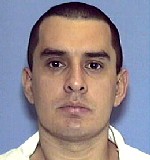
George Rivas
Murderer Russell Ellwood
Murderer · USA · 1991
Russell Ellwood was a former taxi driver. Authorities suspected him of killing…
20 victims
Russell Ellwood
Murderer · USA · 1991
Russell Ellwood was a former taxi driver. Authorities suspected him of killing…
20 victims
 Robert Martines Perez
Murderer · USA · 1994
Name: Robert Martines Perez · Other name used in proceedings: Robert Martinez P…
15 victims
Robert Martines Perez
Murderer · USA · 1994
Name: Robert Martines Perez · Other name used in proceedings: Robert Martinez P…
15 victims
 Billy Frank Vickers
Murderer · USA · 1993
Billy Frank Vickers Vickers was executed by lethal injection in Texas on Januar…
14 victims
Billy Frank Vickers
Murderer · USA · 1993
Billy Frank Vickers Vickers was executed by lethal injection in Texas on Januar…
14 victims
 David Lee Goff
Murderer · USA · 1990
David Lee Goff was convicted of capital murder for the September 1, 1990, murde…
1 victim
David Lee Goff
Murderer · USA · 1990
David Lee Goff was convicted of capital murder for the September 1, 1990, murde…
1 victim
 Susan May
Murderer · United Kingdom · 1992
Susan May (principal carer for her aunt) was convicted of the murder of Hilda M…
1 victim
Susan May
Murderer · United Kingdom · 1992
Susan May (principal carer for her aunt) was convicted of the murder of Hilda M…
1 victim
 Flor Contemplacion
Murderer · Singapore · 1991
Flor R. Contemplacion (January 1953 - March 17, 1995) was a Filipina domestic w…
2 victims
Flor Contemplacion
Murderer · Singapore · 1991
Flor R. Contemplacion (January 1953 - March 17, 1995) was a Filipina domestic w…
2 victims
 David Lynn Simonsen
Murderer · USA · 1988
David Lynn Simonsen was sentenced to death on February 24, 1989. The judgment o…
2 victims
David Lynn Simonsen
Murderer · USA · 1988
David Lynn Simonsen was sentenced to death on February 24, 1989. The judgment o…
2 victims
- Gender
- male
- Country
- USA
- Location
- Dallas County, Texas, USA
- Date of birth
- May 6, 1970
- Age at first offence
- 30
- Characteristics
- robbery, fugitive, history of mental illness, member of the "texas seven
- Victim profile
- Aubrey Hawkins, 29 ( Irving police officer )
- Method of murder
- Shooting
- Date(s) of murder
- December 24, 2000
- Years active
- 2000
- Date of arrest
- January 23, 2001
- Status
-
Executed
Sentenced to death on August 29, 2001; executed by lethal injection in Texas on February 29, 2012
Overview
George Rivas was convicted of capital murder and was sentenced to death. He was executed by lethal injection in Texas on February 29, 2012.
Timeline
- 08/29/2001 — George Rivas was convicted of capital murder and was sentenced to death.
- 12/24/2000 — The county of the capital-murder offense was Dallas County; the incident involved a robbery in which an Irving police officer was murdered.
- 12/13/2000 — George Rivas and six co-defendants escaped from the John B. Connally Unit.
- 01/20/2001 — A friend of Wade Holder watched “America’s Most Wanted” and told Wade that the “Texas 7” were staying in his RV Park.
- 01/21/2001 — The friend of Wade Holder confirmed the location and reported the suspicious activities to local authorities.
- 01/21/2001 — El Paso County Sheriff’s Department SWAT team found Garcia, Rodriguez, and Rivas in a Jeep Cherokee in the RV Park.
- 01/23/2001 — Authorities received information on the whereabouts of the last two; they were hiding in a Holiday Inn in Colorado Springs.
- 01/24/2001 — A local KKTV television anchorman, Eric Singer, was taken into the hotel where on camera he interviewed Newbury and Murphy by telephone.
- 02/29/2012 — George Rivas was executed at 6:22 p.m. CST in Huntsville, Texas.
- 06/23/2004 — The Court of Criminal Appeals of Texas delivered a direct-appeal opinion affirming the trial court’s judgment.
Background
George Rivas (TDCJ Number 999394) was born 05/06/1970 and was Hispanic and male. His hair color was Black, his height was 5 ft 10 in, and his weight was 214. His eye color was Brown, and his native county and native state were listed as El Paso, Texas.
He had a prior prison record: #702267, on a life sentence from El Paso County for 13 counts of aggravated kidnapping with a deadly weapon, 4 counts of aggravated robbery with a deadly weapon, and one count of burglary of a habitation. At the time of the present offense, he was serving the life sentence and had escaped from TDCJ.
He was described as the leader of the “Texas 7” prison-break gang.
The offence
While Rivas was on escape from TDCJ, he and 6 co-defendants robbed a sporting goods store at gunpoint. An Irving police officer was murdered outside the store as Rivas and co-defendants left the scene.
The incident involved robbery of a sporting goods store in Irving, including the taking of loot that included $70,000 in cash, 44 firearms and ammunition for the guns. Aubrey Hawkins, an Irving police officer, was shot 11 times and run over with a stolen SUV driven by Rivas during the robbery and escape.
Investigation
A reward for Rivas and his accomplices grew after Hawkins’ murder. A $100,000 reward was offered, and it later climbed to $500,000 before the group was apprehended.
Authorities apprehended the group in Colorado as a result of “America’s Most Wanted.” A friend of Wade Holder, the owner of the Coachlight Motel and R.V. Park in Woodland Park, Colorado, watched the television program “America’s Most Wanted” and told Wade that they were staying in his RV Park. The friend believed the Texas 7, who were being compared to Angel Maturino Resendiz, were in his trailer park. After confirmation, the friend reported the suspicious activities to local authorities.
The El Paso County Sheriff’s Department SWAT team found Garcia, Rodriguez, and Rivas in a Jeep Cherokee in the RV Park.
Arrest and capture
Garcia, Rodriguez, and Rivas were found in a Jeep Cherokee at the RV Park. Authorities moved in and captured them at a nearby gas station.
Halprin and Harper were found in an RV. Halprin surrendered peacefully, but Harper was found dead after a standoff. Harper shot himself in the chest and left temple with a pistol.
A remaining group of four members were taken into police custody. Authorities received information about the whereabouts of the last two. Newbury and Murphy were hiding out in a Holiday Inn in Colorado Springs, Colorado. A deal brokered between Newbury and Murphy allowed them to make live TV appearances before they were arrested.
In the early hours of January 24, a local KKTV television anchorman, Eric Singer, was taken into the hotel where on camera he interviewed the two by telephone. Newbury and Murphy harshly denounced the criminal justice system in Texas; Newbury added: “the system is as corrupt as we are.”
Co-defendants and “Texas 7” members
Co-defendants included:
- Michael Rodriguez (sentenced to death; executed in 2008)
- Donald Newberry (sentenced to death)
- Randy Halprin
- Patrick Murphy, Jr.
- Joseph Garcia
- Larry Harper (deceased by suicide)
- George Rivas (leader)
The group was described as consisting of:
- Joseph C. Garcia
- Randy Ethan Halprin
- Larry James Harper (deceased by suicide)
- Donald Keith Newbury
- Patrick Henry Murphy, Jr.
- George Rivas (Ringleader)
- Michael Anthony Rodriguez (executed in 2008)
Rivas was described as the ringleader of the Texas 7.
Escape and prison-break details
Rivas and six other inmates carried out an escape from the John B. Connally Unit, a maximum-security state prison near Kenedy, Texas. The escape used “well-planned ploys” to overpower and restrain nine civilian maintenance supervisors, four correctional officers and three uninvolved inmates at approximately 11:20 a.m. during a period described as the slowest period of the day with less surveillance.
The escape description included: one offender calling someone over while another hit the victim on the head from behind; offenders removing clothing, tying up victims, gagging them, and placing victims in an electrical room behind a locked door; attackers stealing clothing, credit cards, and identification; impersonating prison officers on the phone and creating false stories to ward off suspicion; and three offenders making their way to the back gate of the prison disguised in stolen civilian clothing and pretending to install video monitors, subduing a gatehouse guard, raiding the guard tower, and stealing numerous weapons. Four offenders who stayed behind made calls to tower guards to distract them, and they stole a prison maintenance pick-up truck, drove to the back gate, picked up their cohorts, and drove away.
They left an ominous note: “You haven’t heard the last of us yet.”
Crime spree details (robberies)
After the breakout, the Texas 7 supported themselves by committing robberies. The white prison truck was found in the parking lot of the Wal-Mart in Kenedy, Texas. After breaking out of the complex, the Texas 7 first went into San Antonio, then robbed a Radio Shack in Pearland, Texas the next day on December 14 at around 2 AM.
The Radio Shack robbery involved entering an adjacent computer software store, knocking down a sheetrock wall to the other side, tethering the Radio Shack safe to the truck, and dragging the safe outside of the building, causing damage to the parking lot and pavement.
On December 19, four members checked into an Econo Lodge motel in Farmers Branch, Texas (under assumed names), where they decided to rob an Oshman’s Sporting Goods in nearby Irving, Texas.
On December 24, 2000, they held up the store and stole 44 guns. A customer standing outside the store noticed commotion inside and called police. Irving police officer Aubrey Hawkins responded to the call, arrived, and was almost immediately ambushed. Hawkins’ autopsy would show he sustained eleven gunshots and his body was run over by the fleeing gang.
After the group was apprehended, their reward increased from $100,000 to $500,000 before capture.
Trial
Rivas was convicted of capital murder. The Texas Penal Code cited was Tex. Penal Code Ann. § 19.03(a)(1), (a)(2). Direct appeal to the Court of Criminal Appeals of Texas was automatic.
Issues raised on direct appeal
The Court of Criminal Appeals of Texas described that Rivas raised seventeen points of error and would affirm.
- Points of error one and two concerned admitting a written statement he gave while detained in Colorado. He argued the statement was obtained in violation of Colorado law because jail personnel refused immediate access to the public defender, and he argued Texas and Colorado law conflicted and that Colorado law should apply. The Court ruled that the only relevant inquiry was whether the statement was obtained in compliance with Article 38.22 and that Rivas did not assert the statement was obtained in violation of Article 38.22. Points of error one and two were overruled.
- Point of error three alleged ineffective assistance of counsel at the guilt/innocence phase. Counsel had challenged the legality of an evidentiary search warrant authorizing taking Rivas’ saliva for DNA testing on grounds including unreasonable search and seizure, failure of the affidavit to establish probable cause, and that the warrant was not signed by a district court judge. At trial, the State presented evidence without objection that Rivas’ DNA matched DNA from the victim’s gun and the driver’s seat of the store manager’s Ford Explorer used to flee. The Court held counsel did not need to repeat objections at trial; the pretrial objections were sufficient to preserve error. Point of error three was overruled.
- Points of error four and five challenged the trial court’s refusal to submit a prospective-juror questionnaire. Rivas requested that the court submit a questionnaire concerning exposure to pretrial publicity, and he alleged violations of Articles 35.17 and 35.16 and his right to a fair and impartial jury under the Sixth and Fourteenth Amendments. The requested questionnaire content included the following text:
- “You have been called as a prospective juror in the State of Texas vs. George Rivas. This case has received pretrial publicity. George Rivas is charged with causing the death of Aubrey Hawkins, an Irving police officer, during the course of robbing a [sic] Oshman's Super Store in Irving, Texas. Please answer the following questions: Have you, as a result of the media, hearsay, or any other reason, formed in your mind, an opinion about the guilty [sic] or innocence of the defendant, George Rivas[?] Yes _____ No _____ Would that conclusion influence you in your acts in finding a verdict in the case? Yes _____ No _____” The trial court refused that request and instead asked different publicity-related questions and required agreement/disagreement with statements. Those statements included:
- “(1) A defendant in a criminal case should be presumed to be innocent unless that [sic] the State proves their guilt beyond a reasonable doubt, if it does. [ ] Agree [ ] Disagree”
- “(2) A jury's verdict should be based only on the evidence heard in the courtroom, and not from what one hears outside the courtroom. [ ] Agree [ ] Disagree”
- “(3) What one hears in the news media is a better source of information than testimony one hears in the courtroom. [ ] Agree [ ] Disagree” The questionnaire also asked: “Do you think you have heard about this case? [ ] Yes [ ] No If yes, please give details (including how you heard - radio, TV, newspaper, word of mouth).” After the prospective jurors completed the trial court’s questionnaire and before either side began individual voir dire, Rivas again asked the judge to submit the publicity questions contained in his proposed questionnaire. The trial court denied the request again. The Court held the trial court did not abuse discretion and overruled points of error four and five.
- Point of error six argued the trial court violated the right to a fair trial by permitting two sheriff’s deputies to sit directly behind him during jury selection. The Court held the placement of two sheriff’s deputies behind him was not inherently prejudicial and that Rivas did not demonstrate actual prejudice. Point of error six was overruled.
- Point of error seven argued the trial court erred in admitting fourteen autopsy photographs into evidence at the guilt or innocence phase. The Court detailed that the State introduced evidence that the assailants shot the victim multiple times and ran over his body, dragging his body several feet. It described the photographs: Exhibits 195 through 200 depicted head and neck injuries, and exhibits 201 through 208 depicted injuries sustained to the rest of the body. It also described Exhibit 204 depicting the victim’s naked body from his head to his knees lying face down on the autopsy table. The medical examiner testified he edited out several photographs and chose only the ones necessary to explain injuries. The Court disagreed that the same information was available through less prejudicial evidence and ruled the trial court did not abuse discretion. Point of error seven was overruled.
- Point of error eight challenged the admission of expert testimony by Dr. Richard Coons regarding future dangerousness. The Court described that Coons testified at punishment that, in his opinion, Rivas would be a future danger to society. The defense argued inadmissibility under Tex. Rule Evid. 702 due to lack of scientific reliability under Kelly and Nenno. The Court described the hearing outside the jury and the factors Coons said he used, including determining whether the defendant had an “active mental illness,” looking at history of violence, attitude about violence, facts of offense, personality and behavior patterns, whether the defendant appeared to have “a conscience to help him control his behavior,” and lastly the “future society of the defendant (i.e., whether that person would be on death row or in general population).” Coons testified in response to a hypothetical that the person described would probably commit criminal acts of violence in the future, posing a continuing threat to society, and that the person would not be amenable to rehabilitation. The Court held any error did not influence the jury’s decision and overruled point of error eight.
- Point of error nine alleged the appeal should be abated until the record was supplemented with the evidentiary search warrant used to obtain DNA evidence. Rivas filed a motion on September 26, 2002; the Court granted the motion to order supplementation. On October 2, 2002 the Court ordered the Dallas County District Clerk to supplement with the warrant. On October 10, 2002, the clerk said the warrant and accompanying affidavit were not found in the trial court’s file. The Court reviewed its record and found the warrant and affidavit were not contained therein and not introduced as exhibits. The Court denied the motion and denied abatement on October 21, 2002, and overruled point of error nine.
- Point of error ten challenged the parole-law jury instruction. The Court described the instruction: “Under the law applicable to this case, if the defendant is sentenced to imprisonment in the Institutional Division of the Texas Department of Criminal Justice for life, the defendant will become eligible for release on parole, but not until the actual time served by the defendant equals 40 years, without any consideration of good conduct time. It cannot accurately be predicted how the parole laws might be applied to this defendant if the defendant is sentenced to a term of imprisonment for life because the application of those laws will depend on decisions made by prison and parole authorities, but eligibility for parole does not guarantee that parole will be granted.” The court also instructed: “During your deliberations, you are not to consider or discuss the possible action of the Board of Pardons and Paroles or the Governor, nor how long a defendant would be required to serve on a sentence of life imprisonment, nor how the parole laws would be applied to this defendant. Such matters come within the exclusive jurisdiction of the Board of Pardons and Paroles and are of no concern of yours.” The Court overruled point of error ten.
- Point of error eleven alleged mitigation special issue unconstitutionality because it omitted a burden of proof, relying on Apprendi. The Court held Apprendi was inapplicable. Point of error eleven was overruled.
- Point of error twelve argued the charge failed to define “probability,” “criminal acts of violence,” and “continuing threat to society.” The Court held prior decisions rejected these arguments and overruled point of error twelve.
- Point of error thirteen argued Article 37.071 violated the Eighth and Fourteenth Amendments because at least ten jurors must agree to return a negative answer to punishment special issues, citing Mills v. Maryland. The Court cited prior decisions and overruled point of error thirteen.
- Points of error fourteen and fifteen argued the Texas capital sentencing scheme was unconstitutional under Fifth, Eighth, and Fourteenth Amendments and the Texas Constitution because it allegedly allowed unlimited jury discretion to consider evidence militating against death while also restricting jury discretion to impose death. The Court rejected the claims and overruled points of error fourteen and fifteen.
- Points of error sixteen and seventeen alleged cumulative effect of constitutional violations. The Court held that without error there is no cumulative effect and overruled points of error sixteen and seventeen.
Appellate decision and affirmance
The Court of Criminal Appeals of Texas stated it affirmed the judgment of the trial court. The opinion was delivered June 23, 2004. The Court was described as en banc.
The Court listed justices joining the opinion and a concurrence:
- Johnson, J., delivered the opinion, in which Keller, P.J., and Price, Womack, Keasler, Hervey, Holcomb, and Cochran, JJ., joined.
- Meyers, J., concurred as to point of error seven and otherwise joined the opinion.
Sentencing
The Court stated that, pursuant to the jury’s answers to the special issues under Texas Code of Criminal Procedure Article 37.071, §§ 2(b) and 2(e), the trial judge sentenced Rivas to death. The direct appeal was automatic under Article 37.071, § 2(h).
Appeals
The direct appeal was addressed in the Court of Criminal Appeals of Texas opinion delivered June 23, 2004, which affirmed the judgment. Rivas raised seventeen points of error and the Court stated it would affirm.
The later discussion in the material described that no 11th-hour appeals were made to try to head off the execution. A parole-law jury instruction and appellate rulings on the issues relating to it were included in the Court of Criminal Appeals opinion.
Outcome
George Rivas was convicted of capital murder and sentenced to death on August 29, 2001.
He was executed by lethal injection in Texas on February 29, 2012 at 6:22 p.m. CST; he was pronounced dead ten minutes later in the described reporting. The statement included his last words as an apology to Hawkins’ family:
“I do apologize for everything that happened. Not because I'm here, but for closure in your hearts,” Rivas said Wednesday evening in a statement intended for Hawkins' family. “I really do believe you deserve that.”
A further set of last words was included in the reporting:
“I do apologize for everything that happened, not because I am here, but for closure in your hearts,” said Rivas in his final words. “I am ready to go.”
The material also included a statement from Rivas addressed to his wife:
“I am grateful for everything in my life,” Rivas said. “To my wife, I will be waiting for you.”
The parole board voted 7-0 to reject a clemency petition for Rivas.
Aftermath
The material described that multiple police officers in uniforms stood in a line outside the Huntsville prison during the execution and walked into the line behind the state criminal justice spokesman as he announced Rivas’ death.
The material also included a quoted statement from Toby Shook, the former Dallas County assistant district attorney who prosecuted Rivas and the others:
“Today is not about George Rivas,” said Toby Shook, the former Dallas County assistant district attorney who prosecuted Rivas and the others for Hawkins' death. “Today is about justice for Aubrey Hawkins and Aubrey's fellow police officers.”
The material also included a quote attributed to former Irving Police Chief Lowell Cannady:
“Aubrey was my man, he worked for me, I felt responsible for him,” said former Irving Police Chief Lowell Cannady.
The material included a final statement attributed to Rivas’ trial lawyer Wayne Huff:
Rivas picked accomplices for the breakout “who probably were more dangerous than he was” and failed to consider they might get caught doing robberies.
It also described that Larry Harper committed suicide as officers closed in.
For co-defendants’ outcomes described in the material:
- Michael Rodriguez was executed on August 14, 2008.
- The other four awaiting execution were Patrick Murphy Jr. 49; Joseph Garcia, 40; Randy Halprin, 34; and Donald Newbury, 49.
- Donald Newbury was set for injection in early February but was spared, at least temporarily, by a U.S. Supreme Court order.
Rivas had married by proxy to a Canadian woman, and she looked on during the execution.
Spotted an error, or have more information about this case?