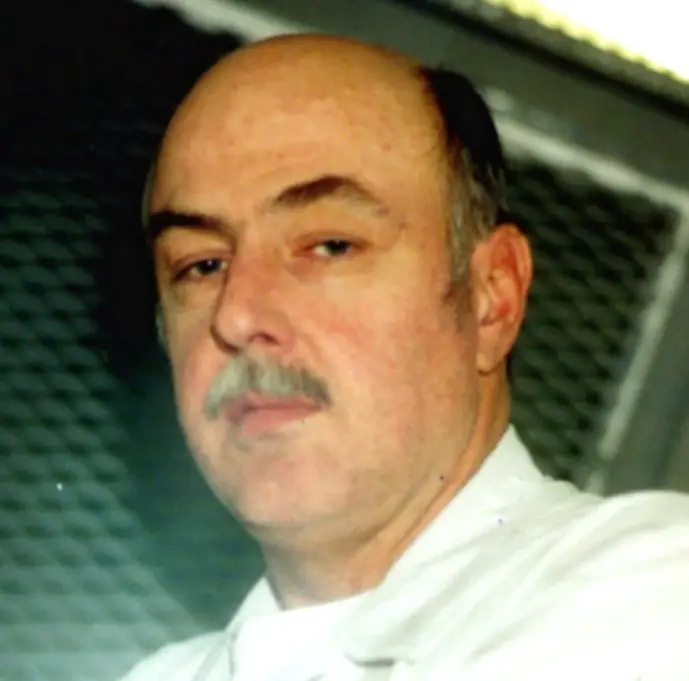
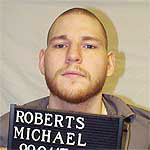
Roy Michael Roberts
Murderer Brian Kevin Rosenfeld
Murderer · USA · 1985
Brian Kevin Rosenfeld Brian Kevin Rosenfeld was sentenced to three concurrent l…
23 victims
Brian Kevin Rosenfeld
Murderer · USA · 1985
Brian Kevin Rosenfeld Brian Kevin Rosenfeld was sentenced to three concurrent l…
23 victims
 Marvin Gray
Murderer · USA · 1975
Marvin Gray was convicted killer who claimed responsibility for 23 slayings and…
23 victims
Marvin Gray
Murderer · USA · 1975
Marvin Gray was convicted killer who claimed responsibility for 23 slayings and…
23 victims
 Yahweh ben Yahweh
Murderer · USA · 1980
Yahweh ben Yahweh was born and legally named Hulon Mitchell Jr. (October 27, 19…
23 victims
Yahweh ben Yahweh
Murderer · USA · 1980
Yahweh ben Yahweh was born and legally named Hulon Mitchell Jr. (October 27, 19…
23 victims
 Russell Ellwood
Murderer · USA · 1991
Russell Ellwood was a former taxi driver. Authorities suspected him of killing…
20 victims
Russell Ellwood
Murderer · USA · 1991
Russell Ellwood was a former taxi driver. Authorities suspected him of killing…
20 victims
 Morris Odell Mason
Murderer · USA · 1978
Morris Odell Mason was a Virginia prisoner who was executed by electrocution in…
2 victims
Morris Odell Mason
Murderer · USA · 1978
Morris Odell Mason was a Virginia prisoner who was executed by electrocution in…
2 victims
 Theodore Maher
Homicide · Monaco · 1999
Theodore Maher was an American registered nurse and an ex-Green Beret. Maher wa…
2 victims
Theodore Maher
Homicide · Monaco · 1999
Theodore Maher was an American registered nurse and an ex-Green Beret. Maher wa…
2 victims
 Darwin Demond Brown
Murderer · USA · 1995
Darwin Demond Brown (32 at execution) was convicted for his part in the bludgeo…
1 victim
Darwin Demond Brown
Murderer · USA · 1995
Darwin Demond Brown (32 at execution) was convicted for his part in the bludgeo…
1 victim
 Clarence Nesbit
Murderer · USA · 1993
Clarence C. Nesbit was convicted of premeditated first degree murder in the Cri…
1 victim
Clarence Nesbit
Murderer · USA · 1993
Clarence C. Nesbit was convicted of premeditated first degree murder in the Cri…
1 victim
 One L. Goh
Mass murderer · USA · 2012
One L. Goh was 43 years old at the time of the Oikos University shooting. He wa…
7 victims
One L. Goh
Mass murderer · USA · 2012
One L. Goh was 43 years old at the time of the Oikos University shooting. He wa…
7 victims
- Gender
- male
- Country
- USA
- Location
- Randolph County, Missouri, USA
- Date of birth
- December 18, 1952
- Age at first offence
- 31
- Characteristics
- —
- Victim profile
- Thomas Jackson ( Correctional Officer )
- Method of murder
- St abbing with knife
- Date(s) of murder
- July 3, 1983
- Years active
- 1983
- Date of arrest
- Same day
- Status
-
Executed
Executed by lethal injection in Missouri on March 10, 1999; clemency petition State of Missouri v. Roy Roberts 709 S.W. 2d 857 (Mo. banc 1986). Roy Michael Roberts was executed on March 10, 1999.
Case record: Roy Michael Roberts
Background
Roy Michael Roberts was convicted and sentenced to death for alleged participation in the stabbing death of a prison guard, Thomas Jackson, during a July 3, 1983 riot in the state prison in Moberly, Missouri, at the Moberly Training Center for Men.
Roberts was never accused of stabbing Jackson. The accusation against Roberts relied on testimony that identified him as the person who restrained Jackson during the riot while other inmates stabbed and murdered Jackson.
Roberts was incarcerated on an armed robbery conviction.
Roberts maintained his innocence.
All of the surviving guards who could identify who stabbed Jackson identified Rodney Carr as the stabber. Carr was convicted of capital murder but received a sentence of life imprisonment rather than death.
Another inmate, Robert Driscoll, was also convicted and sentenced to death for stabbing Jackson. Driscoll’s conviction was reversed in 1995 by a federal appeals court because of a prosecutor’s error. Driscoll was to be retried in November.
Because of this, Roberts was the only person under sentence of death for the crime.
The offence
The murder occurred in the midst of the bedlam and confusion caused by “over thirty rioting inmates.”
The riot occurred on July 3, 1983.
Captain Denver Halley led a group of 6 guards into a common area to remove an unruly prisoner, described as one of several inmates who had become drunk on homemade alcohol. As the guards approached, about “3 dozen prisoners” mobbed them. Several guards, including Halley, were injured.
Roberts admitted punching a guard during the melee but denied any role in Jackson’s death.
The inmates who stabbed Jackson were later identified as Rodney Carr and Robert Driscoll.
At trial, four witnesses testified in the guilt phase that Roberts was holding Jackson when Jackson was stabbed. Three were guards—Denver Halley, Robert Wilson and Wayne Hess—and one was an inmate, Joseph Vogelpohl.
The appeal materials described the witnesses as giving testimony that changed over time, and asserted that the eyewitness identifications were suspect.
Investigation
Two weeks after the riot, Mark Schreiber submitted a 17-page internal investigation report of the murder. The report did not mention Roy Roberts.
The report confirmed that nobody knew who, if anyone, was holding Jackson while he was being stabbed. The report also stated that additional participants might not ever be identified because of difficulties identifying other assailants of Officer Jackson, other than those mentioned in the Supplemental Report, inmates Driscoll and Carr.
Schreiber’s report concluded that hypnosis might be beneficial to identify more suspects.
A conclusion excerpt from Mark S. Schreiber’s memorandum, dated July 18, 1983, was reproduced in the materials:
Conclusion Every investigative effort has been and is being made to determine the identity of and to bring to justice the individual or individuals who are responsible for the death of CO/I Thomas Glen Jackson and the subsequent assaults upon other correctional officers at MTCM on July 3, 1983. Due to the number of inmates who were intoxicated and who, to varying degrees participated in the riot, the full extent of the number and identity of those involved may never be known. The greatest obstacle which has hampered ongoing investigation thus far has been the inability of potential eyewitnesses to remember anything as to the identity of the officers' assailants. This is not to say that the officers have not honestly made such attempts. The hard facts are that when one is fighting for life itself there is no time to sit down and take notes. It was suggested by Sgt. L. Dale Belshe that perhaps it might be beneficial if the officers involved were to be placed under hypnosis if they are willing. I feel that such an investigative procedure might be of benefit. Sgt. Belshe has indicated that he is willing to make the arrangements. A continued effort will be made to identify any individual who was involved in the acts of violence which took place on July 3, 1983. The important factor in an investigation of this magnitude is not who or what agency receives the credit but that agencies working together as a single effective investigative unit do all that is possible within the realm of police science to solve the problem for the benefit of all concerned.
The memo was described as “Memo to W. David Blackwell from Mark S. Schreiber, dated July 18, 1983, Re: Supplemental Investigation - MTCM Incident of July 3, 1983, at p. 17.”
Arrest
Roberts was already in prison at the time of the events described. No separate arrest narrative was provided beyond his incarceration on an armed robbery conviction.
Trial
The trial judge was Ronald R. McKenzie.
The prosecutor was identified as “No.” in the provided case summary.
Roberts was convicted and sentenced to death for his alleged participation in the stabbing death of Thomas Jackson during the July 3, 1983 riot.
Seven trial witnesses were described in the clemency materials, with four eyewitnesses giving guilt-phase identification testimony.
The clemency materials discussed testimony from:
- Captain Denver Halley, who testified at trial that from a foot away through the glass window, he saw Roberts hold Jackson “by the arm and also by the hair of the head and keeping him right up against the door casing.”
- Robert Wilson, who testified at trial that Roy Roberts held Jackson around the neck and that Roberts was the one preventing Jackson from getting away.
- Wayne Hess, who testified that some inmates had Jackson in a headlock, and that later he had been shown photos.
- Joseph Vogelpohl, who testified at trial that Roberts restrained Jackson while Driscoll stabbed him.
The clemency materials also discussed additional testimony about the riot and fisticuffs involving Roberts:
- Officer Kroeckel testified that he and Roberts fought in a fist-fight in the control center.
Roberts was described as weighing more than 300 pounds and as having allegedly avoided getting blood on his clothing because he was behind Jackson during the attack.
Denver Halley’s statements and trial testimony
The clemency materials described that after the riot, Halley wrote a report at night and that the signed report was dated 3:17 a.m. on July 4, 1983. The materials reproduced an excerpt from Halley’s July 4 statement:
I attempted to help Officer Jackson get away from the inmates. They were holding him and during this procedure, I was knocked down twice, plus was hit in the arm with a pipe. I heard Officer Jackson holler and I finally managed to drag him out. He was bleeding profusely and I dragged Officer Jackson across the Rotunda and knew at that time that he was dying.
The materials asserted that Halley failed to mention Roberts in his initial statement. They described Halley later identifying Roberts and gave further excerpts of Halley trial testimony:
- Halley testified that while Roberts was holding him, “I would see Jackson jerking and blood getting all over him.”
- The materials described Halley testifying that when Halley attempted to rescue Jackson, Roberts let go of Jackson to hit Halley, and then Roberts retook his hold.
The materials included a depiction of Halley’s identification after the riot, and described that Halley later retired and was living in Macon, Missouri at the time the clemency materials were written.
The materials also quoted Halley in a later statement:
I have no doubt in my mind,
“I knew Roberts and I was close enough to blow in his ear. I was no more than 2 feet from him while they were stabbing Tom and I was trying to get to him to pull them off.”
The materials further quoted Halley regarding not implicating Roberts unfairly:
I know they are saying that I picked him out from a whole wing of prisoners to say he did it,
“That's a crock.”
Robert Wilson’s statements
The materials described Wilson’s initial statement at 2:30 a.m on July 4, 1983, including an excerpt:
Officer TG Jackson, KF Goodin & DL Kroeckel went in B wing and brought out a man who was intoxicated. As they was bring the man out the door about 30 t 40 inmates busted out the wing door after us. I grabbed one inmate by the head and was hitting him. He came out with a knife and cut me on the left hand. Then (S) went for officer T.G. Jackson. At this time Officer Humphrey hit him with bat & (S) went down. The other inmates drug back into the wing. By then I was fighting with anoughter (sic) inmate & the other officers got the wing locked down.
The materials then described a later Wilson statement as more complete and reproduced a substantial excerpt, including:
I grabbed inmate Carr around the neck from behind and started hitting him with my flashlight. He pulled a shank and cut me across the left hand freeing himself from my grip. Lunged forward approximately 3 feet sticking Officer Jackson in the chest area.
The materials described that in the later statement, Wilson said inmates moved and that Officer Jackson was placed onto a stretcher and taken to the prison hospital, and that other guards returned with shotguns. The excerpt included:
Myself, Officer Kroeckel and Halley placed Officer Jackson onto a stretcher [illegible] to the prison hospital.
And:
Capt. Halley and a new officer by the name of Dillon ran to the administration building to get shotguns and more help.
The materials asserted that in Wilson’s initial statements, Roberts was not referenced, and later identification testimony in trial implicated Roberts.
Wayne Hess’s statements
The materials described a July 4 statement by Wayne Hess in which Hess stated that “three or four inmates had ahold of his [Jackson'] head and tried to pull him back into the wing.” The materials asserted that Hess stated he did not know any of those inmates and remembered only Carr.
The materials described a July 9 statement in which Hess stated that “some of the inmates had Jackson in a headlock.” The materials further described that Hess said he was shown photos, and he identified Carr.
The materials described prosecution attempts to hypnotize Hess to bolster memory.
Joseph Vogelpohl’s statements and trial testimony
The materials described Joseph Vogelpohl as the only other witness who identified Roberts in the guilt phase.
The materials described Vogelpohl’s initial statement on July 4, 1983, including that the statement did not mention Roy Roberts and that Vogelpohl said he had seen Driscoll assemble a knife, then seen Driscoll “punch at” Officer Jackson, and that Officer Jackson “had got stuck.” The materials also stated that Vogelpohl announced he was making a statement so he wouldn’t “take the rap” for the crime.
The materials described Vogelpohl’s subsequent statement to Officers Merritt and Ullery on October 3, 1983, and asserted it differed from later trial testimony.
The materials said Vogelpohl wrote a letter to a friend, Dewitt Burns, and stated that he heard “Ed Ruegg, not Roberts, had held Jackson.”
At trial, the materials described Vogelpohl’s testimony as turning on Roberts and included that he testified Roberts suggested inmates should “rush” the guards, stopped Jackson at the wing door, and that he saw Driscoll stab Officer Jackson while Roberts held him.
Sentencing
Roberts was sentenced to death.
The clemency materials asserted that Carr’s jury deadlocked on punishment and the judge’s only option had been to sentence him to life in prison. The materials described that Carr’s life sentence was instead of death.
The materials asserted that Driscoll’s conviction and death sentence were reversed in 1995 by a federal appeals court and that Driscoll was to be retried.
Appeals
The materials described major issues on appeal as:
- Accomplice liability
- Sufficiency of the evidence
Evidence suggesting innocence was described as:
- A statement of co-defendant that Roberts was not involved.
The materials referred to “Clemency petition State of Missouri v. Roy Roberts 709 S.W. 2d 857 (Mo. banc 1986).”
The materials also described that federal habeas appeals counsel included Bruce D. Livingston, Moscow, Idaho, and Leonard J. Frankel, Clayton, Missouri.
Outcome
Roberts was executed by lethal injection in Missouri on March 10, 1999.
Roberts was pronounced dead at 12:07 a.m., 2 minutes after the state administered the first of 3 lethal doses at the state penitentiary in Potosi.
Roberts’ last words were, in part, “You're killing an innocent man.”
The materials described that Governor Mel Carnahan turned down Roberts’ appeal for a last-minute reprieve about 10 p.m. Tuesday and denied the clemency petition, stating that he did not find sufficient evidence to overturn the jury’s verdict.
The materials described a Vatican letter to Carnahan and stated it asked that the governor spare Roberts’ life.
The materials described clemency petition filings and requests:
- The applicant applied to Governor Mel Carnahan for an order granting executive clemency, or alternatively either commuting the death sentence to life without parole or staying the execution and convening a board of inquiry.
The clemency application included verbatim quotations attributed to multiple U.S. governors, including Buddy Roemer, L. Douglas Wilder, George W. Bush, George F. Allen, and Phil Batt. The quotations were included in the clemency materials and were about clemency standards and doubt about guilt.
Aftermath
Roberts became the 3rd condemned prisoner to be put to death that year in Missouri, and the 35th overall since Missouri resumed executions in 1989.
The materials described that death penalty opponents said questions about Roberts’ guilt warranted delay and angered due to arbitrary nature of Missouri executions.
The materials discussed that Missouri Republicans criticized Governor Carnahan’s commuting of Darrell Mease’s death sentence to life in prison after Pope John Paul II pleaded for Mease’s life, and that they hinted the case would be used in Carnahan’s campaign for U.S. Senate.
Other details
Victim and relationship
The prison guard victim was Thomas Jackson, age 62, male, race of victim Caucasian. The relationship to defendant was described as prison guard where Roberts was incarcerated.
The clemency materials also used the name “CO/I Thomas Glen Jackson.”
Evidence used to obtain conviction
The evidence was described as:
- Testimony of prison guard, who belatedly identified Roberts
- Informant testimony
The materials also asserted that no physical evidence tied Roberts to the murder of Officer Jackson and claimed no blood was found on Roberts after the attack.
Polygraph test
The materials stated that on February 19, 1999, Roberts took a polygraph test administered by Donald I. Dunlap, A.C.P., with the test report concluding:
- “no deception” in Roberts’ denial of involvement in Jackson’s murder
- denial of holding Jackson by the hair
- denial of pinning Jackson against a door casing
- denial of physical contact
A verbatim conclusion statement from the polygraph letter report was included:
It is the opinion of the polygraphist that deception was not indicated in this person's polygraph records when he answered the following questions as indicated:
- When Jackson was being stabbed, were you holding him in any way? Answer, No.
- When Jackson was being stabbed, were you holding him by the hair? Answer, No.
- Just before Jackson was stabbed, did you pin him against a door casing? Answer, No.
- While Jackson was being stabbed, did you have any physical contact with him? Answer, No.
The materials described that Roberts passed the polygraph despite being under stress of a warrant of execution set for March 10, 1999.
Investigation about blood and clothing
The materials described an affidavit of Richard S. Hays and claimed that Major Willie Dennis spoke with Hays on February 20, 1999 and stated he supervised removal and transfer of inmates from Wing B and supervised removal of Roy Roberts from his cell and saw no blood on Roberts, and would have confiscated evidence if blood was on clothing.
Individuals named in the materials
The materials named:
- Roy Roberts’ co-defendant (described as a co-defendant who stated Roberts was not involved)
- Tom Jackson / Officer Tom Jackson / CO/I Thomas Glen Jackson
- Rodney Carr
- Robert Driscoll
- Joseph Vogelpohl
- Denver Halley
- Robert Wilson
- Wayne Hess
- Joseph Vogelpohl
- Leonard J. Frankel
- Bruce D. Livingston
- Roy Roberts’ counsel named as Tom Marshall
- Governor Mel Carnahan
- Chris Sifford
- Tom Block
- Pope John Paul II
- Mark Schreiber
- Sgt. L. Dale Belshe
- W. David Blackwell
- Denver Halley’s age as 76 when he was quoted as retired in Macon, Mo.
- Donald I. Dunlap
- Donald I. Dunlap’s business name as Don Dunlap & Associates
- Richard S. Hays
- Major Willie Dennis
- Richard S. Hays of the Federal Defenders of Eastern Washington and Idaho
- Donald I. Dunlap’s background described including Kansas City Police Department service
- Joseph Vogelpohl’s friend named Dewitt Burns
- A person named Ed Ruegg
- Prosecutor Finnical
- Officer Kroeckel
- Officer Goodin
- Lt. Kroeckel
- Lt. Arney
- Officer Dillon
- Officer Humphrey / Officer Humphry
- Officers Merritt and Ullery
- Lt. Arney
- J. Wardlaw & J. Hodge
- The New York Times
- The Washington Post
- The Idaho Statesman
- Dallas Morning News
- New Orleans Times-Picayune
- Moberly Training Center for Men
- Potosi Correctional Center
- State penitentiary in Potosi
- Moberly, Missouri
Prior case referenced in the clemency materials
The clemency application referenced:
- Driscoll v. Delo, 71 F.3d 701 (8th Cir. 1995)
- State of Missouri v. Roy Roberts, 709 S.W. 2d 857 (Mo. banc 1986)
- United States v. Scheffer, 118 S.Ct. 1261 (1998)
- Robert Driscoll case proceedings referenced in depositions and testimony excerpts
- Prison riot incident on July 3, 1983 with multiple witnesses and internal investigations
Content and procedural requests in clemency application
The clemency materials included an “INTRODUCTION” and sections labeled “DOUBTS ABOUT ROBERTS' GUILT” with subsections A, B, and C discussing eyewitness identifications, physical evidence, and the polygraph test, respectively. The clemency application also included a “CONCLUSION” requesting Governor Carnahan stop the execution scheduled for March 10, 1999 and requesting at least commutation or a board of inquiry.
The materials included multiple verbatim quotations from governors and other individuals about clemency standards and doubt about guilt, including:
- Buddy Roemer (quoted): “While there is guilt for Ronald Monroe, in an execution in this country the test ought not be reasonable doubt; the test ought to be is there any doubt.”
- L. Douglas Wilder (quoted): “I cannot in good conscience erase the presence of a reasonable doubt and fail to employ the powers vested in me as governor to intervene.”
- George W. Bush (quoted): “The first question I ask in every case is whether there is any doubt about the individual's guilt or innocence. This is the first case since I have been the governor when the answer to that question was 'yes'.... I take this action so that all Texans can continue to trust the integrity and fairness of our criminal justice system.”
- George F. Allen (quoted): “There was more than sufficient evidence to show he was guilty, but there were some questions as far as I was concerned. I was able to get some information that I know the judges and jurors did not necessarily receive. Some of the evidence came in after the trial.”
- Phil Batt (quoted): “My decision finally was reached by some slight tinge of doubt about both the commission of the crime and the location of the crime.... I'd have to say in the main that I lean toward the prosecution side. However, as I mentioned, if there's the slightest doubt, I'm reluctant to have a man executed.”
The materials also included quoted statements from Frankel and Block. Frankel was quoted saying: “That kind of discrepancy shows how arbitrary you can get,” and “It's a sad reading of the Constitution, but it's the reading the courts have given it.” Block was quoted saying: “Roy Roberts is as likely to be innocent as he is guilty,” and “But Carnahan will have pressure not to commute his sentence -- from political opponents and corrections officers.” The governor’s spokesman, Chris Sifford, was quoted: “Roy Roberts is as likely to be innocent as he is guilty,” and “That's over and done with,” and “He (Carnahan) hasn't had a 2nd thought about the Mease case, and it has no bearing on this one.”
Spotted an error, or have more information about this case?