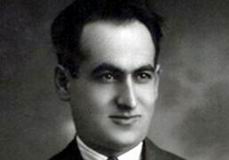
Soghomon Tehlirian
Murderer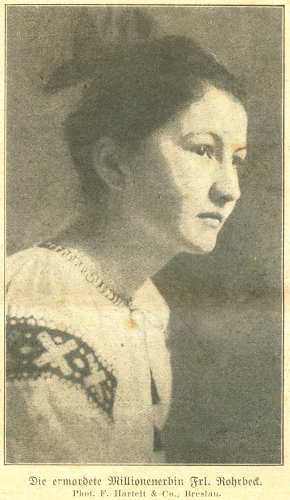 Peter Grupen
Murderer · Germany · 1921
Peter Grupen was Ursula Schade’s stepfather and Dorothea Rohrbeck’s step uncle.…
2 victims
Peter Grupen
Murderer · Germany · 1921
Peter Grupen was Ursula Schade’s stepfather and Dorothea Rohrbeck’s step uncle.…
2 victims
 Kürt Erich Tetzner
Murderer · Germany · 1929
Kürt Erich Tetzner (also known as Stranelli) was a German businessman born in 1…
1 victim
Kürt Erich Tetzner
Murderer · Germany · 1929
Kürt Erich Tetzner (also known as Stranelli) was a German businessman born in 1…
1 victim
 Christopher Solomon
Homicide · USA · 1997
Christopher Julian Solomon (TDCJ Number 999311) was born on 01/30/1980. He was…
1 victim
Christopher Solomon
Homicide · USA · 1997
Christopher Julian Solomon (TDCJ Number 999311) was born on 01/30/1980. He was…
1 victim
 Chris Benoit
Murderer · USA · 2007
Chris Benoit was a Canadian professional wrestler. On June 25, 2007, Benoit, hi…
2 victims
Chris Benoit
Murderer · USA · 2007
Chris Benoit was a Canadian professional wrestler. On June 25, 2007, Benoit, hi…
2 victims
 Michael John Yowell
Murderer · USA
Name: Michael John Yowell · TDCJ number: 999334 · Date of birth: 01/25/1970 · P…
1998 victims
Michael John Yowell
Murderer · USA
Name: Michael John Yowell · TDCJ number: 999334 · Date of birth: 01/25/1970 · P…
1998 victims
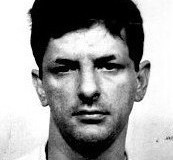 Stephen Peter Morin
Serial killer · USA · 1981
Offender: Stephen Peter Morin (February 19, 1951 – March 13, 1985) Execution da…
3 victims
Stephen Peter Morin
Serial killer · USA · 1981
Offender: Stephen Peter Morin (February 19, 1951 – March 13, 1985) Execution da…
3 victims
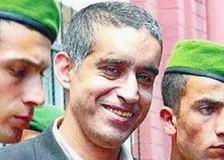 Yavuz Yapicioglu
Serial killer · Turkey · 1994
Yavuz Yapıcıoğlu (born 1967) was a Turkish serial killer and arsonist, nickname…
18 victims
Yavuz Yapicioglu
Serial killer · Turkey · 1994
Yavuz Yapıcıoğlu (born 1967) was a Turkish serial killer and arsonist, nickname…
18 victims
- Gender
- male
- Country
- Germany
- Location
- Berlin, Germany
- Date of birth
- April 2, 1897
- Age at first offence
- 24
- Characteristics
- mentally ill
- Victim profile
- Grand Vizir Talat Pasha, 47
- Method of murder
- Shooting
- Date(s) of murder
- March 15, 1921
- Years active
- 1921
- Date of arrest
- —
- Status
-
Died in custody
Found "not guilty" on grounds of temporary insanity; Died in May 23, 1960
Background
Soghomon Tehlirian (Armenian: Սողոմոն Թեհլերյան) was born on April 2, 1897, in Pakarish near Erzincan, Ottoman Empire. He died on May 23, 1960, in San Francisco, California, United States.
Tehlirian was an Armenian Evangelical (Protestant) and an Armenian Genocide survivor. The case also described Tehlirian as being a native of Yerznka.
The offence
Tehlirian assassinated the former Grand Vizir Talat Pasha in the Charlottenburg District of Berlin, Germany.
The assassination occurred in broad daylight and in the presence of many witnesses on March 15, 1921. It was described as an act of vengeance for Tehlirian’s role in orchestrating the Armenian Genocide.
The assassination was described as part of the Dashnak Party's Operation Nemesis.
Trial
Tehlirian was tried for murder.
Tehlirian was eventually acquitted by the German court. The verdict was “not guilty” on grounds of temporary insanity.
The record stated that the trial was a sensationalized event at the time. Tehlirian was defended by three defense attorneys, including Dr. Theodor Niemeyer, professor of Law at Kiel University.
The trial examined not only Tehlirian’s actions but also Tehlirian’s conviction that Talat Pasha was the main author of the Armenian Genocide.
The defense attorneys made no attempt to deny that Tehlirian had killed a man. Instead, they focused on the influence of the Armenian Genocide on Tehlirian's mental state. The jury rendered the verdict after slightly over an hour.
Outcome
The German court acquitted Tehlirian on the charge of murder, finding him “not guilty” on grounds of temporary insanity.
Legacy
The trial influenced Polish lawyer Raphael Lemkin. Lemkin reflected on the trial with the following quotation, verbatim:
"Why is a man punished when he kills another man? Why is the killing of a million a lesser crime than the killing of a single individual?"
The record stated that Lemkin later coined the term “genocide”.
The record further stated that Hannah Arendt compared Tehlirian to Shalom Schwartzbard, who assassinated Ukrainian statesman Simon Petlyura in Paris in 1925. Arendt’s comparison was based on what Schwartzbard believed about Petlyura’s culpability in the anti-Jewish pogroms in the Ukraine.
The record reported Arendt’s discussion with the following quoted material, verbatim:
"insisted on being tried", in order "to show the world through court procedure what crimes against his people had been committed and gone unpunished." [T]he one in the center of the play, on whom all eyes are fastened, is now the true hero, while at the same time the trial character of the proceedings is safeguarded, because it is not "a spectacle with prearranged results" but contains that element of "irreducible risk" which... is an indispensable factor in all criminal trials. Also, the J'accuse , so indispensable from the viewpoint of the victim, sounds, of course, much more convincing in the mouth of a man who has been forced to take the law into his own hands than in the voice of a government-appointed agent who risks nothing. And yet... it is more than doubtful that this solution would have been justifiable in Eichmann's case, and it is obvious that it would have been altogether unjustifiable if carried out by government agents. The point in favor of Schwartzbard and Tehlirian was that each was a member of an ethnic group that did not possess its own state and legal system, that there was no tribunal in the world to which either group could have brought its victims.
Film adaptation
The French film “Mayrig” by Henri Verneuil depicted Talat's assassination and Tehlirian's trial.
The record also stated that the 1982 American film Assignment Berlin, directed by Hrayr Toukhanian, accurately chronicles Talaat Pasha's assassination in Berlin.
Tehlirian's trial was adapted in the Turkish film Blood on the Wall. The record stated that it greatly differed and presented a very fictional account of the actual trial. It added that experts dismissed the film as fiction and Turkish propaganda.
Other details
The record named Tehlirian’s wife as Anahit Tatikian. The record also included a note about a portrait of Mehmet Talaat Pasha, described as Minister of Interior of the Ottoman Empire between 1913 and 1917, and as a primary executor of the Armenian Genocide.


Spotted an error, or have more information about this case?