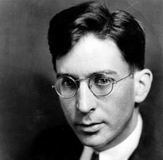
Carl Weiss
Murderer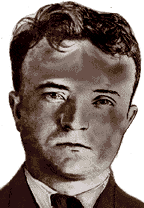 Paul Jaworski
Murderer · USA · 1926
Paul Jaworski was born in Poland as Paul Poluszynski in 1900. He later immigrat…
20 victims
Paul Jaworski
Murderer · USA · 1926
Paul Jaworski was born in Poland as Paul Poluszynski in 1900. He later immigrat…
20 victims
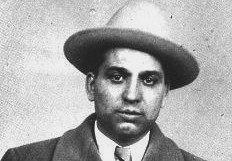 Harry Maione
Murderer · USA · 1937
Harry “Happy” Maione (1908 – February 19, 1942) was a New York mobster who serv…
12 victims
Harry Maione
Murderer · USA · 1937
Harry “Happy” Maione (1908 – February 19, 1942) was a New York mobster who serv…
12 victims
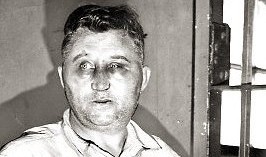 Harry Powers
Murderer · USA · 1931
Harry Powers was executed by hanging on March 18, 1932, at the West Virginia Pe…
5 victims
Harry Powers
Murderer · USA · 1931
Harry Powers was executed by hanging on March 18, 1932, at the West Virginia Pe…
5 victims
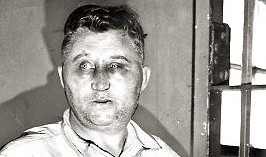 Herman Drenth
Murderer · USA · 1931
Herman Drenth was also known by the aliases Harry F. Powers and Cornelius O. Pi…
5 victims
Herman Drenth
Murderer · USA · 1931
Herman Drenth was also known by the aliases Harry F. Powers and Cornelius O. Pi…
5 victims
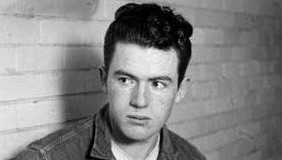 William Edward Hickman
Murderer · USA · 1926
William Edward Hickman was a man who tried to solve his financial problems by k…
5 victims
William Edward Hickman
Murderer · USA · 1926
William Edward Hickman was a man who tried to solve his financial problems by k…
5 victims
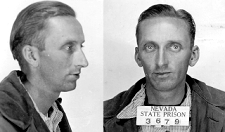 Luther Jones
Murderer · USA · 1936
Luther Jones Luther Jones was executed by asphyxiation-gas in Nevada on January…
4 victims
Luther Jones
Murderer · USA · 1936
Luther Jones Luther Jones was executed by asphyxiation-gas in Nevada on January…
4 victims
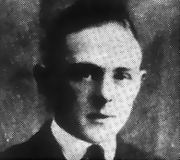 Ernest Brown
Murderer · 1933
Ernest Brown was executed by hanging at Armley prison in Leeds on February 6, 1…
1 victim
Ernest Brown
Murderer · 1933
Ernest Brown was executed by hanging at Armley prison in Leeds on February 6, 1…
1 victim
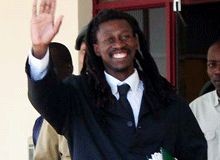 Modise Mokwadi Fly
Murderer · Botswana · 2006
Modise Mokwadi Fly was a Botswana politician and activist. He was the general s…
1 victim
Modise Mokwadi Fly
Murderer · Botswana · 2006
Modise Mokwadi Fly was a Botswana politician and activist. He was the general s…
1 victim
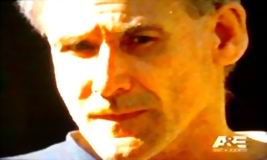 Ronald Glenn West
Murderer · Canada · 1970
Ronald Glenn West was a Toronto police officer and served as a traffic cop at T…
2 victims
Ronald Glenn West
Murderer · Canada · 1970
Ronald Glenn West was a Toronto police officer and served as a traffic cop at T…
2 victims
 Bobby Marion Francis
Murderer · USA · 1975
Bobby Marion Francis (also referred to as Bobby Marion Francis) · August 16, 19…
1 victim
Bobby Marion Francis
Murderer · USA · 1975
Bobby Marion Francis (also referred to as Bobby Marion Francis) · August 16, 19…
1 victim
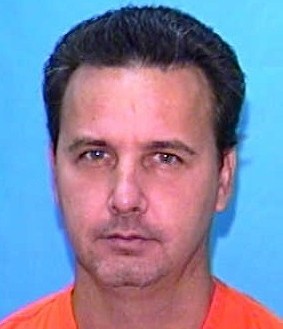 Gary Ray Bowles
Serial killer · USA · 1994
Gary Ray Bowles (b. January 25, 1962) was a Florida death row prisoner. At the…
6 victims
Gary Ray Bowles
Serial killer · USA · 1994
Gary Ray Bowles (b. January 25, 1962) was a Florida death row prisoner. At the…
6 victims
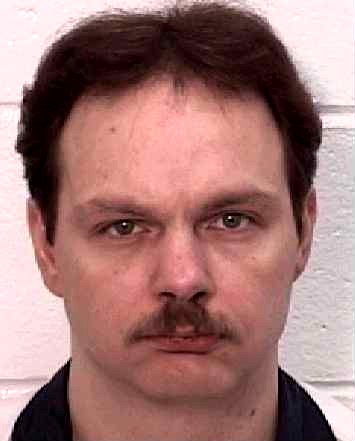 James Randall Rogers
Murderer · USA · 1980
James Randall Rogers was convicted in Floyd County of murder and aggravated ass…
1 victim
James Randall Rogers
Murderer · USA · 1980
James Randall Rogers was convicted in Floyd County of murder and aggravated ass…
1 victim
- Gender
- male
- Country
- USA
- Location
- Baton Rouge, Louisiana, USA
- Date of birth
- December 6, 1906
- Age at first offence
- 29
- Characteristics
- —
- Victim profile
- U.S. Senator Huey Pierce Long, Jr.
- Method of murder
- Shooting
- Date(s) of murder
- September 8, 1935
- Years active
- 1935
- Date of arrest
- —
- Status
-
Long's bodyguards opened fire and Weiss was hit with sixty-two bullets.
Case overview
Carl Weiss died at the scene after being shot in the Capitol building in Baton Rouge.
Timeline
- September 8, 1935 — Weiss allegedly shot Huey Long in the Capitol building in Baton Rouge; Long’s bodyguards opened fire and Weiss was hit with as many as sixty bullets and died at the scene.
- October 29, 1991 — Weiss’s body was exhumed from Roselawn Cemetery in Baton Rouge for forensic evaluation.
- October 29, 1991 — The exhumation brought about an investigation into police evidence that had vanished from the Long assassination examination.
- December 22, 1963 — Yvonne Weiss died.
Background
Carl Austin Weiss (December 6, 1906 – September 8, 1935) was a Baton Rouge, Louisiana physician described as a “gifted young Baton Rouge” physician who was alleged to have been the apparent assassin of U.S. Senator Huey Pierce Long, Jr. His family disputed the assertion.
Weiss was born in Baton Rouge to Dr. Carl Adam Weiss and the former Viola Maine. He was educated in local schools and graduated as the valedictorian of Catholic High School. He obtained his bachelor’s degree in 1925 from Louisiana State University in Baton Rouge. He received his medical degree from Tulane University in New Orleans in 1927. He did postgraduate work in Vienna, Austria, and was thereafter awarded internships in Vienna and at Bellevue Hospital in New York City.
In 1932, he returned to Baton Rouge to enter private practice with his father. He was president of the Louisiana Medical Society in 1933. He was a member of the Kiwanis Club.
The offence
On September 8, 1935, Weiss allegedly shot Huey Long in the Capitol building in Baton Rouge. Long’s bodyguards then opened fire and riddled Weiss’s body with as many as sixty bullets. Weiss died at the scene.
Investigation and competing accounts
The circumstances of Long’s shooting were described as murky, and written accounts were described as filled with contradictions.
Dave Haas, the leader of an anti-Long group called the “Minute Men,” claimed that five men met in the DeSoto Hotel in Baton Rouge to draw straws as to who would kill Long. Haas claimed that Weiss allegedly drew the short straw and, according to Haas:
“He would have killed Huey as he would a snake.”
Weiss’s sister-in-law, Ida Catherine Pavy Boudreaux (born 1922) of Opelousas recalled that his body was sent to the Smithsonian Institution in Washington, D.C., for a study of bullets entering and exiting the body.
Persistent claims alleged that Weiss actually was unarmed and struck Long with his hand. Those claims contended that Long was accidentally shot by his own guards when they opened fire on Weiss. These rumors were supported by several witnesses and the fact that Long had a bruised lip at the time of his emergency surgery.
Francis C. Grevemberg (born 1914), the former head of the Louisiana state police and twice a candidate for governor, voiced this view.
Long backers contended that the senator slipped and hit the marble wall at the scene of the gunfire.
Other theories held that Long’s assassination was arranged to prevent him from winning the presidency in 1936, either from within the Democratic Party or as a third party candidate backed by the Share Our Wealth organization. It was described as widely understood that Long’s populist, progressive policies had earned him many powerful enemies who would not have wanted him to become president.
Exhumation and forensic developments
Weiss was interred in Roselawn Cemetery in Baton Rouge. His body was exhumed on October 29, 1991, for forensic evaluation, fifty-six years after the event, and never returned to Roselawn.
The exhumation was described as having been done by James E. Starrs, a forensic scientist with George Washington University. The remains were described as skeletal, and they were found to still contain two bullets that had not been removed by doctors prior to burial due to how deeply they were embedded in the body.
Both bullets were found in the area of the head, and both bullets still had contained in their hollow points remnants of white linen. The linen was described as from the white linen suit that Weiss was wearing when he died. Because the bullets were found in his head, it was described as showing that Weiss was in a defensive position when he was shot, with his arms up towards his face.
The exhumation brought about an investigation into police evidence that had vanished from the Long assassination examination, including the gun that Weiss supposedly used to kill Long. The investigation uncovered that the gun in question was in the possession of the daughter of one of the former police investigators of the case, having been passed down to her upon death. The investigation also uncovered a clip of ammo from the gun, a spent .38 caliber bullet, and photos of the clothing worn by Huey Long at the time of his death.
Tests on the gun supposedly used by Weiss to kill Long found that the spent .38 caliber bullet, while the same caliber as Weiss’s gun, was not fired from the gun. The bullet showed signs of two strikes, one hard and one soft. It was described as assumed that the bullet struck first the marble walls in the State Capital building where Long was shot, and then ricocheted and hit Long. The fatal shot was described as thought to have come from one of Long’s own bodyguards.
All of those developments were attributed to James E. Starrs, who wrote a book on the subject called “A Voice for the Dead.”
Aftermath
Weiss’s family moved after his death. Weiss’s mother, Yvonne Weiss (born 1908), and his son Carl moved to New York City, where she was a member of the faculty of Columbia University. Ida Boudreaux, Yvonne’s youngest sister and the maternal aunt of Carl Weiss, Jr., recalled that the move was necessary to avoid the hostile political climate against the Weiss family in Louisiana in the late 1930s.
Yvonne Weiss subsequently married Henri Samuel Bourgeois, a Canadian. She died on December 22, 1963, exactly one month after the assassination of U.S. President John F. Kennedy.
Carl Weiss, Jr. resided on Long Island in New York and had been trying for years to clear his father’s name. Carl Weiss, Jr. met with U.S. Senator Russell B. Long (1918–2003), Long’s son and successor in the Senate, and the two agreed to put aside past differences and reach a reconciliation.
Other details
The Pavy-Opelousas connection
In 1933, Dr. Weiss married the former Yvonne Louise Pavy of Opelousas, the seat of St. Landry Parish. The couple had one son, Carl Austin Weiss, Jr. (born 1934).
Yvonne Louise Pavy was the daughter of Judge Benjamin Henry Pavy (1874–1943) and the former Ida Veazie (died 1941). Judge Pavy was part of the anti-Long political faction.
Pavy’s brother Felix Octave Pavy, Sr. (died 1962), an Opelousas physician, had run for lieutenant governor in 1928 on an intraparty ticket opposite the Long slate. Felix Pavy was defeated for lieutenant governor by Paul N. Cyr of Iberia Parish, who thereafter turned against Long.
Judge Pavy was the Sixteenth Judicial District state judge from St. Landry and Evangeline parishes. He did not seek reelection in 1936, after Long had the legislature gerrymander the seat to include a majority of pro-Long voters within a revised district.
Weiss’s father was described as a prominent eye specialist who had once treated Senator Long.
Claims about assassination plot and political plans
In July 1935, two months prior to his death, Long claimed that he had uncovered an assassination plot against himself. Long had positioned himself to run against Franklin D. Roosevelt in the 1936 elections and announced his bid in August 1935; a month later, he was dead.
Historian and Long biographer T. Harry Williams of LSU later claimed that the senator had never intended to run for the presidency in 1936. Williams claimed instead that Long had been plotting with Father Charles Coughlin, a Catholic priest and populist radio personality, to run someone else on the soon-to-be-formed Share Our Wealth Party ticket.
Williams’s described plan was that this candidate would split the leftist vote with President Roosevelt and thereby elect a Republican president and demonstrate the electoral appeal of “Share Our Wealth.” Long was described as waiting four years and running for president in 1940 as a Democrat against a sitting Republican incumbent.
Television discussion of the event
During the 1990s, the NBC television series Unsolved Mysteries raised the possibility that Weiss did not kill Long, but that the powerful senator was accidentally shot to death by his own bodyguards who failed to protect him from danger. In the segment, a historian questioned that if Weiss was armed with a gun, how he got through the heavily guarded Capitol Building without having the weapon confiscated. The segment also questioned how Weiss had many opportunities before the actual shooting to assassinate Senator Long as he walked up and down the hallways ignoring Weiss’s repeated requests to speak to him, and it noted that Long had his back to Weiss seconds before the shooting.
Spotted an error, or have more information about this case?