
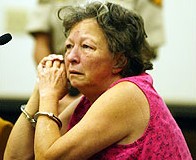
Beth Carpenter
Murderer Bobbie Sue Terrell
Murderer · USA · 1984
Bobbie Sue Dudley Terrell was a Pinellas County nurse and worked as the night s…
12 victims
Bobbie Sue Terrell
Murderer · USA · 1984
Bobbie Sue Dudley Terrell was a Pinellas County nurse and worked as the night s…
12 victims
 Megan Huntsman
Murderer · USA · 1996
Megan Huntsman was 40 at sentencing. She was a mother of three children who wer…
6 victims
Megan Huntsman
Murderer · USA · 1996
Megan Huntsman was 40 at sentencing. She was a mother of three children who wer…
6 victims
 Angela Johnson
Murderer · USA · 1993
Angela Jane Johnson was convicted in federal court of aiding and abetting the m…
5 victims
Angela Johnson
Murderer · USA · 1993
Angela Jane Johnson was convicted in federal court of aiding and abetting the m…
5 victims
 Catherine May Wood
Murderer · USA · 1987
Catherine May Wood was an American caregiver who worked at the Alpine Manor Nur…
5 victims
Catherine May Wood
Murderer · USA · 1987
Catherine May Wood was an American caregiver who worked at the Alpine Manor Nur…
5 victims
 Michele Kalina
Murderer · USA · 1996
Michele Kalina pleaded guilty to murder for one of five infants she initially w…
5 victims
Michele Kalina
Murderer · USA · 1996
Michele Kalina pleaded guilty to murder for one of five infants she initially w…
5 victims
 Amy Bishop
Murderer · USA · 1986
Amy Bishop — biology professor and perpetrator · James Anderson — Bishop’s husb…
4 victims
Amy Bishop
Murderer · USA · 1986
Amy Bishop — biology professor and perpetrator · James Anderson — Bishop’s husb…
4 victims
 Lois Jurgens
Murderer · USA · 1965
Lois Jurgens (born 1925) was an American convicted murderer in Minnesota. She w…
1 victim
Lois Jurgens
Murderer · USA · 1965
Lois Jurgens (born 1925) was an American convicted murderer in Minnesota. She w…
1 victim
 Tiffany Powell
Murderer · USA · 2014
Tiffany Powell was 34 years old, of Akron. She was in the middle of a custody b…
1 victim
Tiffany Powell
Murderer · USA · 2014
Tiffany Powell was 34 years old, of Akron. She was in the middle of a custody b…
1 victim
 Walter LaGrand
Murderer · USA · 1982
Walter LaGrand was convicted for his role in a bungled armed robbery of the Val…
1 victim
Walter LaGrand
Murderer · USA · 1982
Walter LaGrand was convicted for his role in a bungled armed robbery of the Val…
1 victim
 Stanley Neace
Mass murderer · USA · 2011
Stanley Neace, aged 47, killed his wife and five others in Breathitt County, Ke…
5 victims
Stanley Neace
Mass murderer · USA · 2011
Stanley Neace, aged 47, killed his wife and five others in Breathitt County, Ke…
5 victims
 Joseph Christopher Garcia
Murderer · USA · 2000
Joseph Christopher Garcia (TDCJ Number 999441) was convicted of capital murder…
2 victims
Joseph Christopher Garcia
Murderer · USA · 2000
Joseph Christopher Garcia (TDCJ Number 999441) was convicted of capital murder…
2 victims
- Gender
- female
- Country
- USA
- Location
- East Lyme, New London County, Connecticut, USA
- Date of birth
- November 2, 1963
- Age at first offence
- 31
- Characteristics
- murder for hire
- Victim profile
- Anson "Buzz" Clinton III, 28 ( her brother-in-law)
- Method of murder
- Shooting
- Date(s) of murder
- March 10, 1994
- Years active
- 1994
- Date of arrest
- November 11, 1997 (in Dublin, Ireland)
- Status
-
Life imprisonment
Sentenced to life in prison without parole on August 1, 2002
Case record: Beth Ann Carpenter
Background
Beth Ann Carpenter was the oldest of three children and was born Nov. 23, 1963. Her middle name, Ann, was used to distinguish her because there were three girls named Beth in her second-grade class. She was nicknamed “Red” in high school and was an honors student who participated in track, basketball and swim teams. She also worked on the school newspaper and yearbook.
Carpenter studied at George Washington University and took pre-med courses. After graduating from college, she attended law school classes with a friend enrolled at the University of Connecticut School of Law and decided to attend law school. She graduated from the Columbus School of Law at Catholic University in 1990. She interned at the Securities and Exchange Commission and sought to practice corporate law. She passed bar exams in New York, Connecticut and Washington, D.C.
At some point before joining Clein and Frasure, she was described as an admitted attorney licensed to practice law in Connecticut.
Carpenter joined the Old Saybrook law firm of Clein and Frasure on Nov. 7, 1992, when she was 28. Clein was described as 22 years older than Carpenter and in his fourth marriage when she joined the firm. Carpenter and Haiman Clein began a torrid affair at the end of November 1993; Clein was described as married and the father of four children. The relationship included statements that Clein once told Carpenter that a book about sexual obsession entitled “Damaged” accurately summed up his feelings about their relationship.
Carpenter’s family became involved in litigation over guardianship and custody of a child, Rebecca Carpenter, Kim Carpenter’s daughter. Cynthia Carpenter and Carpenter pursued removal of Kim Carpenter as guardian of Rebecca. The Probate Court issued an ex parte order granting Cynthia temporary custody in October 1992, and in December 1992 it reversed the temporary order and returned guardianship and custody to Kim after steps were taken. In January 1993, Kim married Anson “Buzz” Clinton III.
Carpenter’s fear and motive in the custody litigation were described as concerns that Kim was not providing Rebecca with proper care and attention, and that Cynthia and Carpenter no longer would be able to see the child if Kim and Clinton left Connecticut. Carpenter was described as motivated to assist her mother because she was concerned that Kim was not providing Rebecca with proper care and attention, and because she believed that Clinton was abusive toward Kim and Rebecca and that Kim was powerless to protect Rebecca from harm.
The offence
On March 10, 1994, travelers on Interstate 95 discovered the body of Anson B. “Buzz” Clinton III lying in the roadway of exit seventy-two, known as the Rocky Neck connector, in the town of East Lyme. The victim had died as a result of multiple gunshot wounds to his head and upper body.
The case was prosecuted as a murder-for-hire arrangement. The jury found Carpenter guilty of capital felony, murder and conspiracy to commit murder. The capital felony conviction was described as arising from Carpenter’s solicitation of Haiman Clein to hire another person for pecuniary gain to kill the victim, with Clein hiring Mark Despres, who then caused the death.
Clarity of the roles in the murder-for-hire arrangement included:
- Carpenter’s role in soliciting or requesting that Clein kill the victim for pecuniary gain.
- Clein’s role as hiring the gunman.
- Despres’ role in intentionally causing the death by shooting.
Investigation
A first set of events placed Carpenter’s family and the victim within the broader custody dispute over Rebecca. Cynthia Carpenter read about the incident in a newspaper and telephoned Carpenter to inform her of the victim’s death. Carpenter then immediately called Clein, who rushed to her apartment.
When Cynthia later called Carpenter to tell her that Connecticut state police were coming to question the Carpenters about the incident, Carpenter and Clein volunteered to come and only after they answered every question asked by the state police did they depart.
In the period after the murder, Clein continued and the affair continued for the next eighteen months despite attempts to end it. Carpenter continued her relationship with Clein for eighteen months after the murder.
Arrest and extradition
Carpenter was arrested in connection with the victim’s murder in November 1997 and was imprisoned in Ireland for nineteen months.
The procedural history included that Carpenter’s plans were thwarted when she was arrested in connection with the victim’s murder and imprisoned in Ireland for nineteen months. On June 1999, Carpenter waived extradition, was arraigned in New London Superior Court, and was charged with capital felony, murder as an accessory and conspiracy to commit murder.
Carpenter’s earlier location in London and Dublin was described in connection with the ongoing police investigation. She left the country to begin a new job in London in January 1995. Later, she left for Dublin and worked at a local pub after attending courses at University College Dublin for about two weeks but being unable to afford tuition.
Trial
A jury trial began after the arraignment. After a two month trial, the jury returned a verdict of guilty on all three counts.
The verdict included:
- guilty on capital felony
- guilty on murder as an accessory
- guilty on conspiracy to commit murder
During trial, the defense presented Carpenter’s account in which she testified she did not ask Clein to kill the victim and did not know Clein had arranged to kill the victim until the weekend following the murder. She also testified that she continued the affair following the murder because of emotional dependence on Clein, explaining she “needed to be with him all the time,” and that she could not break away. Her testimony included explanations of attempts to end the relationship, including changing locks and phone numbers, and described behaviors when Clein returned or called.
The prosecution argued that Carpenter persuaded Clein to hire Mark Despres to shoot Clinton five times at close range on the shoulder of an Interstate 84 off ramp. The court proceedings and appeals recounted the evidence.
The trial included contested evidentiary rulings related to:
- exclusion of expert testimony on codependent relationships
- admission of hearsay evidence related to motive
- admission of investigative reports and testimony about the victim’s intention to move to Arizona
- admission of coconspirator hearsay through Chris Despres testimony
- exclusion of testimony related to alleged threats and duress arguments
- exclusion of evidence of a radio tape recording
- exclusion of testimony about Carpenter’s state of mind before the murder
- jury instructions on the elements of murder for hire
Excluded expert testimony: codependency
Robert Novelly, a psychologist, was offered to testify regarding the nature of codependent relationships and why women often fail to leave such relationships. The defense sought the testimony to rebut the state’s claim that Carpenter’s failure to end the affair with Clein following the murder indicated complicity.
The court ultimately excluded Novelly’s testimony. The trial court excluded it on the ground that expert testimony on codependent relationships may not be admitted without prior evidence that the individuals involved have codependent personalities and that such evidence was lacking in the present case.
Novelly testified in offer of proof: “For example, if ․ the male was very narcissistic, self-centered, preoccupied with his own power, preoccupied with his own vanity, his own sense that the rules don't apply to him ․ it's a narcissistic personality, and when you team it up with other traits, you get the kind of individual I described who needs someone to keep reaffirming how great they are, how omnipotent they are, how all of their egocentric selfishness is reaffirmed.“It's got to be reaffirmed by someone. It's reaffirmed in this pathological relationship. That type of person will typically ․ watch for females who have huge dependency [needs], their self-esteem might be fragile. They are so needy emotionally that their well of need can almost never be filled. The fear of abandonment is substantial. It's huge. And therefore what the narcissistic person ․ looks for is the person who they can control, who'll fawn over them, who'll affirm to them their own omnipotence. And in that relationship, what the dependent person gets in return is having all of their dependency needs met. They get reaffirmed that they are important, that they have a sense of self-worth that they didn't have outside of that relationship.“
The trial court’s reasoning included that it required diagnostic evidence or expert testimony to establish that the partners had personality traits conducive to forming a codependent relationship.
Admission of motive-related hearsay
Several items were admitted over objections. Cynthia Carpenter’s affidavit and written account of a telephone conversation with the victim were included for limited purposes connected to custody litigation context and provided information to witnesses, not for their truth as to the matters asserted, as instructed.
Cynthia Carpenter’s written account included verbatim statements. The written account stated:
“[The victim] called-I asked if I might speak with Kim. He stated that I was not allowed to speak with her as I upset her. I stated that she never indicated to me that she was upset by anything I said.“I asked what happened Wednesday night regarding our meeting at McDonald's when they had agreed we might visit with Rebecca. He stated that the visit was supposed to be a meeting with Kim and him, which it was not. He arrived with a tape recorder stating the above.“At this point he became insulting:“-I can't be a grandmother if I don't know how to be a mother.“-Getting a restraining order to prevent me from speaking to Kim on the phone and from going into Stop & Shop and ‘harassing’ Kim.“-If we are on Stagecoach Road he will force [me] off the road with his tow truck.“-He is Rebecca's ‘father’ and he will tell us what the rules are.“-If we give him any problems he will disappear with Kim and Rebecca.“-He is adopting Rebecca shortly.“-The ‘psychologist’ states that we are the ones who are causing Rebecca problems.“[The victim] calls claiming he would like to put a resolution to our problems. However, each time he immediately begins by denying [me] access to my daughter and hurling insults. The conversation ended with [the victim] stating he was Rebecca's father and he controlled the situation. If we ever want to see Kim or Rebecca again we need to cooperate with him or he would disappear with both of them.”
Investigative reports prepared by the department for the Probate Court were admitted as business records, but the Supreme Court described that statements included in the reports were testimonial for Crawford purposes and that any improper admission was harmless beyond a reasonable doubt.
Dee Clinton’s testimony about the victim’s intent to move to Arizona was admitted as evidence of the victim’s state of mind, but was found to have lacked an evidentiary foundation; the Supreme Court concluded that any improper ruling was harmless.
Coconsiprator exception testimony: Chris Despres
Chris Despres testified after Despres’ father told him details. The contested statement included that Clein had asked Despres to kill somebody. Chris testified that his father responded that Clein asked him to kill somebody whom he identified as the victim because Clein knew a person who “wanted the guy dead and [Clein] was going to make the connection ․” The material included also testimony that Clein told his father that the target of the murder had been hitting, sexually abusing or putting out cigarettes on his wife or children.
Exclusion related to Jocelyn Johnson and duress claims
The defense sought to introduce testimony from Jocelyn Johnson, Despres’ girlfriend for twelve and one-half years, regarding a claim that Despres said Clein threatened to kill him if he did not carry out the murder.
The Supreme Court described that the trial court excluded that testimony as impermissible hearsay and the appellate court concluded the trial court did not abuse its discretion.
Exclusion of radio tape recording
The defense sought to introduce evidence of a telephone call to a nationally syndicated radio talk show from a male caller who identified himself as “Chris” and confessed to a murder allegedly committed by his father. The court ruled on authentication and excluded the tape recording.
The Supreme Court described that the call had been given to the state and that:
- the caller identified himself as “Chris”
- the caller stated he had been involved in a murder for hire when he was fifteen and that he was “ ‘the one [who] actually did it.’ ”
- Chris Despres had denied that he was the caller
- the court determined the defense failed to make a prima facie showing that the voice was the same
Sentencing
At sentencing, the court merged the capital felony and murder convictions and sentenced Carpenter on those two merged counts to life imprisonment without the possibility of release.
On the count of conspiracy to commit murder, the court sentenced Carpenter to a term of twenty years imprisonment to be served concurrently.
Separate sentencing coverage in the record states:
- Judge Robert Devlin Jr. sentenced her to life in prison without the possibility of release.
- She was sentenced to life in prison without parole on August 1, 2002.
Appeals
Carpenter appealed her conviction. The Connecticut Supreme Court affirmed the judgment of conviction in an opinion dated October 11, 2005 (Supreme Court of Connecticut, State v. Carpenter, No. 16854). The opinion described that the appellate claims included challenges to: 2. admission of irrelevant hearsay evidence regarding purported motive 3. admission of hearsay evidence disclosing existence of a conspiracy 4. exclusion of evidence pertaining to the gunman’s state of mind 5. exclusion of evidence of an alleged confession by the gunman’s son 6. exclusion of evidence of Carpenter’s state of mind prior to the murder 7. jury instruction on the elements of murder for hire
The Supreme Court affirmed the judgment of the trial court and held that the claimed errors either did not constitute constitutional error or were harmless where improper evidentiary admissions occurred.
Aftermath
A later habeas corpus petition was filed. The record describes that:
- the habeas case was set to go to trial Oct. 18 in the Rockville courthouse where all of the state’s habeas cases are heard
- Carpenter again sought reduction in her life sentence
- Carpenter was described as incarcerated at the Janet S. York Correctional Institution in Niantic
- an attorney, Norman A. Pattis, said the trial may not go forward
- attorney Tara Knight and attorney Hugh F. Keefe were described as having represented Carpenter at her trial
- the habeas lawsuit claims Keefe and Knight provided “ineffective counsel”
- an asserted claim included that there was no physical evidence to convict her and that the state relied on Clein, who took a plea deal to avoid being exposed to the death penalty and was the key witness at Carpenter’s trial
- Daloyd “Dee” Clinton died in June 2009
The record also described sentencing outcomes for other participants:
- Clein was serving a 35-year prison sentence (in some later coverage)
- Despres was serving a 45-year prison sentence
- Joseph Fremut died of cancer early in that period while awaiting trial on charges he planned the murder but was not present when it was carried out
Other details
People and roles named in the case
- Beth Ann Carpenter: defendant; attorney.
- Kim Carpenter (also described as Kim Carpenter Clinton): Carpenter’s younger sister; mother of Rebecca Carpenter.
- Anson “Buzz” Clinton III: victim; shot to death.
- Cynthia Carpenter: Carpenter’s mother; pursued custody and guardianship litigation.
- Richard Carpenter: Carpenter’s father; described as involved in custody litigation and landscaping business in later coverage.
- Haiman Clein: real estate attorney and former law partner/employer; accused conspirator and witness; pleaded guilty to conspiracy to commit murder in connection with the plot and entered a plea arrangement described as capped at 45 years.
- Mark Despres (spelled Mark Despres or Mark Depres in different portions of the text): gunman; pleaded guilty to murder and conspiracy to commit murder; sentenced to 45 years in prison.
- Joseph Fremut: described as co-conspirator who helped Depres plan the murder; died of cancer.
- Mark Rademacher: assistant public defender named in the Supreme Court arguments.
- Kevin T. Kane: state’s attorney named in Supreme Court arguments; and he was referenced as prosecutor in trial coverage.
- Peter A. McShane: senior assistant state's attorney named in Supreme Court arguments.
- Tara Knight: co-defense counsel named in later coverage and Supreme Court argument record.
- Hugh F. Keefe: co-defense counsel named in later coverage and Supreme Court argument record.
- Norman A. Pattis: attorney mentioned in the habeas corpus discussion.
- Edwin Perez: jury foreman named in April 12, 2002 verdict coverage.
- Robert J. Devlin Jr.: judge who sentenced Carpenter.
- Dee Clinton (Daloyd “Dee” Clinton): victim’s mother; testified at trial.
- Suzanne Clinton: named in verdict coverage as 11 at time of murder; 19 at time of reporting.
- Cynthia Carpenter and Richard Carpenter: named as escort and family members in trial coverage.
- Kelley MaCombe: a spectator named in verdict coverage.
- Robert Novelly: psychologist witness offered by defense.
- Vittorio Ferrero: psychiatrist who testified in the trial record description concerning Clein.
- Chris Despres: Despres’ teenage son named; testified.
- Jocelyn Johnson: Despres’ girlfriend for twelve and one-half years; testimony sought to be admitted and excluded.
- Linda Kidder: court-appointed guardian ad litem described in trial evidentiary discussion.
- Teresa L. Jenkins: department investigator described in evidentiary discussion.
- Tricia Gaul: wife of Rebecca’s natural father John Gaul, described as testimony relating to the file and documents given by the defendant.
- John Gaul: Rebecca’s natural father, named in custody dispute discussion.
- Brianna: mentioned as a newborn daughter in testimony described from Dee Clinton’s account.
- Brianna’s mother and father context was included only as described with newborn daughter; the newborn was named in that passage.
Quotes captured verbatim in the record
The record contained several verbatim statements.
- Clein’s last words to Carpenter at his arrest in the Supreme Court narrative:
“ ‘You set me up ․’ ”
- Devlin’s sentencing remark as quoted in trial coverage:
“insane” and something that Carpenter could have prevented. “Having been convicted of contract murder, I have no difficulty imposing this sentence,”
- Dee Clinton’s statement at sentencing coverage:
“see the fires of hell”
- Dee Clinton’s reported statement to reporters:
“poppycock”
- Tara Knight’s reported statement outside the courthouse:
“correct the record”
- During Supreme Court offer of proof, Novelly’s quoted hypothetical response included codependency description, including:
“like a hand fitting into a glove ․”
- Dee Clinton’s record included the quoted victim letter/envelope reference to Arizona, and a statement in Cynthia Carpenter’s written account included:
“If we ever want to see Kim or Rebecca again we need to cooperate with him or he would disappear with both of them.”
- Trial evidentiary discussion included a coconspirator phrase quoted by Chris Despres:
“wanted the guy dead and [Clein] was going to make the connection ․”
Spotted an error, or have more information about this case?