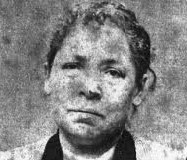
Marie Goold
Murderer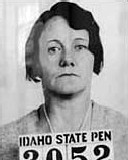 Lydia Trueblood
Murderer · USA · 1915
Lydia Trueblood was born in 1915. She was convicted in Idaho in 1921 and died o…
6 victims
Lydia Trueblood
Murderer · USA · 1915
Lydia Trueblood was born in 1915. She was convicted in Idaho in 1921 and died o…
6 victims
 Louise Peete
Murderer · USA · 1912
Louise Peete (born Lofie Louise Preslar; September 20, 1880; Bienville, Louisia…
3 victims
Louise Peete
Murderer · USA · 1912
Louise Peete (born Lofie Louise Preslar; September 20, 1880; Bienville, Louisia…
3 victims
 Martha Rendell
Murderer · Australia · 1907
Martha Rendell was executed by hanging at Fremantle Prison on October 6, 1909.…
3 victims
Martha Rendell
Murderer · Australia · 1907
Martha Rendell was executed by hanging at Fremantle Prison on October 6, 1909.…
3 victims
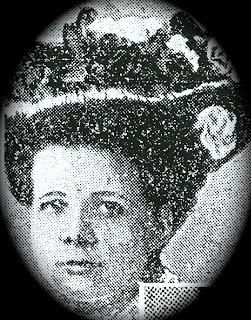 Augusta Fullam
Murderer · India · 1911
Augusta Fullam Augusta Fullam was sentenced to death in 1913. Her sentence was…
2 victims
Augusta Fullam
Murderer · India · 1911
Augusta Fullam Augusta Fullam was sentenced to death in 1913. Her sentence was…
2 victims
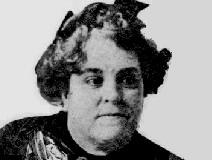 Cordelia Botkin
Murderer · USA · 1898
Cordelia Botkin was a stocky woman of 44 who left her own husband and started a…
2 victims
Cordelia Botkin
Murderer · USA · 1898
Cordelia Botkin was a stocky woman of 44 who left her own husband and started a…
2 victims
 Ada Chard Williams
Murderer · United Kingdom · 1899
Ada Chard Williams (also referred to as Ada Chard-Williams and Mrs. Hewetson in…
1 victim
Ada Chard Williams
Murderer · United Kingdom · 1899
Ada Chard Williams (also referred to as Ada Chard-Williams and Mrs. Hewetson in…
1 victim
 Margaret Rudin
Murderer · USA · 1994
Margaret Rudin (born May 31, 1943) was an American woman convicted in the Decem…
1 victim
Margaret Rudin
Murderer · USA · 1994
Margaret Rudin (born May 31, 1943) was an American woman convicted in the Decem…
1 victim
 Alphonso Stripling
Murderer · USA · 1988
Alphonso Stripling was convicted by a jury in Douglas County of shooting four e…
2 victims
Alphonso Stripling
Murderer · USA · 1988
Alphonso Stripling was convicted by a jury in Douglas County of shooting four e…
2 victims
 Tony Egbuna Ford
Murderer · USA · 1991
Tony Egbuna Ford Tony Egbuna Ford was 18 years old in 1991. Ford gave a ride to…
1 victim
Tony Egbuna Ford
Murderer · USA · 1991
Tony Egbuna Ford Tony Egbuna Ford was 18 years old in 1991. Ford gave a ride to…
1 victim
 Brian Donald Hume
Murderer · United Kingdom/Switzerland · 1949
Brian Donald Hume partnered in illegal activities with Stanley Setty. Hume had…
2 victims
Brian Donald Hume
Murderer · United Kingdom/Switzerland · 1949
Brian Donald Hume partnered in illegal activities with Stanley Setty. Hume had…
2 victims
- Gender
- female
- Country
- Monaco
- Location
- Monte Carlo, Monaco
- Date of birth
- 1850
- Age at first offence
- 57
- Characteristics
- dismemberment, torture, murder for hire
- Victim profile
- Mme. Emma Levin
- Method of murder
- Stabbing with knife
- Date(s) of murder
- August 4, 1907
- Years active
- 1907
- Date of arrest
- 2 days after
- Status
-
Died in custody
Sentenced to death on December 4, 1907; commuted to life imprisonment in January 1908; died of typhoid fever in a Montpellier jail in 1914.
Case details
Marie Goold was sentenced to death on December 4, 1907. Her sentence was commuted to life imprisonment in January 1908. She died of typhoid fever in a Montpellier jail in 1914.
The offence
Marie Goold was convicted in connection with the murder of Mme. Emma Levin. Her dismembered body was found in a trunk at the railway station in Marseilles. The head and parts of the legs were missing, and they were found in a small portmanteau that Vere Goold was holding. Mme. Levin had several wounds on the head and she had been stabbed several times in the chest.
The villa where Mme. Levin was murdered was examined for evidence including splashed blood in the walls of the dining room, and a saw, a chopper, a knife, and a dagger were discovered.
Investigation
A servant girl stated that she heard sounds of a struggle and that a voice cried out: “Let me alone.”
At Marseilles railway station, a porter named Louis Pons noticed blood oozing from a trunk left with instructions to dispatch it to London, and he informed the police despite Mr. Goold’s assertion that it only contained poultry. Police brought Mr. and Mrs. Goold back to the station and opened the trunk in their presence. The trunk contained the butchered body of Mme. Levin.
The remains of Mme. Levin were found in the opened trunk, with the head and parts of the legs missing from the trunk contents and instead found in a small portmanteau that Goold was holding. Police found that Mme. Levin had been stabbed multiple times and had wounds on the head.
Arrest
Mr. and Mrs. Goold were arrested at Marseilles after they arrived there with luggage from Monte Carlo. They left a large trunk at the railway station with instructions to dispatch it to London. They drove to a hotel where they used the name of Mr. and Mrs. Javanach. Mr. and Mrs. Goold were then brought back to the station and the trunk was opened in their presence.
Trial
During the trial, the case attracted great attention.
The Goolds’ first account of the tragedy admitted the mutilations but denied all responsibility for the murder. Mrs. Goold declared that when Mme. Levin visited her home a man rushed in with a knife in his hand and killed her, shouting: “You wretch. You have ruined me. Now I am going to kill you.” Mr. Goold stated that the woman was killed by a man during the absence of himself and his wife and that they decided to cut the body into pieces and put them in a trunk in order to avoid scandal.
At trial, Vere Goold was described as having confessed that he was the murderer. The relative strengths of character of the two came out during the trial.
Marie Goold was sentenced to death, and Vere Goold was sentenced to life imprisonment on Devil’s Island. Mrs. Goold’s sentence was reduced to life imprisonment.
A judge told her: “You deserve two death sentences.”
The trial was described as theatrical, with sneering, laughter and heckles from the galleries. A prosecutor was said to have mounted “a passion of abuse.” Doctors testified that Vere was “a moral idiot and a degenerate,” and that his ability to reason and make judgements had been weakened by his addictions to alcohol and opium.
Sentencing
Her death sentence was commuted to life imprisonment in January 1908. She was sent to Montpellier Prison.
Appeals
By January 1908, both of the Goolds were in the midst of ultimately unsuccessful appeals. A month later, Marie’s death sentence was commuted to life imprisonment.
Outcome
Marie Goold died of typhoid fever in a Montpellier jail in 1914.
Other details
Marie Goold had been married three times. Her earlier life was described by crime historian Jay Robert Nash as one of an “adventuress,” and it was noted that “her first two husbands died mysteriously,” adding that “there may have been more husbands who met the same fate.”
Marie Goold was described as the niece of Mlle. Girodin residing with the Goolds at the Villa Menesini on the first floor of the villa in the Boulevard des Moulin, Monte Carlo.
Mme. Emma Levin was the widow of a Stockholm merchant who died about eight years earlier. Mme. Levin was always smartly dressed and very intelligent, and her mother still lived. Mme. Levin had no children of her own but had adopted a little girl from poor parents who lived in Switzerland. The parents later insisted that their daughter be restored to them.
Mme. Castellazi, a Swedish lady who knew Mme. Levin at Monte Carlo, spoke highly of her to a representative of the Petit Parisian and said: “the only fault to find with her was that she was too fond of jewelry and took an ostentatious delight in wearing it.” Her jewelry was estimated to be worth more than $10,000.
Mme. Levin left the Hotel Bristol at Monte Carlo on Sunday evening wearing much of her jewelry collection.
On Sunday August 4 at 5 o’clock, Mme. Levin entered the Villa Menesini and was not again seen alive.
When police found the trunk contents, Vere Goold held a small portmanteau containing the head and parts of the legs.
In the villa, items included a saw, a chopper, a knife and a dagger found during an examination of the villa.
Mrs. Goold and Vere Goold used the titles of “Sir” and “Lady” Goold in connection with their lives in Monte Carlo.
Marie Goold and Vere Goold had been at Monte Carlo for gambling, and they were later arrested in Marseilles after leaving the trunk at the station.
During a public dispute, the Goolds had a dispute in the casino involving Mme. Levin and another hanger-on, which got into social columns at Monte Carlo.
Marie Goold’s background included being the daughter of an iron monger called Girodin at La Scone Isere, and she was born in 1860. She was brought up as a dressmaker.
Marie Goold was described as having great energy and complete authority over her husband Marie Girodin, who lived with her father and mother while first married to a young man of St. Marcellin against her parents’ wishes. A week after that wedding, she left her new home with a little money, took refuge in Geneva, worked for some times as a dressmaker, and then proceeded to London where she met Goold. It was sixteen years since she married Goold at St Mary of the Angels Paddington.
After business declined, the couple went to Montreal and established a large dressmaking business catering for the best society. They retired and then lived at 18 Adelaide terrace Waterloo Liverpool adopting the title of Sir Vere and Lady Goold.
At their Monte Carlo villa, they were accompanied by their niece, Mlle. Girodin.
Vere Thomas “St. Leger” Goold was an Irish tennis player, born on 2 October 1853 in Clonmel, County Tipperary, Ireland, and he died on 8 September 1909 in Devil’s Island, French Guiana penal colony, where he was in prison convicted of murder and premature death, by suicide.
Vere Goold was described as having lived after 1883 with drink and drugs, and he had been asked by a relative to pay a bill at a dressmaker’s shop in the Bayswater section of London owned by Miss Marie Giraudin.
In 1891, Goold married Marie Giraudin.
The Goolds took with them her niece, Isabelle Giraudin, when they went to Monte Carlo in 1907.
In their confession and accounts, Vere suggested that he loved Marie Goold deeply. In a letter to his wife, Goold asked: “I wonder if all these horrors are a bad dream?”
After arrest and return to Monte Carlo, a large crowd collected at the station with cries of “death to the murderers, death to the murderers.” Some attempted to break through the line of police and carabineers to lynch the pair.
During the court proceedings, the headline in the Daily Globe, a New York newspaper, was described as “Lady MacBeth Reborn.”
In the narrative of events, neighbour heard a woman scream, “leave me alone,” and Isabelle was said to have been sent out with strict instructions not to return until evening.


Spotted an error, or have more information about this case?