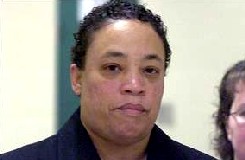
Daphne Wright
Murderer Miranda Barbour
Murderer · USA · 2013
Miranda Barbour, 19, defendant. · Elytte Barbour, 22, defendant and husband of…
100 victims
Miranda Barbour
Murderer · USA · 2013
Miranda Barbour, 19, defendant. · Elytte Barbour, 22, defendant and husband of…
100 victims
 Megan Huntsman
Murderer · USA · 1996
Megan Huntsman was 40 at sentencing. She was a mother of three children who wer…
6 victims
Megan Huntsman
Murderer · USA · 1996
Megan Huntsman was 40 at sentencing. She was a mother of three children who wer…
6 victims
 Michele Kalina
Murderer · USA · 1996
Michele Kalina pleaded guilty to murder for one of five infants she initially w…
5 victims
Michele Kalina
Murderer · USA · 1996
Michele Kalina pleaded guilty to murder for one of five infants she initially w…
5 victims
 Tiffany Hall
Murderer · USA · 2006
Tiffany Hall was 24 when she was charged in September 2006. She later entered a…
5 victims
Tiffany Hall
Murderer · USA · 2006
Tiffany Hall was 24 when she was charged in September 2006. She later entered a…
5 victims
 Banita Jacks
Murderer · USA · 2007
Banita Jacks was a Washington, DC resident convicted of murdering her four daug…
4 victims
Banita Jacks
Murderer · USA · 2007
Banita Jacks was a Washington, DC resident convicted of murdering her four daug…
4 victims
 Holly Grigsby
Murderer · USA · 2011
Holly Grigsby was sentenced to life in prison without parole on July 15, 2014.…
4 victims
Holly Grigsby
Murderer · USA · 2011
Holly Grigsby was sentenced to life in prison without parole on July 15, 2014.…
4 victims
 Roy Fontaine
Serial killer · United Kingdom · 1977
17 June 1924 — Archibald Thompson Hall was born in Glasgow. · 1941 — He receive…
5 victims
Roy Fontaine
Serial killer · United Kingdom · 1977
17 June 1924 — Archibald Thompson Hall was born in Glasgow. · 1941 — He receive…
5 victims
 Johnny Joe Martinez
Murderer · USA · 1993
Johnny Joe Martinez was convicted of capital murder for the robbery and murder…
1 victim
Johnny Joe Martinez
Murderer · USA · 1993
Johnny Joe Martinez was convicted of capital murder for the robbery and murder…
1 victim
 Ynobe Matthews
Serial killer · USA · 1999
Ynobe Matthews was convicted of capital murder in June 2001 and was sentenced t…
6 victims
Ynobe Matthews
Serial killer · USA · 1999
Ynobe Matthews was convicted of capital murder in June 2001 and was sentenced t…
6 victims
 Melissa Lucio
Murderer · USA · 2007
Melissa Elizabeth Lucio was convicted of capital murder for the death of her 2-…
1 victim
Melissa Lucio
Murderer · USA · 2007
Melissa Elizabeth Lucio was convicted of capital murder for the death of her 2-…
1 victim
 Tian Mingjian
Mass murderer · China · 1994
Tian Mingjian (Chinese: 田明建) was an Army officer with the rank of First Lieuten…
23 victims
Tian Mingjian
Mass murderer · China · 1994
Tian Mingjian (Chinese: 田明建) was an Army officer with the rank of First Lieuten…
23 victims
- Gender
- female
- Country
- USA
- Location
- Sioux Falls, Minnehaha County, South Dakota, USA
- Date of birth
- 1964
- Age at first offence
- 42
- Characteristics
- dismemberment
- Victim profile
- Darlene VanderGiesen, 42 (another deaf woman)
- Method of murder
- "Blunt force head trauma or suffocation or both"
- Date(s) of murder
- February 1, 2006
- Years active
- 2006
- Date of arrest
- 9 days after
- Status
-
Life imprisonment
Sentenced to life in prison on April 17, 2007
Background
Daphne Wright was deaf and was described as lesbian. She lived with her girlfriend Sallie Collins in the home of Wright’s friend, Jackie Chesmore, and both Wright and Collins were deaf. In September, Collins moved to an apartment complex known within the Sioux Falls deaf community as the “deaf apartments.” While living there, Collins became friends with Darlene VanderGiesen, who was also deaf.
Wright became jealous of VanderGiesen and thought that VanderGiesen was trying to destroy Wright’s relationship with Collins.
The offence
On February 1, 2006, Wright met VanderGiesen at a Pizza Hut restaurant ostensibly to plan a Valentine's Day surprise for Collins. VanderGiesen was never seen again.
Two days after the meeting, VanderGiesen’s father reported that his daughter was missing. The next day, police found VanderGiesen's vehicle abandoned in the Pizza Hut parking lot. VanderGiesen’s car keys, house keys, wallet, and identification were missing. Police also found clothing matching the description of what VanderGiesen had been wearing on the last day she had been seen.
Investigators examined VanderGiesen's computer and cell phone text messages and obtained information from related communication companies that led police to Chesmore’s home. E-mails had been sent from Chesmore’s computer to VanderGiesen’s computer under the user name “Wendy.” The e-mails advised VanderGiesen to stop visiting the deaf apartments and contained insults directed at VanderGiesen. Wright had also sent an e-mail under her name stating: “Hi this is Collins's lover as you know who am I[sic], right? am very disappointment [sic] in you because you always visit Collins when am [sic] not there, enough please, thanks․”
The State’s theory at trial was that on February 1, 2006, Wright invited VanderGiesen to the Pizza Hut meeting as a ruse and that after they met Wright struck VanderGiesen on the head with a blunt object, leaving a seven-inch skull fracture. The State’s theory further stated that Wright tightly cinched a plastic bag over VanderGiesen’s head, cutting off her oxygen supply. Dr. Brad Randall testified that the cause of VanderGiesen's death was either “blunt force head trauma or suffocation or both.” Wright's expert, Dr. Donald Habbee, agreed with Dr. Randall on the cause of death.
The State also presented evidence that Wright tried to cover up the killing by attempting to burn VanderGiesen’s body. When this failed, Wright dismembered VanderGiesen’s body with an electric chainsaw in the basement of Chesmore’s home. Chesmore testified that when she arrived home from work on February 3, 2006, she observed Wright cleaning and removing carpet remnants from the basement and observing Wright loading bags of garbage and chunks of concrete into the back of Wright’s vehicle.
The State alleged that Wright disposed of VanderGiesen’s legs and lower torso in a dumpster behind a store near Chesmore’s home. Those body parts were discovered in an area landfill on February 11, 2006. An American Sign Language sweatshirt that belonged to VanderGiesen was discovered in the landfill with the body parts, and DNA from both VanderGiesen and Wright was found on the sweatshirt. The State alleged that Wright disposed the remaining portion of VanderGiesen’s body in a roadside ditch in Minnesota, not far from the South Dakota border.
Wright later faced conviction for kidnapping and murder connected to VanderGiesen’s death, including premeditated murder and felony murder, and dismemberment.
Investigation
Detectives found that Wright’s e-mails and related communications were linked to Chesmore’s home. They then conducted interviews and searches connected to Wright.
A psychologist, Dr. McCay Vernon, conducted an evaluation of Wright prior to trial. Based on testing, he determined that Wright had the reading ability of a third-grader. A Bender Gestalt assessment suggested the possibility of brain damage, yet Wright’s non-verbal IQ was 114 to 117. Dr. Vernon testified that Wright had a very good grasp of American Sign Language (ASL) but that there were many commonly used legal terms for which there were no signs. He testified that it was difficult to convey many legal concepts to a person such as Wright who was “prelingually deaf,” meaning that she became deaf before learning language. Dr. Vernon recommended that trial testimony be interpreted to Wright consecutively, rather than simultaneously, and he opined that although the court could accommodate Wright using real-time captioning in which Wright could see what the court reporter was typing, it would be of little use to Wright because of her limited comprehension levels.
In discovery of physical evidence, the State’s decision and the appellate opinion described the police findings after the interview: the search of Wright's vehicle revealed reddish stains on the rear bumper that appeared to be blood; subsequent DNA testing reflected that the blood matched VanderGiesen’s profile. A receipt from a hardware store found in Wright’s bedroom in Chesmore’s home showed that Wright had purchased an electric chainsaw on February 3, 2006. The search of Chesmore’s basement revealed fresh blue paint under which police discovered cut marks in the concrete floor, and testing confirmed the presence of VanderGiesen’s DNA under the paint. A further search of the floor and walls of the basement revealed bone, muscle, and blood fragments matching VanderGiesen’s DNA.
Arrest
After these discoveries, Wright was arrested and indicted on charges of murder in the first degree (premeditated murder), murder in the second degree (felony murder), and aggravated kidnapping.
Trial
The State asked for the death penalty in the sentencing context described in the Associated Press report. In closing arguments, prosecutor Dave Nelson said Daphne Wright deserved to die by lethal injection because the mutilation was the act of a depraved mind. Wright’s public defender, Jeff Larson, argued that she burned and cut the body as an afterthought and that the slaying was an isolated act motivated by jealousy. Larson asked the jury, “Do you really think the body was dismembered for some perverse pleasure,” and asked whether it was “or because she couldn't figure out how to get a 200-pound body out of the basement?”
The jury was described as 11 women and one man, and it decided that the state had proved depravity of mind beyond a reasonable doubt but opted for life in prison without parole rather than a death sentence.
On April 12, 2007, the jury considering Daphne Wright’s fate found her guilty of first-degree murder, felony murder and kidnapping of Darlene VanderGiesen. Wright wiped her eyes as the verdict was announced.
The appeal later described that the jury returned a verdict of guilty on all three counts, and that the jury found that a death sentence should not be imposed. The trial court sentenced Wright to concurrent life sentences on the premeditated murder and aggravated kidnapping convictions and imposed no sentence on the felony murder conviction.
Sentencing
Wright was sentenced to concurrent life sentences on the premeditated murder and aggravated kidnapping convictions. She received no sentence on the felony murder conviction.
The Associated Press report stated that Wright was sentenced Wednesday to life in prison, and it said she was sentenced on April 17, 2007.
Appeals
The case “STATE OF SOUTH DAKOTA, Plaintiff and Appellee, v. Daphne Antranette WRIGHT, Defendant and Appellant” had No. 24531 and involved arguments on March 25, 2009, with decision dated June 24, 2009.
Wright appealed her convictions of premeditated murder, felony murder, and aggravated kidnapping. The appeal raised issues regarding the admissibility of Wright’s statements to police, hearing-impairment accommodations provided at trial, minority representation in the jury pool, admission of prior acts, sufficiency of the evidence, and a question of double jeopardy. The Supreme Court of South Dakota “affirm[ed].”
Wright’s statements to police; custody and Miranda
Wright argued that her statements to police made during her interview at the law enforcement center should have been suppressed because she was in custody and was not advised of her Miranda rights, she was denied requests to consult with an attorney, and her statements were involuntary. The Supreme Court addressed these issues and concluded that Wright’s statements were not required to be preceded by Miranda warnings because Wright was not in custody at the time of the interview. The court also addressed her request for counsel and voluntariness, including a factual finding that Wright’s will was not overborne.
The appellate opinion described that Wright asked Detective Olson: “Do I need to call a lawyer?” Detective Olson responded: “Like I said, I just want you to sit here and talk to me. I want to figure this out. You know if you didn't do anything wrong then you wouldn't need a lawyer. I want you to talk to me and tell me what happened.”
Interpretation and accommodations for hearing impairment
Wright argued that she was denied her constitutional rights because the circuit court denied her request for consecutive interpretation and appointment of a certified deaf interpreter (CDI) during the trial. The circuit court had provided multiple alternative accommodations, including CDI assistance before the proceedings, five level-five certified ASL interpreters during the trial, real time captioning, trial videotaping capturing the ASL interpreters' hands, daily DVDs of trial proceedings provided each evening, daily opportunities to apprise the court of any communication problems, and the opportunity to take breaks at any time during the proceeding.
The appellate opinion concluded Wright was not denied due process and did not establish that she was fundamentally unfairly treated by the interpretation procedures, also concluding the circuit court did not abuse its discretion in denying a CDI during courtroom proceedings.
Juror selection; minority representation
Wright moved for a mistrial arguing the jury pool did not represent a cross-section of the community. The appellate opinion described the legal standard and noted that the State conceded that African Americans were a distinct group. The circuit court found African Americans were not fairly represented but found Wright failed to make a prima facie case of systematic exclusion.
Wright argued that under-representation resulted from revocation of some people’s driver's licenses and the effect on people of lower economic status. The appellate opinion described that Wright did not provide evidence of a relationship between driver's license revocations and economic status or race and did not provide statistics regarding voter registrations of African Americans and how the use of the driver's license list supplemented with voter registrations affected the jury pool. The Supreme Court concluded Wright failed to make the required showing for systematic exclusion.
Prior altercation evidence
Wright argued the circuit court erred in admitting evidence of an altercation that occurred five days prior to VanderGiesen’s disappearance. The altercation occurred while VanderGiesen was visiting Collins at Collins’s apartment. Wright arrived unexpectedly. Collins testified that when Wright saw VanderGiesen, Wright “got very mad and said, ‘Why are you destroying our relationship?’” Collins asked Wright to leave, but Wright refused. Collins suggested that VanderGiesen leave. As she was leaving, VanderGiesen “gave Wright the middle finger.” Wright started walking towards VanderGiesen, but Collins intervened by grabbing Wright. After VanderGiesen left, Collins and Wright argued about Collins’s relationship with VanderGiesen. Collins asked Wright to leave, but Wright refused. Collins tried to leave, but Wright blocked her at the door. Collins eventually left and called the police. When police arrived, Wright agreed to leave and threatened Collins that she would be “very sorry.”
The appellate opinion described that the State moved to offer evidence of this altercation as res gestae and other acts evidence. Wright objected under arguments that it was not res gestae and did not fall under exceptions for other acts evidence and that it was substantially more prejudicial than probative. The circuit court allowed the evidence as res gestae and under SDCL 19-12-5 (Rule 404(b)). The appellate court concluded the circuit court did not abuse its discretion.
Sufficiency of the evidence
Wright argued there was insufficient evidence to support kidnapping and thus felony murder, and insufficient evidence of premeditation for first-degree murder. The Supreme Court analyzed statutory definitions and concluded that the circumstantial evidence supported findings that VanderGiesen was inveigled and decoyed into meeting Wright at Pizza Hut, that after the meeting VanderGiesen disappeared and was murdered and dismembered, that the injuries and cause of death were established through expert and physical evidence, and that Wright’s actions after the killing supported implicit findings of premeditation. The Supreme Court concluded the evidence was sufficient to support the convictions for kidnapping and felony murder.
Double jeopardy
Wright argued that convictions for kidnapping and felony murder violated double jeopardy. The appellate opinion declined to consider the argument because Wright failed to preserve it for appeal. It stated that Wright never asked the circuit court to rule on the issue, and that failure to raise an issue before the circuit court constituted a waiver, including a double jeopardy claim.
Cumulative error
Wright argued cumulative effect of errors denied her a fair trial. The Supreme Court concluded that because Wright had not established any prejudicial error, she received a fair trial.
Outcome
Wright was convicted of first-degree murder, felony murder and kidnapping of Darlene VanderGiesen. The jury found that a death sentence should not be imposed, and instead it resulted in life in prison without parole. The court sentenced Wright to concurrent life sentences on the premeditated murder and aggravated kidnapping convictions and imposed no sentence on the felony murder conviction.
The Supreme Court of South Dakota affirmed Wright’s convictions on June 24, 2009.
Other details
Interview and timing described in the appellate decision
The appellate opinion described that Wright and other parties voluntarily drove together to the Sioux Falls law enforcement center (LEC) for an interview. Detective Olson interviewed Wright using a certified sign language interpreter. Olson informed Wright when she arrived that he was conducting a missing person investigation, that she was not being charged with a crime, that she was free to leave, and that she could stop the questioning at any time. Wright was not advised of her Miranda rights.
During the interview, Wright initially denied sending the e-mails to VanderGiesen. When informed that contrary information was possessed from the communication companies, she admitted she was the person who sent all of the e-mails and repeatedly changed her story about the meeting.
The interview lasted from 10:49 a.m. until 12:54 p.m. Approximately one hour into the interview, Olson reminded Wright that she was free to leave and could stop the questioning at any time. Wright did not request to leave or stop. Instead, she consistently denied having knowledge of VanderGiesen’s disappearance.
At 12:54 p.m., Wright unequivocally asked for an attorney. Police obtained and executed a search warrant on Wright’s person, home, and vehicle. She was kept at the LEC until 6:10 p.m. while the search of her person concluded.
Spotted an error, or have more information about this case?