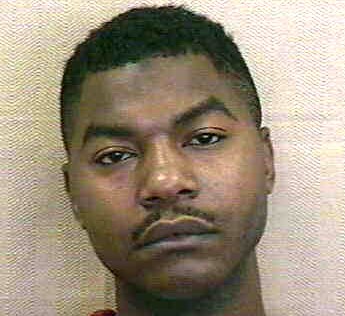
William Quentin Jones
Murderer Brian Kevin Rosenfeld
Murderer · USA · 1985
Brian Kevin Rosenfeld Brian Kevin Rosenfeld was sentenced to three concurrent l…
23 victims
Brian Kevin Rosenfeld
Murderer · USA · 1985
Brian Kevin Rosenfeld Brian Kevin Rosenfeld was sentenced to three concurrent l…
23 victims
 Yahweh ben Yahweh
Murderer · USA · 1980
Yahweh ben Yahweh was born and legally named Hulon Mitchell Jr. (October 27, 19…
23 victims
Yahweh ben Yahweh
Murderer · USA · 1980
Yahweh ben Yahweh was born and legally named Hulon Mitchell Jr. (October 27, 19…
23 victims
 Russell Ellwood
Murderer · USA · 1991
Russell Ellwood was a former taxi driver. Authorities suspected him of killing…
20 victims
Russell Ellwood
Murderer · USA · 1991
Russell Ellwood was a former taxi driver. Authorities suspected him of killing…
20 victims
 Elizabeth Ramsey
Murderer · USA · 2011
Elizabeth Ramsey was the 33-year-old stepmother of Johnathan Ramsey. Johnathan…
1 victim
Elizabeth Ramsey
Murderer · USA · 2011
Elizabeth Ramsey was the 33-year-old stepmother of Johnathan Ramsey. Johnathan…
1 victim
 Buck Ruxton
Murderer · United Kingdom · 1935
Buck Ruxton (21 March 1899, Bombay – 12 May 1936, Manchester) was also known as…
2 victims
Buck Ruxton
Murderer · United Kingdom · 1935
Buck Ruxton (21 March 1899, Bombay – 12 May 1936, Manchester) was also known as…
2 victims
 James Earl Reed
Murderer · USA · 1994
James Earl Reed was convicted of murdering Joseph Lafayette and Barbara Lafayet…
2 victims
James Earl Reed
Murderer · USA · 1994
James Earl Reed was convicted of murdering Joseph Lafayette and Barbara Lafayet…
2 victims
 John Hicks
Murderer · USA · 1985
John Hicks was executed by the state of Ohio on November 29, 2005, by lethal in…
2 victims
John Hicks
Murderer · USA · 1985
John Hicks was executed by the state of Ohio on November 29, 2005, by lethal in…
2 victims
 Volker Eckert
Serial killer · France/Spain/Germany · 1974
Volker Eckert (b. 1959) was a German truck driver and serial killer who confess…
19 victims
Volker Eckert
Serial killer · France/Spain/Germany · 1974
Volker Eckert (b. 1959) was a German truck driver and serial killer who confess…
19 victims
- Gender
- male
- Country
- USA
- Location
- Wake County, North Carolina, USA
- Date of birth
- August 29, 1968
- Age at first offence
- 19
- Characteristics
- robbery, drugs
- Victim profile
- Edward Peebles (male, 32)
- Method of murder
- Shooting (Uzi 9 mm pistol)
- Date(s) of murder
- March 7, 1987
- Years active
- 1987
- Date of arrest
- Same day
- Status
-
Executed
Executed by lethal injection in North Carolina on August 22, 2003
Case record: William Quentin Jones
Background
William Quentin Jones was convicted in connection with a robbery and shootings at a Raleigh convenience store on 7 March 1987.
Jones later was sentenced to death and remained on death row until his execution in North Carolina.
The offence
Shortly before midnight on 7 March 1987, several employees and customers were in a Raleigh Fast Fare convenience store.
Jones entered the store wearing a ski mask and fired an Uzi 9 mm pistol three to six times. Two bullets struck Orlando Watson, who, after surgery, survived the wounds he suffered.
Jones then said “this is a stickup,” turned, and twice shot Edward Peebles, 32, who was standing in the corner of the store. The bullets ruptured Peebles’ aorta and a large vein, causing massive hemorrhaging and ultimately death.
Jones directed Charles Taylor, the man behind the counter, to open the cash register. Jones threatened to kill Taylor. When Taylor was unable to open the register, Jones grabbed it and pulled it by the cord out the front door, around the fence, and to the side of the building.
A tape from a security camera showed that Jones fired six shots as he entered the convenience store. He fired before announcing that he was robbing the store and discharged a total of 10 bullets.
Police Officer Tony Wisniewski, who was patrolling the area, was summoned. Wisniewski entered the Fast Fare and radioed for assistance, transmitting a description of the gunman given to him by those in the store.
Within minutes several other officers arrived at the scene and secured the area. There were scratches and gouges along the sidewalk where Jones had dragged the cash register.
At a low wall, Sergeant Inman observed the silhouette of someone’s head, chambered a round in his shotgun and ordered the person to freeze. The figure fled, and the police gave chase, ultimately apprehending Jones at a ball park within several blocks of the Fast Fare.
The fleeing person was Jones. Pursuing officers testified that Jones was not appreciably mentally impaired when he was arrested.
At the crime scene, the police discovered shell casings and bullets fired from a semiautomatic weapon. A mounted video camera recorded much of the robbery and its tape was played several times at the sentencing hearing to illustrate testimony for the State and to cross-examine one of Jones’ witnesses.
During the events at the store, Jones took the cash register and left the convenience store.
Investigation
Investigators found a ski mask, a red N.C. State sweatshirt, the cash register, and an Uzi semiautomatic weapon near the low wall where Sgt. Inman had first observed Jones.
Subsequent analysis of the cash register revealed at least one of Jones’ fingerprints.
Arrest
Jones was apprehended at a ball park within several blocks of the Fast Fare after police pursuit following Sgt. Inman’s order to freeze.
Jones was arrested, taken to the police station, and interrogated. Over the next two days, he was questioned several more times by different officers and at different places.
Trial
Sentencing hearing and pleas
Jones was sentenced to death in Wake Superior Court for the murder of Ed Peebles.
He also received consecutive sentences of 40 years for robbery with a dangerous weapon and 20 years for assault with a deadly weapon with intent to kill inflicting serious injury.
Jones entered conditional pleas of guilty on charges of first-degree murder, robbery with a dangerous weapon, and assault with a deadly weapon with intent to kill inflicting serious injury. The conditional pleas preserved his right to appeal the trial court’s order denying his motion to suppress a confession.
The jury recommended a sentence of death for the murder conviction, and the trial court entered judgment accordingly, imposing consecutive prison terms of 40 years on the robbery conviction and 20 years on the assault conviction.
Evidence presented at the capital sentencing proceeding
At the capital sentencing proceeding, the State’s evidence tended to show the robbery and shootings described in the offence section, including that Jones fired an Uzi 9 mm pistol, killed Edward Peebles, and injured Orlando Watson.
The State’s rebuttal evidence also tended to show: On 20 February 1987, Jones and two others broke into the Triangle Jewelry and Pawn in Cary, and stole seven firearms, including an Uzi 9mm gun carrying up to twenty-two rounds of ammunition. The State’s evidence also indicated Jones continued to receive financial support from his mother, who was then living in Baltimore, and his father, who was living in Raleigh.
Defendant’s evidence
Jones’ evidence tended to show that Dr. Billie Corder, a clinical psychologist, examined and tested him three times.
Dr. Corder obtained information about Jones from his family and about the offences from police. She stated that Jones was not psychotic, but that his social functioning and his problem-solving ability were impaired, his emotional responses to the world were unstable, and that he could be characterized as a borderline personality with antisocial tendencies.
Dr. Corder stated that Jones’ full scale I.Q. was 92, and that he functioned much like an adolescent. She stated that Jones had no vocational skills and relied on others for financial support.
Dr. Corder learned that Jones’ father had been diagnosed as a paranoid schizophrenic and admitted to Dorothea Dix Hospital at least fifteen times since 1973. She also learned that Jones’ mother had a drug abuse problem since Jones was a child.
Dr. Corder learned that shortly before the crime Jones had been staying with his girlfriend and her mother. Dr. Corder stated that the girlfriend, who was carrying Jones’ child, broke up with him three days prior to the killing, and her mother made Jones move out of the home. Dr. Corder believed these events and other stressful occurrences exacerbated Jones’ personality disorder. She believed Jones showed remorse, shame, and guilt during interviews.
Dr. Corder stated that Jones’ ability to conform his conduct to the requirements of the law was impaired on 7 March 1987 because of his disorder exacerbated by stress.
On cross-examination, Dr. Corder admitted that at the time of the shootings Jones had the mental capacity to know the difference between right and wrong. She stated that Jones does not accept societal norms like law-abiding people.
Dr. Selwyn Rose, a psychiatrist, also testified. Dr. Rose interviewed Jones, reviewed a transcript of Jones’ confession, and viewed the videotape of the crime.
Dr. Rose believed Jones knew the difference between right and wrong and was able cognitively to know what he was doing at the time of the crimes. Dr. Rose believed Jones had the specific intent to commit a robbery and to kill “in the primitive sense of knowing that when you squeeze a trigger somebody is going to get hit.”
However, as far as “thinking about, planning or wanting to kill somebody,” Dr. Rose testified Jones was not capable of that type of intent at the time of the shootings.
Dr. Rose believed Jones had a “borderline personality disorder” with a fragile ego. He stated that Jones displayed mixed traits such as immaturity, impulsiveness, substance abuse, and passive aggressive characteristics, and that none of these traits were strong enough to become diagnoses.
Dr. Rose testified that Jones told him Jones had been using a substantial amount of drugs in the three days prior to the crimes and had been assaulted on the day of the robbery for the alleged disappearance of $200 worth of “reefer.”
Viewing the videotape during cross-examination, Dr. Rose testified that Jones’ stride and the manner in which he walked into the store could not be described as unusual.
Dr. Rose stated that Jones’ ability to conform his conduct to the requirements of the law was impaired at the time of the crimes.
Dr. Rose believed Jones’ use of a mask showed planning for the robbery, but that Jones did not plan the killing.
Some of Jones’ friends testified. They stated that in the evening before the robbery, Jones had snorted cocaine, smoked marijuana, and drunk beer. According to Toni Lannette Herring, Jones was “very high” and “hyper.” Ms. Emily May stated Jones was “jittery,” “nervous,” and “crying” that evening. Other friends testified in a similar manner.
Jones’ parents testified about his upbringing. In his early life, Jones was both the victim of and a witness to domestic violence. The testimony indicated both his parents had alcohol and drug abuse problems, and his father was a schizophrenic.
Appeals
State appeal (sentence vacated; resentencing ordered)
In State v. Jones, 396 S.E.2d 309 (N.C. 1990) (Direct Appeal), the Supreme Court held that:
- defendant’s confession was admissible, and
- requirement that jury find unanimously each mitigating circumstance before the circumstance could be considered in ultimate sentencing decision was reversible error.
The decision was “Affirmed in part, vacated in part and remanded.”
The case “arose from a robbery and shootings at a convenience store.” On charges of first degree murder, robbery with a dangerous weapon, and assault with a deadly weapon with intent to kill inflicting serious injury, Jones entered conditional pleas of guilty preserving his right to appeal the trial court’s order denying his motion to suppress a confession.
The Supreme Court held that the trial court properly denied Jones’ motion to suppress, found no error in the sentencing proceeding in the robbery and assault cases, and remanded the murder case for a new sentencing proceeding “in light of McKoy v. North Carolina, 494 U.S. 433, 110 S.Ct. 1227, 108 L.Ed.2d 369 (1990).”
State appeal (affirmance of resentencing)
In State v. Jones, 443 S.E.2d 48 (N.C. 1994) (Direct Appeal), Jones’ robbery and assault convictions and sentences were affirmed, and the case was remanded for a new sentencing hearing on capital murder conviction.
On remand, the Superior Court, Criminal Session, Wake County, Robert L. Farmer, J., imposed the death sentence, and Jones appealed.
The Supreme Court held that:
- the trial court erred in not allowing Jones to question prospective jurors as to their ability to follow court’s instruction, but the error was not prejudicial;
- voir dire was not unduly restricted;
- videotape showing murder was admissible;
- jurors were adequately questioned before being excused based on reservations about death penalty;
- submission of mitigating circumstance of no significant criminal history was not required;
- the jury was properly instructed on definition of mitigating circumstances and on application of those circumstances to decision-making process;
- different findings as to mitigating circumstances in sentencing hearings did not violate double jeopardy;
- prosecutor’s arguments to the jury were not improper; and
- the death penalty was not excessive or disproportionate.
The decision was “Affirmed.” Exum, C.J., filed a concurring opinion.
U.S. Supreme Court
The U.S. Supreme Court denied Jones’ petition for a writ of certiorari to review the decision of the U.S. Fourth Circuit Court of Appeals, which affirmed Jones’ conviction and death sentence after completion of initial state and federal post-conviction proceedings.
Outcome
The death sentence was imposed after resentencing and was affirmed on direct appeal in State v. Jones, 443 S.E.2d 48 (N.C. 1994) (Direct Appeal).
Sentencing details after resentencing
At the new sentencing hearing, the evidence showed that at approximately 11:45 p.m. on 7 March 1987, six people including Edward Peebles and Orlando Watson were in the convenience store. Edward Peebles was killed and Orlando Watson was wounded by the rifle fire. The defendant took the cash register and left the convenience store, and a video camera recorded what had happened.
The jury found two aggravating circumstances:
- that the murder was committed for pecuniary gain, and
- that it was part of a course of conduct which included the commission of other crimes of violence.
The jury found four mitigating circumstances.
The jury found that the aggravating circumstances outweighed the mitigating circumstances and recommended the defendant receive the death penalty, which was imposed.
Execution and last statements
Other details
Execution timing and witnesses
Jones was pronounced dead at 2:16 a.m. after receiving an injection at Central Prison in Raleigh.
A small gallery of reporters, Jones’ family, and the victim’s family watched through a thick glass window. Jones winked at his lawyer and his relatives when he was brought into the execution chamber.
Jones’ brother, Hollis Jones of Thomasville, watched, as did his uncle and lawyer. Also watching were Ed Peebles’ wife, daughter, two sisters and brother.
Stephen Dear, executive director of People of Faith Against the Death Penalty, spoke outside the prison. Marsha Early, assistant minister at North East Baptist Church in Durham, also spoke.
Outside the prison, a group of between 30 and 40 death penalty opponents held a candlelight vigil.
Jones’ last statements and final meal
During the 10 minutes he waited for the injection of lethal drugs, Jones looked repeatedly at members of Peebles’ family and said, “I’m sorry.”
Just before the drugs put him to sleep, Jones looked back at his uncle and lawyer and said “I’m gone.” He then said “I love you” several times to family.
Jones’ last statement was made in English and Arabic asking for mercy.
Jones’ final meal was tossed salad with shredded carrots and cheese, thousand island dressing and a soda.
Jones’ final words were: “I’m sorry. I’m gone. I love you”.
Clemency and gubernatorial actions
Pam Walker, a spokeswoman for the state Correction Department, said Jones had eaten his last meal by 5:30 p.m., while waiting for word on whether the U.S. Supreme Court or Gov. Mike Easley would stop his execution.
Gov. Mike Easley denied clemency about six hours before the scheduled execution after having reviewed the clemency petition and concluding that there were no compelling reasons to invalidate the sentence recommended by the jury and affirmed by the courts.
Jones’ attorneys argued that his death sentence should have been commuted because he was 18 years old at the time of the murder.
Peebles’ family told Easley that Jones deserved to die. Jackie Peebles, Ed Peebles’ 53-year-old sister, said: “My thoughts are people have choices. Everybody does. Now he has to suffer the consequences of his choices. My brother had no choice.”
Jones’ brother, Hollis Jones of Thomasville, said Jones visited his brother regularly in prison and that he was not the same person who was convicted in November 1987. Hollis Jones also said: “He is also concerned about the Peebles family, as well as his own. Killing Quentin will not bring justice to them ... it will just be another person deceased,”
Jones’ lawyers filed a motion with the state Supreme Court asking that the execution be halted and argued that the death sentence was disproportionate to the crime.
Gretchen Engel, a lawyer, said during a news conference: “The death sentence is simply the wrong punishment for this individual,” and “Quentin Jones is clearly not the worst of the worst, for whom the death penalty should be reserved.”
Engel also said Jones had no history of violence before he shot and killed Edward Peebles.
Execution date-setting
Correction Secretary Theodis Beck set August 22, 2003 as the execution date for William Quentin Jones.

Spotted an error, or have more information about this case?