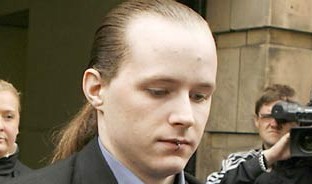
Luke Mitchell
Homicide Mick Philpott
Homicide · United Kingdom · 2012
Michael “Mick” Philpott was an Englishman who had gained notoriety as a crimina…
6 victims
Mick Philpott
Homicide · United Kingdom · 2012
Michael “Mick” Philpott was an Englishman who had gained notoriety as a crimina…
6 victims
 Dyson Allen
Homicide · United Kingdom · 2012
Dyson Allen was convicted for starting a fire in a wardrobe in the children’s b…
4 victims
Dyson Allen
Homicide · United Kingdom · 2012
Dyson Allen was convicted for starting a fire in a wardrobe in the children’s b…
4 victims
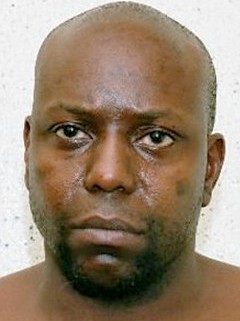 Peter Bryan
Homicide · United Kingdom · 1993
Peter Bryan was a schizophrenic cannibal who was sentenced to closed psychiatri…
3 victims
Peter Bryan
Homicide · United Kingdom · 1993
Peter Bryan was a schizophrenic cannibal who was sentenced to closed psychiatri…
3 victims
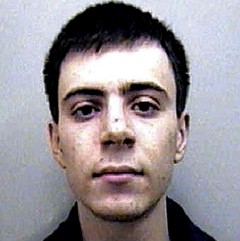 Gregory Davis
Homicide · United Kingdom · 2003
Gregory Davis was sentenced to closed psychiatric confinement in 2003. He serve…
2 victims
Gregory Davis
Homicide · United Kingdom · 2003
Gregory Davis was sentenced to closed psychiatric confinement in 2003. He serve…
2 victims
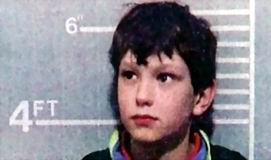 Jon Venables
Homicide · United Kingdom · 1993
Jon Venables was born 13 August 1982. He was a 10-year-old boy when he abducted…
1 victim
Jon Venables
Homicide · United Kingdom · 1993
Jon Venables was born 13 August 1982. He was a 10-year-old boy when he abducted…
1 victim
 Matthew Hardman
Homicide · United Kingdom · 2001
1998 — Matthew Hardman moved to Llanfairpwll, Anglesey, when he was 13; his fat…
1 victim
Matthew Hardman
Homicide · United Kingdom · 2001
1998 — Matthew Hardman moved to Llanfairpwll, Anglesey, when he was 13; his fat…
1 victim
 Michael Van McDougall
Murderer · USA · 1979
Michael Van McDougall was convicted of fatally stabbing a neighbor and was late…
1 victim
Michael Van McDougall
Murderer · USA · 1979
Michael Van McDougall was convicted of fatally stabbing a neighbor and was late…
1 victim
 Morris Solomon
Serial killer · USA · 1986
Morris Solomon was an Oak Park handyman and serial killer. He was convicted of…
7 victims
Morris Solomon
Serial killer · USA · 1986
Morris Solomon was an Oak Park handyman and serial killer. He was convicted of…
7 victims
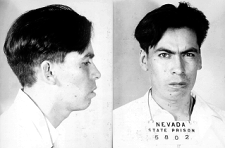 Gregorio Arellano
Murderer · USA · 1949
Gregorio Arellano was executed in the Nevada State Prison on July 24, 1951. He…
1 victim
Gregorio Arellano
Murderer · USA · 1949
Gregorio Arellano was executed in the Nevada State Prison on July 24, 1951. He…
1 victim
 Deidra Lane
Murderer · USA · 2000
Deidra Lane pleaded guilty to voluntary manslaughter in 2003 after her estrange…
1 victim
Deidra Lane
Murderer · USA · 2000
Deidra Lane pleaded guilty to voluntary manslaughter in 2003 after her estrange…
1 victim
- Gender
- male
- Country
- United Kingdom
- Location
- Dalkeith, Scotland, United Kingdom
- Date of birth
- J uly 24, 1988
- Age at first offence
- 15
- Characteristics
- juvenile (14), rape?, paedophile, murder-suicide, history of mental illness, drugs, fugitive
- Victim profile
- His girlfriend, Jodi Jones, 14
- Method of murder
- St abbing with knife
- Date(s) of murder
- June 30, 2003
- Years active
- 2003
- Date of arrest
- April 14, 2004
- Status
-
Life imprisonment
Sentenced to life in prison (minimum 20 years) on February 11, 2005; appeal against conviction refused on 16 May 2008
Case information
Luke Muir Mitchell (born July 24th 1988) was a Scottish teenager convicted of murdering his girlfriend, Jodi Jones. Jodi Jones was 14 years of age at the time of her death, and Mitchell was a few weeks short of his 15th birthday at the time of the murder. At the time of his conviction, he was aged 16.
Timeline
- 30 June 2003 — Jodi Jones was murdered in woodland near Dalkeith, Midlothian.
- 2 July 2003 — Detective Constable Michelle Lindsay visited the Mitchell family and spoke to the appellant; she was present when a news item on television was shown.
- 4 July 2003 — Mitchell’s home was searched at 203 Newbattle Abbey Crescent; bottles containing urine were found in his bedroom.
- 11 November 2004 — Trial first called; unempanelled jurors were directed it would be inappropriate for them to serve if they knew any party or had personal connections with the circumstances.
- 16 November 2004 — A juror was found to have a connection through the appellant’s then girlfriend; the trial was deserted pro loco et tempore.
- 18 November 2004 — New jurors were admonished before being empanelled; the trial then took place over 42 days.
- 21 January 2005 — The jury found Mitchell guilty after 5 hours of deliberation.
- 11 February 2005 — Mitchell was sentenced to detention without limit of time, with a punishment part of 20 years specified; Nimmo Smith told him he would spend a minimum of 20 years in prison before being considered for parole.
- 14 August 2003 — Police interviewed Mitchell under caution.
- March 2006 — Mitchell was granted leave to appeal against his conviction and the length of his sentence.
- November 2006 — Mitchell won the right to appeal against his conviction for murder.
- February 2008 — The Court of Criminal Appeal heard Mitchell’s appeal.
- 16 May 2008 — The appeal against conviction was refused; the opinion was delivered and the court rejected his grounds of appeal.
- May 2007 — A BBC Scotland “Frontline Scotland” documentary special was broadcast about the case on BBC One.
- July 25th — Mitchell’s mother Corinne appeared on Talk 107 radio protesting her son’s innocence.
- January 2008 — The appeal was stated as taking place in January 2008.
- May 2008 — The original conviction was upheld.
The offence
On 30 June 2003, Jodi Jones, then aged 14, was murdered in woodland near Dalkeith. Her body was found along a path through woods, and prosecutors later described her injuries in court as a “savage knife attack.” Her injuries included cuts to the throat, the right cheek, the left breast, numerous cuts to the stomach, and cuts round both eyes. Some injuries appeared to have been inflicted post-mortem. The cut to the neck severed the windpipe and jugular vein, as well as the carotid artery on the left side, causing death within a couple of minutes. Defensive injuries suggested that she had struggled with her assailant. There was no evidence of recent sexual abuse.
Background and relationships
Mitchell and Jodi Jones attended St David’s High School in Dalkeith. They began their relationship in around March 2003. From an early stage the relationship involved sexual intercourse. By June 2003 they were seeing each other most week nights and at the weekend.
Jodi Jones lived in the Easthouses area of Dalkeith with her mother, Judith Jones, her sister, Janine Jones, and her mother’s partner, Alan Ovens. There was evidence that she took cannabis, but her family generally regarded her as sensible and reliable. She had an interest in music, particularly the rock band Nirvana, and she liked to wear dark baggy clothing.
Mitchell lived with his mother, Corinne Mitchell, and his brother, Shane Mitchell, in the Newbattle area to the west of Easthouses. He had similar taste in music and clothing and regularly used cannabis. There was evidence that Mitchell was also sexually involved with another 15 year old girl, Kimberley Thomson.
Investigation
Discovery of the body and search
After Jodi Jones failed to return home, a search party was formed. At 2300 on the night of the murder, the search party consisted of Jodi Jones’s grandmother, Alice Walker, Janine Jones, and Janine’s boyfriend, Steven Kelly. The search party left the deceased’s house and began walking along the path from the Easthouses end heading west. Mitchell, accompanied by his dog, walked from the west end of the path heading in the opposite direction. He met the rest of the search party near the east end of the path, and thereafter all members of the party headed west along the path. Mitchell went through a distinctive “V”-shaped hole in one part of the wall to find the body, claiming a family dog alerted him to something suspicious. This was challenged by members of the search team, who originally stated the dog scrabbled at the wall and “suddenly pull[ed] Luke over to the wall.” The prosecution stated that only the killer could have known the exact location of Jodi’s body.
The body was found in the wooded area behind the wall bordering the path, about 13.6 metres west of the “V” point. Access to the wooded area was gained via the “V” point. Foliage, overhanging branches, and a tree stump obscured views westwards from parts of the wall. Only from beyond the stump could one see the feet of the deceased; the head lay closer to the wall than the feet.
Jodi’s body was found naked apart from socks on the front part of her feet. Other items of clothing were strewn around the area. Her trousers had been used to tie her hands behind her back. There was no sign of a struggle except in the area around the body.
Key parts of the prosecution case
“Guilty knowledge” from body discovery
The prosecution relied on “guilty knowledge,” arguing that Mitchell’s ability to find the body quickly despite poor conditions showed he already knew where it was. Mitchell’s account was that after passing the “V” point he was alerted by his dog to something behind the wall, then he retraced his steps to the “V” point and climbed through to find the body.
Break in the wall and mock-up
To allow the jury to explore the plausibility of these claims, a mock-up wall was erected in the Laigh Hall, below Parliament Hall within Parliament House, across the road from the High Court of Justiciary in Edinburgh’s Old Town.
Undermining the alibi through Shane Mitchell
The Crown’s “broken alibi” argument relied on evidence from Shane Mitchell. Under cross-examination, Shane Mitchell revealed he was viewing internet porn in the house at the time the murder was said to have occurred and agreed he would only have done this if he thought the house to be empty.
Evidence concerning clothing, smell, and objects
There was evidence that Mitchell’s clothes may have have been destroyed in a garden incinerator and neighbours noted a strange smell coming from the garden. A neighbour described the smell as “wood smoke.” No forensic evidence was recovered from the incinerator, described as an 11" diameter log burner.
A knife pouch was found in Mitchell’s possession with inscriptions: “JJ 1989 - 2003” and “The finest day I ever had was when tomorrow never came.”
Arrest and charges
Mitchell was arrested and charged with the murder. He also faced a separate charge of supplying cannabis. A trial judge later dismissed a murder trial-related attempt to proceed outwith the Edinburgh area. A motion to separate the murder trial from other charges was refused at an earlier stage.
Mitchell lodged special defences of alibi and incrimination. The alibi defence was that he was not on the Roan’s Dyke Path between the hours of 1700 and 1745, being at his home and other points around the Newbattle Abbey Road area. The special defence of incrimination stated the deceased was murdered by “person or persons whose identity is or identities are to the panel unknown”.
Trial
Court and pleas
Mitchell was tried at the High Court of Justiciary at Edinburgh. He pleaded not guilty and advanced an alibi.
The trial ran for 42 days, being described as the longest trial of a single accused in Scottish legal history.
Trial jury management
During the aborted trial diet, a juror was discharged after it was discovered the juror had a connection with an individual connected to Mitchell. The trial judge gave clear instructions to the jury before and during the trial, including telling them it was inappropriate for jurors who knew Jodi Jones, knew Luke Mitchell, or had connections with the area where she lived and where she was allegedly murdered to serve. Connections with St David’s Roman Catholic High School in Dalkeith were also covered.
As finally composed, the jury comprised ten jurors living in Edinburgh and one each from Whitburn, Livingston, South Queensferry, Ratho and Penicuik. No objection was taken to those jurors on the ground of their addresses.
Evidence presented at trial (overview)
The Crown’s case was based on circumstantial evidence and relied on three “key” chapters:
- The discovery of the deceased’s body (Mitchell first went through the “V” point and quickly found the body).
- The evidence of Andrina Bryson, who saw a male and a female near the Easthouses end of the Roan’s Dyke Path around 1650–55 on 30 June 2003 and identified the male as Mitchell from photographs.
- The evidence of Shane Mitchell, Mitchell’s brother, undermining Mitchell’s alibi by testifying about his own presence in the house and internet viewing.
Other circumstances relied on included:
- The testimony of Lorraine Fleming and Rosemary Walsh about seeing Mitchell at around 1740–1745 at a gate between the west end of the path and Mitchell’s house.
- Evidence about a parka-style jacket owned and worn by Mitchell, allegedly missing after the murder.
- Evidence about a log burner being used on 30 June at around 1830–1930 and later at around 2200, with neighbours describing an unusual smell.
- Evidence about Mitchell’s interest in knives, including a 4 inch lock-knife in a pouch (“skunting” knife) that was not found in an initial police search, and the later purchase of another knife and pouch by his mother in December 2003.
- Evidence about inscriptions on the knife pouch and items found later.
- Evidence about Mitchell purchasing and viewing a Marilyn Manson DVD.
- Evidence about Mitchell’s interest in Satanism, expressed in essays and graffiti on schoolbooks.
- The prosecution argument that Mitchell made a comment to David High that the deceased “would not be coming out on that evening.”
- Evidence concerning Mitchell’s mother, Corinne Mitchell, including evidence about the tattoo obtained in October 2003 and the Crown’s challenge to her credibility.
Defence evidence and statements
Mitchell did not give evidence. His position was outlined in statements to police officers. He maintained that he was at home during the period when the Crown case suggested the murder occurred. He saw the deceased at lunchtime on the day of the murder, said she took the school bus home after school, and said he walked back. He denied seeing her alive after a particular point. He said he returned home around 1600 or 1605, that she texted him at about 1620, and that he replied he would come out later to make dinner. He said arrangements were made for her to come down to the Newbattle area but no time was fixed. He said the last text was at about 1640. He said that after that he listened to music while cooking dinner, that his mother arrived at 1715, and that Shane Mitchell was not in the house then.
Mitchell said he waited for the deceased, left at around 1730 or 1740 because she had not arrived, and waited at the entrance to the estate on Newbattle Road, moving between that point and a track at Barndale Cottages closer to the west end of the path. He said he saw boys from school as he stood there and waited about 45 minutes. He said he then walked into Newbattle Abbey and later contacted David High to meet him. He said he spoke to Alan Ovens about 25 minutes after waiting outside and was told she had left to meet him. He said David High appeared about 25 minutes after Mitchell phoned him. He said he arrived home between 2105 and 2110 and watched a video until he received a text at 2241 from the deceased’s mother.
Mitchell’s description of body discovery was that his dog, trained as a tracker, went straight to the wall at the “V” point and started clawing it, after which he doubled back to the “V” point, handed the dog to Mrs Walker, and climbed through. He said he looked left, walked about six paces, and saw the deceased’s legs and then her body. He said the dog started to climb up on the wall at a point parallel to where the body was found. He also gave information to Detective Constable Michelle Lindsay and provided a sketch plan indicating where the deceased might have gone and where the body was found.
Verdict
On 21 January 2005, the jury found Mitchell guilty after 5 hours of deliberation. The court found him guilty after the 42-day trial.
Mitchell was convicted of murder and found guilty of supplying cannabis.
Sentencing
On 11 February 2005, sentencing took place. Nimmo Smith told Mitchell he would spend a minimum of 20 years in prison before being considered for parole. The court sentenced him to detention without limit of time with a punishment part of 20 years specified.
Appeals
Leave to appeal and additional grounds
In March 2006, Mitchell was granted leave to appeal against his conviction and the length of his sentence at the High Court of Justiciary sitting as the Court of Criminal Appeal in Edinburgh on the grounds of the trial judge’s refusal to hear the original case outside the city.
In November 2006, Mitchell won the right to appeal against his conviction for murder. The judges said only one ground would be allowed, relating to the trial judge’s refusal to move Mitchell’s case out of Edinburgh following publicity.
The Court of Criminal Appeal heard Mitchell’s appeal in February 2008, and in May 2008 his original conviction was upheld.
Opinion delivered 16 May 2008
On 16 May 2008, the appeal against conviction was refused. The opinion was delivered by the Lord Justice General, Lord Hamilton, sitting with Lord Osborne and Lord Kingarth.
The court rejected the grounds including:
- The challenge to the decision not to hear the trial outwith Edinburgh area.
- A sufficiency/unreasonable verdict challenge, including discussion of Andrina Bryson’s identification evidence and whether it could support the verdict.
- Challenges about admitting evidence, including evidence relating to bottles containing urine in the bedroom.
- Challenges about admission of portions of a tape recorded police interview on 14 August 2003.
- Challenges about the admission of evidence from family liaison officer Detective Constable Michelle Lindsay.
- Challenges about admitting evidence relating to Mitchell’s tattoo and testimony from Corinne Mitchell.
The court stated that police questioning of Mitchell on 14 August 2003 was “outrageous” and “to be deplored,” while still rejecting the argument that the trial judge was bound to exclude the answers led into evidence.
The court also rejected arguments that unfairness in identification evidence amounted to a miscarriage of justice.
Aftermath and media
A BBC Scotland “Frontline Scotland” documentary special was broadcast in May 2007 about the case on BBC One.
The documentary explored a theory that the murder might have been committed by “a student and heavy drug user” who was alleged to have handed in an essay about killing a girl in the woods a few weeks before the murder, and that a friend saw him soon after the murder and said he was heavily scratched about the face. The documentary also covered misconceptions about Mitchell’s supposed interest in Marilyn Manson and The Black Dahlia case, and it discussed the factual basis for what was found in Mitchell’s room, including a Marilyn Manson CD and a ripped up calendar. It stated that after searching Mitchell’s computer, no links were found to The Black Dahlia or the paintings done by Manson of the murder. The documentary also discussed allegations about satanic scribblings on Mitchell’s school books and influence from computer game monologues from Max Payne.
Other details
Individuals involved
Jodi Jones’s family included:
- Judith Jones (mother)
- Janine Jones (sister)
- Alice Walker (grandmother)
- Alan Ovens (mother’s partner)
- Stephen Kelly (19, Janine’s boyfriend)
Additional witnesses named in the appeal opinion included:
- Leonard Kelly (cycling along the path and hearing “a strangling sort of sound, a human thing”)
- John Ferris (moped along the path)
- Gordon Dickie (moped along the path)
- Lorraine Fleming (gate sighting)
- Rosemary Walsh (gate sighting)
- Andrina Bryson (path sighting and identification from photographs)
- David High (meeting arrangements and testimony)
- Mahasweta Roy (forensic scientist regarding bottles found in bedroom)
- Detective Constable Michelle Lindsay (family liaison officer)
- Professor Anthony Busuttil (pathologist)
- Detective Constable George Thomson (police interview officer)
- Detective Constable Russell Tennant (police interview officer)
- Detective Sergeant David Gordon (police interview officer)
- PC Anita Dow (evidence of urine bottles on 14 April 2004)
- Detective Superintendent Dobbie (instructions regarding suspicion and caution)
- Detective Inspector Thomas Martin (force co-ordinator/spokesperson in relation to family liaison officers)
- Corinne Mitchell (Mitchell’s mother)
Mitchell’s brother and defence witness:
- Shane Mitchell
Admission and evidence details quoted in the opinion
“We have come, with some hesitation, to the view that this ground is arguable.”
“There is an argument that the trial judge failed adequately to take into account the circumstances that the publicity might have had an impact of particular strength not only in the immediate locality of the crime but in a somewhat wider area embracing the city of Edinburgh and other towns in the Lothians,” he said.
“truly wicked”
Police interview description and court criticism
“outrageous”
“to be deplored.”
Example of questioning described as outrageous (verbatim)
“You say you recognise it as Jodi and you say you can see that it had throat and you said you could see it was completely naked. Now what's nonsense cause you've just watched that and you cannae tell that, you say you can see you barely see something there. What you've said you're a liar, you're a liar. Everything you've been constantly lying to us all the way through this interview. You've lied to us about using cannabis - you use cannabis all the time, we've had loads of people tell us you use cannabis three times as much as anybody else would. You buy. We know who you buy the cannabis from, do you think we've no done an enquiry blah blah blah blah blah. We know who you bought the cannabis from, we know the amounts he sells it to you, we know the people that you sell it to a day after, we know that. You've lied about that, you've lied about all these knives, you say well I dinnae have these knives there's, as I say, 45 people telling us you had knives, you, are they all lying as well? These, the three people down the path, Alice, Steven and Janine, are they lying as well? That video reconstruction there shows that you could not have seen Jodi and recognise it as Jodi.”
Spotted an error, or have more information about this case?