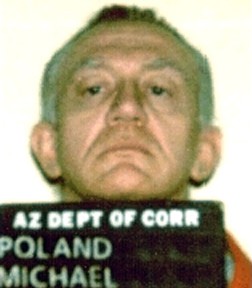
Michael Poland
Murderer Ervil LeBaron
Murderer · USA · 1972
Ervil Morrell LeBaron (1925 to August 16, 1981) was the leader of a polygamous…
35 victims
Ervil LeBaron
Murderer · USA · 1972
Ervil Morrell LeBaron (1925 to August 16, 1981) was the leader of a polygamous…
35 victims
 Brian Kevin Rosenfeld
Murderer · USA · 1985
Brian Kevin Rosenfeld Brian Kevin Rosenfeld was sentenced to three concurrent l…
23 victims
Brian Kevin Rosenfeld
Murderer · USA · 1985
Brian Kevin Rosenfeld Brian Kevin Rosenfeld was sentenced to three concurrent l…
23 victims
 Marvin Gray
Murderer · USA · 1975
Marvin Gray was convicted killer who claimed responsibility for 23 slayings and…
23 victims
Marvin Gray
Murderer · USA · 1975
Marvin Gray was convicted killer who claimed responsibility for 23 slayings and…
23 victims
 Yahweh ben Yahweh
Murderer · USA · 1980
Yahweh ben Yahweh was born and legally named Hulon Mitchell Jr. (October 27, 19…
23 victims
Yahweh ben Yahweh
Murderer · USA · 1980
Yahweh ben Yahweh was born and legally named Hulon Mitchell Jr. (October 27, 19…
23 victims
 Clifton Charles Russell
Murderer · USA · 1979
Clifton Charles Russell was sentenced to death in April 1980 for the murder of…
1 victim
Clifton Charles Russell
Murderer · USA · 1979
Clifton Charles Russell was sentenced to death in April 1980 for the murder of…
1 victim
 Derrick Mason
Murderer · USA · 1994
Derrick O'Neal Mason was an inmate identified as Derrick O'neal Mason (gender:…
1 victim
Derrick Mason
Murderer · USA · 1994
Derrick O'Neal Mason was an inmate identified as Derrick O'neal Mason (gender:…
1 victim
 Vladislav Volkovich
Serial killer · Ukraine · 1991
The Nighttime Killers (Ночной Серийник) were responsible for a string of brutal…
16 victims
Vladislav Volkovich
Serial killer · Ukraine · 1991
The Nighttime Killers (Ночной Серийник) were responsible for a string of brutal…
16 victims
 Terry Clark
Murderer · USA · 1986
Terry Doug Clark (May 17, 1956 – November 6, 2001) was executed by the State of…
1 victim
Terry Clark
Murderer · USA · 1986
Terry Doug Clark (May 17, 1956 – November 6, 2001) was executed by the State of…
1 victim
 Edward Schad
Murderer · USA · 1978
Edward Schad was tried for the killing of Lorimer “Leroy” Graves, a 74-year-old…
1 victim
Edward Schad
Murderer · USA · 1978
Edward Schad was tried for the killing of Lorimer “Leroy” Graves, a 74-year-old…
1 victim
 Charles Harrelson
Murderer · USA · 1968
Charles Voyde Harrelson (born July 23, 1938 – March 15, 2007) was an American f…
2 victims
Charles Harrelson
Murderer · USA · 1968
Charles Voyde Harrelson (born July 23, 1938 – March 15, 2007) was an American f…
2 victims
- Gender
- male
- Country
- USA
- Location
- Mohave County, Arizona, USA
- Date of birth
- J une 11, 1940
- Age at first offence
- 37
- Characteristics
- armed robbery, kidnapping
- Victim profile
- Russell Dempsey and Cecil Newkirk ( armored car drivers )
- Method of murder
- Drowning
- Date(s) of murder
- May 24, 1977
- Years active
- 1977
- Date of arrest
- May 1978
- Status
-
Executed
Executed by lethal injection in Arizona on June 16, 1999
Case overview
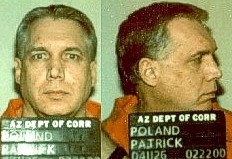
Michael Poland was executed by lethal injection in Arizona on June 16, 1999. He had been sentenced to death in connection with the robbery, kidnapping, and murder of two Purolator guards, Russell Dempsey and Cecil Newkirk.
Timeline
- May 24, 1977 — Two Purolator guards, Russell Dempsey and Cecil Newkirk, left Phoenix in an armored van to make cash deliveries to banks in Prescott, Sedona and Flagstaff; at the Bumblebee Road exit on Interstate-17, they were stopped by the Polands, who were disguised as highway patrolmen and drove a car fitted with emergency lights; the Polands took the guards captive and removed close to $300,000 in cash.
- May 25, 1977 — Authorities found the abandoned Purolator van.
- May 25, 1977 (morning) — Michael rented a boat at the Lake Mead marina, piloted the boat to a seldom-used landing, met his brother, put the guards into canvas bags, took them across the lake, and dumped them into the water.
- About 3 weeks later — The bodies surfaced in a cove on the Nevada side of the lake.
- October 23, 1979 — Trial start of the first trial.
- November 24, 1979 — Convicted in the first trial.
- April 9, 1980 — Sentenced to death in the first trial.
- October 18, 1982 — Trial start of the second trial.
- November 18, 1982 — Convicted in the second trial.
- February 3, 1983 — Sentenced to death in the second trial.
- Feb. 24, 1986 — Argued in the Supreme Court of the United States.
- May 5, 1986 — Decided in the Supreme Court of the United States.
- June 16, 1999 — Executed by lethal injection in Arizona.
The offence
On May 24, 1977, Russell Dempsey and Cecil Newkirk left Phoenix in an armored van on their run to banks in Prescott, Sedona and Flagstaff. At the Bumblebee Road exit on Interstate-17, they were stopped by the Polands, who were disguised as highway patrolmen and were driving a car fitted with emergency lights. The Polands took the guards captive and removed close to $300,000 in cash.
The Polands drove the guards about 250 miles from the robbery site to Lake Mead. They wrapped the guards in custom-made canvas bags weighted with rocks and dumped them into the water. The bodies surfaced about three weeks later in a cove on the Nevada side of the lake, which forms a portion of the Nevada-Arizona border.
Autopsies indicated that the most probable cause of death was drowning, although one may have died of a heart attack. It was not possible to determine if the guards were drugged, but there was no evidence of a struggle. Police found the Polands on a spending spree back in their hometown of Prescott after checking the registration of a truck that had been pulled from the sand by a tow truck near the site of the guards' deaths.
Investigation and arrest
Authorities found the abandoned Purolator van on May 25, 1977. The Polands were arrested nearly a year after Russell Dempsey and Cecil Newkirk disappeared. The Polands were found on a spending spree back in their hometown of Prescott after police checked the registration of a truck that had been pulled from the sand by a tow truck near the site of the guards' deaths.
Trial
Michael Poland and his younger brother, Patrick Poland, were tried for first-degree murder.
The jury disbelieved their alibi defense and convicted them of first-degree murder. Trial start dates were October 23, 1979 (first trial) and October 18, 1982 (second trial). Conviction dates were November 24, 1979 (first trial) and November 18, 1982 (second trial).
The jury's verdict was later described as tainted by a jury-room discussion of evidence not admitted at trial, which necessitated reversal and retrial.
Sentencing
After conviction, the trial judge sat as sentencer in a separate proceeding.
First sentencing proceeding
At the first sentencing hearing, the prosecution relied on evidence presented at trial and argued that two statutory aggravating circumstances were present: (1) that the defendants committed the offense for the receipt or expectation of pecuniary value under former Ariz. Rev. Stat. Ann. § 13-454(E)(5) (Supp. 1973); and (2) that the defendants committed the offense in an especially heinous, cruel, or depraved manner under former Ariz. Rev. Stat. Ann. § 13-454(E)(6) (Supp. 1973).
The trial judge made the following finding on the “pecuniary gain” aggravating circumstance:
"The court finds the aggravating circumstance in § 13-454E(3) [sic] is not present. This presumes the legislative intent was to cover a contract killing. If this presumption is inaccurate, the evidence shows the defendants received something of pecuniary value, cash in the amount of $281,000.00. "
"This, then, would be an aggravating circumstance."
The judge found that the “especially heinous, cruel, [or] depraved” aggravating circumstance was present, stating that the murders were:
"shockingly evil, insensate, and marked by debasement."
Finding that the aggravating circumstance outweighed the mitigating evidence, the trial judge sentenced petitioners to death on April 9, 1980.
Events on appeal affecting first sentencing
On appeal, the Arizona Supreme Court agreed that the jury's verdict was tainted and required reversal and retrial. It also held that the evidence on which the State relied at the first sentencing hearing was insufficient to support a finding of the “especially heinous, cruel, or depraved” aggravating circumstance. It further held that the trial court “mistook the law” when it did not find the pecuniary value aggravating circumstance was applicable and stated that on retrial, if the defendants were again convicted of first degree murder, “the court may find the existence of this aggravating circumstance.”
Second sentencing proceeding
On remand, Michael Poland and Patrick Poland were again convicted of first-degree murder. At the second sentencing hearing, the prosecution relied on evidence presented at the second trial and presented additional evidence, arguing that both the “pecuniary gain” and “especially heinous, cruel, or depraved” aggravating factors were present in each petitioner’s case.
The prosecution also alleged a third aggravating circumstance in Patrick Poland’s case: a previous conviction of “a felony . . . involving the use or threat of violence on another person” under Ariz. Rev. Stat. Ann. § 13-454(E)(2) (Supp. 1973).
The trial judge found all aggravating circumstances alleged by the prosecution and again sentenced both petitioners to death. Michael Poland’s second death sentence was imposed on February 3, 1983.
Appeals
Michael Poland’s death sentence and related issues were litigated up to the Supreme Court of the United States.
Supreme Court case citation and issues
The Supreme Court of the United States case included Michael Kent Poland and Patrick Gene Poland as petitioners:
- Poland v. Arizona, 476 U.S. 147 (1986)
The Supreme Court record included:
- Nos. 85-5023, 85-5024
- Argued Feb. 24, 1986
- Decided May 5, 1986
The Supreme Court described that petitioners robbed a bank van of $281,000 in cash and killed the guards by dumping them into a lake in sacks weighted with rocks. Petitioners were convicted of first-degree murder in an Arizona state court, with a separate hearing in which the trial judge found two aggravating circumstances at the first sentencing hearing, sentencing them to death.
The Supreme Court held:
- “The judgment of the Supreme Court of Arizona is Affirmed.”
It also held on the Double Jeopardy Clause question that reimposing the death penalty did not violate the Double Jeopardy Clause.
Published opinions listed for Michael Poland
Published opinions included:
- United States v. Poland, 659 F.2d 884 (9th Cit. 1981)
- State v. Poland (Michael), 132 Ariz. 269, 645 P.2d 784 (1982)
- State v. Poland (Michael), 144 Ariz. 412, 698 P.2d 207 (1985)
- Poland v. Arizona, 476 U.S. 147, 106 S. Ct. 1749, 90 L. Ed. 2d 123 (1986)
- Poland v. Stewart, 117 F.3d 1094 (9th Cit. 1997)
Other sentencing and conviction details mentioned
The Polands were convicted in federal court on robbery and kidnapping charges, and in state court on the murder charges. The Polands were sentenced to 100 years in prison on federal kidnapping and robbery charges in 1979. They were convicted of first-degree murder twice, in 1979 and in 1982. Their first convictions were overturned on appeal.
The Supreme Court decision’s summary included that the Arizona Supreme Court held evidence was insufficient to support the “especially heinous” circumstance, but sufficient to support the “pecuniary gain” circumstance after remand. It also stated the court rejected the argument that the Double Jeopardy Clause barred reimposition of the death penalty.
The Supreme Court opinion included references to procedural posture and precedent, including:
- Bullington v. Missouri
- Arizona v. Rumsey
- Burks v. United States
- North Carolina v. Pearce
- United States v. Scott
- Green v. United States
A dissenting opinion by Justice MARSHALL stated:
“I dissent.”
Last meal and execution details
Last meal
Michael Poland’s last meal was:
- Three Fried eggs, sunny side up
- Four slices of bacon
- Order of hash browns
- Two slices of whole wheat toast, with two pats of real butter
- Two individual serving size boxes of Raisin Bran cereal
- Two cartons of milk
- Two cups of Tasters Choice coffee
Execution and statements
Michael Poland was executed by injection Wednesday. He raised his head several times to look at the window into the witness chamber as his death warrant was being read. When asked if he had any last words, Michael Poland said he was hungry and said:
“I'd like to know if you're going to bring me lunch afterward,"
"I'm really hungry. I can't think of anything else."
Michael Poland mouthed the words, “I love you,” to two of his sons and a daughter-in-law who witnessed the execution.
Michael’s chest heaved several times as the lethal dose of medications began flowing at 3:12 p.m. He puffed out his cheeks twice before being declared dead at 3:14 p.m.
Mental competence litigation
Michael Poland’s lawyers unsuccessfully tried to convince courts that he did not understand he was going to die and was therefore mentally incompetent to be executed. The lawyers claimed that three psychiatrists diagnosed him as delusional, and Michael believed he had the power to influence people and to stop his execution by a force of his will.
A claim that the stress of living on death row rendered Michael mentally incompetent stayed his execution for a short time. A Pinal County judge ruled that Michael Poland was aware he was being executed and why, meeting the legal standard for mental competence. The ruling was upheld on appeal.
Victims and impact statements
Two victims were named: Purolator guards Russell Dempsey and Cecil Newkirk.
Both guards’ widows wrote to the clemency board, which rejected Michael Poland’s plea for a commutation or reprieve on Tuesday, requesting that the Polands should not be spared. Lola Newkirk wrote:
"They planned and executed the death of 2 very precious human beings. They deprived them of a full life and also cheated me of many happy years with my husband I still love so very much,"
Lola Newkirk witnessed the execution with 16 other relatives of the victims. Dempsey's widow, Jane, did not attend.
Other details
Michael Poland was described as 59 years old. His legal team included attorney Dale Baich, who said Michael believed he had the power to influence people and to stop his execution by a force of his will.
The execution was described as occurring more than two decades after he and his brother posed as highway patrolmen, robbed an armored car, and killed its two guards. The execution was described as the 6th person executed in Arizona that year, with a record; the largest previous 1-year total was 5 executions in 1943.
Patrick Poland could be executed as early as this year but no date has been set.
Spotted an error, or have more information about this case?