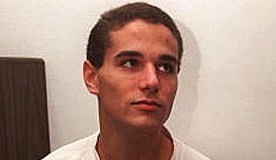
Samuel Sheinbein
Homicide Jack Kevorkian
Homicide · USA · 1990
Jack Kevorkian (born May 26, 1928) was a controversial American pathologist. He…
130 victims
Jack Kevorkian
Homicide · USA · 1990
Jack Kevorkian (born May 26, 1928) was a controversial American pathologist. He…
130 victims
 David Koresh
Homicide · USA · 1993
David Koresh (born Vernon Wayne Howell; August 17, 1959 – April 19, 1993) led t…
79 victims
David Koresh
Homicide · USA · 1993
David Koresh (born Vernon Wayne Howell; August 17, 1959 – April 19, 1993) led t…
79 victims
 Todd Hall
Homicide · USA · 1996
Todd Hall was described by neighbors as "mentally slow" and was said to have su…
9 victims
Todd Hall
Homicide · USA · 1996
Todd Hall was described by neighbors as "mentally slow" and was said to have su…
9 victims
 Clinton Bankston
Homicide · USA · 1987
15 August 1987 — Ann Morris (63), her sister Sally Nicholson (59), and Sally’s…
5 victims
Clinton Bankston
Homicide · USA · 1987
15 August 1987 — Ann Morris (63), her sister Sally Nicholson (59), and Sally’s…
5 victims
 Joshua Jenkins
Homicide · USA · 1996
Joshua Jenkins was a 15-year-old American killer who killed five members of his…
5 victims
Joshua Jenkins
Homicide · USA · 1996
Joshua Jenkins was a 15-year-old American killer who killed five members of his…
5 victims
 Tivasha Logan
Murderer · USA · 2009
Tivasha Logan was sentenced to life in prison without parole on July 11, 2012 a…
1 victim
Tivasha Logan
Murderer · USA · 2009
Tivasha Logan was sentenced to life in prison without parole on July 11, 2012 a…
1 victim
 Gerard Schaefer
Serial killer · USA · 1969
Gerard John Schaefer was born in Wisconsin on March 25, 1946. He was the oldest…
9 victims
Gerard Schaefer
Serial killer · USA · 1969
Gerard John Schaefer was born in Wisconsin on March 25, 1946. He was the oldest…
9 victims
 Parveen Bibi
Murderer · Pakistan · 2016
Parveen Bibi was convicted of murdering Zeenat Rafiq by burning her to death in…
1 victim
Parveen Bibi
Murderer · Pakistan · 2016
Parveen Bibi was convicted of murdering Zeenat Rafiq by burning her to death in…
1 victim
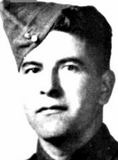 August Sangret
Murderer · United Kingdom · 1942
August Sangret was a French-Canadian soldier of First Nations birth who was con…
1 victim
August Sangret
Murderer · United Kingdom · 1942
August Sangret was a French-Canadian soldier of First Nations birth who was con…
1 victim
- Gender
- male
- Country
- USA
- Location
- Montgomery County, Maryland, USA
- Date of birth
- 1980
- Age at first offence
- 17
- Characteristics
- dismemberment
- Victim profile
- Alfredo Enrique Tello Jr., 19
- Method of murder
- Beating with the butt of a sawed off shotgun
- Date(s) of murder
- September 16, 1997
- Years active
- 1997
- Date of arrest
- 12 days after (in Israel)
- Status
-
Imprisoned
Sentenced to 24 years in prison in Israel on October 24, 1999
Case details
Samuel Sheinbein was a Jewish-American teenager who killed an acquaintance, Alfredo Enrique Tello Jr., and then dismembered and attempted to cremate his body in Aspen Hill, Maryland.
The case involved Samuel Sheinbein and his former classmate at the Charles E. Smith Jewish Day School, Aaron Benjamin Needle, who had been indicted with Sheinbein in Tello’s death.
Timeline
- 16 September 1997 — Samuel Sheinbein bludgeoned Alfredo Tello to death, cut up his body with an electric saw, and hid the body parts in a nearby garage.
- September 1997 — Samuel Sheinbein fled to Israel with the help of his father, Sol Sheinbein.
- Sept. 28, 1997 — Samuel Sheinbein was arrested in Israel.
- October 24, 1999 — An Israeli court sentenced Samuel Sheinbein to 24 years in prison.
- October 25, 1999 — The sentence was described as having been pronounced by a three-judge panel in Israel.
Background
Samuel Sheinbein was described as an incoming senior at Kennedy High School at the time of the killing. He was 17 when he killed Tello, and he later received a sentence at age 19. Aaron Needle had been enrolled at Montgomery College.
Tello was described as 19 at the time and as working at a Rockville fish store.
Sheinbein offered a friend money to kill a young woman’s new boyfriend or to lure him into a car where Sheinbein would have altered the locks so the victim could not get out. The friend refused, later telling friends he thought Sheinbein was joking.
The offence
Samuel Sheinbein and Aaron Needle killed Alfredo Enrique Tello Jr. in Montgomery County, Maryland.
Prosecutors described that Sheinbein and Needle had an argument involving racial slurs about Tello being Latino and Needle being Jewish. They described that Tello punched Needle in front of a fellow Montgomery Community College student on whom Needle had a crush, and that Needle then became “really quiet” and dialed his cell phone. When asked to whom he was talking, Needle answered, “My friend, Sam.”
On the day that Tello did not meet friends, he had been told to meet at 7 p.m. at the [Plaza] del Mercado, a shopping center in Wheaton, but he never showed.
Montgomery County prosecutors said they did not know for certain when and where Tello was killed. One theory described in the case was that Tello was probably disabled with a stun gun and then strangled with a rope while in Needle’s Honda. It was also described that Tello apparently was beaten in the head with the butt of a sawed off shotgun and cut on the chest somewhere else.
After the killing, Sheinbein dismembered Tello’s body with a power saw, burned his torso, and stashed it in an Aspen Hill garage near Sheinbein’s home. Tello’s limbs were never found, and were described as probably being dumped in neighbors’ garbage cans.
A police dog specially trained in sniffing out bodies picked up a scent in the Sheinbein’s garage and sniffed down the driveway and along a gutter before losing the scent at a drainage ditch.
“Any person who slashes another human being, strangles another human being, cuts off their arms and legs, torches the body, flees the country for absolutely no justifiable reason, in our view poses a threat for the rest of their life,” said Montgomery State's Attorney Douglas F. Gansler.
Investigation
By 8 that night, prosecutors said police detectives were sitting in the Sheinbeins’ living room, talking to Sol and Victoria Sheinbein about their son and his friend, Aaron Needle, and neither teenager could be located.
A real estate agent noticed on Sept. 19 that the front door lock had been tampered with. When the agent got inside, a foul stench led to the garage. Montgomery patrol officers responded to a call for a “suspicious situation” in a vacant house. Police photographs showed a blackened form that was difficult to identify as human.
A theory described by Montgomery County prosecutors was that Sheinbein and Needle hosed off the garage, and the dog picked up the lingering scent of the blood that would have washed down the driveway, perhaps at night while the neighbors slept.
Arrest and flight
Days after the killing, both Sheinbein and Needle surfaced in New York City. Prosecutors said they called their parents, saying they were in trouble and needed money to go to Israel.
Needle committed suicide in the Montgomery County jail on the eve of his trial, hanging himself.
Sheinbein fled to Israel with the help of his father, Sol Sheinbein, who held dual citizenship in the United States and Israel. Israeli authorities later found a two-page note in a Tel Aviv hotel room where Sheinbein and his brother spent Samuel’s last day of freedom. Prosecutors said Sheinbein’s brother had hired him a prostitute and bought him his first bottle of wine.
“It's all just a bad coincidence,” the note said, “that things turned out as bad as they did.”
It was described as being widely believed to be a suicide note and as stating that he had gone “beyond the lengths necessary” to protect himself.
Sheinbein successfully sought refuge in Israel under a law preventing extradition of Israeli citizens to foreign courts, and a court recognized his right to be tried there. The Israeli Supreme Court blocked the attempt by the United States and Israel to have him extradited.
A later description in the case said the Tel Aviv court ruled Sheinbein’s sentence would run from the day of his arrest in Israel, Sept. 28, 1997, and that he would thus have 22 more years to serve on the 24-year sentence. It was also stated that he would be eligible for parole after serving two-thirds of the full sentence in 2013.
Trial and legal proceedings
Sheinbein was tried in Israel after extradition was forbidden by the Israeli Supreme Court.
An agreement described in the case called for Sheinbein to stand before three Israeli judges and plead guilty to one of Montgomery County’s most gruesome slayings, admitting only to 10 brief facts in a legal document written in Hebrew. The agreement was described as a plea bargain reached in August, and it was described that he confessed to the murder and that the sides avoided what would have been a trial of exceptional duration and complexity.
On October 24, 1999, the sentencing occurred. It was described as being pronounced by a three-judge panel.
“The actual murder, together with the monstrous acts that were committed to the body, show that the sanctity of life and a person's dignity in both life and death are values to which the defendant attaches no significance,” said Uri Goren, president of Tel Aviv District Court, reading in Hebrew from the sentencing document.
“In light of his age, and in light of the severity of his actions, the defendant therefore deserves a severe and deterring punishment,” Goren said.
Sentencing
Samuel Sheinbein was sentenced to 24 years in prison in Israel on October 24, 1999.
It was stated that he would be eligible to apply for furloughs of 24 to 96 hours beginning in 2003 and to apply for parole in 2013, when he would be 33. It was also stated that he was eligible for conjugal visits immediately.
Before sentencing, it was described that the sentence included the time Sheinbein had already served since 1997.
The plea agreement recommendation was described as being the same sentence pronounced by the three-judge panel. It was also stated that judges were not bound by the recommendation and could have sentenced Sheinbein to a shorter or longer prison term.
It was stated that Judge Uri Goren ordered Sheinbein to undergo psychiatric treatment while in prison.
“According to Israel law, this is definitely a severe punishment,” prosecutor Hadassah Naor told reporters.
“We respect the American court system, and we hope they respect ours,” Naor said.
It was also described that Israeli authorities would take into account the severity of Sheinbein’s crime, the potential danger he posed to others, and his behavior in prison, among other factors, before he was considered for furloughs or parole.
Appeals
No appeal outcome was described for Samuel Sheinbein beyond the Israeli Supreme Court’s refusal to allow extradition, and it was described that when the Israeli attorney-general failed in an attempt to appeal against that decision, the state started proceedings against Sheinbein.
It was also described that although Sheinbein had never been in Israel before, his lawyer argued successfully to the Israeli Supreme Court that his client was entitled to protection of citizenship in the Jewish state—barred from extradition—because his father had long claimed Israeli citizenship. Since then, the Knesset changed the law, requiring proof of not only Israeli citizenship but also a “residential connection” to the country.
Outcome
Samuel Sheinbein received a sentence of 24 years in prison in Israel.
The case was described as having threatened to sour relations between Israel and its ally, the US, and as having led to threats from legislators to cut foreign aid to Israel.
United States Representative Bob Livingston threatened to cut American foreign aid to Israel by $50 million if Israel did not extradite Sheinbein, and Representative Sonny Callahan threatened to cut the entire $1.2 billion in aid. It was also described that a hold was placed on interim payment of just over $75 million in October 1997.
Aftermath
Sol Sheinbein was described as wanted in the United States on a misdemeanor charge of hindering or obstructing a police investigation in connection with helping his son flee to Israel.
It was stated that the misdemeanor meant Sol would not be prosecuted unless he returned to the United States. It was also stated that Montgomery prosecutors explored the possibility of attempting to revoke Sol Sheinbein’s law license in the United States, with an acknowledgment that disbarment based on an arrest warrant instead of a conviction would be difficult.
Before sentencing, Samuel Sheinbein’s mother, Victoria Sheinbein, declined to answer reporters’ questions and was described as telling the Associated Press:
“It's unfair,” she told the Associated Press before the hearing. “It couldn't have happened to a better kid.”
Other details
Eitan Maoz, one of Sheinbein’s Israeli lawyers, said he still could not comment on the teenagers’ reasons, and stated:
“Any explanation that will be given should be given to the court, not to the press.”
John McCarthy, deputy Montgomery state's attorney, said:
“In the annals of Montgomery County, it's about as horrible a case as you get in terms of gruesomeness and what they did to the body. . . . I think they were damaged kids, but I don't know if we have a good explanation.”
During the plea agreement discussions, it was described that Sheinbein would admit only 10 brief facts and that the agreement would effectively close the case without a jury or the public getting a full account of what investigators believed happened before Tello’s charred and dismembered body was wrapped in trash bags and dumped in a Wheaton garage.
The “Recipe for Murder” was described as a single sheet of notebook paper containing items including “Zap, pepper, metal restraints, rainsuits . . . X-acto hobby knife, plastic bags” and other items, listing the Dujitsu 2000 knife with a check mark next to “recommended by Consumer Reports,” and listing size 14 shoes. The note also included:
“If they don't fit, u must acquit,”
which was described as echoing lawyer Johnnie Cochran’s line to the jury about the glove fitting too snuggly on O.J. Simpson’s hand.
Spotted an error, or have more information about this case?