Ronald Keith Spivey
Murderer Ervil LeBaron
Murderer · USA · 1972
Ervil Morrell LeBaron (1925 to August 16, 1981) was the leader of a polygamous…
35 victims
Ervil LeBaron
Murderer · USA · 1972
Ervil Morrell LeBaron (1925 to August 16, 1981) was the leader of a polygamous…
35 victims
 Brian Kevin Rosenfeld
Murderer · USA · 1985
Brian Kevin Rosenfeld Brian Kevin Rosenfeld was sentenced to three concurrent l…
23 victims
Brian Kevin Rosenfeld
Murderer · USA · 1985
Brian Kevin Rosenfeld Brian Kevin Rosenfeld was sentenced to three concurrent l…
23 victims
 Marvin Gray
Murderer · USA · 1975
Marvin Gray was convicted killer who claimed responsibility for 23 slayings and…
23 victims
Marvin Gray
Murderer · USA · 1975
Marvin Gray was convicted killer who claimed responsibility for 23 slayings and…
23 victims
 Yahweh ben Yahweh
Murderer · USA · 1980
Yahweh ben Yahweh was born and legally named Hulon Mitchell Jr. (October 27, 19…
23 victims
Yahweh ben Yahweh
Murderer · USA · 1980
Yahweh ben Yahweh was born and legally named Hulon Mitchell Jr. (October 27, 19…
23 victims
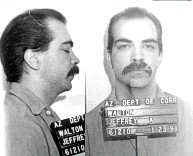 Jeffrey Alan Walton
Murderer · USA · 1986
Jeffrey Alan Walton was sentenced to death for the first-degree murder of Thoma…
1 victim
Jeffrey Alan Walton
Murderer · USA · 1986
Jeffrey Alan Walton was sentenced to death for the first-degree murder of Thoma…
1 victim
 Brian Keith Moore
Murderer · USA · 1979
Brian Keith Moore was sentenced to death on November 29, 1984 in Jefferson Coun…
1 victim
Brian Keith Moore
Murderer · USA · 1979
Brian Keith Moore was sentenced to death on November 29, 1984 in Jefferson Coun…
1 victim
 William Howard Putman
Murderer · USA · 1980
July 9, 1980 — William Putman purchased a .38 caliber revolver at a Talladega,…
3 victims
William Howard Putman
Murderer · USA · 1980
July 9, 1980 — William Putman purchased a .38 caliber revolver at a Talladega,…
3 victims
 Andrew Wamsley
Murderer · USA · 2003
Andrew Wamsley was sentenced to life in prison on March 10, 2006. Andrew Wamsle…
2 victims
Andrew Wamsley
Murderer · USA · 2003
Andrew Wamsley was sentenced to life in prison on March 10, 2006. Andrew Wamsle…
2 victims
 Jacob Lee Davis
Murderer · USA · 1998
Jacob Lee Davis · May 19, 1998 — Robert "Nick" Creson was shot in a parking lot…
1 victim
Jacob Lee Davis
Murderer · USA · 1998
Jacob Lee Davis · May 19, 1998 — Robert "Nick" Creson was shot in a parking lot…
1 victim
- Gender
- male
- Country
- USA
- Location
- Bibb County/Muscogee County, Georgia, USA
- Date of birth
- November 11, 1939
- Age at first offence
- 37
- Characteristics
- armed robbery, kidnapping
- Victim profile
- Charles McCook / Bill Watson ( off-duty police officer )
- Method of murder
- Shooting ( .38-caliber revolver and a .357 Smith & Wesson)
- Date(s) of murder
- December 27, 1976
- Years active
- 1976
- Date of arrest
- Next day
- Status
-
Executed
Executed by lethal injection in Georgia on January 24, 2002
Case record: Ronald Keith Spivey
Ronald Keith Spivey was executed by lethal injection in Georgia on January 24, 2002.
The offence
Macon: Charles McCook murder (pool hall brawl over $20)
On Dec. 27, 1976, Spivey shot and killed Charles McCook in a Macon pool hall brawl over $20. Spivey then took a twenty-dollar bill from McCook’s shirt pocket.
An argument occurred in a bar in Macon, Georgia, between Spivey and Charles McCook over a twenty-dollar pool game bet. Spivey ended the dispute by firing his gun which wounded a bystander and killed McCook.
Investigation
After the shootings and robberies, Spivey had cash and two guns when he was captured. Authorities found $360 in cash believed to have come from the bar along with two guns: a .38-caliber revolver and a .357 Smith & Wesson with Bill Watson’s name and badge number 197 engraved on the butt.
Offences in Columbus: Final Approach Lounge at Peachtree Mall
Killing of off-duty police officer Billy Watson
Spivey then drove to Columbus and to the Final Approach Lounge at Peachtree Mall. Shortly after 2 a.m. on Dec. 28, 1976, Bill Watson, an off-duty Columbus police officer working as a security guard, noticed that the door to the Final Approach was still open. Watson and Welton Emmit “Buddy” Allen, the 21-year-old manager of the nearby Briar Rabbit restaurant, decided to walk over and investigate.
Spivey robbed two waitresses and a customer inside the lounge. Watson entered the lounge to investigate why the door was open beyond the 2 a.m. closing time. As Watson approached the bar doorway, Spivey shot Watson twice in the head and chest, killing him. Spivey then shot Allen two or three times.
Allen survived by playing dead; further shootings
Allen survived by playing dead. When they left the lounge, Spivey herded his three hostages out of the Final Approach, took Watson’s gun, and continued with the hostages toward the parking lot. When they reached the door, Allen groaned. Spivey turned and shot him again. Allen played dead again.
From the parking lot, Spivey continued shooting and wounded another person. Spivey saw Allen duck into the Briar Rabbit and fired several more times through a window, hitting an employee of that restaurant, who survived. Spivey continued shooting into the restaurant, wounding a bartender in the hip.
Kidnapping and hostage taking: Mary Jane Davidson
Spivey then ordered college professor and part-time bar waitress Mary Jane Davidson to drive him to Alabama. He also took Watson’s gun as he left the lounge.
Spivey was captured two miles south of Wedowee, Ala., just before daybreak. Police in Alabama arrested Spivey the next morning and freed Davidson.
Gun-related robbery and additional wounded victim details
Spivey’s Columbus actions included wounding another person from the parking lot and wounding a bartender at the Briar Rabbit. Only one employee was described as being hit through a window, and that employee survived.
Sentencing
Life sentence for Charles McCook murder
Spivey received a life sentence for the murder of Charles McCook.
Trial
First trial for Watson: conviction thrown out (1977)
Spivey was tried twice for killing Watson. The first conviction in 1977 was thrown out because he was “compelled to be a witness against himself in a psychological exam,” according to court records.
Second trial for Watson: murder, armed robbery, and kidnapping conviction (1983)
In 1983, a second Muscogee County jury convicted Spivey of murder, armed robbery and kidnapping.
Death sentence and execution
Death sentence imposed; executed by lethal injection
Spivey was sentenced to die for killing off-duty Columbus police Officer Billy Watson. Spivey was pronounced dead at 7:34 p.m. at the Georgia Diagnostic & Classification Prison in Jackson.
The execution took seven minutes, and other reports described it as taking 10 minutes.
Final meal and final statement
Final meal
Spivey’s final meal was three cheeseburgers, chili, french fries, a milk shake and pickles.
Final words (verbatim)
He said:
"If I had a million lives, I couldn't say I'm sorry enough . . . . And what happened in that case changed me so much. I'm not the same person I was 25 years ago. In our society, we hear and say 'what would Jesus do.' You can believe I don't believe Jesus would do this. . . . It allows no room for redemption."
He also said the death penalty:
"dragged the victim's family and my family through living hell. It's incredibly sad that we live in a society that feels it has to kill people."
He urged his four friends who had come to "leave this thing without any bitterness, any hatred, any anger."
Additional reported statements included:
"If I had a million lifetimes, I could never say I'm sorry enough," "I've tried to be a decent and useful human being these last 25 years." He said the death penalty “offers no room for redemption and it drags the families -- my family and the victims' -- through hell.”
After guards removed his microphone, Spivey continued talking, twice saying “I love you” to witnesses he had selected, and called out, "Deliver me. Deliver me to the love" before resting his head.
Appeals and legal proceedings
Spivey’s case included multiple appeals and habeas proceedings.
Citations included:
- Spivey v. State , 246 S.E.2d 288 (Ga. 1978) (Direct Appeal).
- Spivey v. State , 259 S.E.2d 60 (Ga. 1979) (McCook Direct Appeal).
- Spivey v. State , 319 S.E.2d 420 (Ga. 1984) (Direct Appeal).
- Spivey v. State , 544 S.E.2d 136 (Ga. 2001) (Stay).
- Spivey v. Head , 207 F.3d 1263 (11th Cir. 2000) (Habeas).
- Spivey v. Zant , 661 F.2d 464 (11th Cir. 1981) (Habeas).
Death penalty method: electric chair review and transition to lethal injection
Georgia’s execution method changed from electrocution to lethal injection following a ruling that electrocution violated the U.S. Constitution’s protection from cruel and unusual punishment.
Spivey had been scheduled to be electrocuted on March 6, 2001, but the Georgia Supreme Court halted the execution to review whether the electric chair violated the constitutional ban on cruel and unusual punishment. A stay was granted pending a later decision on the constitutionality of electrocution.
The Georgia Supreme Court later ruled in October that electrocution violated the constitutional protection, prompting the state to begin using lethal injection.
In addition, there was reporting that a schedule for execution in the electric chair had been set “on, or within seven days of 6 March 2001,” and that Spivey’s death sentence had been in place since 1977, with him on death row for over 23 years at that time.
Clemency proceedings and execution schedule
A warrant was signed by Muscogee County Chief Judge Kenneth Followill ordering the execution of Ronald Keith Spivey between Jan. 24 and Jan. 31, with the Department of Corrections setting the specific time for Spivey’s death at 7 p.m. Jan. 24.
Spivey’s attorneys unsuccessfully challenged the qualifications of three of the five members of the state Board of Pardons and Paroles. The challenge involved Chairman Walter Ray, Bobby Whitworth and Gene Walker. Walker was named in a sexual harassment lawsuit, while the court filing focused primarily on a criminal investigation of Whitworth and Ray.
Execution-day medical participation dispute (MCG physicians)
Medical College of Georgia President Daniel W. Rahn backed away from an earlier request to keep MCG physicians out of the execution chamber after conversations with the commissioner.
Dr. Rahn apologized for an “overly strong” Jan. 16 letter to Corrections Commissioner Jim Weatherington objecting to a physician employed by MCG’s Georgia Correctional Health Care being asked to confirm death after executions.
Dr. Rahn said he misunderstood what the MCG physician was being asked to do, and said: “I've had conversations with the commissioner, and I'm satisfied that at present the role of GCHC physicians is acceptable.”
In Dr. Rahn’s Jan. 16 letter, he wrote:
"We feel we cannot allow our physician staff to participate in this process in any capacity. I am aware that our (GCHC) physician has not been asked to administer the intravenous material, but even his presence in the death chamber could compromise his provider relationship with the inmate population."
Scott Stallings, spokesman for the Georgia Department of Corrections, said the department was prepared to ask a second staff physician to attend executions to pronounce death.
The execution guidelines called for two physicians to be present to pronounce death after a lethal injection was administered, and a third privately contracted physician was described as assisting in putting in an intravenous catheter and calling for more drugs.
It was stated that contract physician involvement included cutting Augusta native Jose High’s chest the night of Nov. 6 so the tube could be inserted, and that Jose High was executed for the July 1976 murder of 11-year-old Bonnie Bulloch in Taliaferro County.
Michael Mears, director of the Multicounty Public Defender office, said ethical guidelines and Georgia law were violated by contract doctors’ participation.
It was reported that Spivey “began the evening of December 27, 1976” by entering a bar in Macon, Georgia and then began a sequence of robberies and shootings leading to his capture near Wedowee, Alabama, before daybreak.
Other details
Family, background, and character descriptions included in reports
Spivey was described as 62 at the time of execution. Another report stated that Spivey was 61 at the time of a scheduled electric chair execution.
Spivey was described as 6-foot-7 and 360 pounds, and was described as a member of Mensa and a former professional basketball player. His brother was described as a star 7-foot center for the University of Kentucky’s 1951 national championship team before being implicated in a point-shaving scandal that led to his lifetime ban by the NBA.
A retired Macon police Lt. Charles Grant said he had a conversation with Spivey days before the killings. Grant said Spivey had been picked up for causing a disturbance at a local lounge, briefly sent to the hospital, and that Grant had had to use the last notch on his handcuffs to cuff Spivey for the ride back to jail. Grant said Spivey told him:
"I have nothing to live for,"
Grant also said he believed it was time the execution took place.
Responding to victims’ families and witnesses
Spivey’s daughter, Ronnie Morgan, made a statement: “My daddy doesn't have to deal with this anymore,” and it was also reported that Morgan hoped to see the death penalty abolished.
Watson’s widow, Linda Mosely, was described as being on the prison grounds and wearing red that she had promised her late husband she would wear. It was reported she was not allowed to witness the execution.
Watson’s three sisters gathered at the home of Billy Watson Jr. in Cataula awaiting word of Spivey’s death. It was reported that the younger Watson said:
"Hate is not in my vocabulary," "I couldn't hate forever. I don't hate Spivey and I don't like the process."
Spivey’s cousin Pat Seaborn said Spivey told her if he got to heaven he hoped he would see the man he killed and said:
"I want to say I'm sorry,"
Criminal history prior to 1976 (as listed)
R. K. Spivey was described with criminal history including:
- 1961, Bibb County: 6 counts of forgery; sentenced to 6 months in jail and 3 years of probation.
- 1963, Bibb County: robbery by force; sentenced to 2 years in prison and 2 years of probation.
- 1965, Dougherty County: armed robbery, escape and car theft; sentenced to 3 years.
- 1976, Bibb County: robbery, pointing a pistol at another, driving under the influence, murder (Charles McCook); sentenced to life in prison.
- Muscogee County: murder (police officer Billy Watson), kidnapping (2 counts), armed robbery (2 counts), aggravated assault (2 counts); sentenced to death, life in prison (2 counts), and 20 years and 10 years (2 counts).
Medical and mental health history described in reports
Spivey was described as having experienced emotional and physical abuse in childhood, including that his father allegedly beat him, locked him in cupboards, and threatened to kill him. The text stated Spivey fled home on numerous occasions and was returned by authorities, and that at school his emotional problems were recognized and he began receiving mental health treatment at the age of 12. It also stated that his father frequently prevented him from receiving psychiatric care.
Spivey was quoted as writing:
"America is killing the economically deprived, those of the lower socioeconomic strata, killing the insane, killing the retarded, killing illiterates, killing the emotionally crippled, killing the socially disenfranchised and the politically powerless of our society, killing those so criminally abused as children that they never had a chance to develop normally to a well-balanced human being".
Spotted an error, or have more information about this case?