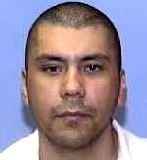
Jose Luis Villegas
Murderer Russell Ellwood
Murderer · USA · 1991
Russell Ellwood was a former taxi driver. Authorities suspected him of killing…
20 victims
Russell Ellwood
Murderer · USA · 1991
Russell Ellwood was a former taxi driver. Authorities suspected him of killing…
20 victims
 Robert Martines Perez
Murderer · USA · 1994
Name: Robert Martines Perez · Other name used in proceedings: Robert Martinez P…
15 victims
Robert Martines Perez
Murderer · USA · 1994
Name: Robert Martines Perez · Other name used in proceedings: Robert Martinez P…
15 victims
 Billy Frank Vickers
Murderer · USA · 1993
Billy Frank Vickers Vickers was executed by lethal injection in Texas on Januar…
14 victims
Billy Frank Vickers
Murderer · USA · 1993
Billy Frank Vickers Vickers was executed by lethal injection in Texas on Januar…
14 victims
 Irene Schroeder
Murderer · USA · 1929
Irene Schroeder (née Crawford) was an American criminal. · February 17, 1909 —…
1 victim
Irene Schroeder
Murderer · USA · 1929
Irene Schroeder (née Crawford) was an American criminal. · February 17, 1909 —…
1 victim
 China Arnold
Murderer · USA · 2005
China Arnold (born March 29, 1980, in Dayton, Ohio) was a defendant in a murder…
1 victim
China Arnold
Murderer · USA · 2005
China Arnold (born March 29, 1980, in Dayton, Ohio) was a defendant in a murder…
1 victim
 Gerald Cornelius Eldridge
Murderer · USA · 1993
Gerald Cornelius Eldridge (defendant) · Cynthia Bogany (former girlfriend; vict…
2 victims
Gerald Cornelius Eldridge
Murderer · USA · 1993
Gerald Cornelius Eldridge (defendant) · Cynthia Bogany (former girlfriend; vict…
2 victims
 Harry Mitts
Murderer · USA · 1994
Harry Mitts was sentenced to death in November 1994 for murders and attempted m…
2 victims
Harry Mitts
Murderer · USA · 1994
Harry Mitts was sentenced to death in November 1994 for murders and attempted m…
2 victims
- Gender
- male
- Country
- USA
- Location
- Nueces County, Texas, USA
- Date of birth
- April 14, 1975
- Age at first offence
- 26
- Characteristics
- parricide, drugs, robbery
- Victim profile
- Erida Perez Salazar, 24, his ex-girlfriend; her son, Jacob, 3; and her mother Alma Perez, 51
- Method of murder
- St abbing with knife
- Date(s) of murder
- January 22, 2001
- Years active
- 2001
- Date of arrest
- Same day
- Status
-
Executed
Sentenced to death on May 21, 2002; executed by lethal injection on April 16, 2014
Case record: Jose Luis Villegas
Timeline
- January 22, 2001 — Lionicio Perez returned home and found his wife Alma Perez’s bruised body lifeless in a pool of blood; he ran to a neighbor to call police and returned to find the bodies of his daughter and grandson; a neighbor said she saw Jose Luis Villegas leaving the Perez home at approximately 8:45 a.m.; police spotted Villegas at approximately 9:30 a.m. in Erida Salazar’s vehicle; Villegas was apprehended after a high-speed chase and foot pursuit; Villegas had three baggies of cocaine in his possession when arrested; after being advised of his rights, Villegas confessed to the three murders; Villegas described arriving at the Perez home at 5:00 a.m., consuming around $200 of cocaine with Erida, stabbing Alma multiple times with a kitchen knife after she ordered him to leave, and then stabbing Erida and her son to death; Villegas left in Erida’s vehicle, pawned a television he stole from the Perez home, and bought more cocaine; Villegas told police he wanted to return to the Perez home to commit suicide by overdosing on cocaine but fled when he saw police already in the home.
- May 9, 2002 — A Nueces County jury convicted Jose Luis Villegas of capital murder.
- May 16, 2002 — After a separate punishment proceeding, the same jury sentenced Villegas to death.
- September 14, 2006 — Villegas filed a timely federal petition for writ of habeas corpus in the U.S. District Court for the Southern District of Texas, Corpus Christi Division.
- July 31, 2007 — The U.S. District Court denied Villegas’s federal petition.
- April 16, 2008 — The United States Court of Appeals for the Fifth Circuit rejected Villegas’s appeal and affirmed the district court’s denial of habeas corpus relief.
- July 15, 2008 — Villegas filed a petition for writ of certiorari in the Supreme Court.
- October 20, 2008 — The Supreme Court denied certiorari review.
- September 14, 2005 — The Court of Criminal Appeals of Texas denied Villegas’s state habeas corpus relief.
- April 16, 2008 — The Fifth Circuit rejected Villegas’s appeal and affirmed the district court’s denial of habeas corpus relief.
- November 7, 2013 — The 319th state district court issued an order setting Villegas’s execution date for April 16, 2014.
- March 21, 2014 — Villegas filed in the 319th state district court a motion to withdraw or modify the execution date.
- April 16, 2014 — Jose Luis Villegas was executed by lethal injection.
- May 21, 2002 — Villegas was listed as “Date Received” as 05/21/2002, age 27, education level 9, and TDCJ number 999417.
Background
Jose Luis Villegas was born on 04/14/1975. He was listed as hispanic male with black hair, brown eyes, height 5 ft 7 in, and weight 186. He was identified as a native county and native state of Nueces, Texas. His prior occupations were cook, dishwasher, and laborer. Records indicated prior prison record: N/A.
During the penalty phase of his trial, jurors learned that Villegas was previously convicted of possession of inhalant paraphernalia, burglary of a building, assault, and terroristic threats. After Villegas’s conviction for capital murder, he was convicted of two counts of indecency with a child committed prior to the capital murder.
Villegas was out on bond for a sexual assault charge at the time of the murders and was supposed to go to court the day of the killings for an incident in which a woman said he punched her in the face. Relatives said that Erida’s mother urged her daughter to break up with Villegas when she learned of the sex charges.
During the federal habeas proceedings and related analysis, Villegas challenged trial counsel’s presentation of mitigating evidence during the penalty phase, arguing counsel failed to investigate thoroughly his background, character, personal circumstances, and mental health history and failed to present adequate evidence of that background in a manner that would mitigate the imposition of the death penalty. The application for a certificate of appealability was denied.
The offence
On January 22, 2001, Villegas fatally stabbed three victims during the same criminal transaction. The victims were:
- Alma Perez, 51 years old, stabbed 35 times.
- Erida Perez Salazar, 24 years old (also referenced as 23 in later reporting), stabbed 32 times; Erida’s child Jacob Salazar, 3 years old, stabbed 19 times.
The United States Court of Appeals for the Fifth Circuit described the sequence of events: Lionicio Perez returned home after being excused early from jury service, found his wife’s bruised body lifeless in a pool of blood, called police, and returned to find the bodies of his daughter and grandson. When police arrived, a neighbor said she saw Villegas leaving the Perez home at approximately 8:45 a.m. Police spotted Villegas at approximately 9:30 a.m. in Ms. Salazar’s vehicle.
Villegas was apprehended after a high-speed chase and foot pursuit. When arrested, he had three baggies of cocaine in his possession, hidden inside his baseball cap. After being advised of his rights, Villegas confessed to the three murders.
Villegas described arriving at the Perez home at 5:00 a.m. He stated that he and Ms. Salazar consumed around $200 of cocaine. After Mrs. Perez returned home from taking Ms. Salazar’s daughter to school, she discovered Villegas’s presence. Mrs. Perez had previously warned her daughter not to let Villegas enter the house. When Mrs. Perez ordered Villegas to leave, he stabbed her several times with a kitchen knife. Villegas then went to a bedroom and stabbed Ms. Salazar and her son to death.
Villegas left in Ms. Salazar’s vehicle. He pawned a television he stole from the Perez home. He bought more cocaine. Villegas told police he wanted to return to the Perez home to commit suicide by overdosing on cocaine, but fled when he saw police already in the home.
Investigation
When police arrived at the scene, a neighbor stated she saw Villegas leaving the Perez home at approximately 8:45 a.m. Police later spotted Villegas at approximately 9:30 a.m. in Ms. Salazar’s vehicle. Police apprehended Villegas after a high-speed chase and foot pursuit.
At the time of arrest, police found three baggies of cocaine in Villegas’s baseball cap.
Arrest
Police spotted Villegas in Ms. Salazar’s vehicle at approximately 9:30 a.m. When arrested, Villegas had three baggies of cocaine in his possession hidden inside his baseball cap.
He described the events leading to the stabbings and how he left the home and pawned a television.
Trial
A Nueces County grand jury indicted Villegas for murdering Alma Perez, Erida Perez Salazar, and Jacob Salazar during the same criminal transaction on Jan. 25, 2001.
Conviction and findings
On May 9, 2002, a Nueces County jury convicted Villegas of capital murder.
In the opinion affirming his conviction, the Texas Court of Criminal Appeals stated that in May 2002, a jury convicted appellant of capital murder and that the trial judge sentenced him to death pursuant to the jury’s answers to special issues under Texas Code of Criminal Procedure Article 37.071.
Death sentence
The same jury sentenced Villegas to death after a separate punishment proceeding. The court record described the sentence as imposed in accordance with Texas Code of Criminal Procedure Article 37.071, including Article 37.071 § 2(g). Delivery of the appellate opinion occurred on February 18, 2004 (en banc; do not publish).
Sentencing
A jury sentenced Villegas to death on May 16, 2002.
During the penalty phase, the state presented evidence regarding the profound impact the crime had on surviving family members and presented testimony of various police and probation officers regarding other crimes and bad acts Villegas committed over the years, including assaults against family members, a burglary and shoplifting charge, and an incident of indecency with his five-year-old daughter.
Villegas presented seven mitigating witnesses:
- Dr. William Swan Jr., who testified about the prolonged and painful death of Villegas’s mother, who died from scleroderma and underwent 18 amputations prior to her death.
- Christina Barrera, Villegas’s older sister, who testified about their mother’s illness and its impact on the family, their father’s alcoholism and abuse, and her concerns over Villegas’s mental health.
- Arcelia Casarez, Villegas’s ex-mother-in-law, who testified about Villegas’s troubled relationship with her daughter, her concerns over Villegas’s mental health, and that she still very much cared for Villegas.
- San Juanita Luna, Villegas’s cousin, who testified about the death of Villegas’s mother and his father’s alcoholism.
- Joseph Hovart, Ph.D., a psychologist, who testified that Villegas suffered from intermittent explosive, dissociative, and major depressive disorders, recurrent and severe, and testified about Villegas’s use of drugs and trauma from witnessing his mother’s death. Hovart opined:
“I think that when he killed those three people, that it was a function of the intermittent explosive disorder and the cocaine abuse and not sleeping at all for a period of time.”
- Jose Luis Villegas Sr., Villegas’s father, who testified about his relationship with his son and that he was a violent father.
- Dennis Longmire, who testified about the Texas death penalty and believed it did not deter crime and could perpetuate violence through institutional example.
During the guilt-innocence phase, Dr. Carlos Estrada, a psychiatrist, testified about Villegas’s mental health problems and social and life history. Estrada diagnosed intermittent explosive, post-traumatic stress, and dissociative disorders and addiction to cocaine, marijuana, and alcohol, concluding intermittent explosive disorder was the condition most related to the crime.
Appeals
State direct appeal
Villegas’s conviction and sentence were affirmed by the Court of Criminal Appeals of Texas on Feb. 18, 2004 on direct appeal. The opinion is described as affirming and overruling points of error, including:
- Eighth and Fourteenth Amendment argument regarding life without parole option (point of error one) was overruled.
- Argument about punishment-phase instructions regarding the effect of a “no” vote by a single juror (point of error five) was overruled.
- Argument asserting the Constitution required the State to bear the burden to prove insufficient mitigation beyond a reasonable doubt (point of error six) was overruled.
- Argument about the State waiving its right to open arguments at the punishment phase (point of error seven) was overruled due to forfeiture.
The Texas Court of Criminal Appeals also addressed ineffective assistance of counsel claims (points of error two, three, and four), stating that the record on direct appeal was not sufficiently developed and that it could not fairly evaluate the merits of the allegation. Points of error two, three, and four were overruled.
State habeas corpus
Villegas filed a state application for writ of habeas corpus after denial of direct appeal. The state habeas court held an evidentiary hearing, issued findings of fact and conclusions of law, and recommended that habeas relief be denied. Relief was denied by the Court of Criminal Appeals on Sept. 14, 2005.
Federal habeas corpus
On Sept. 14, 2006, Villegas filed a petition for writ of habeas corpus in the U.S. The district court denied the petition on July 31, 2007.
Villegas then filed an appeal. On April 16, 2008, the Fifth Circuit rejected the appeal and affirmed the denial of habeas corpus relief.
Villegas filed a petition for writ of certiorari in the Supreme Court on July 15, 2008. The Supreme Court denied certiorari review on Oct. 20, 2008.
Outcome
Villegas’s application for a certificate of appealability (COA) was denied. The Fifth Circuit concluded Villegas failed to make a substantial showing of the denial of a constitutional right, concluding that additional mitigation evidence gathered at state habeas hearing was largely cumulative and that the state habeas court did not unreasonably apply federal law.
Aftermath
A media advisory issued by the Texas Attorney General stated that Jose Luis Villegas was scheduled for execution after 6 p.m. on April 16, 2014, pursuant to a court order by the 319th District Court of Nueces County.
Execution
Villegas was executed by lethal injection on April 16, 2014. He was pronounced dead at 7:04 p.m. CDT.
When asked if he had a statement before being put to death, Villegas made the following statement:
“I would like to remind my children once again I love them. Everything is OK. I love you all, and I love my children. I am at peace. It does kind of burn. Goodbye, goodbye.”
The execution was described as carried out after his attorneys unsuccessfully argued to the U.S. Supreme Court that he was mentally impaired and ineligible for the death penalty. The Supreme Court denied his final appeal on the execution day.
Six relatives of his victims witnessed the execution but declined to comment afterward.
Mark Skurka, the Nueces County district attorney who prosecuted Villegas, made the following comments after watching the execution:
“I was struck by the calm and peacefulness inside that room as opposed to the utter terror the victims must have been in as Jose Luis Villegas stabbed them,” Mark Skurka, the Nueces County district attorney who prosecuted Villegas, said after watching the execution.
“He made no attempt to make peace with the family, apologize to the family or show any remorse for taking the lives of three people,” Skurka said.
“The family expressed to me that they are glad that this is finally over and that justice has finally been done, even though it took a very long time in their minds for this to happen.”
Other details
- Villegas v. Quarterman is cited as 274 Fed. Appx. 378 (Tex. Crim. App. 2008) with habeas proceedings referenced.
- The Fifth Circuit described the case as involving an application for a certificate of appealability filed by Jose Luis Villegas to appeal the denial of habeas corpus relief under 28 U.S.C. § 2254.
- The Fifth Circuit described that Villegas sought a COA with respect to claims that trial counsel provided ineffective assistance during the penalty phase by failing to investigate and present mitigating evidence regarding his background, character, personal circumstances, and mental health history.
- The Fifth Circuit stated that counsel presented seven mitigating witnesses and that the state presented evidence regarding other crimes and bad acts committed over the years, including assaults against family members, burglary and shoplifting, and indecency with a five-year-old daughter.
- During the federal analysis, the court discussed that the state presented evidence of Villegas’s violent background and lengthy criminal history, including that he brutally stabbed three individuals including a three-year-old child.
- Final/Last Words were also listed as:
- Information about “Final/Special Meal” stated that Texas no longer offers a special “last meal” to condemned inmates and that the inmate is offered the same meal served to the rest of the unit.
- Villegas’s TDCJ Number was listed as 999417.
- Additional procedural details included that direct appeal was automatic and that the trial judge sentenced appellant in accordance with the jury’s answers to the special issues under Texas Code of Criminal Procedure Article 37.071, including Article 37.071 § 2(b) and § 2(e), with instructions referenced in the appellate discussion.

Spotted an error, or have more information about this case?