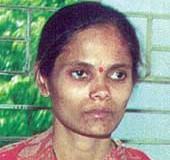
Seema Gavit
Murderer Phoolan Devi
Murderer · India · 1981
Phoolan Devi was shot dead by three masked gunmen outside her Delhi bungalow on…
20 victims
Phoolan Devi
Murderer · India · 1981
Phoolan Devi was shot dead by three masked gunmen outside her Delhi bungalow on…
20 victims
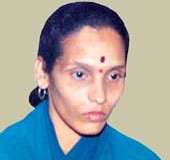 Renuka Shinde
Murderer · India · 1990
Renuka Shinde was sentenced to death on June 29, 2001. The High Court upheld th…
9 victims
Renuka Shinde
Murderer · India · 1990
Renuka Shinde was sentenced to death on June 29, 2001. The High Court upheld th…
9 victims
 Umesh Reddy
Murderer · India · 1998
Umesh Reddy was sentenced to death on October 27, 2006. The Karnataka High Cour…
18 victims
Umesh Reddy
Murderer · India · 1998
Umesh Reddy was sentenced to death on October 27, 2006. The Karnataka High Cour…
18 victims
 Neah Verma
Murderer · India · 2011
Name: Neah Verma Age: 23 Occupation: beautician / salesgirl for beauty products…
3 victims
Neah Verma
Murderer · India · 2011
Name: Neah Verma Age: 23 Occupation: beautician / salesgirl for beauty products…
3 victims
 Augusta Fullam
Murderer · India · 1911
Augusta Fullam Augusta Fullam was sentenced to death in 1913. Her sentence was…
2 victims
Augusta Fullam
Murderer · India · 1911
Augusta Fullam Augusta Fullam was sentenced to death in 1913. Her sentence was…
2 victims
 Dhananjoy Chatterjee
Murderer · India · 1990
Dhananjoy Chatterjee was born in Kuludihi, West Bengal, India on August 14, 196…
1 victim
Dhananjoy Chatterjee
Murderer · India · 1990
Dhananjoy Chatterjee was born in Kuludihi, West Bengal, India on August 14, 196…
1 victim
 Gary James Johnson
Murderer · USA · 1986
Gary James Johnson was executed by lethal injection in Texas on January 12, 201…
2 victims
Gary James Johnson
Murderer · USA · 1986
Gary James Johnson was executed by lethal injection in Texas on January 12, 201…
2 victims
 Abbas Baqir Abbas
Mass murderer · Sudan · 2000
Abbas Baqir Abbas was identified as a member of the militant Al-Takfir wa al-Hi…
23 victims
Abbas Baqir Abbas
Mass murderer · Sudan · 2000
Abbas Baqir Abbas was identified as a member of the militant Al-Takfir wa al-Hi…
23 victims
 Steven Benson
Murderer · USA · 1985
Steven Benson was a 33-year-old Florida businessman who was arrested and charge…
2 victims
Steven Benson
Murderer · USA · 1985
Steven Benson was a 33-year-old Florida businessman who was arrested and charge…
2 victims
 Jeffrey MacDonald
Murderer · USA · 1970
Jeffrey Robert MacDonald (M.D.; born on October 12, 1943) was a former member o…
3 victims
Jeffrey MacDonald
Murderer · USA · 1970
Jeffrey Robert MacDonald (M.D.; born on October 12, 1943) was a former member o…
3 victims
 Gavin Gosnell
Murderer · New Zealand · 2011
Gavin Gosnell was 28 at the time of sentencing and was accused of murdering Chr…
1 victim
Gavin Gosnell
Murderer · New Zealand · 2011
Gavin Gosnell was 28 at the time of sentencing and was accused of murdering Chr…
1 victim
 Edwin Hart Turner
Murderer · USA · 1995
Edwin Hart Turner was convicted of capital murder in the deaths of Eddie Brooks…
2 victims
Edwin Hart Turner
Murderer · USA · 1995
Edwin Hart Turner was convicted of capital murder in the deaths of Eddie Brooks…
2 victims
- Gender
- female
- Country
- India
- Location
- Pune, Kolhapur, and Nashik, Maharashtra, India
- Date of birth
- 1 975
- Characteristics
- kidnapping
- Victim profile
- Santosh, Anjali, Shradha, Gauri and Pankaj ( aged between one and five years)
- Method of murder
- Starvation - Smashing their heads against walls or electricity poles
- Date(s) of murder
- June 1990 - October 1996
- Years active
- 1990–1996
- Date of arrest
- November 19, 1996
- Status
-
Sentenced to death
Sentenced to death on June 29, 2001; death sentence confirmed by the Supreme Court on August 31, 2006; High Court upheld the verdict on September 9, 2004
Case record: Seema Mohan Gavit and Renuka Shinde (Anjanabai Gavit case)
Status
Seema Mohan Gavit and her sister Renuka Shinde received death sentences. The sessions court sentenced them to death on June 29, 2001. The Bombay High Court upheld the death sentences on September 9, 2004. The Supreme Court confirmed the death sentences on August 31, 2006.
People
- Seema Mohan Gavit — accused; sister of Renuka Shinde.
- Renuka Shinde (also referred to as Renuka Kiran Shinde; alias “Rinku”) — accused; sister of Seema Mohan Gavit.
- Anjanabai Gavit (also referred to as Anjanabai Gavit; Anjana Gavit) — mother of Seema Mohan Gavit and Renuka Shinde; principal accused; arrested along with the sisters and Kiran Shinde; died during trial.
- Kiran Shinde — Renuka Shinde’s husband; turned approver; was acquitted.
- Aseem Saroday — Pune-based human rights lawyer.
- Ujjwal Nikam — special public prosecutor.
- Justices K G Balakrishnan and G P Mathur — Supreme Court bench.
- Justices R M S Khandeparkar and R S Mohite — Bombay High Court judges.
- Judge G L Yedke — Kolhapur additional district and sessions judge who sentenced Renuka and Seema to death.
- Inspector Mandaleshwar Madhavrao Kale — investigating officer.
- Sudhakar Shinde — Nashik-based journalist of Marathi daily Deshdoot.
- Ram Murlidhar Mudhe — panch witness; identified Seema Gavit in court and testified about handwriting samples.
- Manik Mulik — defence lawyer.
- Ajit Pahade — Parimal Lodge owner who requested a copy of a panchnama and received photocopies.
- Fehmida Sayyed — another death row prisoner in Yerwada Jail.
- Swati Saroday — advocate who worked with Renuka for rehabilitating her four children.
- Vidya Kulkarni — neighbour and prime witness for the prosecution.
- Anjanabai Gavit’s husband Mohan — father abandoning the family; later described in the narrative as Mohan Gavit; part of the family history recounted during trial-related reporting.
- Pratibha — referred to as Mohan’s later partner after he moved out.
- Mohan’s first/second wife’s relatives and family members mentioned in the narrative:
- Ashish — son from Renuka’s first marriage; used by Renuka as a defence.
- Kranti — stepdaughter of Mohan; daughter of Mohan’s second wife; killed by the sister duo.
- Pratibha’s younger daughter — targeted in 1996 when the sisters were caught.
- Victims named:
- Santosh
- Anjali
- Shradha
- Gauri
- Pankaj
- Bhavna (also described as one of the children)
- Naresh (also described as one of the children)
- Pinki (Anjali alias “Pinki” in the handwriting/panch witness section)
- Gauri and Pankaj are included in the list of five identified murders; other victims are referenced by the police belief and by charged counts.
Timeline
- June 29, 2001 — A local court sentenced Renuka Kiran Shinde (27) and Seema Mohan Gavit (25) to death; Kiran Shinde was acquitted.
- December 4, 1998 — Ram Murlidhar Mudhe, a panch witness, identified Seema Gavit during testimony in the Anjanabai Gavit abduction and murder case; evidence involved handwriting sample identification.
- September 9, 2004 — The Bombay High Court upheld the death sentence awarded to Renuka Shinde and Seema Gavit.
- August 31, 2006 — The Supreme Court confirmed the death sentence for Seema Mohan Gavit and Renuka Shinde.
- October 1996 — The sisters were caught when they visited Mohan to kidnap his second daughter; complaint against the trio was referenced as filed on October 22, 1996.
- 1996 — The families of the accused were arrested in connection with kidnapping and murder charges.
- 1990 — The abduction and petty theft framework began, with Renuka caught pickpocketing at the Chatursinghi temple in Pune and the subsequent start of the kidnapping scheme.
Background
Seema Mohan Gavit and her sister Renuka Shinde were described as sisters whose actions led to death sentences. Their mother Anjanabai Gavit was described as the mastermind behind the killings and died during trial. Reporting around the case described Seema and Renuka as having started with petty criminal activity and later developing a pattern of kidnapping children and using them as cover for thefts, with killings when the children became a problem.
The offence
The case involved the kidnapping of children and their use in begging and petty thefts, followed by killings when the children were no longer useful or became a nuisance.
Victims and charged counts
- The accused were charged with the murder of five children:
- Santosh, Anjali, Shradha, Gauri and Pankaj.
- The police belief was that they had kidnapped 13 children and murdered nine of them.
- One account stated that nine murders were charged and the sessions court found the accused guilty of six murders.
- The High Court said that the prosecution could prove only five cases.
- The Supreme Court confirmation upheld the death sentence in relation to murdering five children out of the 13 kidnapped and forced into petty crime.
Ages and circumstances described
- Victims were described as aged between seven months and four years in the Supreme Court-related discussion.
- Another part of the record described victims as aged between one and five years.
- The children were described as being carried in crowded places to avoid suspicion and were kidnapped from crowded locations such as temple premises, railway stations, fairs, and bus stations, and from areas including Thane, Nashik, and other locations in the period between 1990 and 1996.
Specific killings described
- Santosh, described as a one-year-old son of a beggar woman, was hurt when hurled to the floor; denied medication; Anjanabai shut him up by bashing his head repeatedly against an iron rod.
- Swapnil, a seven-month-old baby, was described as dropped by Seema because she could not deal with its incessant crying.
- A two-year-old boy was described as being hung upside down and its head was slammed against a wall.
- A child was described as having its body chopped and stuffed into a gunny bag; the bag was carried while the group watched a movie at Alka Talkies in Kolhapur and ate bhel puri with the bag between their feet.
- In one account, Santosh was described as crying at a bus stand; the women banged his head against the floor and then an iron pole till he died; his body was thrown under an autorickshaw.
- Another child, a described three-year-old (Pankaj), was said to have talked to passers-by about his parents and was hung upside down from the ceiling with his head repeatedly slammed against a wall.
- Additional described victims included:
- Bhavna, described as an 18-month-old who was gagged, bundled into a handbag, and dumped in the ladies’ toilet of a cinema.
- Naresh, described as a two-year-old who was starved and beaten to death.
Investigation
Investigations were described as beginning after missing child reports and later uncovering evidence linked to multiple murders.
Arrest-related and evidence-related details
- The case narrative described the sisters and their mother starting kidnapping and petty thefts after Renuka was caught pickpocketing at the Chatursinghi temple in Pune in 1990; Renuka’s son Ashish from her first marriage was used as a defence during that incident.
- The investigating officer Inspector Mandaleshwar Madhavrao Kale said they could not trace a girl at first but when the trio returned to kidnap Pratibha’s younger daughter they were caught.
- The state CID took over investigations.
- Evidence included a testimony from panch witness Ram Murlidhar Mudhe concerning handwriting sample identification and a handwriting-related panchnama.
Evidence and testimony (handwriting identification)
Ram Murlidhar Mudhe testified that:
- Seema Gavit was identified as the lady whose handwriting samples had been taken by the CID at Nashik.
- Mudhe described taking the handwriting samples in six different blank papers and signing alongside CID officer Shinde and other witnesses.
- Mudhe denied charges made by defence lawyer Manik Mulik and said the panchnama was correct and signed by him on the direction of police.
- Mudhe said the visitors’ register book of Parimal Lodge, Nashik was seized in his presence on November 6, 1996, during the period when the accused had kidnapped Anjali alias Pinki.
- Mudhe agreed there was some overwriting and that figures were changed in his presence, describing it as by the police.
- Mudhe stated that later police discovered a mistake in the original panchnama copy and found that the copy was overwritten.
- Mudhe also stated that Parimal Lodge owner Ajit Pahade demanded a copy of the panchnama and photocopies were handed over.
The defence lawyer Manik Mulik raised an objection to a prosecutor’s application to allow approver Kiran Shinde to meet his children because the approver was also one of the main accused.
Arrest
Arrest details in the narrative included that:
- The sisters were caught in October 1996 when they visited Mohan to kidnap his second daughter.
- A complaint was registered on October 22, 1996 accusing the three (Renuka, Seema, and their mother Anjanabai) of kidnapping.
- After police questioning and CID involvement, evidence hinted at several murders.
- Kiran Shinde was described as turning approver and giving details to the police.
Trial
Proceedings and convictions
- The trial began in September 1998 (as described).
- Accounts stated that:
- The sessions court sentenced Renuka and Seema to death.
- Their mother Anjanabai died during trial.
- Kiran Shinde, who turned approver, was acquitted in one account and had charges dropped in another account.
Quantified trial findings (as described in reporting)
- One account said the sessions court found them guilty of six murders while the High Court held only five cases were provable.
- Another account stated that the sessions court sentenced them to death after being convicted on June 22 for kidnapping 13 children and killing nine of them, and then receiving the death sentence on June 29, 2001.
Court remarks and evidence emphasis
- Judge G L Yedke was described as saying the women kidnapped innocent children who could not offer resistance, used them for begging, and killed them brutally when the children outlived their utility.
- Judge Yedke described the murders as most heinous and said the two sisters seemed to have enjoyed killing the children.
- The special government prosecutor Ujjwal Nikam sought death for the convicts.
Verbatim Supreme Court remarks
The Supreme Court bench made the following comments while upholding the death sentences:
“Going into the details of the case, we find no mitigating circumstances against them apart from the fact they are women. Further the nature of their crime and the systematic way in which each child was kidnapped and killed amply demonstrates the depravity of the mind of the appelants. They indulged in criminal activities for a very long period and continued till they were caught by the police. They very cleverly executed plans of kidnapping the children, and the moment they were no longer useful, killed them and threw the dead body at some deserted place,”
The bench said that the sisters had “not been committing crimes under compulsion but took it very casually and killed all these children, least bothering about their life or the agony of their parents.”
The bench also said:
“We do not think that these appelants are likely to reform, and will remain a menace to society. The inhabitants of the locality in which the two were living was so horrified that they could not send their children to school for the fear that they would be kidnapped or killed,”
“They indulg[ed] in criminal activities for a very long period and continued till they were caught by the police.”
Sentencing
Sessions court
- On June 29, 2001, the sessions court sentenced Renuka Kiran Shinde (27) and Seema Mohan Gavit (25) to death.
- The court acquitted Kiran Shinde, Renuka’s husband, who had turned approver.
High Court
- The Bombay High Court upheld the death sentence on September 9, 2004.
Appeals
- Appeals by Renuka and Seema were not quashed.
- The Supreme Court dismissed their appeals and confirmed the death sentences on August 31, 2006.
- The Supreme Court bench vacated the stay it had granted against execution of both, when their appeal had been admitted.
Outcome
- Death sentences were confirmed by the Supreme Court on August 31, 2006.
- Seema and Renuka were described as lodged in Yerawada Jail, Pune.
- Renuka was described as sent to Nagpur jail after the Supreme Court verdict, in one account.
- The sisters were described as separated after the Supreme Court verdict.
- Renuka was described as transferred back to Yerwada, and they were described as lodged in separate cells.
- Fehmida Sayyed, also sentenced to death by the Bombay High Court for the twin bomb blasts in Mumbai in 2003, was described as giving Renuka’s company in Yerwada.
Aftermath
Mercy petition and jail visits
A jail official was quoted regarding mercy petition status:
“Every time the jail superintendent visits they want to know about the status of their mercy petition. In their mind there is no doubt about their sentence being commuted,”
Separation and children
- Renuka’s children were described as regular visitors earlier, then visits became erratic.
- A source described the oldest child turning 18 and being released, with the oldest child insisting on taking all siblings with him.
- Advocate Swati Saroday recalled that Renuka was disturbed by separation and wanted to be with her sister:
“She wanted to be with her sister and would often go on hunger strikes. She was very disturbed at the separation. She also wanted her children to have access to her bank accounts but they were sealed. She would fret over what would happen to them,” Swati Saroday also acknowledged being flummoxed by Renuka’s love for her children despite killing others.
Another death-row prisoner
- Fehmida Sayyed was mentioned as being in Yerwada jail and sentenced to death by the Bombay High Court for the twin bomb blasts in Mumbai in 2003.
Other details
- One account stated that Anjanabai died a year after arrest; another stated that Anjanabai died as an undertrial in December 1997, 14 months after she was arrested in Nashik.
- Another account stated that the court examined 156 witnesses.
- The narrative said there were “no eyewitnesses” but relied on approver testimony from Kiran Shinde in the Supreme Court discussion and other reporting.
- Kiran Shinde was described as testifying against Renuka and Seema and as having charges dropped; in the June 29, 2001 reporting, he was acquitted.
- Prime witness Vidya Kulkarni was quoted regarding seeing Renuka and Seema beating Kranti every day:
- A maths teacher and her family were quoted about their daughter playing with Renuka’s children and never knowing their “credentials” until news appeared:
- Aseem Saroday was quoted:
- Aseem Saroday was also quoted about a specific disposal scene involving the bag and the movie at Alka Talkies:
- A prosecutor Ujjwal Nikam was quoted about the duration of killing and memory:
- An investigating officer was quoted about Santosh:
“We limited the period of killing to six years. However, this had been going on for longer than that. The women could not remember how many children they had killed.”
“They chopped the body of one child and stuffed it into a gunny bag for disposal. The gang carried the bag with them and watched a movie at Alka Talkies in Kolhapur and ate bhel puri while the bag lay between their feet,”
“Their ordinariness makes their actions even more horrifying.”
“My daughter used to play with Renuka’s children. She even accompanied Anjana to the market several times. God was kind enough to ensure that my daughter remained unharmed. We never knew about their credentials until the news appeared in the papers. Today we don’t know whom to trust,” she says.
“My apartment window opened on theirs. I could see them beating up Kranti everyday. I had many things to tell.”
“Santosh was hurt when he was hurled to the floor. Denied medication, the baby's wounds festered and he was crying uncontrollably. Anjanabai shut him up by bashing his head repeatedly against an iron rod,”
Spotted an error, or have more information about this case?