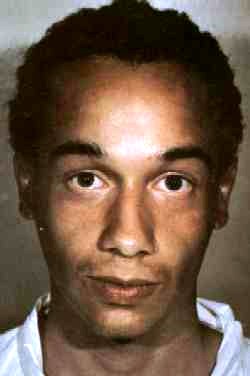
Kenneth Erskine
Serial killer Dennis Nilsen
Serial killer · United Kingdom · 1978
Dennis Andrew Nilsen was born on November 23, 1945. He lived in London. He was…
16 victims
Dennis Nilsen
Serial killer · United Kingdom · 1978
Dennis Andrew Nilsen was born on November 23, 1945. He lived in London. He was…
16 victims
 Archibald Hall
Serial killer · United Kingdom · 1977
Archibald Hall was born as Archibald Thompson Hall in Glasgow on 17 June 1924.…
5 victims
Archibald Hall
Serial killer · United Kingdom · 1977
Archibald Hall was born as Archibald Thompson Hall in Glasgow on 17 June 1924.…
5 victims
 Colin Ireland
Serial killer · United Kingdom · 1993
Name: Colin Ireland · Also known as / tabloid name: London's "Gay Slayer" · Cri…
5 victims
Colin Ireland
Serial killer · United Kingdom · 1993
Name: Colin Ireland · Also known as / tabloid name: London's "Gay Slayer" · Cri…
5 victims
 Roy Fontaine
Serial killer · United Kingdom · 1977
17 June 1924 — Archibald Thompson Hall was born in Glasgow. · 1941 — He receive…
5 victims
Roy Fontaine
Serial killer · United Kingdom · 1977
17 June 1924 — Archibald Thompson Hall was born in Glasgow. · 1941 — He receive…
5 victims
 Stephen Akinmurele
Serial killer · United Kingdom · 1995
Stephen Akinmurele was accused in connection with the deaths of multiple pensio…
5 victims
Stephen Akinmurele
Serial killer · United Kingdom · 1995
Stephen Akinmurele was accused in connection with the deaths of multiple pensio…
5 victims
 Lam Kor-wam
Serial killer · United Kingdom · 1982
Lam Kor-wan (Traditional Chinese 林過雲, born 1955) was one of Hong Kong's two kno…
4 victims
Lam Kor-wam
Serial killer · United Kingdom · 1982
Lam Kor-wan (Traditional Chinese 林過雲, born 1955) was one of Hong Kong's two kno…
4 victims
 Nehemiah Griego
Mass murderer · USA · 2013
Nehemiah Griego was a 15-year-old male. · January 19, 2013 — Police found five…
1 victim
Nehemiah Griego
Mass murderer · USA · 2013
Nehemiah Griego was a 15-year-old male. · January 19, 2013 — Police found five…
1 victim
 Leif Christian Halvorsen
Murderer · USA · 1983
Leif Christian Halvorsen was sentenced to death on September 15, 1983 in Fayett…
3 victims
Leif Christian Halvorsen
Murderer · USA · 1983
Leif Christian Halvorsen was sentenced to death on September 15, 1983 in Fayett…
3 victims
 Mark Jefferies
Murderer · Australia · 1820
Mark Jefferies was an escaped convict who was described as a rapist and a canni…
5 victims
Mark Jefferies
Murderer · Australia · 1820
Mark Jefferies was an escaped convict who was described as a rapist and a canni…
5 victims
 John Peoples
Murderer · USA · 1983
John W. Peoples Jr. was a defendant in a capital murder case arising from the J…
3 victims
John Peoples
Murderer · USA · 1983
John W. Peoples Jr. was a defendant in a capital murder case arising from the J…
3 victims
- Gender
- male
- Country
- United Kingdom
- Location
- Stockwell, London, England, United Kingdom
- Date of birth
- 1962
- Age at first offence
- 25
- Characteristics
- rape, rape?, sex with corpse, serial rapist, torture
- Victim profile
- Eileem Emms, 78 / Janet Cockett, 67 / Valentine Gleim,84, and Zbigniew Strabawa, 94 / William Carmen, 84 / William Downes, 74 / Florence Tisdall, 83
- Method of murder
- Strangulation
- Date(s) of murder
- April -July 1987
- Years active
- 1987
- Date of arrest
- J uly 28, 1987
- Status
-
Life imprisonment
Sentenced to life in prison 1988
Case record: Kenneth Erskine
Kenneth Erskine (born 1962) was an English serial killer known as the “Stockwell Strangler.”
Background
Erskine was 24 years old when he committed the crimes, but he had the mental age of a 12-year-old. He was diagnosed by court psychiatrists as possessing “a mental age of eleven.” He was known as a “persistent loner” and drifted through special schools and flophouses.
Erskine was abandoned by his parents. He was born to an English mother, Margaret, and an Antiguan father, Charles. Erskine was one of four sons and was remembered by neighbours to be a chubby, Bible reading soul. His education took place at a series of schools for maladjusted children. Several times he violently attacked teachers and pupils and appeared to inhabit a fantasy world. He attempted to drown several pupils on a swimming outing and stabbed a teacher in the hand with a pair of scissors.
Erskine’s family cut themselves off from him and he had no contact with them for years. When police arrested Erskine for the stranglings, they discovered that he had been a Rastafarian but had been shunned by fellow Rastafarians due to his habit of stealing. His only possessions were the clothes he stood up in and several building society books.
As a teenager, Erskine twice tried to hang his younger brother John. By the time he was 16, he had turned to drugs. His mother kicked him out of their home and disowned him after he tried to give John some cannabis. Two years later he tried to kill a youth with whom he was having a homosexual affair; he burst into the boy’s bedroom, stabbing and slashing at him as the youth lay on the bed. After being kicked out, he spent seven years drifting through London’s homeless and rootless twilight world, living mainly in squats in Brixton and Stockwell and committing petty crime. He carried out several burglaries and was regularly getting caught. His attacks were directed especially at elderly people.
While in Borstal for burglary in 1982, Erskine shocked staff by painting pictures of elderly people in bed with gags in their mouths, burned to death, or with daggers in them. Other drawings showed headless figures with blood spurting from their necks. He pinned the ghoulish drawings above his bed. The prison doctors asked the authorities not to free him, but he was released and four years later embarked on his killing spree.
Erskine was described as a disturbed individual who “It tries to think for me. It says it will kill me if it gets me. It blanks things from my mind.” Erskine told police that he was haunted by a whispering woman’s voice, coming out of walls and doors, which gave him dizzy spells. He claimed the voice tried to control him and that he could not fight it.
Erskine’s trial included mention that, when he was involved in an affair with a young male, one night he burst into his boyfriend’s bedroom and started stabbing him; no charges were laid and Erskine was allowed to go free. A former cellmate described Erskine’s temper: “He’d get really mad. When they were least expecting it he’d pick up a chair and hit them over the head.”
A childhood friend gave her opinion: “I can’t believe he did those things. Kenneth is just too weak and quiet.”
A senior detective gave his opinion: “There is simply no way of knowing how many defenceless old folk he killed; it could be dozens. This man must be from another planet. He simply does not have any regard for human life at all.”
A former cellmate and other comments included the view: “I’m nice and cosy inside and I don’t give a damn if I ever come out.”
The offence
During 1986, Erskine murdered seven elderly people by breaking into their homes and strangling them; most often the victims were sexually assaulted. The crimes took place in south and north London.
In several cases, victims’ bedsheets were pulled up to their chins. In none of the cases had there been a struggle and there were no signs of forced entry; it looked as though Erskine had got in through unsecured windows in some cases. In some cases the victims were robbed.
Five of the victims had been sexually molested. Authorities could not determine whether the acts were committed before or after death. In four of the seven cases the victim had been buggered after death.
Erskine also used a pattern in which he knelt on victims’ chests and used only one hand to strangle them. Unconsciousness would have occurred within 30 seconds and death within two or three minutes, according to examination described in the case account.
After the victims’ deaths, their arms were folded across their chests and they were tucked up neatly in bed in at least some cases. This contributed to speculation that the deaths had appeared as though the victims had died in their sleep.
Victims
Erskine’s victims were all elderly:
- Mrs Eileen Emms (78), of Wandsworth, died on 9 April 1986.
- Mrs Janet Cockett (67), died on 9 June 1986.
- Valentine Gleim (84), Polish pensioner.
- Zbigniew Strabawa (94), Polish pensioner.
- Mr William Carmen (84), of Islington.
- Mr William Downes (74), in a Stockwell bedsit.
- Mrs Florence Tisdall (83 as stated in one place; later it was stated she was 80), a widow who lived at a retirement complex in Fulham.
Investigation
Police suspected Erskine of four other murders, including the murder of Wilfred Parkes (aged 81, at Stockwell, on 2 June 1986) and Trevor Thomas (aged 75, at Lambeth, on 21 July 1986). Erskine had never been charged with any of these murders.
Detectives compared details across the murders. Forensic findings included:
- A short Afro–Caribbean head hair at the scene of Emms’ killing.
- Shoe marks that matched at three scenes.
- At the scene of the Cockett murder, fingerprints were found on a displaced plantpot.
- A palm print was found on the wall of the Downes’ kitchen.
- A clear palm print was lifted at the Downes’ scene.
A pathologist involved in the case reported that, from the pattern of injuries, it looked as though all the killings were linked.
A pathologist examination of the victims indicated they were strangled by the killer using only one hand.
At least one additional attempt to tie the crimes together involved the attempted strangulation of Frederick Prentice. Prentice (74) survived and described the attacker.
At the scene of Emms’ killing, a portable television set was detected missing when Emms’ home help noticed it.
At Cockett’s murder, detectives noticed family photographs on the bedroom mantelpiece had been placed face down or turned away from the crime scene.
At Carmen’s flat, £400 to £500 of savings was missing and there were clear signs of ransacking. In a separate description, roughly $900 was missing from Carmen’s home.
In one account, it was stated that the killer left virtually no signs of a break-in, and that a short Afro–Caribbean head hair was a key forensic clue.
Investigators were given a team of over 200 detectives and senior officers from the C1 Murder Squad, which logged details from incident rooms throughout London on a special Home Office computer known as HOLMUS.
Police issued appeals and treated the killer as “The Stockwell Strangler.” The police were described as drafting up to 350 officers, including a team of 150 detectives and senior officers from the C1 Murder Squad. Plainclothes officers watched old people’s homes and static observation points were set up near old people’s homes with extra patrols.
In one description, a psychologist was brought in to build up a profile of “The Strangler,” including whether the killer’s ritual was an attempt to cover tracks or a sign that he was acting out a “bizarre fantasy.”
Detective Chief Superintendent Ken Thompson of Scotland Yard was put in charge of the case and appealed to the strangler to surrender.
Arrest
Erskine was arrested on 28 July 1986 at a social security office. He had been trying to conceal one of his savings accounts from Social Security, and he was expected to collect a cheque on 28 July.
Erskine did not struggle when handcuffs were applied. Investigators found that his palm print matched one found at a Stockwell murder scene.
Frederick Prentice picked Erskine out of a lineup without a second’s hesitation. Scotland Yard also issued Erskine’s picture to the media to find more witnesses.
Trial
Erskine’s trial opened at the Old Bailey on 12 January 1988. He faced seven counts of murder and one count of attempted murder. He pleaded not guilty but was found guilty on all eight counts.
In one account, Erskine was convicted across the board on 29 January 1988 after a trial lasting 18 days.
In one description, the charges included seven murders and one attempted murder, and it stated that two additional murders dating from 1986 were eliminated from the list on grounds of insufficient evidence.
In the trial, Prentice gave testimony, and jurors were visibly moved while listening to the evidence in Prentice’s case.
During questioning, Erskine seemed to plead amnesia and told police: “I don’t remember killing anyone, I could have done it without knowing it. I am not sure if I did.”
The trial is described as beginning at the Old Bailey on 12 January 1988, with a further description of jury selection for the Old Bailey trial starting after 12 January 1988 and the trial began with a jury of seven women and five men.
Sentencing
The presiding judge sentenced Erskine to seven life terms for the murders and an additional 12 years for attempted murder.
The judge recommended that Erskine serve a minimum of 40 years before parole. It was described as one of the heaviest ever handed out in British legal history.
Appeals
In July 2009, murder convictions were reduced to manslaughter on the grounds of diminished responsibility following an appeal.
Outcome
Erskine was held at Broadmoor Hospital under the Mental Health Act 1983.
He was unlikely to be freed until at least 2028 and the age of 66 was mentioned in the case narrative.
Aftermath
In February 1996, Erskine prevented the possible murder of Peter Sutcliffe, “the Yorkshire Ripper,” in Broadmoor by raising the alarm as a fellow inmate, Paul Wilson, attempted to strangle Sutcliffe with the flex from a pair of stereo headphones.
Erskine was described as housed in Broadmoor secure hospital and as being informed he would die in prison.
A psychiatrist’s efforts to understand his mind were described, alongside speculation in the case narrative about his ability to distinguish fantasy from reality.
Erskine said: “It tries to think for me. It says it will kill me if it gets me. It blanks things from my mind.”
Erskine told police: “I don’t remember killing anyone, I could have done it without knowing it. I am not sure if I did.”
Other details
Erskine was nicknamed the “heatwave killer,” and later nicknamed “the stockwell strangler” because most murders occurred in and around Stockwell in South London.
Some publications claimed Florence Tisdall was murdered at the age of 83; this account stated she was 80 years old.
Some publications wrote the name Zbigniew Stabrawa as Zbigniev Stabrava.
Some publications claimed William Carmen was murdered at the age of 84; this account stated he was 82 years old.
The record mentioned police had closed the book on two other murders and that police dropped two additional murders on insufficient evidence.
Erskine was connected to theft and hiding proceeds. It was stated he had ten bank and building society accounts opened to hide proceeds and that during the three months of the murders he had paid in around £3,000, including £300 the morning after the Carmen murder.
A watch was kept at the office where he signed on, and it was described that he was discovered collecting Social Security payments.
A hairdresser told police Erskine requested that she bleach his head and pubic hair; she agreed to the former but refused the latter request. She said that while he waited for bleach to take effect, he took the bowl with the bleach and applied it to his public region, tried to bleach his eyebrows, and got chemical into his eyes and needed help washing it out.
DNA fingerprinting with swabs taken from the Downes murder indicated Erskine could have been responsible, but it could not be proved conclusively.
On 27 June 1986, Frederick Prentice was awoken by sounds of someone entering his bedroom. Prentice switched on the bedside light and told the intruder to get out. He was then attacked and strangled. Prentice freed one hand, pressed an alarm button on the side of his bed, and the attacker ran off. In that account, the attacker uttered: “Kill, Kill, Kill.”
Spotted an error, or have more information about this case?