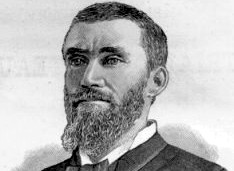
Charles Guiteau
Murderer Joseph LaPage
Murderer · USA · 1874
Joseph LaPage was described as a French-Canadian trapper who donned a bearskin…
2 victims
Joseph LaPage
Murderer · USA · 1874
Joseph LaPage was described as a French-Canadian trapper who donned a bearskin…
2 victims
 Louis Wagner
Murderer · USA · 1873
Louis Wagner had lived on Smuttynose Island with six Norwegian immigrants: Mare…
2 victims
Louis Wagner
Murderer · USA · 1873
Louis Wagner had lived on Smuttynose Island with six Norwegian immigrants: Mare…
2 victims
 Carlyle Harris
Murderer · USA · 1891
Carlyle Harris was executed by electrocution at Sing Sing Prison on May 7, 1893…
1 victim
Carlyle Harris
Murderer · USA · 1891
Carlyle Harris was executed by electrocution at Sing Sing Prison on May 7, 1893…
1 victim
 Daniel Wilkinson
Murderer · USA · 1883
Daniel Wilkinson (c. 1845 – November 21, 1885) was the last person to be execut…
1 victim
Daniel Wilkinson
Murderer · USA · 1883
Daniel Wilkinson (c. 1845 – November 21, 1885) was the last person to be execut…
1 victim
 James Huberty
Mass murderer · USA · 1984
James Oliver Huberty was a 41-year-old unemployed security guard. He was born i…
21 victims
James Huberty
Mass murderer · USA · 1984
James Oliver Huberty was a 41-year-old unemployed security guard. He was born i…
21 victims
 Katherine Seeber
Murderer · USA · 2000
Katherine Seeber (defendant) · Pedro Sanchez (accused in Queens County Criminal…
1 victim
Katherine Seeber
Murderer · USA · 2000
Katherine Seeber (defendant) · Pedro Sanchez (accused in Queens County Criminal…
1 victim
 Michael DeLozier
Murderer · USA · 1995
Michael DeLozier was convicted of two counts of first-degree murder in Oklahoma…
2 victims
Michael DeLozier
Murderer · USA · 1995
Michael DeLozier was convicted of two counts of first-degree murder in Oklahoma…
2 victims
 Paul Runge
Serial killer · USA · 1995
Paul Frederick Runge was 31 when he was charged in Chicago with murdering and s…
7 victims
Paul Runge
Serial killer · USA · 1995
Paul Frederick Runge was 31 when he was charged in Chicago with murdering and s…
7 victims
 Menzies Hallett
Murderer · New Zealand · 1979
Name: Menzies Hallett Age: 72 Year of sentencing status: Sentenced to life in p…
1 victim
Menzies Hallett
Murderer · New Zealand · 1979
Name: Menzies Hallett Age: 72 Year of sentencing status: Sentenced to life in p…
1 victim
- Gender
- male
- Country
- USA
- Location
- Washington, Distric of Columbia , USA
- Date of birth
- J une 8, 1841
- Age at first offence
- 40
- Characteristics
- mentally ill, history of mental illness
- Victim profile
- James A. Garfield , 49 (Uited States of America President)
- Method of murder
- Shooting ( .44 Webley British Bulldog revolver)
- Date(s) of murder
- July 2, 1881
- Years active
- 1881
- Date of arrest
- Same day
- Status
-
Executed
Executed by hanging in the District of Columbia on June 30, 1882
Case record: Charles Guiteau
Overview
Charles Julius Guiteau (September 8, 1841 – June 30, 1882) was an American lawyer who assassinated President James A. Garfield on July 2, 1881. Garfield died of complications following the shooting on September 19.
Guiteau had a history of mental illness. He was housed at St. Elizabeths Hospital in the southeastern quadrant of Washington, D.C. throughout the trial and until his execution. He was found guilty and was hanged on June 30, 1882 in the District of Columbia.
The characteristics and background described in the record
Guiteau was described as having a history of mental illness. The record also described conduct during the events leading to and surrounding the assassination and his trial.
The record stated that Guiteau was repeatedly rejected during his time in the Oneida Community. It reported that his nickname there was "Charles Gitout." It also reported that he left the community twice, attempted to start a newspaper called "The Daily Theocrat," and filed lawsuits against the community’s founder, John Humphrey Noyes.
The record said that Guiteau obtained a law license in Chicago based on a casual bar exam and started a law firm there, though he was not successful. It reported that he later turned to theology, publishing a book titled The Truth which was almost entirely plagiarized from John Humphrey Noyes. It reported that after that, he took an interest in politics.
The record stated that Guiteau was told personally never to return by Secretary of State James G. Blaine on May 14, 1881. It reported that Guiteau then decided that God had commanded him to kill the President. It also stated that he borrowed fifteen dollars and went to purchase a revolver, which the record described as lost.
Timeline
- September 8, 1841 — Charles Julius Guiteau was born.
- July 2, 1881 — Guiteau shot President James A. Garfield.
- September 19, 1881 — Garfield died of complications following the shooting.
- October 8, 1881 — George Corkhill filed the presentment and indictment against the prisoner for the murder of James Garfield.
- November 14, 1881 — Guiteau’s trial began in Washington D.C.
- November 28, 1881 — Guiteau took the stand.
- January 12, 1882 — Closing arguments began.
- January 23, 1882 — Guiteau was found guilty.
- January 25, 1882 — Guiteau was found guilty.
- May 22, 1882 — Guiteau’s appeals were rejected.
- June 22, 1882 — President Arthur listened to arguments by defense experts for twenty minutes.
- June 24, 1882 — President Arthur announced he would not intervene.
- June 30, 1882 — Guiteau was hanged in the District of Columbia; on the scaffold he recited a poem he had written called "I am Going to the Lordy."
People
- Charles J. Guiteau / Charles Julius Guiteau — defendant; assassin of President James A. Garfield.
- James A. Garfield — victim; President of the United States who was shot on July 2, 1881 and died on September 19, 1881.
- Chester Arthur — Vice President of Garfield; succeeded Garfield as President.
- Walter Smith Cox — presiding judge at Guiteau’s trial.
- Leigh Robinson — court-appointed defense lawyer.
- George Scoville — court-appointed defense lawyer; Guiteau was represented by his brother-in-law, George Scolville/Scoville.
- Wayne MacVeagh — U.S. Attorney; served as chief prosecutor.
- George Corkhill — district attorney for Washington; on the prosecuting team.
- Walter Davidge — named as one of the lawyers to the prosecution team; involved in prosecution argument.
- John K. Porter — named as one of the lawyers to the prosecution team.
- Elihu Root — named as one of the lawyers to the prosecution team.
- E.B. Smith — named as one of the lawyers to the prosecution team.
- Dr. D. W. Bliss — doctor who performed the autopsy.
- Patrick Kearney — arresting officer.
- Dr. John Gray — superintendent of New York’s Utica Asylum; wrote a memo and later testified for the prosecution.
- Dr. James Kiernan / Dr. James Kienarn — Chicago neurologist; testified for the defense.
- Dr. Edward C. Spitzka — New York neurologist; testified for the defense.
- Dr. Fordyce Barker — testified for the prosecution.
- Dr. Noble Young — prison physician; testified for the prosecution.
- Allen Hamilton — psychiatrist called an “alienist” at the time; testified for the prosecution.
- Bill Jones — a horse’s drunk rider; fired a pistol through the bars of Guiteau’s van after Bliss’s testimony.
- William Mason — a guard named as firing at Guiteau on September 11, 1881.
- John P. Hamlin — jury foreman.
- Secretary of State James G. Blaine / James G. Blaine — told Guiteau never to return on May 14, 1881.
- Secretary of State James G. Blaine — accompanied Garfield into the station on July 2, 1881.
- Robert Todd Lincoln — waited at the station to see the President off.
- Secretary of War Robert Todd Lincoln — identified in the record as waiting at the station.
- James and Harry — Garfield’s sons identified in the record as accompanying him.
- Dr. D. W. Bliss — described as head physician for the next eighty days.
- Chester Arthur — mentioned multiple times in connection with appeals and after Garfield’s death.
The offence
On July 2, 1881, Guiteau lay in wait for President James A. Garfield at the Baltimore and Potomac Railroad station. As Garfield entered the station, Guiteau shot Garfield twice from behind. The second shot lodged in the back described as lodging in the back "with the exulting words, repeated everywhere: 'I am a Stalwart of the Stalwarts... Arthur is President now.'" (New York Herald, July 3, 1881).
The record reported that Garfield died eleven weeks after being shot, after a long, painful bout of blood poisoning brought on by doctors poking the wound with unwashed hands and non-sterilized instruments.
In the record, Garfield was described as conscious but in shock after the shooting. It also described doctors probing the wound and the course of illness over the ensuing weeks.
Investigation and arrest
After Guiteau fired his second shot, the record described that he turned to leave and was apprehended before he could leave. The arresting officer was identified as Patrick Kearney. The record described that Kearney did not take Guiteau’s gun until after arrival at the police station. The record also stated that a crowd screamed "Lynch him!" and that Guiteau uttered exulting words during surrender.
The record also reported that Guiteau later asked on the way to jail whether the officer was a Stalwart and made statements including:
- "It is all right, it is all right."
- "Doctor, I am a dead man."
Trial
Opening of the trial; venue and courtroom issues
The trial began on November 14, 1881 in Washington D.C. The record described jury selection as difficult and taking three days, with questioning of 175 potential jurors before settling on a jury of twelve men. It also reported that Guiteau was unhappy about his team of "blunderbuss lawyers" and that he planned to handle much of the defense himself.
Prosecution evidence and testimony
The prosecution focused on detailing the events surrounding the assassination. The record named witnesses including Secretary of State Blaine, Patrick Kearney (the arresting officer), and Dr. D. W. Bliss, who performed the autopsy. It reported that letters written by Garfield shortly before the assassination were introduced as exhibits, and that vertebrae shattered by Guiteau’s bullet were introduced as exhibits.
The record stated that the most important testimony came from Dr. Bliss, who used Garfield’s actual spine and argued that Guiteau’s shot directly caused Garfield’s death.
Defense evidence and insanity arguments
The defense argued that Guiteau was legally insane and repeatedly addressed legal insanity versus actual medical insanity. The record described Guiteau as insisting he was legally insane at the time of the shooting, while he claimed he was not medically insane. It described that this position caused a rift between him and his defense lawyers.
In the record, a physician summoned to Guiteau’s home after he threatened his wife testified that he told Guiteau’s sister at the time that his brother was insane and should be committed, and that he concluded Guiteau had been captured by "an intense pseudo-religious feeling."
The record also reported that Guiteau took the stand on November 28 and traced the story of his life. It reported that much of the testimony focused on his years at the Oneida Community, his political activities in spring 1881, and the period of June when he awaited word from God about whether his inspiration to kill Garfield was divine. It stated that he took alleged narrow escapes from death as evidence of God’s plan.
On cross-examination, the record reported that prosecutor John K. Porter asked whether Guiteau was familiar with the Biblical commandment, "Thou shalt not kill." The record reported Guiteau responded that the divine authority overcame the written law.
The record said the heart of the defense case was built by medical experts. It reported that Dr. James Kiernan/Kienarn testified that a man could be insane without delusions or hallucinations and that the defendant was doubtless insane, though his credibility was damaged in cross-examination. It reported that defense experts included Dr. Edward C. Spitzka, whose testimony included:
- "Guiteau is not only now insane, but that he was never anything else."
- "a moral monstrosity." It also included Spitzka’s statement in response to cross-examination of his training:
- "In the sense that I treat asses who ask me stupid questions, I am."
Prosecution medical counter-testimony
The record reported that the prosecution countered with medical experts including Dr. Fordyce Barker, Dr. Noble Young, and Allen Hamilton, who testified that Guiteau was "perfectly sane" and "as bright and intelligent a man as you will ever see in a summer's day" and that he knew the difference between right and wrong. It also reported Dr. John Gray testified that Guiteau was seriously "depraved," but not insane, and that insanity showed itself in more than bad acts. The record described insanity in Gray’s terms as a "disease" and associated it with cerebral lesions in his opinion.
Quotations from the record during trial proceedings
The record included the following quotations:
- George Corkhill (described as District of Columbia district attorney and on the prosecuting team) stated in a pre-trial press statement:
- "He's no more insane than I am. There's nothing of the mad about Guiteau: he's a cool, calculating blackguard, a polished ruffian, who has gradually prepared himself to pose in this way before the world. He was a deadbeat, pure and simple. Finally, he got tired of the monotony of deadbeating. He wanted excitement of some other kind and notoriety, and he got it."
- Guiteau in response to cross-examination regarding the commandment "Thou shalt not kill" responded:
- "the divine authority overcame the written law."
- Guiteau said:
- "I am a man of destiny as much as the Savior, or Paul, or Martin Luther."
- Guiteau said before the judge Cox (regarding Garfield being killed by medical malpractice):
- "The doctors killed Garfield, I just shot him."
- During jury foreman’s announcement of the verdict:
- "Guilty as indicted, sir."
- Guiteau yelled at the judge after sentencing:
- "I had rather stand where I am that where the jury does or where your Honor does."
- After the guilty verdict was read, Guiteau yelled at the jury:
- "you are all low, consummate jackasses"
Jury deliberation and verdict
The record stated that the jury deliberated for only an hour. It reported that in a candlelit courtroom, jury foreman John P. Hamlin announced:
- "Guilty as indicted, sir."
The record also stated that Guiteau was found guilty on January 23, 1882 and that he was found guilty on January 25, 1882. The record did not reconcile the dates.
Sentencing
The record stated that Judge Cox sentenced Guiteau "to be hanged by the neck until you are dead" on June 30, 1882.
Appeals and rejection of intervention
The record reported that Guiteau appealed but that the appeal was rejected. It also reported that his appeals were rejected on May 22, 1882.
The record reported that President Arthur listened to arguments by defense experts on June 22 and that on June 24 President Arthur announced that he would not intervene. It included Guiteau’s statement when he heard the news:
- "Arthur has sealed his own doom and the doom of this nation."
The record also reported that Guiteau requested that his case might be heard by the Supreme Court in full bench and wrote a letter to Garfield seeking delay until the following January so that his case might "be heard by the Supreme Court in full bench."
Execution and final statements
The record stated that Guiteau was hanged on June 30, 1882 in the District of Columbia.
On the scaffold, Guiteau recited a poem he had written called "I am Going to the Lordy." The record stated that he originally requested an orchestra to play as he sang, but that the request was denied. The record also described that he read fourteen verses of Matthew and a poem of his own that ended with:
- "Glory hallelujah! Glory hallelujah! I am with the Lord!"
Other details
Housing during trial
The record repeatedly stated that Guiteau was housed at St. throughout the trial and up until his execution.
Media and behavior during trial
The record described that Guiteau was a media darling during his trial and repeatedly badmouthed his defense team and others, formatted his testimony in epic poems which he recited at length, solicited legal advice from spectators via passed notes, and dictated an autobiography to the New York Herald. It also reported that he ended his autobiography with a personal ad for a nice Christian lady under thirty.
Additional events described as part of the case narrative
The record described several incidents beyond the assassination itself, including Guiteau asking about being a Stalwart in jail and an incident where a guard named William Mason fired at Guiteau on September 11, 1881 but missed. It also described the public’s concern about lynching and officials moving him to a brick cell with only a small opening at the top of a bulletproof oaken door.
Items described as preserved after execution
The record stated that part of Guiteau’s brain remained on display at the Mütter Museum in Philadelphia. It also stated that Guiteau’s bones and more of his brain, along with Garfield’s backbone and a couple of ribs, were kept at the National Museum of Health and Medicine in Washington, D.C. on the grounds of the Walter Reed Army Medical Center.
Civil service reform linkage described in the record
The record stated that Garfield’s assassination was instrumental to the passage of the Pendleton Civil Service Reform Act on January 16, 1883. It reported that Garfield called for civil service reform in his inaugural address and supported it as President. It also reported that the act was passed as something of a memorial to the fallen President.
Spotted an error, or have more information about this case?