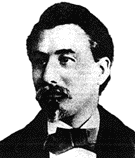
Louis Wagner
Murderer John Wesley Hardin
Murderer · USA · 1867
John Wesley (Wes) Hardin (1853-1895) was an American outlaw, gunfighter, and co…
42 victims
John Wesley Hardin
Murderer · USA · 1867
John Wesley (Wes) Hardin (1853-1895) was an American outlaw, gunfighter, and co…
42 victims
 Henry Wirz
Murderer · USA · 1864
Henry Wirz (also known as Heinrich Hartmann Wirz) (November 25, 1823 – November…
11 victims
Henry Wirz
Murderer · USA · 1864
Henry Wirz (also known as Heinrich Hartmann Wirz) (November 25, 1823 – November…
11 victims
 Henry Newton Brown
Murderer · USA · 1870
Henry Newton Brown — 19th century gunman; orphan; raised by relatives in Rolla,…
6 victims
Henry Newton Brown
Murderer · USA · 1870
Henry Newton Brown — 19th century gunman; orphan; raised by relatives in Rolla,…
6 victims
 Joseph LaPage
Murderer · USA · 1874
Joseph LaPage was described as a French-Canadian trapper who donned a bearskin…
2 victims
Joseph LaPage
Murderer · USA · 1874
Joseph LaPage was described as a French-Canadian trapper who donned a bearskin…
2 victims
 Marion Hedgepeth
Murderer · USA · 1870
Name: Marion Hedgepeth · Also known as: “Handsome Bandit,” “Debonair Bandit,” “…
2 victims
Marion Hedgepeth
Murderer · USA · 1870
Name: Marion Hedgepeth · Also known as: “Handsome Bandit,” “Debonair Bandit,” “…
2 victims
 Michael James Perry
Murderer · USA · 2001
Name: Michael James Perry · TDCJ number: 999444 · Date of birth: 04/09/1982 · A…
3 victims
Michael James Perry
Murderer · USA · 2001
Name: Michael James Perry · TDCJ number: 999444 · Date of birth: 04/09/1982 · A…
3 victims
 Darnell Williams
Murderer · USA · 1986
Darnell Williams received a death sentence on March 23, 1987. On July 2, 2004,…
2 victims
Darnell Williams
Murderer · USA · 1986
Darnell Williams received a death sentence on March 23, 1987. On July 2, 2004,…
2 victims
 William Hale
Murderer · USA · 1921
Name: William Hale · Known as: the so-called "King of the Osage Hills" · Occupa…
24 victims
William Hale
Murderer · USA · 1921
Name: William Hale · Known as: the so-called "King of the Osage Hills" · Occupa…
24 victims
 Gunter Ewen
Spree killer · Germany - France · 1999
Gunter Hermann Ewen committed suicide as police stormed his Luxembourg hotel ro…
5 victims
Gunter Ewen
Spree killer · Germany - France · 1999
Gunter Hermann Ewen committed suicide as police stormed his Luxembourg hotel ro…
5 victims
 Raymond Landry
Murderer · USA · 1982
Raymond Landry Sr. was the person convicted in a Texas capital case. Raymond La…
1 victim
Raymond Landry
Murderer · USA · 1982
Raymond Landry Sr. was the person convicted in a Texas capital case. Raymond La…
1 victim
 Molly Midyette
Murderer · USA · 2006
Molly Midyette was convicted of child abuse resulting in death in the 2006 deat…
1 victim
Molly Midyette
Murderer · USA · 2006
Molly Midyette was convicted of child abuse resulting in death in the 2006 deat…
1 victim
- Gender
- male
- Country
- USA
- Location
- York County, Maine, USA
- Date of birth
- ???
- Characteristics
- —
- Victim profile
- Anethe Christensen and Karen Christensen
- Method of murder
- Beating with ax
- Date(s) of murder
- March 6, 1873
- Years active
- 1873
- Date of arrest
- Same day
- Status
-
Executed
Executed by hanging on June 25, 1875
Background
Louis Wagner had lived on Smuttynose Island with six Norwegian immigrants: Maren Hontvet, her older sister Karen, their brother Ivan Christensen and his new wife Anethe, Maren's husband John, and John's brother Matthew. The group included Louis Wagner as a guest from the previous summer, when they had taken in a Prussian fisherman as a house guest.
The men ran a successful fishing business. Louis Wagner helped bait trawls in exchange for room and board when he was not ill from rheumatism and being nursed by the women.
Six months before the March 6, 1873 murders, Louis Wagner moved to Portsmouth on the mainland and eventually to a boarding house on Water Street. He was described as living hand to mouth, behind in his rent, and assisting local fishermen when work was available. He grumbled constantly about his poverty and the state of his worn clothing.
He reportedly spoke to one fisherman about a passion for young Anethe of Smuttynose. He also told the story of a “wicked man” he knew who, back in his homeland, had lived with a family and then returned to steal from them.
By 1873 the Hontvet group was described as an anachronism. John had made a successful business, but few could.
The events were set within the wider context of Seacoast NH’s tourism boom in 1873, with rival inns and hotels being constructed or opened on nearby islands and the New Castle area.
Smuttynose Island and nearby locations were described as holding a number of ghosts and legends, including pirate treasure used to build a breakwater and graves of shipwrecked Spanish sailors. The island’s former name and notable sites were also described.
Celia Thaxter had no doubt of Louis Wagner’s guilt. Her family owned a large tourist hotel on Appledore Island near Smuttynose. One of the murdered women had worked for the Thaxters two weeks earlier. Celia herself had lived on Smuttynose years before, and her family still owned the island and rented the “Hontvet House” as it became known.
The offence
On March 6, 1873, two Norwegian immigrants were murdered at the “Hontvet House” on Smuttynose Island: Karen Christensen and Anethe Christensen. A double midnight murder occurred on Smuttynose Island, and Maren Hontvet survived.
The narrative described the victims’ bodies as “frozen butchered bodies” discovered when Maren’s husband John, John’s brother Matthew, and Anethe’s husband Ivan Christensen arrived at 10 a.m. aboard the Clara Bella to discover them. Anethe was found in the kitchen with her head split, and Karen was found in the unoccupied half of the small house. Both victims were partially naked.
Maren Hontvet hid in the rocks at the end of the island for warmth, clutching her dog Ringe. She attracted attention at about 7 a.m. by shouting and waving her skirt.
Maren identified Louis Wagner as the killer. Maren heard a call from Karen to John and then a cry out: “John is killing me.” The killer attacked Karen in the darkness. Maren attempted to get to Karen, but the killer blocked the door with a stick. Maren then helped Anethe outdoors through the bedroom window, but Anethe was described as being too petrified to scream or run for help.
Anethe was attacked with a dull ax used to chop ice at the well. Anethe screamed: “Louis. Louis. Louis.” Maren, still inside the house, witnessed the attack.
Maren pulled Karen into the bedroom, but Karen was too injured to escape. Maren grabbed a skirt and escaped through the window in her bare feet with the dog.
The narrative described Louis Wagner as hitting Maren with a chair and swinging at her with the ax, breaking it against the window frame. Maren then reported that she saw a lantern come on in the house and heard Karen’s final cries from a distance.
The trail of blood convinced the jury that the killer was familiar with the Hontvet house. The well where the murderer washed was described as yards from the house and unmarked. Someone used the silverware to eat a meal and left bloody prints on the tea kettle. Bloody boot prints were found around the area where the killer searched.
A trunk contained money that was hidden: it was described as $600 in one part and then as $135. Louis Wagner made off with about $20, taken from a purse that included three $5 bills and some coins. A button was later found in Louis Wagner’s pocket; Karen had planned to find a match for the button when she went to Portsmouth.
The narrative also discussed questions about why Louis Wagner did not flee immediately, describing his route after abandoning a rowboat in New Castle, looking wild and disheveled to locals, changing his shirt, and possibly hiding a knife in his room floorboards based on a rediscovered news article.
Investigation
The well was described as close to the house and unmarked. Bloody boot prints were found around where the killer had searched in vain for Maren. Evidence included bloody prints on the tea kettle and traces connected to a meal using the silverware.
The narrative also described an ax with a broken handle displayed in a glass case as the ax experts agreed Louis Wagner used to carve the life from the two Norwegian immigrants.
Arrest
Louis Wagner was arrested the very next day at a hotel in Boston, Massachusetts, shortly after the discovery of the murders and described as a short train ride from Portsmouth, NH. He was arrested soon after he went to the hotel he knew, and he was described as having initially refused to be recognized.
The narrative described that Louis Wagner told a woman that he had “just murdered two sailors and had one left to kill.” When arrested soon after at the hotel, he went “without question or protest.”
The narrative also included the background of his movements around the dock and train disruptions. Maren’s husband John testified that the crew of the Clara Bella had been forced to wait in Portsmouth for a train load of bait from Boston. Louis Wagner stopped by the dock and offered to help bait trawls. John testified that he had cleared $600 and was saving toward a new boat. John also testified that when the train delivery was pushed up further, Louis asked John three times if he planned to return to Smuttynose that night. It was described as the first night the women had ever been left alone.
A local fisherman found Louis Wagner’s dory missing from Pickering Wharf nearby at 8 p.m., and the narrative said it was assumed Louis Wagner borrowed it. The boat was found the next day near New Castle, with the newly installed oar “thole pins” described as mysteriously worn as if subjected to weeks of use in a single night.
The narrative said Maren testified that a passing fisherman carried her husband’s message saying he would return very late.
Trial
The trial of Louis Wagner began June 9, 1875, and lasted nine days. The decision took 55 minutes.
Louis Wagner’s capture, trial, conviction, escape, recapture, imprisonment, and eventual execution were described as being in the headlines for 27 months.
He insisted to the end that he was innocent, and that “God would not allow him to be executed for crimes he did not commit.” His position was described as swaying even the editor of a major New York newspaper who recorded Louis Wagner’s last hours.
Crowds poured into Maine from Portsmouth and beyond. Many people were described as convinced of his innocence. A large number of residents were described as swarming around the city and the train station when he was returned to Portsmouth from Boston. The next day hundreds of fishermen and “shoalers” marched to the city jail intent on lynching the killer named by Maren Hontvet.
Jurisdiction issues were described as arising quickly when it became clear the crime had been committed in Maine, not New Hampshire. Louis Wagner’s attorney made much of this fact. He was transferred to South Berwick and then to Alfred, Maine to stand trial.
There were also descriptions of Louis Wagner escaping from a new prison after picking the lock and leaving a dummy figure in his cot. The narrative described border dispute over jurisdiction and speculation that Maine sympathizers helped Louis Wagner and two others to escape. Afterward, Louis Wagner was described as being apprehended in Farmington, NH in a few days.
The narrative listed circumstantial evidence presented at trial:
- Karen Hontvet’s button found in the pocket of the accused.
- The returned dory with worn thole pins.
- Witnesses who saw Louis Wagner crossing that morning from New Castle to Portsmouth.
- A bloody shirt the defendant said was covered with fish guts, but chemical analysis proved it was human blood.
- Bloody boot marks on the island matched ones in the mud at New Castle and matched boots owned by Louis.
Witness testimony described that a number of people testified that Louis Wagner said he was so poor that he might have to murder someone to get money.
The narrative described that Louis Wagner provided elaborate and unsupported testimony. He claimed that the evening of the murder he had baited 600 trawls for the owner of a schooner, but he could not remember the name of the ship nor the man. He claimed he had drinks in a bar in Portsmouth that he could not name, became sick, and fell asleep outside, despite no patrolmen being described as having seen anyone in that area. He testified he spent part of the night on the couch of a boarding house in the next room to where the Hontvet crew was baiting their own trawls, and the narrative said this was shown to be untrue.
When asked why he was curious about the women alone on the island, Louis Wagner said he wanted to help a mysterious woman named Johannah to get to the Isles. The defense lawyer reportedly produced none of the people named by Louis Wagner for an alibi. His landlady testified he had not returned all night.
Soon after his arrest, the narrative said that in a deposition Louis Wagner protested he was familiar with the Hontvet house and that, should he want to rob them, he could have done it easily and without detection. He also said he knew of a second ax and where the well was located. At trial, the narrative said he blamed John Hontvet and even Maren for framing him.
The jury found Louis Wagner guilty of murder in the first degree. The decision took 55 minutes.
Sentencing
Louis Wagner was executed by hanging on June 25, 1875.
Outcome
Louis Wagner was hanged alongside John T. Gordon. The narrative described that Louis Wagner and a triple-murderer John T. Gordon were hanged on June 25, 1875.
The narrative described that three more executions followed in 1885 before Maine finally abolished capital punishment.
Aftermath
John Gordon had attempted suicide and succeeded in wounding himself mortally. Officials were obliged to haul his bleeding half dead body into place on the gallows and put the noose around his head. Louis Wagner was described as saying aloud: “Poor Gordon, poor Gordon, you are almost gone,” and then, smiling, said a gentle farewell as the floor of the scaffold disappeared below him.
The narrative described doubts about Louis Wagner’s guilt continuing after his execution. Alternative theories pointed the finger at Maren’s husband John, at Maren herself, at a neighboring “shoalers,” or at nearby hotel construction workers. The narrative also said that despite a nearly airtight criminal case, doubts continued unabated.
Maren Hontvet was described earlier as having eluded the killer by hiding all night and eventually bringing him to justice.
Other details
Maren Hontvet was said to have attracted attention at about 7 a.m. March 6, 1873 and then was discovered by the Ingebretson children playing outdoors on nearby Appledore Island.
Old Mr. Ingebretson was described as rowing from Appledore to Smuttynose and becoming the first person to discover the horrific double murder of Maren’s sister Karen and sister-in-law Anethe.
Celia Thaxter wrote a melodramatic but detailed summary of events in Atlantic Monthly called “A Memorable Murder.”
The narrative described cultural works connected to the Smuttynose story, including a “Ballad of Louis Wagner” by John Perrault, a short play adapted from that ballad by Jeff Symes, and film projects considered by Fritz Lang and Louis De Rochemont. It also mentioned that director Oliver Stone had optioned a movie script version of Shreve’s popular novel.
A short film based on Perrault’s ballad was described as having been made by UNH cinematographer Gary Sampson in the early 1980s.
The narrative described the “murder” house on Smuttynose Island as long gone, ravaged by 19th century souvenir hunters who carried away blood spattered bits of wall and floorboard.
In later description, the bodies of Anethe Christensen and Karen Christensen were said to lie in a quiet Portsmouth, NH cemetery, ten miles in from their island home.
The narrative also referenced disputed claims about whether Louis Wagner was executed as the last man executed in Maine, quoting Shoals historian Lyman Ruttledge.

Spotted an error, or have more information about this case?