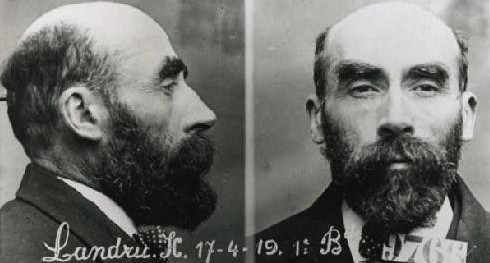
Henri Landru
Serial killer Marcel Petiot
Serial killer · France · 1942
Marcel André Henri Félix Petiot was a French doctor. He was convicted of multip…
27 victims
Marcel Petiot
Serial killer · France · 1942
Marcel André Henri Félix Petiot was a French doctor. He was convicted of multip…
27 victims
 Thierry Paulin
Serial killer · France · 1984
Thierry Paulin was born in Fort-de-France, Martinique on November 28, 1963. His…
21 victims
Thierry Paulin
Serial killer · France · 1984
Thierry Paulin was born in Fort-de-France, Martinique on November 28, 1963. His…
21 victims
 Antoinette Scieri
Serial killer · France · 1924
Antoinette Scieri was born in Italy and emigrated to France as a child. In the…
12 victims
Antoinette Scieri
Serial killer · France · 1924
Antoinette Scieri was born in Italy and emigrated to France as a child. In the…
12 victims
 Joseph Vacher
Serial killer · France · 1894
Joseph Vacher (November 16, 1869 – December 31, 1898) was a French serial kille…
11 victims
Joseph Vacher
Serial killer · France · 1894
Joseph Vacher (November 16, 1869 – December 31, 1898) was a French serial kille…
11 victims
 Jeanne Weber
Serial killer · France · 1905
Jeanne Weber (born 7 October 1874) was a French child-care provider and serial…
10 victims
Jeanne Weber
Serial killer · France · 1905
Jeanne Weber (born 7 October 1874) was a French child-care provider and serial…
10 victims
 Francis Heaulme
Serial killer · France · 1984
Francis Heaulme was sentenced to several life sentences in different trials, 19…
9 victims
Francis Heaulme
Serial killer · France · 1984
Francis Heaulme was sentenced to several life sentences in different trials, 19…
9 victims
 Sid Ahmed Rezala
Spree killer · France · 1999
Sid Ahmed Rezala Rezala committed suicide apparently by inhaling the dense blac…
3 victims
Sid Ahmed Rezala
Spree killer · France · 1999
Sid Ahmed Rezala Rezala committed suicide apparently by inhaling the dense blac…
3 victims
 James Holmes
Mass murderer · USA · 2012
James Eagan Holmes (born December 13, 1987) was the admitted perpetrator of a m…
12 victims
James Holmes
Mass murderer · USA · 2012
James Eagan Holmes (born December 13, 1987) was the admitted perpetrator of a m…
12 victims
 Paul Evans
Murderer · USA
Paul Evans was born on 01/30/72. He was tried in the Nineteenth Judicial Circui…
1 victim
Paul Evans
Murderer · USA
Paul Evans was born on 01/30/72. He was tried in the Nineteenth Judicial Circui…
1 victim
 Jordan Nelson
Homicide · New Zealand · 2012
Jordan Nelson was a 13-year-old. He was New Zealand's youngest convicted murder…
1 victim
Jordan Nelson
Homicide · New Zealand · 2012
Jordan Nelson was a 13-year-old. He was New Zealand's youngest convicted murder…
1 victim
 James Michael Briddle
Murderer · USA · 1980
James Michael Briddle was executed by lethal injection in Texas on December 12,…
2 victims
James Michael Briddle
Murderer · USA · 1980
James Michael Briddle was executed by lethal injection in Texas on December 12,…
2 victims
- Gender
- male
- Country
- France
- Location
- France
- Date of birth
- April 12, 1869
- Age at first offence
- 46
- Characteristics
- serial rapist, abuser, torture, financial gain, the bodies were never found
- Victim profile
- Jeanne-Marie Cuchet, 39 / Andre Cuchet, 16 / Thérèse Laborde-Line, 47 / Marie Angélique Guillin, 51 / Berthe Anna Héon, 55 / Anne Collomb, 44 / Andrée-Anne Babelay, 19 / Célestine Buisson / Louise-Joséphine Jaume, 38 / Anne-Marie Pascal, 33 / Marie Thérèse Marchadier, 37
- Method of murder
- Strangulation?
- Date(s) of murder
- 1915 - 1919
- Years active
- 1915–1919
- Date of arrest
- April 12, 1919
- Status
-
Executed
Executed by guillotine in Versailles on February 25, 1922
Overview
Henri Désiré Landru (born April 12, 1869; died February 25, 1922) was a French serial killer and real-life Bluebeard. He was executed by guillotine in Versailles on February 25, 1922. Two victims are named in the case record.
Timeline
- 1887 — Henri Landru spent four years in the French Army.
- 1891 — Henri Landru was discharged from military service; he then proceeded to have a sexual relationship with his cousin.
- 1900 — Henri Landru was sentenced to two years imprisonment after being arrested and found guilty of fraud.
- 1914 — Landru was estranged from his wife and was working as a second-hand furniture dealer.
- 1914 — Landru began murders; he placed advertisements in the lonely hearts sections of Paris newspapers.
- 1914 to 1918 — Landru claimed 11 victims: 10 women plus the teenaged son of one of his victims.
- 1915 — Madame Cuchet (last seen January 1915) was among the victims; the son of Madame Cuchet (last seen January 1915) was also listed as missing.
- 1915 — Madame Laborde-Line (last seen 26 June 1915) was listed as missing.
- 1915 — Madame Guillin (last seen 2 August 1915) was listed as missing.
- 1915 — Madame Heon (last seen 8 December 1915) was listed as missing.
- 1915 — Madame Collomb (last seen 25 December 1915) was listed as missing.
- 1916 — Andree Babelay (last seen 12 April 1916) was listed as missing.
- 1916 — Madame Buisson (last seen 19 August 1916) was listed as missing.
- 1917 — Madame Jaume (last seen 25 November 1917) was listed as missing.
- 1918 — Madame Pascal (last seen 5 April 1918) was listed as missing.
- 1919 — Madame Marchadier (last seen 15 January 1919) was listed as missing.
- 1919 — The sister of one of Landru’s victims, Madame Buisson, attempted to track down her missing sibling and persuaded police to arrest him.
- November 1921 — Landru stood trial on 11 counts of murder.
- February 25, 1922 — Henri Landru was executed by guillotine in Versailles.
Background
Henri Landru was born in Paris. After leaving school, he spent four years in the French Army from 1887 to 1891. After discharge, he had a sexual relationship with his cousin, and she bore him a daughter. Landru did not marry the cousin; he married another woman two years later and had four children. He was shortly swindled out of money by a fraudulent employer. After that, he turned to fraud himself and operated scams that usually involved swindling elderly widows. He was convicted of fraud in 1900 and was sentenced to two years imprisonment.
By 1914, Landru was estranged from his wife and was working as a second-hand furniture dealer. Landru put advertisements in lonely hearts sections in Paris newspapers, usually offering an apparent marriage prospect to widows. The narrative ties the murders to the period of World War I, when many men were being killed in trenches and left widows available.
The offence
Between 1914 and 1918, Landru murdered victims and claimed 11 victims: 10 women plus the teenaged son of one of his victims. Landru seduced women who came to his Parisian villa. After he gained access to their assets, he killed them and burned their dismembered bodies in his oven.
Landru used a wide variety of aliases in his schemes. His aliases were so numerous that he kept a ledger listing all the women with whom he corresponded and which particular identity he used for each woman.
His cover-up strategy left victims listed as missing. With no bodies, the police had difficulty knowing what had happened to them.
Victims
The case record listed the following victims as missing:
- Madame Cuchet (last seen January 1915)
- Son of Madame Cuchet (last seen January 1915)
- Madame Laborde-Line (last seen 26 June 1915)
- Madame Guillin (last seen 2 August 1915)
- Madame Heon (last seen 8 December 1915)
- Madame Collomb (last seen 25 December 1915)
- Andree Babelay (last seen 12 April 1916)
- Madame Buisson (last seen 19 August 1916)
- Madame Jaume (last seen 25 November 1917)
- Madame Pascal (last seen 5 April 1918)
- Madame Marchadier (last seen 15 January 1919)
In the narrative about the Bluebeard cases, the record also included additional victim context:
- Cuchet was described as a 39-year-old woman with a 16-year-old son, Andre.
- Andree Babelay was described as 19-year-old and as a servant girl.
- Madame Guillin was described as a 51-year-old widow whose full name was Marie Angelique Desiree Pelletier.
- A “teenaged son” of one of the victims was listed in the victim count.
Investigation
In 1919, the sister of one of Landru’s victims, Madame Buisson, attempted to track down her missing sibling. She did not know Landru’s real name, but she knew his appearance and where he lived, and she persuaded the police to arrest him.
Initially, Landru was charged only with embezzlement. Landru refused to talk to police. Police dug up his garden but found no results, and it seemed there was insufficient evidence to charge him with murder.
Policemen eventually found paperwork listing the missing women, including Madame Buisson. By combining this material with other documents, authorities built enough evidence to charge him with murder.
The narrative also described that two of Guillin’s friends received postcards from Landru saying Guillin was unable to write herself. It also described forged letters from Buisson to her dressmaker and to the concierge of her Paris apartment, and that Landru represented himself as the attorney of Madame Jaume, who was described as divorcing her husband, closing out her bank accounts.
For two years, authorities investigated disappearances without Landru admitting anything. The gardens in Gambais and Vernouillet were dug up repeatedly. The record stated that authorities tried to link Landru to purchases of acids and other chemicals, but efforts did not succeed. Neighbors reported noxious fumes from Landru’s kitchen, and the stove he installed shortly after arriving in Gambais was inspected. Evidence of murder was uncovered: in the ashes, police found small bones “undoubtedly human” and burned items described as recognizable fasteners of the kind worn on clothes of French women. Landru was described as disposing of victims by burning their remains.
The ledger entry included names and details, including:
- “A Cuchet, G. Cuchet, Bresil, Crozatier, Havre. Ct. Buisson, A. Collomb, Andree Babelay, M. Louis (sic) Jaume, A. Pascal, M. Thr. Mercadier.”
Arrest
The narrative described that in 1919 Madame Buisson’s sister, Mademoiselle Lacoste, searched for “Fremiet,” then spotted Landru leaving a dry goods shop. She returned to the store and found the man’s name was “Guillet,” and he lived in the Rue de Rochechouart with his mistress. Police were summoned and Landru was arrested.
After arrest, authorities returned to Gambais and conducted a thorough search. The gardens were excavated for bones; the only remains police found were those of a pair of dogs. Authorities also searched Landru’s old villa at Vernouillet and found it empty.
Trial
Landru stood trial on 11 counts of murder in November 1921. He was convicted on all counts and sentenced to death.
The record described Landru’s courtroom conduct. It said he refused to answer questions and denied or refused to discuss evidence repeatedly. It also stated that during his trial Landru traced a picture of his kitchen, including the stove in which he was accused of burning his victims. He gave this drawing to one of his lawyers, Auguste Navières du Treuil.
The narrative further stated:
- The jury deliberated for two hours after nearly 25 days of testimony.
- Landru’s defense involved refusing to answer questions and continuing to assert he had “nothing to say” in response to repeated questions.
- The penalty for the crime was death.
Sentencing
Landru was sentenced to death after being convicted on all 11 counts of murder at trial.
Appeals
No appeals were described in the case record.
Outcome
Landru was executed by guillotine in Versailles on February 25, 1922.
Aftermath
The record stated that during his imprisonment Landru presented his attorneys with artwork he had drawn while in prison. It added that inside the frame the attorneys would have found a written confession admitting his crimes and the means by which he disposed of the bodies, but the confession was not discovered until nearly five decades later.
The record also stated that in December 1967 the drawing was made public. The drawing included text written in pencil on the back that Landru had written:
"Ce n'est pas le mur derrière lequel il se passe quelque chose, mais bien la cuisinière dans laquelle on a brûlé quelque chose"
The record described the drawing as having been interpreted as Landru’s confession to his crimes.
Other details
Misconduct and relationships mentioned in the narrative
The narrative included that Landru remained married to Mme. Remy and together they had four children. It also described that Landru seduced his cousin in 1891 (Mademoiselle Remy) who became pregnant and bore him a daughter, and later married Mme. Remy.
Additional person named in the narrative
- Auguste Navières du Treuil, described as one of Landru’s lawyers who received the kitchen drawing.
Cultural references included in the record
The record stated that Landru inspired Charlie Chaplin’s film Monsieur Verdoux (1947) and that Bluebeard’s Ten Honeymoons starred George Sanders as Landru. It also referenced the 1962 film Landru directed by Claude Chabrol, the 1963 episode of The Twilight Zone titled “The New Exhibit,” and the inclusion of the case in an episode of the 1976 BBC series Second Verdict. It additionally listed a 2005 French movie named Désiré Landru as an adaptation, and a 2001 French book by Frédéric Pagès under the pseudonym Jean-Baptiste Botul titled Landru: Precursor of Feminism (Landru, Precurseur du Feminisme: La Correspondance Inedite, 1919-1922). It listed English accounts including Dennis Barden’s The Ladykiller: The Life of Landru, the French Bluebeard and William Bolitho’s Murder for Profit.
The record further stated that Henri Désiré Landru’s severed head was on display at the Museum of Death in Hollywood, California.


Spotted an error, or have more information about this case?