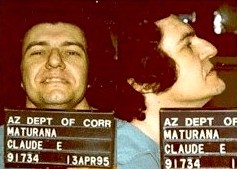
Claude Eric Maturana
Murderer Brian Kevin Rosenfeld
Murderer · USA · 1985
Brian Kevin Rosenfeld Brian Kevin Rosenfeld was sentenced to three concurrent l…
23 victims
Brian Kevin Rosenfeld
Murderer · USA · 1985
Brian Kevin Rosenfeld Brian Kevin Rosenfeld was sentenced to three concurrent l…
23 victims
 Yahweh ben Yahweh
Murderer · USA · 1980
Yahweh ben Yahweh was born and legally named Hulon Mitchell Jr. (October 27, 19…
23 victims
Yahweh ben Yahweh
Murderer · USA · 1980
Yahweh ben Yahweh was born and legally named Hulon Mitchell Jr. (October 27, 19…
23 victims
 Russell Ellwood
Murderer · USA · 1991
Russell Ellwood was a former taxi driver. Authorities suspected him of killing…
20 victims
Russell Ellwood
Murderer · USA · 1991
Russell Ellwood was a former taxi driver. Authorities suspected him of killing…
20 victims
 Robert Martines Perez
Murderer · USA · 1994
Name: Robert Martines Perez · Other name used in proceedings: Robert Martinez P…
15 victims
Robert Martines Perez
Murderer · USA · 1994
Name: Robert Martines Perez · Other name used in proceedings: Robert Martinez P…
15 victims
 Lino Renzi
Homicide · Italy · 2013
Lino Renzi, aged 45, was ordered to closed psychiatric confinement on July 2013…
1 victim
Lino Renzi
Homicide · Italy · 2013
Lino Renzi, aged 45, was ordered to closed psychiatric confinement on July 2013…
1 victim
 Charles Don Flores
Murderer · USA · 1998
Charles Don Flores (Hispanic male) was sentenced to death on April 2, 1999. He…
1 victim
Charles Don Flores
Murderer · USA · 1998
Charles Don Flores (Hispanic male) was sentenced to death on April 2, 1999. He…
1 victim
 Bonnie Heady
Murderer · USA · 1953
Bonnie Emily Brown Heady — convicted under the Lindbergh Act; kidnapper and mur…
1 victim
Bonnie Heady
Murderer · USA · 1953
Bonnie Emily Brown Heady — convicted under the Lindbergh Act; kidnapper and mur…
1 victim
 Obie Weathers
Murderer · USA · 2000
Name: Obie Weathers · TDCJ number: 999396 · Date of birth: 08/11/1981 · Age at…
1 victim
Obie Weathers
Murderer · USA · 2000
Name: Obie Weathers · TDCJ number: 999396 · Date of birth: 08/11/1981 · Age at…
1 victim
 John Earl Baughman
Murderer · Antigua and Barbuda · 1995
John Earl Baughman was tried and convicted in Antigua and Barbuda for the murde…
1 victim
John Earl Baughman
Murderer · Antigua and Barbuda · 1995
John Earl Baughman was tried and convicted in Antigua and Barbuda for the murde…
1 victim
- Gender
- male
- Country
- USA
- Location
- Pima County, Arizona, USA
- Date of birth
- J uly 1, 1957
- Age at first offence
- 33
- Characteristics
- mentally ill, rape, torture
- Victim profile
- Glenn Estes, 16
- Method of murder
- Shooting
- Date(s) of murder
- July 5, 1990
- Years active
- 1990
- Date of arrest
- —
- Status
-
Sentenced to death
Sentenced to death on April 13, 1992.
Case record: Claude Eric Maturana
Background
Claude Eric Maturana was a French national in Arizona. He was held as an inmate on death row after being sentenced to death.
Maturana was believed to have been born in France in July 1957, but details of his arrival in the United States were scant. Records suggested that his mother may have lived in Florida and that she was now deceased, and no family members had come forward. Although French authorities were reported to have recognised Maturana as a French national, the possibility existed that he later obtained US citizenship through naturalisation.
The offence
Maturana and his co-defendant Stephen Ballard were angry with Glenn Estes, a 16-year-old boy who lived with his mother, because he had stolen a car manifold from them.
On the night of July 5, 1990, Maturana and Ballard went to Estes' home and lured him away with the promise that they would “party” in the desert. They drove Estes to an extremely remote location. Maturana shot Estes 12 times, and Ballard cut his throat. They tossed Estes' body in a water tank, where it was discovered the next morning by a ranch hand.
The case narrative also described that Estes was allegedly tricked into accompanying Maturana and co-defendant Stephen Ballard to a remote spot in the desert where he was shot repeatedly and then partially decapitated.
Maturana suspected Estes of stealing an auto part from him. Maturana was sentenced to death in 1992 for the murder of 16-year-old Glen Estes near Tucson.
Investigation
A ranch hand discovered Estes' body in a water tank the next morning after the killing.
Trial
Maturana was sentenced to death in April 1992.
The presiding judge was Michael D. Alfred. The prosecutor was Kenneth Peasley. The trial began on February 20, 1992. The verdict was reached on February 26, 1992.
Aggravating circumstances were listed as:
- Prior crime of violence
- Especially cruel, heinous or depraved
Mitigating circumstances were listed as:
- None
Sentencing
Sentencing occurred on April 13, 1992, when Maturana received a death sentence.
His co-defendant Stephen Ballard was given a life sentence.
Appeals
The state's case against Maturana for the murder of Glen Estes was stayed pending resolution of the issue of mental competence.
Outcome
Maturana remained on death row. His appeals had not run their course.
Maturana was sentenced to death on April 13, 1992.
The case was reported with the published opinion:
- State v. Maturana, 180 Ariz. 126, 882 P.2d 933 (1994).
Aftermath
In 1994, Maturana's mental heath began to deteriorate noticeably. By 1997, communication with him became all but impossible. He became delusional, reciting strings of numbers in what he considered to be codes.
In January 1999, a Superior Court judge concurred with the findings of two court-appointed doctors and declared Maturana mentally incompetent. As prescribed by state law, Maturana was transferred from death row to a special unit on the grounds of the Arizona State Hospital for “competency restoration treatment …until the prisoner becomes competent to be executed”.
The chief medical officer of the state hospital supervising Maturana's treatment refused on grounds of medical ethics to administer therapy other than medication required to keep Maturana comfortable. The doctor diagnosed Maturana as suffering from chronic paranoid schizophrenia. In a report to the court, the doctor suggested the death sentence be commuted to life imprisonment in this case.
To date, the hospital administration was unable to find an Arizona Department of Health professional willing to administer treatment directed at rendering Maturana competent for execution.
The Attorney General's office contested the claim of mental incompetence and argued that, under state law, the hospital was required to provide a doctor willing to restore Maturana to a degree of mental competence sufficient to allow his execution.
Arizona health officials engaged a doctor from the state of Georgia. After evaluation, the doctor concluded that Maturana was seriously ill but competent to be executed. The doctor was said to have expressed willingness to administer further competency restoration treatment.
The activation of a remote control electro-shock stun belt was alleged to have occurred during Maturana's transportation to a court hearing in June 1999. Maturana was reported to have suffered a seizure during which he badly bit his tongue.
Maturana was declared incompetent in January 1999 after Ryan requested a psychiatric evaluation, and he was sent to a prison unit on the grounds of the Arizona State Hospital in Phoenix. Doctors kept him on the same drug he had been on for years to control his condition but refused to try to restore his competence with more aggressive medication because it conflicted with the American Medical Association code of ethics. The organization deemed it unethical to treat someone to restore competence in such a case because it was the equivalent of participating in an execution.
Dr. Jack Potts, described as the chief forensic psychiatrist in Maricopa County, said: “Our role is do no harm. It wasn't a hard call.” and “It's very clear it's an ethical violation,'' said Dr. Jack Potts, the chief forensic psychiatrist in Maricopa County, who turned down a request to treat Maturana.
The hospital found Dr. Nelson Bennett of Atlanta through extensive networking. Bennett's diagnosis that Maturana was competent shocked Dr. Jerry Dennis, who had been medicating him. Dennis said: “A person who says he's dead already, how can he have an adequate understanding of being killed?”
Dr. Jerry Dennis also said: “A person who says he's dead already, how can he have an adequate understanding of being killed?”
Kent Cattani, overseeing death penalty appeals for the Arizona Attorney General's office, said: “Since the U.S. Supreme Court allowed capital punishment to resume in 1976, no death row inmate in the United States has been found incompetent and then treated by government doctors in an attempt to restore his competency and allow his execution,”
Ajamu Baraka, who coordinated Amnesty International's anti-death penalty efforts, said: “It contravenes international standards to execute someone with any form of mental impairment,'' and “The idea that a state would go to such length to make someone well and transform them for the sole purpose of then imposing punishment strikes us as absurd and immoral.''
Cattani argued: “I don't think the penalty should be reduced on what could be short-term incompetence.''
Maturana’s lawyer, Carla Ryan, said that Maturana spent his days talking about visits from his mother, who died 30 years ago, and that he had hallucinations that he was already dead. Ryan said: “He doesn't have a clue where reality is,'' and “It doesn't make sense to me why they should spend so much time and money to kill him.'' Ryan refused a request to interview Maturana.
Gov. Jane Hull signed a bill banning the execution of mentally retarded criminals. The U.S. Supreme Court was preparing to debate the same issue as a push by death penalty foes hoped would eventually spare the mentally impaired from capital punishment.
The narrative also stated that, on May 23, Maturana’s attorney planned to argue before the state Supreme Court that more rigorous standards for mental competency during a trial should apply to her client. The standards required the defendant to be able to assist in his own defense.
Maturana was described as years away from execution because his appeals had not run their course.

Spotted an error, or have more information about this case?