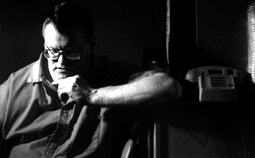
Duncan McKenzie
Murderer Ervil LeBaron
Murderer · USA · 1972
Ervil Morrell LeBaron (1925 to August 16, 1981) was the leader of a polygamous…
35 victims
Ervil LeBaron
Murderer · USA · 1972
Ervil Morrell LeBaron (1925 to August 16, 1981) was the leader of a polygamous…
35 victims
 Marvin Gray
Murderer · USA · 1975
Marvin Gray was convicted killer who claimed responsibility for 23 slayings and…
23 victims
Marvin Gray
Murderer · USA · 1975
Marvin Gray was convicted killer who claimed responsibility for 23 slayings and…
23 victims
 Yahweh ben Yahweh
Murderer · USA · 1980
Yahweh ben Yahweh was born and legally named Hulon Mitchell Jr. (October 27, 19…
23 victims
Yahweh ben Yahweh
Murderer · USA · 1980
Yahweh ben Yahweh was born and legally named Hulon Mitchell Jr. (October 27, 19…
23 victims
 Charles Manson
Murderer · USA · 1969
Charles Milles Manson (born November 12, 1934) was an American criminal and mus…
9 victims
Charles Manson
Murderer · USA · 1969
Charles Milles Manson (born November 12, 1934) was an American criminal and mus…
9 victims
 Kang Ho-sun
Serial killer · South Korea · 2006
Kang Ho-sun was a Korean serial killer who was sentenced to death on April 22,…
10 victims
Kang Ho-sun
Serial killer · South Korea · 2006
Kang Ho-sun was a Korean serial killer who was sentenced to death on April 22,…
10 victims
 Charles Sinclair
Serial killer? · USA / Canada · 1980
Charles Sinclair was described as having been sought for killings that were lin…
13 victims
Charles Sinclair
Serial killer? · USA / Canada · 1980
Charles Sinclair was described as having been sought for killings that were lin…
13 victims
 James Upchurch
Murderer · USA · 1988
James Bartlett Upchurch III (born August 17, 1968) was an American man convicte…
1 victim
James Upchurch
Murderer · USA · 1988
James Bartlett Upchurch III (born August 17, 1968) was an American man convicte…
1 victim
 Matthew Beck
Mass murderer · USA · 1998
On March 6, 1998, Matthew Beck killed four of his supervisors at the Connecticu…
4 victims
Matthew Beck
Mass murderer · USA · 1998
On March 6, 1998, Matthew Beck killed four of his supervisors at the Connecticu…
4 victims
- Gender
- male
- Country
- USA
- Location
- Pondera County, Montana, USA
- Date of birth
- October 5, 1951
- Age at first offence
- 23
- Characteristics
- torture, rape
- Victim profile
- Lana Harding, 23 (schoolteacher)
- Method of murder
- Strangulation / Beating
- Date(s) of murder
- January 21, 1974
- Years active
- 1974
- Date of arrest
- Next day
- Status
-
Executed
Executed by lethal injection in Montana on May 10, 1995
Case information
Duncan Peder McKenzie Jr. was convicted of the murder of Conrad, Montana schoolteacher Lana Harding.
Timeline
- January 21, 1974 — Lana Harding was last seen in Conrad, Montana at about 5:00 p.m. Lana Harding was a 23-year-old rural school teacher in Pondera County, Montana.
- Tuesday afternoon, January 22, 1974 — The county attorney filed a complaint charging Duncan McKenzie with assault before the justice of the peace, and obtained a warrant for his arrest and a search warrant.
- January 22, 1974 — Investigation on that day revealed a red tennis shoe belonging to Lana Harding outside the school, a drag trail from the teacherage to a nearby road, blood near the end of the drag trail, and a wrist watch belonging to Lana in the same area as the blood.
- September 1974 — Duncan McKenzie entered pleas of not guilty to several crimes.
- February 1, 1975 — Criminal Case No. 6593A in the District Court of the Eighth Judicial District of the State of Montana, in and for the County of Cascade.
- 1975 — A jury convicted Duncan Peder McKenzie, Jr. of aggravated kidnapping and deliberate homicide by means of torture.
- March 3, 1975 — McKenzie was sentenced to death.
- February 7, 1975 — Special prosecutor Douglas Anderson met with Judge Nelson ex parte for about forty-five minutes, about one week after the guilty verdict and one month before sentencing.
- December 8, 1980 — The Supreme Court of the United States denied McKenzie's petition for a writ of certiorari (Justice Marshall and Justice Brennan dissented).
- March 10, 1988 — The United States Court of Appeals for the Ninth Circuit affirmed the district court’s dismissal of McKenzie’s petition for writ of habeas corpus.
- 1990 — The United States Court of Appeals for the Ninth Circuit decided Duncan McKenzie’s appeal in a matter involving the ex parte meeting between the prosecutor and the trial judge prior to sentencing.
- 1992 — The federal district court held a hearing on the Gardner v. Florida claim and ruled that there was no credible proof that the 1975 conference could have influenced the sentencing decision, and the Ninth Circuit later affirmed.
- June 24, 1999 — A federal appellate decision addressed McKenzie’s second federal habeas petition raising again the issue of the meeting between the special prosecutor and the sentencing judge.
- May 10, 1995 — Duncan Peder McKenzie Jr. was executed by lethal injection in Montana.
- May 11, 1995 — A report noted the execution had occurred “early today.”
Background
Duncan Peder McKenzie Jr. was born in Chicago, Illinois.
The victim was Lana Harding, a 23-year-old rural school teacher in Pondera County, Montana.
McKenzie had recently moved into the community and had worked for the K & K Wholesale Seed Company located approximately three miles from the Pioneer School teacherage.
McKenzie had made arrangements to buy a 1948 black Dodge pickup, recognizable to most inhabitants of the area because it had belonged to one local owner for a long period of time.
McKenzie had served a previous prison sentence for assault.
Harding’s mother, Ethel Harding, later had been elected to the state senate and was among those to witness McKenzie’s death.
McKenzie had repeatedly asserted his innocence, and various appeals enabled him to avoid eight previous dates with the executioner in his 20 years on death row.
The offence
Missing teacher and discovery of the body
On Tuesday morning, January 22, 1974, Lana Harding failed to appear at school. At the Pioneer School teacherage where she lived, the bed was found in a disheveled condition.
The sheriff of Pondera County was called and officers were dispatched to the school arriving there midmorning.
Lana Harding was last seen in Conrad, Montana, 13 miles from the teacherage on Monday, January 21, at about 5:00 p.m.
Events linking McKenzie to Harding
McKenzie had worked on the pickup after work on January 21.
He was seen leaving K & K Wholesale Seed Company at approximately 6:45 p.m. in his black pickup headed toward his place of residence not far from the teacherage. The pickup was seen about 7:00 p.m. about a mile from the teacherage.
Around 8:00 p.m., McKenzie knocked on the door of the Pearson farm residence located across the road from the teacherage. He asked for assistance in starting his pickup. It was later determined his pickup was parked in the road at a point where the drag trail ended and where the blood and watch were found the following day.
At the Pearson residence McKenzie asked directions to his own residence and called his wife to say he was coming home. Don Pearson pulled the pickup, got it started, and noted McKenzie did not drive on towards his place of residence.
Shortly thereafter, the pickup was seen being driven toward the drill where Lana Harding’s body was found the following day.
Condition and injuries
Her body was found clothed only in a shirt, sweater and bra. It was draped over the tongue of a grain drill.
She had been severely beaten about the head and body.
A forensic pathologist testified that the death blow had been delivered to the head and laid open the right side.
A rope was tied around her neck; there was evidence she had been strangled, though pressure had been released so she did not die of strangulation.
A coil of wire was entangled in her hair, later shown to have come from a roll of wire found in the back of McKenzie’s pickup.
McKenzie kidnapped Harding from her home at the Pioneer School, raped and then strangled her near to death, and finally beaten her until she died.
Investigation
Investigation that day revealed (1) a red tennis shoe belonging to Lana Harding just outside the school, (2) a drag trail from the teacherage to a nearby road, (3) blood near the end of the drag trail later identified as Lana’s type and RH factor, and (4) a wrist watch belonging to Lana in the same area as the blood.
During the search for the body and the investigation, three additional items were found:
- A pair of gloves worn by McKenzie at work found in a field not far from where the body was discovered with human blood on them.
- Overshoes with Lana’s type blood and brain tissue found about a quarter of a mile away, and impressions from the soles matched the heels of boots later taken from McKenzie’s home.
- Lana’s purse found near the place where the overshoes were covered.
County attorney actions included filing a complaint and obtaining a warrant for arrest and a search warrant.
The black Dodge pickup was seized and impounded, and blood was found in the bed of the pickup and on the springs. The back end of the pickup had been recently sprayed with black paint; the spray paint was later identified by FBI experts as identical to paint brand-named “Weekend,” which was not available in the Conrad-Pondera County, Montana area.
A can of black spray paint was found in the cab of the pickup, and another was later found at McKenzie’s home.
Items found in the back of the pickup were:
- A coil of wire later identified as having been the source of wire found in the victim’s hair.
- An exhaust manifold that had been painted black.
- Human blood of the same kind and RH factor as Lana’s and brain and corticle tissue found on the manifold.
Dr. John Pfaff examined the victim’s body and the manifold and testified the manifold could have inflicted the fatal blow.
At the drill site where the body was located, a piece of brass from a water pump was found. The prior owner of the Dodge pickup testified the brass piece was in the back of the pickup when McKenzie took possession of it on January 19.
Several co-workers at the K & K Wholesale Seed Co. testified at trial that McKenzie said on January 21 that he broke in every new vehicle by engaging in sexual intercourse in it.
Several days before January 21, McKenzie had remarked that he had had intercourse with country school teachers, that they were naive, that he could teach them, and that they were easy to get.
Arrest
After the county attorney filed a complaint and obtained a warrant, McKenzie was arrested at his home.
Trial
McKenzie entered pleas of not guilty to several crimes.
Following trial, a jury convicted him of deliberate homicide by means of torture and aggravated kidnapping.
The judge entered judgment, and a death sentence was imposed.
Written jury instructions addressed seven counts in the information:
- Deliberate homicide — two counts.
- Aggravated kidnapping — two counts.
- Sexual intercourse without consent — one count.
- Aggravated assault — two counts.
The charge of deliberate homicide by lying in wait or ambush was dismissed by the court.
A defense of mental disease or defect excluding responsibility for criminal conduct was addressed in the instructions. The instructions stated the defendant was required to prove this defense by a preponderance of the evidence.
Jury findings and disputed instruction issue
The jury convicted McKenzie of deliberate homicide “by means of torture” and aggravated kidnapping.
McKenzie was also convicted under instructions discussed in subsequent appellate decisions where some jury instructions unconstitutionally shifted to him the burden of disproving his criminal intent element.
The Montana Supreme Court conceded that jury instructions unconstitutionally shifted the burden of proof to McKenzie to disprove that he had the criminal intent necessary to support conviction, but found the constitutional violation harmless beyond a reasonable doubt in 1980.
Sentencing
Judge R.J. Nelson sentenced McKenzie to death.
The Montana death penalty statute required a sentence of death for deliberate homicide when certain circumstances applied unless there were mitigating circumstances; one enumerated circumstance included homicide committed by means of torture.
For aggravated kidnapping, the statute required a death sentence upon a finding that the victim was dead as a result of the defendant’s criminal conduct unless there were mitigating circumstances.
The sentencing judge approved jury findings of statutory aggravating circumstances and concluded McKenzie committed “brutal, conscienceless, torture, rape and deliberate killing of a human being,” and that the murder was committed during the commission of a felony, that McKenzie had a prior conviction for a violent crime and was “dangerous and potentially dangerous,” and that rehabilitation of the defendant was impossible.
Before sentencing, the trial court ordered and considered a presentence investigation report.
The trial court followed a procedure offering McKenzie a presentence hearing on mitigating facts and circumstances. McKenzie declined to offer evidence in mitigation at or before sentencing, but filed a post-trial petition and motion in mitigation raising potentially mitigating factors including his mental condition, age, upbringing, social relations, and family ties. The trial judge rejected his arguments and found there were no mitigating circumstances.
An ex parte meeting occurred between special prosecutor Douglas Anderson and Judge Nelson regarding special prosecutor work, shortly before sentencing.
Appeals
Montana Supreme Court
The Montana Supreme Court affirmed McKenzie’s convictions and death sentence and rejected claims, including the claim that jury instructions unconstitutionally shifted to McKenzie the burden of proving his state of mind.
The Montana Supreme Court’s later decisions conceded some jury instruction burden-shifting but affirmed conviction and sentence as harmless beyond a reasonable doubt.
United States Supreme Court
The Supreme Court granted certiorari multiple times and remanded for further consideration.
On December 8, 1980, the Supreme Court denied McKenzie’s petition for a writ of certiorari; Justice Marshall and Justice Brennan dissented.
Federal habeas petitions and ex parte-meeting Gardner claim
McKenzie filed federal habeas petitions after state post-conviction relief.
While litigating his first federal habeas petition, McKenzie discovered that a week after the jury verdict and a month before sentencing, the trial prosecutor had a forty-five minute ex parte meeting with the trial judge.
McKenzie alleged that the meeting violated his rights under Gardner v. Florida.
In 1992, the federal district court ruled that there was no credible proof that the 1975 conference could have influenced the sentencing decision, and the Ninth Circuit later affirmed.
On a third federal habeas petition filed on the eve of his execution, McKenzie challenged his execution after a twenty-year stay on death row and claimed the state should be held responsible for almost fifteen years of delay on the Gardner claim.
Montana countered that it should be responsible only for five years and nine months of the twenty-year stay because that was the time his case spent on direct appeal.
The appellate panel dismissed the petition on procedural grounds, and McKenzie was executed two days later.
In a separate federal appeal, the Ninth Circuit addressed the denial of his second federal habeas petition and affirmed.
Ninth Circuit decision on Sandstrom error
The Ninth Circuit affirmed dismissal of McKenzie’s habeas corpus petition and held that the Sandstrom errors were harmless beyond a reasonable doubt.
The Ninth Circuit also addressed and rejected arguments about sentencing after the breakdown of a plea agreement and rejected constitutional challenges to the Montana death penalty statutes.
A dissent argued the instruction errors were not harmless and described confusion throughout the jury instructions.
Outcome
Duncan Peder McKenzie Jr. was executed by lethal injection in Montana on May 10, 1995.
Aftermath and statements
A spokesman for Gov. Marc Racicot said officials granted one of McKenzie’s last requests: to be allowed to listen to music at his execution. The prison provided the tape player and the tape was a Marty Robbins album.
A 43-year-old prisoner, Duncan McKenzie Jr., was described as the first person put to death by Montana since 1943; the report noted he was the first person to be executed in Montana since 1976 when the death penalty was reinstated.
McKenzie made statements in the days before execution, including:
“Well, I'll either be executed Wednesday morning sometime or I will have my sentence commuted to life without parole which, being alive, has a lot of benefits to it but but being alive in a place like this has a lot of drawbacks to it so... I've got kids out there that I haven't seen in years & some that don't want to see me....”
He also stated:
“Someone who I had a great deal of trust in at the time, & who's died since, told me that death should not be feared. That each night when we go to sleep we dream for a certain period of time. Sometimes our subconscious & our conscience will remember the dream or a portion of it. When we're not dreaming, there's a void. It's just emptiness. We don't know it's there. It's just part of the nights as it goes by. It's a little slice of death & yet...we don't fear going to sleep.... We fear only what we don't know or fear itself.”
He further stated:
“The way I look at it-death-it's something we have to accept whether we want to or not because from the day we're born to the day of our death, we're dying. All of us...”
When he touched on his victim, Lana Harding, he said:
“I've heard nothing but wonderful things about Lana Harding as long as I've been here. So, I can't say anything bad about her or her mother for that matter. I can understand her grief & her anger because she sustained a terrible loss.”
Other details
Personal details included in the case material
The case material listed:
- Marital status: widowed
- Children: three
The case material also included the label “No A013790” and the place of incarceration “Montana State Prison Deer Lodge, Montana.”
Execution-related method and location
Execution was described as being carried out by lethal injection at Montana State Prison in Deer Lodge, Montana.

Spotted an error, or have more information about this case?